Keep Going

Keep GoingI don’t mean to say that I have already achieved these things or that I have already reached perfection. But I press on to possess that perfection for which Christ Jesus first possessed me. No, dear brothers and sisters, I have not achieved it, but I focus on this one thing: Forgetting the past and looking forward to what lies ahead, I press on to reach the end of the race and receive the heavenly prize for which God, through Christ Jesus, is calling us. (Philippians 3:12-14)

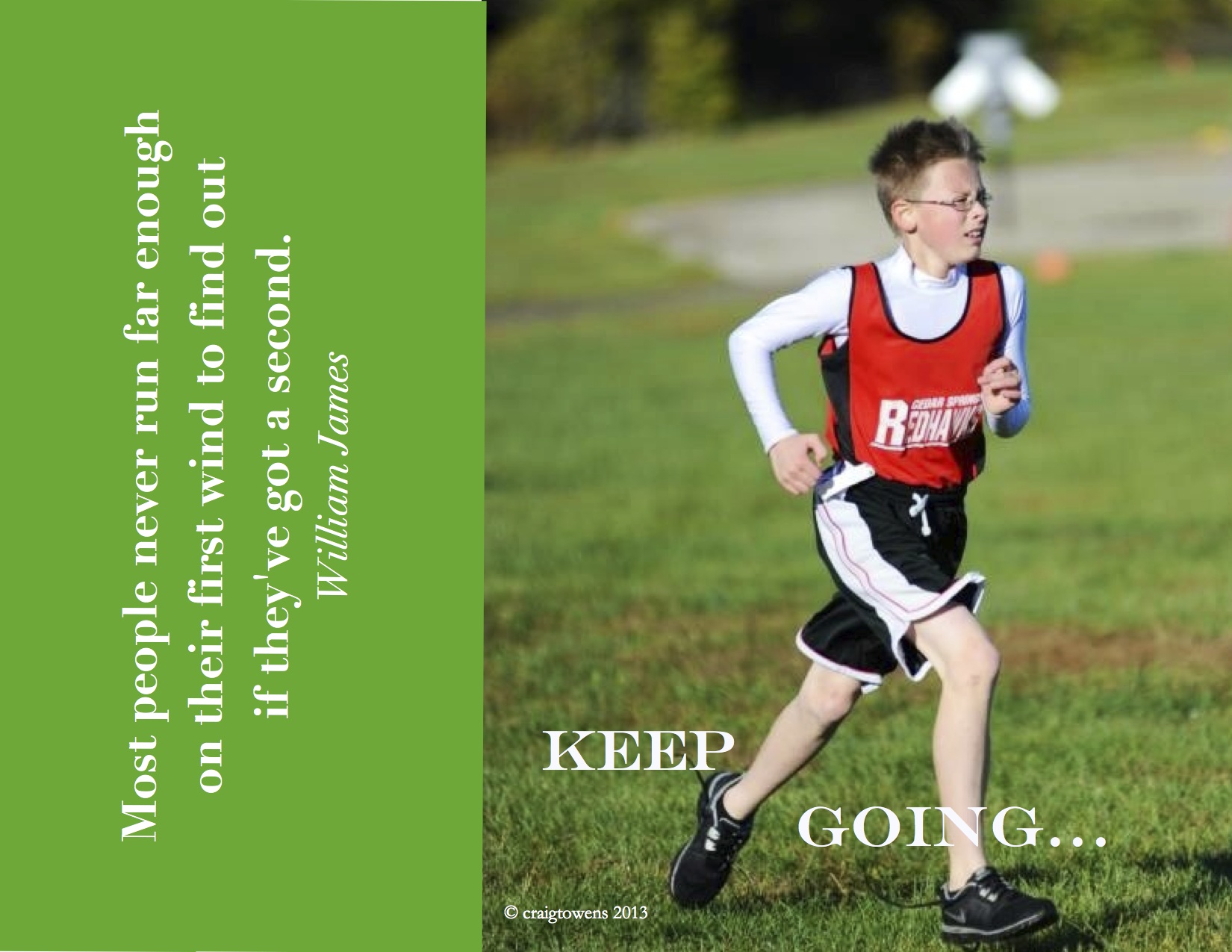
“Most people never run far enough on their first wind to find out if they’ve got a second.” —William James

When things go wrong, as they sometimes will,
When the road you’re trudging seems all uphill,
When the funds are low but the debts are high,
And you want to smile but you have to sigh,
When care is pressing you down a bit…
Rest if you must, but don’t you quit!

Life is queer with its twists and turns,
As every one of us sometimes learns,
And many failures turn about
When we might have won had we stuck it out.
Don’t give up though the pace seems slow…
You may succeed with another blow.

Often the struggler has given up
When he might have captured the victor’s cup;
And he learned too late when the night came down,
How close he was to the golden crown.

Success is failure turned inside out…
And you can never tell how close you are
It may be near when it seems so far.
So stick to the fight when you’re hardest hit
It’s when things seem worst that you must not quit. —Edgar A. Guest

Don’t Give Up!

My dear pastor, I know the ministry can seem to be unrewarding at times. Maybe you’re even wondering if all of your labors are even making a difference. Hear this loud and clear: Your ministry is making an eternal difference … Don’t give up!

Let these encouraging words from Charles Spurgeon sink into your heart:

C.H. SpurgeonPutting our hand to this plough and looking back will prove that we were unworthy of the kingdom. If there be a hundred reasons for giving up your work of faith, there are fifty thousand for going on with it. Though there are many arguments for fainting, there are far more arguments for persevering. Though we might be weary, and do sometimes feel so, let us wait upon the Lord and renew our strength, and we shall mount up with wings as eagles, forget our weariness, and be strong in the Lord and in the power of His might….

As the rain climbs not up to the skies, and the snow flakes never take to themselves wings to rise to heaven, so neither shall the word of God return unto Him void, but it shall accomplish that which He pleases. We have not spent our strength in vain. Not a verse taught to a little girl, nor a text dropped into the ear of a careless boy, nor an earnest warning given to an obdurate young sinner, nor a loving farewell to one of the senior girls, shall be without some result or other to the glory of God. And, taking it all together as a mass, though this handful of seed may be eaten of the birds, and that other seed may die on the hard rock, yet, as a whole, the seed shall spring up in sufficient abundance to plentifully reward the sower and the giver of the seed. We know that our labor is not in vain in the Lord. (emphasis added)

Keep preaching God’s Word: it IS making a difference.

Thursdays With Oswald—Speak Out Now

This is a weekly series with things I’m reading and pondering from Oswald Chambers. You can read the original seed thought here, or type “Thursdays With Oswald” in the search box to read more entries.

Oswald Chambers

Speak Out Now

     How many of us in times of peace and civilization bother one iota about the state of men’s hearts towards God? Yet these are the things that produce pain in the heart of God, not the wars and the devastation that so upsets us. The human soul is so mysterious that in the moment of a great tragedy men get face to face with think they never gave heed to before, and in the moment of death it is extraordinary what takes place in the human heart towards God.

From Christian Disciplines 

Many people will question their beliefs during times of crisis and change. It’s fine for the church and Christians to be there during those times of upheaval, but it’s far better for us to be there before the upheaval.

I developed a friendship with my next door neighbor for seven years and never had a chance to share very much about my faith in Christ. But when a tragedy hit his life, his first phone call was to me and then I had an opportunity to really share with him. Why did he reach out to me? Because I already had a relationship with him.

Let’s not wait until a tragedy strikes to begin to share the Good New of Jesus, but let’s speak out now. Be a great neighbor, coworker, study partner, friend, citizen now so that there is an open door for those folks to come to you when their life is in crisis.

Growing Pains

Listen to the podcast of this post by clicking on the player below, and you can also subscribe on AppleSpotify, or Audible. 

I remember when I was a teenager having such an ache in my legs at night. I’d be laying on my bed trying to sleep, but I couldn’t get comfortable because of that dull, unrelenting ache in my legs. I’d go ask my Mom what was going on, and her reply was simple: “Those are growing pains.”

In order to grow in any area of our lives—physically, emotionally, mentally, relationally—we have to go through a certain amount of pain.

No pain, no gain.

The process is not always a lot of fun, but that’s why we have to keep our eyes on the goal. The process may not be something we like, but the end results will make the pain worth it.

For instance, you may not like dieting but you like the weight loss or lower cholesterol numbers, so you stick with it. You may not like saying, “I’m sorry, I was wrong, please forgive me” but you like the healed relationship, so you say it.

Throughout the New Testament the phrase one another is frequently used to address how members of the Body of Christ should relate to each other. God desires that all of us operate interdependently with one another. In order to get there, we must get ready for some growing pains!

In Ephesians 4:2, Paul tells us what is required to get to a place of unity and maturity in the Church:

  • Be completely humble (the King James Version says lowliness). This Greek word means not letting our thoughts rise far from the ground. In other words, we are thinking of ourselves as God thinks of us, not independently as a self-made man or woman, but viewing all of my success as God-appointed. This process toward interdependence starts in our thoughts—in our attitudes about ourselves and about others.
  • Gentle means strength under control. Gentleness says, “I could do this, but for your sake I won’t.”
  • Patient interaction (KJV: longsuffering) with others is allowing them the freedom to grow just as others allowed me the freedom to grow.
  • Bearing with one another in love. Think of a load-bearing wall in a building that is holding up the weight of the roof and walls. When we bear with one another we are helping to share the burdens.

Being humble with ourselves and gentle and patient with others is the way we go through the growing pains of bearing with one another in love. The process may not be a lot of fun, but the end result is something that glorifies God, that’s why we must stick with one another through all our growing pains.

Check out all of the other messages in our series Live Together by clicking here.

►► Would you please prayerfully consider supporting this ministry? My Patreon supporters get behind-the-scenes access to exclusive materials. ◀︎◀︎

Love Is… (part 3)

Love Is… worsheet 3True love—or the Greek word agape—is a hard-working verb. It’s not mushy. It’s not puppy love. It’s not even romantic. It’s a love that is determined to love another no matter what! It’s the kind of love God extended toward us when we weren’t doing anything worthy of His love, and it’s the kind of love Jesus told we as us His disciples would be known for.

We just wrapped up a series called Loving The Unloveable where we explored what the Bible says about how we are to live out this agape love, especially to those who seem “unloveable.” We went through a list of 15 facets of this love spelled out in 1 Corinthians 13.

You can read about the first five facets by clicking here.

You can read about the second set of attributes by clicking here.

Here are the final five—

Love is protecting

  • The King James Version says love bears all things. So we need to ask, “What does love bear?”
  • The Greek word means: “protecting by covering with silence.”
  • In other words, we bear with the insults of an unloveable/unloving person by refusing to talk about them in a negative way.
  • Agape doesn’t talk about people (unless it’s a conversation with God); agape only talks lovingly to people. Agape protects their reputation.

Love is trusting

  • Love has a high confidence in success. Not my success, but God’s success. So we keep believing for a breakthrough; keep trusting God to accomplish something; keep doing our part in pointing out the best (or the best that is yet to be) in others.

Love is hopeful 

  • The Amplified Bible says: love’s hopes are fadeless under all circumstances.
  • So we work now, but we are always looking forward to the future with joy and full confidence.
  • Think about a farmer: After he plants the seed, he doesn’t see it any more. But his outlook remains hopeful. So he waters a seed he cannot see. He fertilizes a seed he cannot see. He works the ground for a seed he cannot see.
  • Our acts of love may be planting a seed, or fertilizing, or watering. Every part is vital; no part can be skipped. And we remain hopeful of a harvest.
  • Let us not become weary in doing good, for at the proper time we will reap a harvest if we do not give up. (Galatians 6:9)

Love is persevering

  • I love the Greek definition: “enduring through every circumstance without ever weakening.”
  • Never let your love waver. Keep on being patient, and kind, and forgiving, and all of the other characteristics of agape listed in 1 Corinthians 13. All of them are irreplaceable and effective! 

Love is maturing

  • Love continues to grow up.
  • Agape is creative, never stagnant or stuck in a rut. Agape finds new ways to express itself.

Here’s where the real test comes in: How will you apply these attributes of love to someone in your life? More specifically: to someone you think is “unloveable”?

I know you have someone in your life that you think is unloveable. With that person’s face clearly in mind, how will you fill in the blanks:

  1. I can protect their reputation by…
  2. I believe God is working in this…
  3. I need to not give up in this area…
  4. I must remember this…
  5. I can how my love more maturely by…

If you would like a downloadable PDF of this worksheet, click here -–> Love Is… worsheet 3

If you would like to download the other worksheets, or if you missed any of the messages in our Loving the Unlovable series, you can check them all our here.

15 Quotes From “Draw The Circle”

Draw The CircleI loved the challenging message about prayer in Draw The Circle by Mark Batterson. You can read my full book review by clicking here. Here are 15 quotes that especially stood out to me.

“You don’t need to seek opportunity. All you have to do is seek God. And if you seek God, opportunity will seek you.”

“Sometimes the purpose of prayer is to get us out of circumstances, but more often than not, the purpose of prayer is to get us through them. I’m certainly not suggesting we shouldn’t pray deliverance prayers, but there are times we need to pray prevailing prayers. …We’re often so anxious to get out of difficult, painful, or challenging situations that we fail to grow through them. We’re so fixated on getting out of them that we don’t get anything out of them. We fail to learn the lessons God is trying to teach us or cultivate the character God is trying to grow in us. We’re so focused on God changing our circumstances that we never allow God to change us! So instead of ten or twenty years of experience, we have one year of experience repeated ten or twenty times. Sometimes we need to pray ‘get me out’ prayers. But sometimes we need to pray ‘get me through’ prayers. And we need the discernment to know when to pray what.”

“After hitting our knees, we need to take a small step of faith. And those small steps of faith often turn into giant leaps. Like Noah, who kept building an ark day after day, we keep hammering away at the dream God has given us. Like the Israelites, who kept circling Jericho for seven days, we keep circling God’s promises. Like Elijah, who kept sending his servant back to look for a rain cloud, we actively and expectantly wait for God’s answer. …We can pray until our knees are numb, but if our praying isn’t accompanied by acting, then we won’t get anywhere. We need to put feet to our faith. After kneeling down, we need to stand up and step out in faith.”

“Maybe our normal is so subnormal that normal seems abnormal. Maybe we need a new normal. Bold prayers and big dreams are normal. Anything less is subnormal.”

“Prayer gives us a God’s-eye view. It heightens our awareness and gives us a sixth sense that enables us to perceive spiritual realities that are beyond our five senses.” 

“Praying is planting. Each prayer is like a seed that gets planted in the ground. It disappears for a season, but it eventually bears fruit that blesses future generations. …Even when we die, our prayers don’t. Each prayer takes on a life, an eternal life, of its own.”

“It’s our childlike faith, not our theological vocabulary, that moves the heart of our Heavenly Father.” 

“Praying hard is not the path of least resistance; it’s usually the path of most resistance because we engage in spiritual warfare. …It’s the prayers you pray when you feel like you want to quit praying that can bring the greatest breakthroughs.”

“Our problem typically isn’t overclaiming the promises of God; it’s underclaiming them.” 

“You’ve got to praise God if the answer is yes and trust Him if the answer if no. If the answer is not yet, you’ve got to keep circling. It’s always too soon to give up! What other option do you have? To pray or not to pray. Those are the only options.”

“Drawing prayer circle isn’t some magic trick to get what you want from God. God is not a genie in a bottle, and your wish is not His command. His command better be your wish. If it’s not, you won’t be drawing prayer circles; you’ll end up walking in circles. …Until His sovereign will becomes your sanctified wish, your prayer life will be unplugged from its power supply.” 

“Sin doesn’t just harden the heart; it also hardens our hearing. In fact, it makes us turn a deaf ear to God because we don’t want to hear the convicting voice of the Holy Spirit. But if you aren’t willing to listen to the convicting voice of the Spirit, you won’t hear His comforting voice, forgiving voice, or merciful voice either. Sin creates relational distance, and distance makes it harder to hear the still, small voice of the Holy Spirit. But if you get close to God, you won’t miss a thing he says. And if you incline your ear to God, God will incline His ear to you.”

“There comes a moment when praying becomes a form of spiritual procrastination. It’s time to stop praying and start acting. …One of the great mistakes we make is asking God to do for us what God wants us to do for Him. …Prayer that doesn’t lead to action isn’t true prayer; it’s self-talk. When we talk to God, God will talk back to us. He will provoke us, rouse us, stir us, goad us, and prompt us. When we say ‘amen,’ inaction is no longer an option.” 

“When God answers a prayer, no matter how big or how small, we need to share it. It’s a stewardship issue. If we don’t turn the answer to prayer into praise, it may very well turn into pride.”

“Our prayers have the potential to write and rewrite history.”

March!

Listen to the podcast of this post by clicking on the player below, and you can also subscribe on AppleSpotify, or Audible.

I’m convinced that many of us have missed answers to prayer because the answers seemed “too practical” or required “too much work” from us. Consider the well-known example of the defeat of the city of Jericho as recorded in the Bible.

Jericho was a massive fortress. Archeologists tell us that the city encompassed over eight acres, and was surrounded by walls which were 30-feet tall and 20-feet wide. Joshua was a brilliant military strategist who up to this point had never suffered a defeat. He asks God for help in defeating this fortress, and God tells him, “March!”

That’s it. Not pray, pray, and pray some more. Not go on a 40-day fast. Make no mistake, the Israelites had been in a period of renewed passion and prayer. As they entered Canaan, they sought God, renewed their vow to serve Him alone, and celebrated the Passover just days before encountering Jericho.

Sometimes our prayers have to have feet. 

Sort of like abolitionist Frederick Douglass who said, “Praying for freedom never did me any good til I started praying with my feet.”

  • We need to pray for the salvation of our loved ones, and talk to them about Christ.
  • We need to pray for God to open the door for employment, and mail the resume.
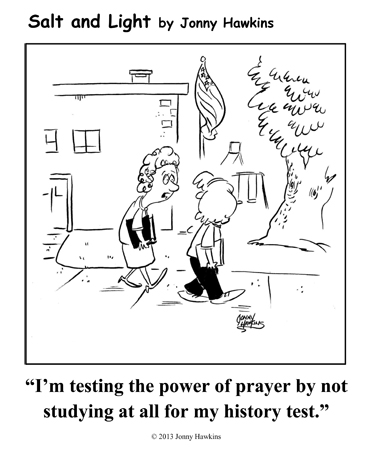
  • We need to pray for God’s help on a test, and study hard.
  • We need to pray, and we need to march.

Jericho delieveredI love the verb tense in this story! God told Joshua, “I have delivered Jericho into your hands” (Joshua 6:2). Later on, after the Israelites completed their 13th hike around Jericho, Joshua said, “Shout! For the Lord has given you the city” (v. 16).

If you are praying for something that is in alignment with God’s Word, then God has given you your Jericho. But you may not see the walls come tumbling down until you march. Keep praying, keep marching, keep circling it in prayer, and watch those walls crumble!

To check out the others messages in this series on prayer called Praying Circles, please click here.

►► Would you please prayerfully consider supporting this ministry? My Patreon supporters get behind-the-scenes access to exclusive materials. Like this exceptional Bible study tool to help with Creation apologetics. ◀︎◀︎

Don’t Settle

C.S. Lewis at his deskI shared this quote with Calvary Assembly of God this morning to remind us that we shouldn’t settle. God wants us to pray BIG and to pray LONG. He wants us to claim His promises. He wants to be glorified by answering our prayers.

“If we consider the unblushing promises of reward and the staggering nature of the rewards promised in the Gospels, it would seem that our Lord finds our desires, not too strong, but too weak. We are half-hearted creatures…like an ignorant child who wants to go on making mud pies in a slum because he cannot imagine what is meant by the offer of a holiday at the sea. We are far too easily pleased.” —C.S. Lewis

Eye On It

Keep Striking

Keep strikingThere is an unusual story in 2 Kings about King Jehoash. Elisha the prophet was on his deathbed, Israel was morally bankrupt and on the brink of defeat. The entire Israeli army had been reduced to fifty horsemen, ten chariots, and ten thousand infantry. It was in this hour of desperation that Jehoash sought out the counsel of Elisha.

Elisha said [to Jehoash], “Get a bow and some arrows,” and he did so. “Take the bow in your hands,” he said to the king of Israel. When he had taken it, Elisha put his hands on the king’s hands.

“Open the east window,” he said, and he opened it. “Shoot!” Elisha said, and he shot. “The Lord’s arrow of victory, the arrow of victory over Aram!” Elisha declared. “You will completely destroy the Arameans at Aphek.”

Then he said, “Take the arrows,” and the king took them. Elisha told him, “Strike the ground.” He struck it three times and stopped. The man of God was angry with him and said, “You should have struck the ground five or six times; then you would have defeated Aram and completely destroyed it. But now you will defeat it only three times.”

What made Elisha angry is what I believe makes God angry. Jehoash came to God when the situation seemed impossible, but he wouldn’t pray it through. It’s almost as if he felt like three times was enough to pray, and then he needed to take it from there.

God wants us to pray BIG, but He also wants us to pray LONG.

We need to keep striking the ground (or as Mark Batterson would say, keep drawing the circle) until God answers. God gave Jehoash a promise of victory, but Jehoash didn’t pray long enough to see it through.

What are you praying for? What promise has God given you? God is glorified when you place your request in His hands, and leave it there. Keep on praying. Keep on striking. Keep on circling until God brings about what He has promised!

To check out the others messages in this series on prayer called Praying Circles, please click here.