And [God] humbled you and allowed you to hunger and fed you with manna, which you did not know nor did your fathers know, that He might make you recognize and personally know that man does not live by bread only, but man lives by every word that proceeds out of the mouth of the Lord. … Know also in your [minds and] hearts that, as a man disciplines and instructs his son, so the Lord your God disciplines and instructs you. (Deuteronomy 8:3, 5 AMPC)
God allows us to be humbled and hungry so that we can learn that He is our only source. Proud people will not open their hearts and minds to learn because they see themselves as know-it-alls.
Because He loves us, God humbles us. If we will yield, we can learn from God and grow in intimacy with Him. “Know also in your minds and hearts that, as a man disciplines and instructs his son, so the Lord your God disciplines and instructs you” (Deuteronomy 8:5). But the proud are deprived of all of these blessings.
Verses 11-20 add a warning about forgetfulness. Success tends to make us think we have accomplished something in our own power, which stokes our pride. Twice we are told to “beware”…
…of forgetting that God is our Provider
…of thinking we are our own provider
Humility keeps us dependent on God and increasingly intimate with Him. Pride pushes God away.
Check out my series of posts about forgetfulness called Fading Gratitude.
Listen to the podcast of this post by clicking on the player below, and you can also subscribe on Apple, Spotify, or Audible.
There is a cliche people love to quote: “Give a man a fish and you feed him for a day. Teach a man to fish and you feed him for a lifetime.”
Is this how Christians should live?
It sounds like the experienced fisherman may be annoyed at having to catch a fish every day just to give it to someone else. If you want to put a noble spin on the cliche, you could say that the wise and patient fisherman invested his time to teach someone else to provide for themselves, never needing to return to their teacher.
This certainly wouldn’t be the example of Jesus.
As He was teaching the large crowd of people, whom He thought of as sheep without a shepherd, they became hungry. Jesus directed His disciples to feed them. He didn’t tell them to teach the crowd to provide for themselves.
As Jesus miraculously fed thousands of people, notice that He kept on giving until they were all satisfied—
And taking the five loaves and two fish, He looked up to heaven and, praising God, gave thanks and broke the loaves and kept on giving them to the disciples to set before the people; and He also divided the two fish among them all. And they all ate and were satisfied.(Mark 6:41-42 AMPC)
The example in the Old Testament was to look to God for a supply of manna every single day. In the New Testament, Jesus taught us to pray for our daily supply of bread every single day (Exodus 16:14-17; Matthew 6:11; John 6:35).
Jesus never wants us to become self-sufficient. Instead, He wants us to remain steadfastly connected to Himself—as surely as a branch is connected to the vine.
Far from teaching us to provide for ourselves, Jesus says, “If you remain in Me and I in you, you will bear much fruit; apart from Me you can do nothing” (John 15:5).
Jesus is never wearied by our continually coming to Him; rather, He is delighted when we do! He wants to be our supply each and every day for all of eternity!
Listen to the podcast of this post by clicking on the player below, and you can also subscribe on Apple, Spotify, or Audible.
It is so much easier to complain than to compliment. We can slide into the negative conversations almost without thinking about it.
In one of the last things that Paul wrote to Timothy—as he’s in prison, quite possibly awaiting execution—he warns his friend against the darkness of the last days (2 Timothy 3:1-5). We need to engage our minds, our wills, and our emotions to not go with the flow of culture’s negativity.
Remember the wise words from George Santayana: “Those who do not learn from history are doomed to repeat it.” The apostle Paul said this before Mr. Santayana (1 Corinthians 10:1-6). We need to learn the lessons of the dangers of forgetfulness that leads us to ingratitude.
Even before Paul, the Old Testament is filled with repeated reminders to remember God’s blessings and gratefully look to Him to supply every need. Let’s unpack some lessons on the importance of gratitude from Israel’s history in Psalm 106.
In Psalm 106:7, the Israelites forget what God has done for them in Egypt. Now that they appear to be pinned between the Red Sea and the onrushing Egyptian army, their forgetfulness becomes grumbling against God (Exodus 14:10-12).
In Psalm 106:13-14, instead of being grateful for the miraculous supply of manna, the Israelites are grumbling about the meat they don’t have (Numbers 11:4-6).
Here’s the lesson for us to learn: God wants to teach us to be thankful for His daily provisions for us (Joshua 5:12; Matthew 6:11).
In Psalm 106:21, 28-29, the next generation of Israelites didn’t remember to be thankful because they had seldom heard their parents express gratitude (Judges 2:10-11).
Here’s the lesson for us to learn: Our daily thankfulness fortifies future generations (Psalm 37).
Here is the repeated pattern we see—
Thankfulness → Forgetfulness → Fearful / Selfish attitudes → Susceptible to the temptation to grumble against God
Thankfulness → Remembering → Joyful / Secure attitudes → Fortified against the temptation to grumble against God
Jim Cymbala said, “Ingratitude to God is the first step toward backsliding and departure from God. So, it is to our benefit to have a thankful heart toward God.”
Let’s put into practice this lesson from King David: “Praise the Lord, O my soul, and forget bot all His benefits” (Psalm 103:2).
Listen to the podcast of this post by clicking on the player below, and you can also subscribe on Apple, Spotify, or Audible.
Jesus is teaching us to pray as citizens of the Kingdom of Heaven, and each phrase of this prayer is a reminder of how we interact with the King of Heaven—Our Father in Heaven, hallowed be Your name. Your Kingdom come, Your will be done on earth as it is in Heaven.
We all have a desire to feel secure—to feel our needs are going to be met. In fact, our anxiety level is usually tied directly to how insecure we may feel. The problem for many of us, however, is that we have mistaken wants for needs, and when those aren’t met as we think they should be, we again experience increasing levels of anxiety.
We see this on full display in Luke 12. First, Jesus addresses a man who is greedily desiring his share of his father’s inheritance. Jesus says, “Life does not consist in an abundance of possessions.”
To illustrate this point, Jesus tells a parable of a rich landowner who harvested more crops than he knew what to do with—a harvest which he calls “plenty.” His solution was to build bigger barns for his abundant harvest, to which God announced, “You fool” (Luke 12:13-21).
This man was not called a fool because he was successful. He was not called a fool because he had plenty. Rather, he was called a fool because his “plenty” caused him to forget his heavenly Father.
This is an invaluable lesson. Sadly, we tend to be a very forgetful people!
After God delivered His people from their bondage in Egypt, and they almost immediately start worrying and then complaining about whether their needs will be supplied. God tells them that He will supply every day exactly what they need (Exodus 16:1-35).
This provision of manna every single morning when they got up was intended to keep them reliant on God and thankful for His provision. But after a while they thought they deserved more—they wanted plenty (Numbers 11:4-6). Later on, Asaph would pinpoints the main culprit of the Israelites’ stumbled throughout their history: forgetfulness (Psalm 78:11, 22-25).
Jesus taught us to come to God in prayer as Our Father. Just as Jesus was daily dependent on His Father, so He teaches us to have that same level of daily abiding.
Jesus reminds us what the daily supply of manna really signified; namely, that He would be our Bread from Heaven for all of eternity (John 6:28-40)!
So that’s why we pray, “Give us today our daily bread.” Once again, this is an acknowledgement that no one else can provide for us, and it is a request that we would stay daily dependent on Him. It’s not, “Give us today our weekly bread.” Or, “Give us today our daily wants.” Or even, “Give us today plenty of things.”
We need our Father for daily bread so that we never, ever forget or vital, indispensable connection to Him!
Even when we don’t have plenty, we are told not to worry but instead to look to our Heavenly Father for His daily supply (Luke 12:22; Philippians 4:6-7).
Listen to the podcast of this post by clicking on the player below, and you can also subscribe on Apple, Spotify, or Audible.
In Romans 3:23 we read, “For all have sinned and fall short of the glory of God.”What does it mean to “fall short” of God’s standard? John Piper describes it this way: “It means that none of us has trusted and treasured God the way we should. We have not been satisfied with His greatness and walked in His ways. We have sought our satisfaction in other things, and treated them as more valuable than God.”
A couple of chapters earlier in Romans, Paul tells us about an exchange that people make. They exchange a relationship with the eternal God for things which they can grab immediately. Sadly, these immediate things are only temporal things that fall short of God’s awesome glory and leave us perpetually unsatisfied (Romans 1:21-25).
We were created by God to crave. Craving is what gives us staying power and brings fulfillment. Think of it this way: Would you rather…
…go to a job that is mundane, boring, and only focused on making money OR go to a job that is fascinating, using our talents, and trying to make a difference in the world?
…eat food that tastes like cardboard OR eat savory food?
…serve a god that is temporary, fickle, and unreliable OR serve a God that is eternal, faithful, strong, and loving?
Or think of it another way: Which of those jobs would you want to go to? Which job would call out your best effort? Which food would you want to eat? Which food would make you want to praise the chef? And which God would you want to spend eternity with? Which God would want to invite others to worship?
God gives us cravings that can only be satisfied in Him. The devil perverts these cravings to get us to go for quick, easy, self-made pleasures. Just think about how he tempted Adam and Eve (Genesis 3:1-6).
Both the Old Testament and New Testament tell us of the joys of eternal cravings being satisfied and the consequences of giving in to temporal cravings. For example:
God gives a craving for future meat, but satisfies us with manna while we wait. The devil temps us to have our meat now (Deuteronomy 12:20; Psalm 106:12-14; Numbers 11:34).
God gives a craving for satisfying relationships. The devil tempts us to indulge our passions now by grabbing the most alluring relationship (Proverbs 5:18-19; Deuteronomy 5:21; Romans 1:24, 26).
God gives a craving for success and significance in His timeframe. The devil tempts us to get ahead now (1 Kings 11:37-38; Genesis 3:6).
It’s a terrible exchange when we give up the glorious eternal for the fading temporal! Romans 1 describes the results as sinful, degrading, shameful, unnatural. That’s because the things of earth are temporary; only God is eternal.
For all that is in the world—the lust of the flesh—craving for sensual gratification—and the lust of the eyes—greedy longings of the mind—and the pride of life—assurance in one’s own resources or in the stability of earthly things—these do not come from the Father but are from the world itself. And the world passes away and disappears, and with it the forbidden cravings (the passionate desires, the lust) of it; but he who does the will of God and carries out His purposes in his life abides (remains) forever. (1 John 2:16-17 AMP)
We have to trust the One who gave us His unshakable promises—Be delighted with the Lord. Then He will give you all your heart’s desires (Psalm 37:4 TLB). Be delighted with Him and He will—not “may” or “hopefully He will” but He will—give you ALL your heart’s desires!
There is an ultimate reward in Heaven but there are incredibly satisfying rewards along the journey to Heaven as well. Rewards like happiness, security, insight, and divine counsel from the Holy Spirit (2 Timothy 4:8; Psalm 119:2, 10, 16, 18, 24).
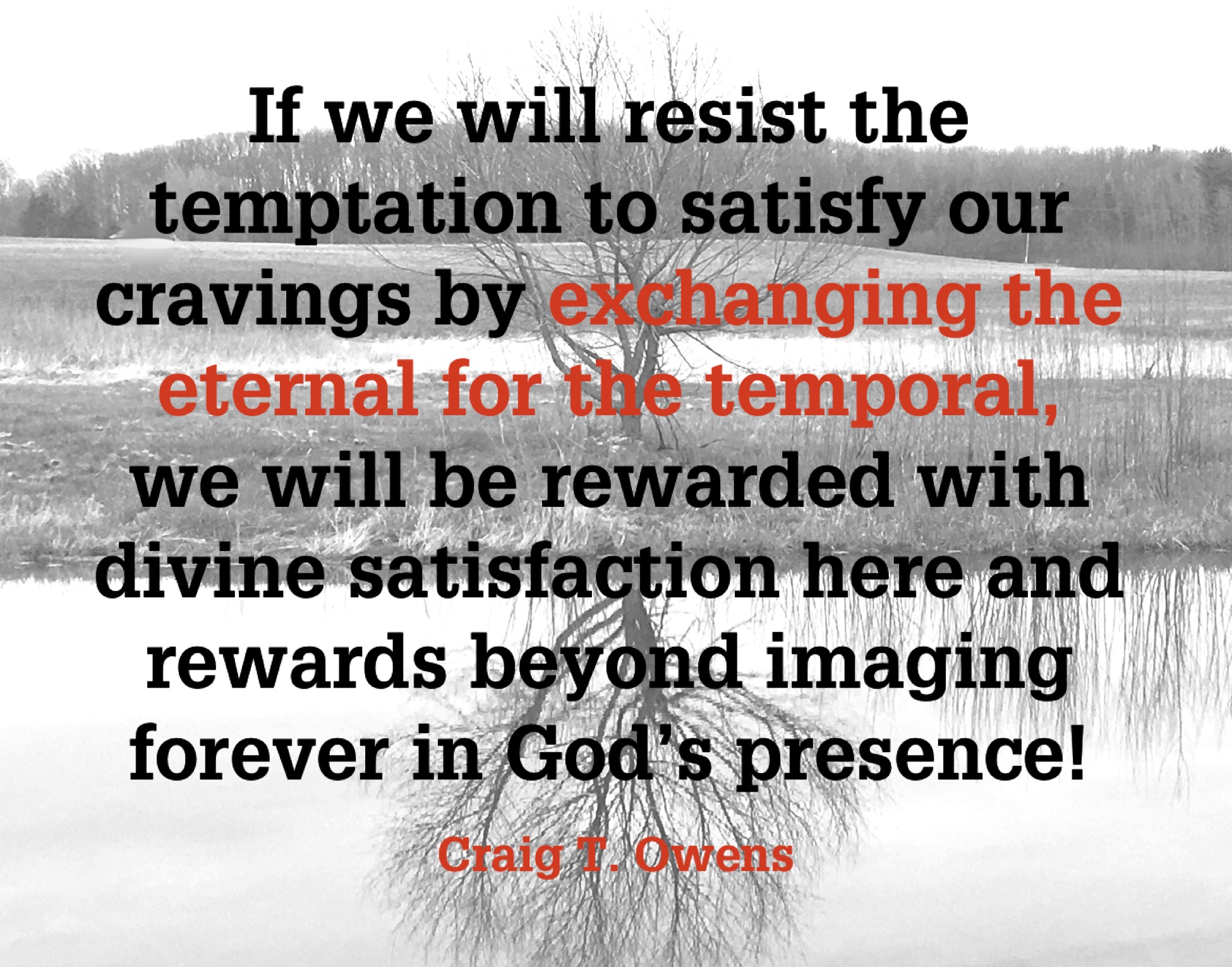
If we will resist the temptation to satisfy our cravings by exchanging the eternal for the temporal, we will be rewarded with divine satisfaction here and rewards beyond imaging forever in God’s presence!
This is a weekly series with things I’m reading and pondering from Charles Spurgeon. You can read the original seed thought here, or type “Thursdays With Spurgeon” in the search box to read more entries.
Listen to the podcast of this post by clicking on the player below, and you can also subscribe on iTunes or Spotify.
Present Communion With Jesus
The desire of a renewed soul is to find Christ and to be with Him. … Past communion with Christ is very well: ‘Therefore I will remember Thee from the land of Jordan…’ (Psalm 42:6). But these are only stale meats, and a loving soul wants fresh food every day from the table of Christ. …
A true loving soul, then, wants present communion with Christ. So the question is, ‘Tell me where You feed. Where do You get Your comfort from, O Jesus? I will go there. … Where do You feed Your flock? In Your house? I will go there, if I may find You there. In private prayer? Then I will not be slack in that. In the Word? Then I will read it night and day. Tell me where You feed; wherever You stand as the Shepherd, there will I be, for I want You. I cannot be satisfied to be apart from You. My soul hungers and thirsts to be with You.’
“Without building in sabbath breaks, we run down emotionally, spiritually, mentally, and physically, which means loving God becomes a chore, not a delight (Mark 12:30). This then means loving your neighbor becomes nearly impossible (Mark 12:31). Ultimately, this means that we aren’t able to be the compassionate, wise, strong shepherds that the sheep under our care need us to be. …
“The goal of sabbathing is to infuse more vitality into the shepherd leader for the purpose of pasturing the sheep under that leader’s care. You cannot give hope to others unless you are hope-filled; you cannot give health to others unless you are healthy; you cannot consistently speak wisdom to others unless you are growing in wisdom. All of this healthy growth for the shepherd leader takes place while sabbathing….”
To reiterate what Pastor Spurgeon said: “A true loving soul, then, wants present communion with Christ.” I hope you will always seek that for yourself.
Fading gratitude can negatively impact our past, present, and future. Because when our gratitude to God begins to fade, so does our understanding of what God has already done for us, our appreciation of what He is still doing for us today, and our hope for what He will provide for us tomorrow. But we can flip the script—Our continual gratitude can begin to positively impact our past, present, and future!
“Gratitude is from the same root word as ‘grace,’ which signifies the free and boundless mercy of God. Thanksgiving is from the same root word as ‘think,’ so that to think is to thank.” —Willis P. King
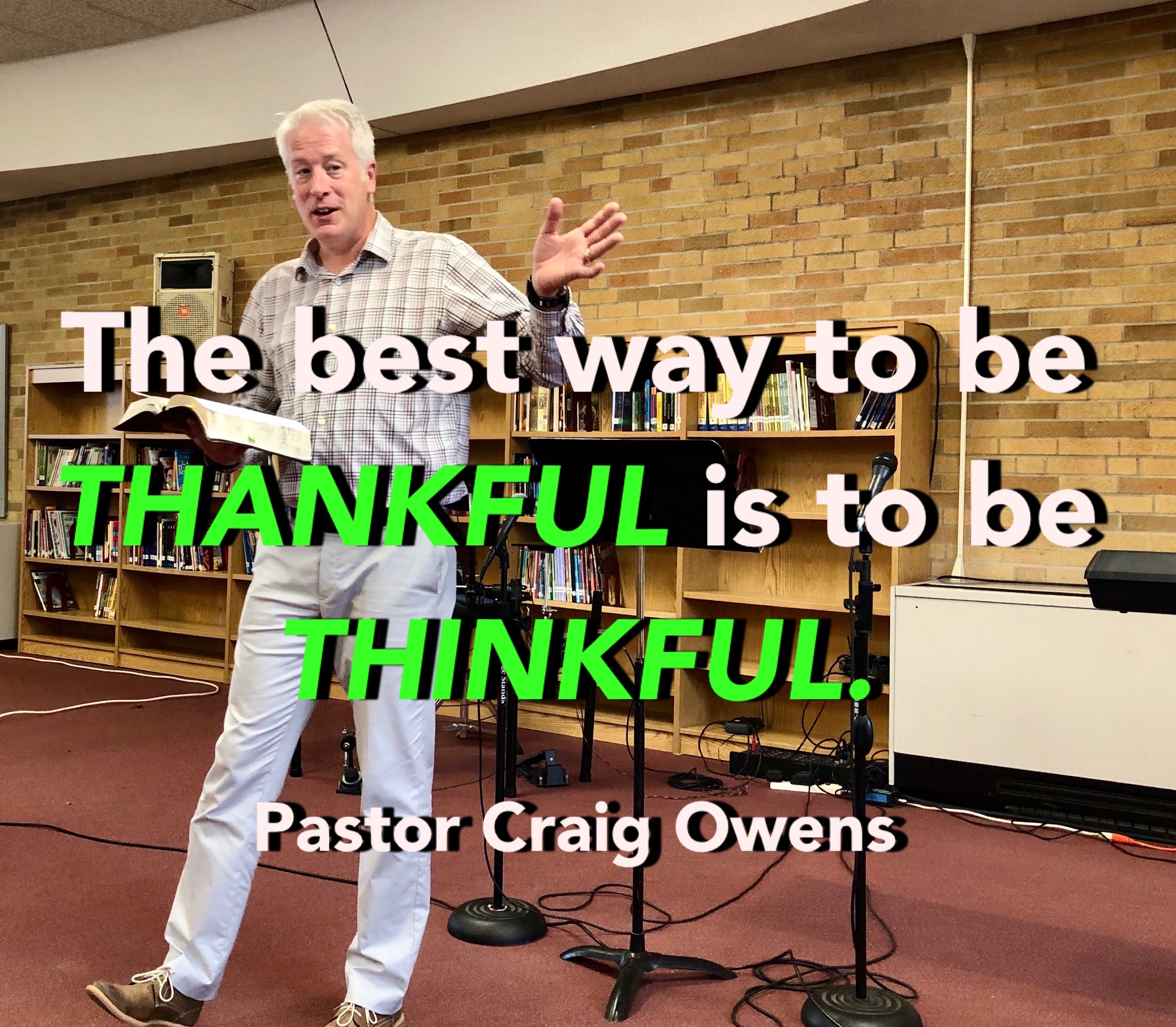
The more we THINK about God’s grace in our lives, the more we can give THANKS for all He has done. Or said another way…
The best way to be THANKFUL is to be THINKFUL!
In Psalm 78, Asaph gives us a two-word reason for the up-and-down history of the Israelites: they forgot. The Israelites’ forgetfulness led to their lack of gratitude, which then caused yet another downward turn away from God. One of the examples he gives us is very informative: the daily provision of manna while the Israelites were in the wilderness (see Psalm 78:11-25; Exodus 16:4, 14-18).
Every day God’s people had their food needs miraculously supplied for them, yet they begin to take this gift of God for granted. They stopped thinking about His provision, and then they began to ungratefully grumble (Numbers 11:4-6). Their grumbling actually caused them to want to return to slavery in Egypt!
With fading gratitude, we can get stuck in the past. We even end up looking back at slavery and scarcity and call it “the good old days”! With fading gratitude for the past, sometimes we beat ourselves up. We say things like, “If I would have known then what I know now….” But you couldn’t know then what you know now. You only know now because of what you went through then, which makes another reason to be grateful. After all, God is using everything we have gone through to work out His plan (see Isaiah 46:9-10; Romans 8:28).
We need to be thinkful about our past so that we can be thankful for what God is doing with it today.
Manna provided food every single day the whole time the Israelites were in the wilderness. It stopped immediately after they entered the Promised Land. For that daily provision, they should have been thankful but it was when they forgot to be thankful that they longed for the past and tried to do things on their own.
The manna is a picture of Jesus. Not only is He our daily bread for today, but He is also our hope for eternity with God in Heaven. And for that, we should be daily thinkfulANDthankful.
If you’d like a fun idea of how to stay thinkfulANDthankful, check this out.
Join us this Sunday as we learn more about the dangers of our fading gratitude.
Often when someone does something nice for us, we feel a certain obligation to return the favor. What about when God blesses us? Are we obligated to do something back? Are there strings attached to His blessings?
The Israelites left Egypt and were now in a desert, on the way to the Promised Land. Although they were free from slavery, they were also without the daily provision of food that their slave owners had provided them.
And did I mention they were in a desert?!
At this desperate point, the people were seriously thinking about returning to their slave owners.
Then the Lord said to Moses, Behold, I will rain bread from the heavens for you; and the people shall go out and gather a day’s portion every day, that I may prove them, whether they will walk in My law or not. (Exodus 16:4 AMP)
God blessed the Israelites with food, but He wanted something in return: their faithful obedience to Him.
If God has blessed me—and, indeed, He has—He requires me to honor Him with that blessing. Too many people pray and seek God fervently in the ‘lean times,’ and when the answer comes they are thankful only at the moment of blessing. This should not be! God has blessed me so that I will continue to seek Him, and so that I will be a blessing to others.
So, yes, there are strings attached to God’s blessings. And I want those strings! Without the strings, I am trying to do things my own way; I am severing myself from God, and from His greater future blessings.



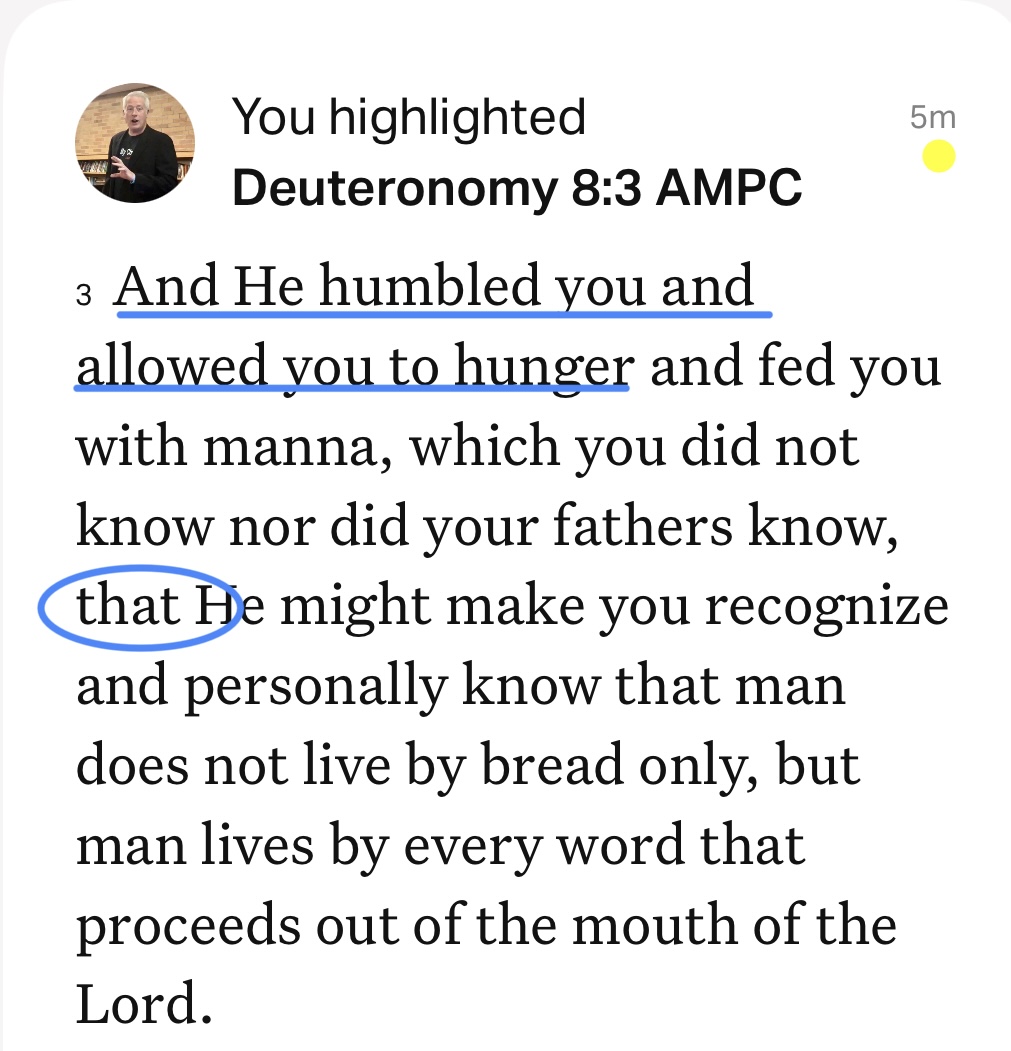 And [God] humbled you and allowed you to hunger and fed you with manna, which you did not know nor did your fathers know, that He might make you recognize and personally know that man does not live by bread only, but man lives by every word that proceeds out of the mouth of the Lord. … Know also in your [minds and] hearts that, as a man disciplines and instructs his son, so the Lord your God disciplines and instructs you. (Deuteronomy 8:3, 5 AMPC)







 Craig T. Owens