8 Quotes From “Warnings To The Churches”

This hard-hitting, no-pulled-punches book is directed primarily at pastors and other church leaders. However, I think anyone who loves Christ and His Bride will find much to ponder in Warnings To The Churches by J.C. Ryle. You can read my full book review by clicking here. 

“Go forward, beloved brethren, and fear not the adversary. Only abide in Christ and the victory is sure. Marvel not at the hatred of the gates of hell. ‘If you were of the world, the world would love you as its own’ [John 15:19]. So long as the world is the world, and the devil is the devil, there must be warfare, and believers in Christ must be soldiers! The world hated Christ, and the world will hate true Christians as long as the earth stands. As the great reformer, [Martin] Luther, said, ‘Cain will go on murdering Abel so long as the Church is on earth.’” 

“He who cannot lie has pledged His royal word that all the powers of hell shall never overthrow His Church. It shall continue, and stand, in spite of every assault. It shall never be overcome.” 

“Weak as this true Church may appear to the eye of man, it is an anvil which has broken many a hammer in times past, and perhaps will break many more before the end. He who lays hands on it is touching the apple of God’s eye!” 

“We corrupt the Word of God most dangerously when we throw any doubt on the absolute inspiration of any part of Holy Scripture.” 

“We corrupt the Word of God when we make defective statements as doctrines. We do so when we add to the Bible the opinions of the Church or of the Church Fathers, as if they were of equal authority. We do so when we take away from the Bible for the sake of pleasing men. We do so when from a feeling of false liberality, keep back any statement which seems narrow, or harsh, or hard. We do so when we try to soften down anything that is taught about eternal punishment or the reality of hell. We do so when we bring forward doctrines in their wrong proportions.” 

“May we never care what men say of us so long as we walk in the light of God’s Word! May we strive and pray to be wholly independent of, and indifferent to, man’s opinion, so long as we please God!” 

“Chosen as believers are by God the Father, justified as they are by the blood and righteousness of Jesus Christ, sanctified as they are by the Holy Spirit, believers are still only men—they are still in the body and still in the world. They are ever near temptation. They are ever liable to misjudge, both in doctrine and in practice. Their hearts, though renewed, are very feeble; their understanding, though enlightened, is still very dim. They ought to live like those who dwell in an enemy’s land, and every day to put on the armor of God. The devil is very busy: he never slumbers or sleeps.” 

“Like the fruit of which Eve and Adam ate, at first sight it looks pleasant and good, and a thing to be desired. ‘Poison’ is not written up on it and so people are not afraid. Like counterfeit coin it is not stamped ‘bad.’ It passes for the real thing, because of the very likeness it bears to the truth. Let us be on our guard against the very small beginnings of false doctrine.” 

Warnings To The Churches (book review)

J.C. Ryle died in 1900, placing his writings two centuries before our own. And yet his Warnings To The Churches sound an alarm that is just as relevant to the Church and her leaders as if it were written last week! 

Bishop Ryle spoke and wrote with an authority that sounded much like the Old Testament prophets thundering, “Thus saith the Lord!” And at the same time, you can also hear his ardent love for Christ’s Bride as tenderly as the beloved disciple John, who called himself “the disciple whom Jesus loved.” Taken together, that means Ryle’s words are steeped in authoritative, loving Scripture. 

He pulls no punches in pointing out how even Church leaders have bought into a definition of “church” that doesn’t quite line up with the way Jesus defined it. He reminds pastors of their heavy responsibility to preach the Word of God in all its purity. Just like Jesus, Ryle warns church leaders of the “leaven of the Pharisees and Sadducees.” And he calls for loving confrontation of those leaders who have succumbed to the “leaven” just as Paul confronted Peter. 

This is a challenging book to read simply because of the gut-level honest introspection that it will require. I certainly couldn’t read through this book thinking I’ve got my act together, and I doubt few others will be able to either. If you are a church leader and you would like Ryle’s iron to sharpen your iron, Warnings To The Churches is a definite must-read for you.

Certainty In Uncertain Times

… Perhaps the Lord will act in our behalf … The God we serve is able to save us from the furnace…but even if God does not save us… (1 Samuel 14:6 and Daniel 3:17-18).

We often remember and even hold in high regard those leaders who rise up in times of crisis or uncertainty. But I think we might be shocked if we knew exactly how scared these seemingly unflappable leaders actually were! 

The Philistines really had the Israelites on the ropes. Israel’s army was slowing melting away, as soldiers one by one were deserting and heading home. The Philistines had captured all of the sword-makers, so that there were only two swords left—one for King Saul and one for his son Jonathan. 

And to make matters even more desperate, the Philistines occupied all the strategic high ground, so that even if the Israelites were going to attempt an attack, they would have to scale the cliffs in order to do so.

For Jonathan, this situation was unbearable. So he said to his armor-bearer (keep in mind that this armor-bearer didn’t really have any armor to bear!), “Let’s go attack the Philistines.” And then he adds this line that probably didn’t instill too much confidence in anyone, “Perhaps the Lord will give us victory.” 

Perhaps?!

Many years later, when the nation of Israel was in exile in Babylon, three Jewish young men found themselves in a literal hot spot. King Nebuchadnezzar had built an enormous statue of himself and commanded that everyone bow down and worship it. Shadrach, Meshach, and Abednego had been promoted into leadership positions in the capital city of Susa, so there was no hiding in the outreaches of the countryside for them. Their disobedience to the king’s command would make them stand out to everyone. The king had ordered that anyone who disobeyed his edict would be thrown into a fiery furnace. 

Shadrach, Meshach, and Abednego were God-fearing men and knew that they could not worship any other god except Yahweh. When the king confronted their disobedience, they also responded with words that didn’t sound very confident, “God can save us, but we’re not sure if He will save us. But even if He doesn’t, we’re not going to bend our knee.” 

If?!

“Perhaps” and “if” don’t sound like very confident words, do they? 

And yet these godly leaders were totally certain in their uncertain times. They weren’t certain of the outcome, but they were certain of God’s ability to bring the ultimate victory. Even in dark times of crisis, godly leaders are certain that God is greater than their uncertain circumstances. 

A mark of a godly leader is one who has a certain confidence in God even in an uncertain crisis.

Jonathan, and Shadrach, and Meshach, and Abednego would all tell us, “Whether God was going to give us victory in the moment of crisis or not, we will remain in God’s presence! We will not compromise. We will not give in to fear. We will not disobey God. We will continue to cling to Him—rescue or not—knowing that He will be glorified in whatever way He chooses to respond.” 

These young men teach an invaluable lesson for all of us even today: Trust God no matter how uncertain the times are. 

This is part 45 in my series on godly leadership. You can check out all of my posts in this series by clicking here.

Handling Personal Attacks

So the people grumbled against Moses … The people gathered in opposition to Moses and Aaron (Exodus 15:24; Numbers 20:2). 

People with limited vision have limited faith too. As a result, they frequently grumble when things don’t go their way. Ironically, their grumbling is almost always directed at the leader who does have far-reaching vision and God-honoring faith! 

For most of his tenure as leader, Moses handled the grumbling of the people well. Sometimes, though, the complaints seemed more personal:

  • …in opposition to Moses and Aaron
  • …they quarreled with Moses
  • …“Why did you…?” 

These complaints may seem like a personal attack, but in the end, we find out that these attacks weren’t really against Moses at all—“the Israelites quarreled with the Lord” (Numbers 20:13). 

God tried to help Moses and Aaron see that this was not a personal attack on them. He instructed them to “speak to that rock” so that water would be provided for the grumbling people. But sadly, Moses and Aaron missed this point. They said to the Israelites, “must we bring you water out of this rock?” And then in total frustration with the quarrelsome Israelites, Moses “struck the rock” instead of speaking to it.

Moses made himself the focal point, not God. God responded: “you did not trust in Me enough to honor Me as holy in the sight of the Israelites” (v. 12).

A mark of a godly leader is one who doesn’t take personal attacks personally.

Previously, Moses responded to the grumblers better—

  • He “cried out to the Lord” and received directions
  • He obeyed God’s directions to the letter
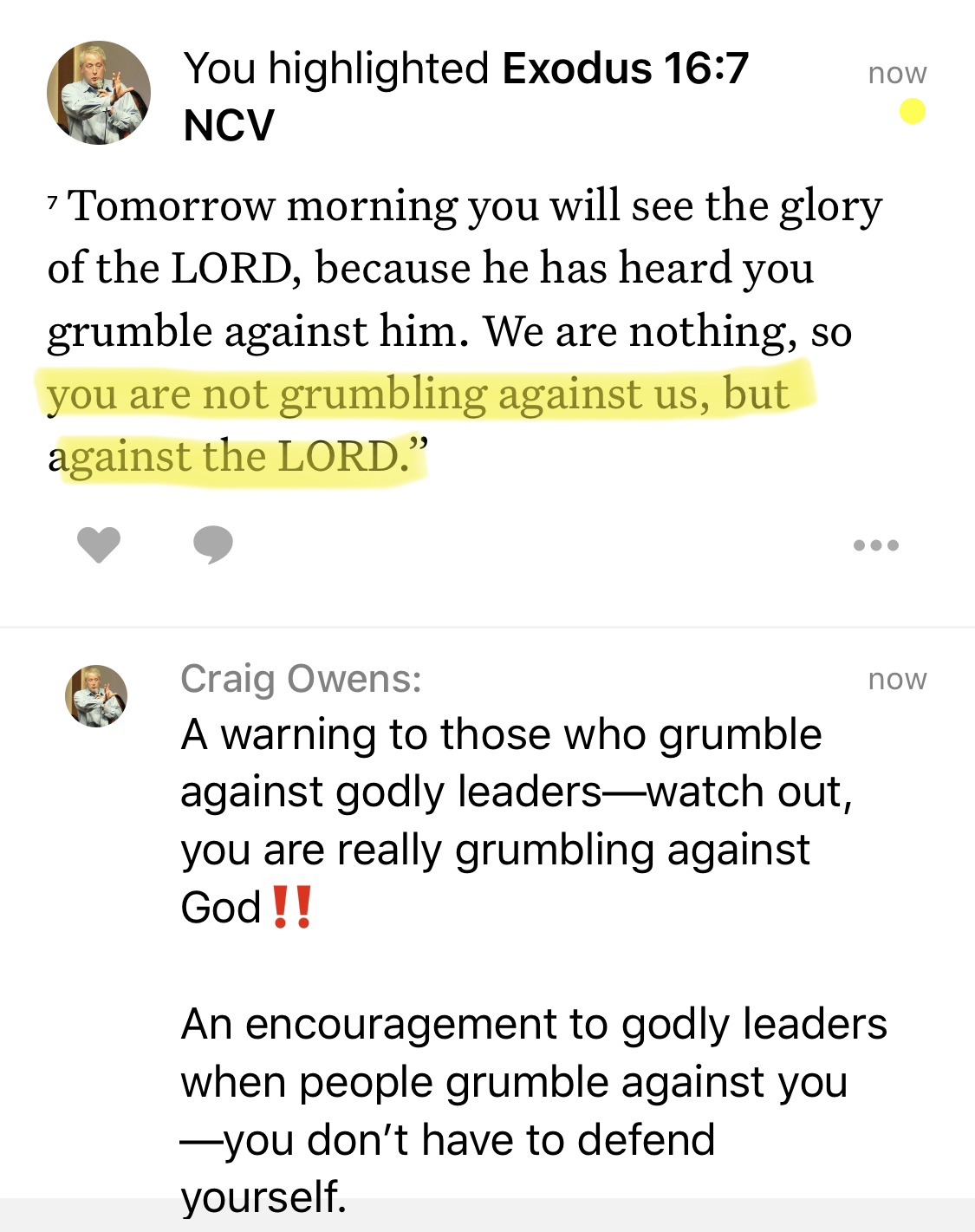
  • He reminded the people that their grumbling was really “against the Lord” (Exodus 16:6-8)
  • He humbled himself before the people and pleaded with them not to rebel against God
  • He humbled himself before God and interceded for the people

If God has called you to lead, people will bring their quarrels and complaints to you. It will feel like a personal attack, but it’s not. When attacked or when people grumble, you need to humble yourself before the Holy Spirit and ask, “Did I do something wrong?” and then listen attentively for His answer.

If the answer is yes: repent, ask forgiveness, make things right.

If the answer is no: don’t take it personally, stay humble before God and the people, and obey the specific directions God will give you. Don’t get frustrated and cut short your tenure as a leader.

This is part 44 in my series on godly leadership. You can check out all of my posts in this series by clicking here.

Proper Correction

Listen to the podcast of this post by clicking on the player below, and you can also subscribe on AppleSpotify, or Audible.

…to the church of the Thessalonians (2 Thessalonians 1:1). 

This short letter from the apostle Paul to the church in Thessalonica is a masterpiece on how to correctly correct fellow Christian brothers and sisters. 

The entire letter follows this pattern: 3 Cs surrounded by prayer—

  1. Compliment
  2. Prayer
  3. Clarify
  4. Prayer
  5. Correct
  6. Prayer

(And then repeat, if necessary.) 

You can download the PDF of this flow chart → Paul’s correction of the Thessalonicans

(1) Compliment and encouragement—“We are bound to thank God always for you…because your faith grows exceedingly” (1:3). Paul complimented their love for each other, their patience and endurance in persecution, and their future glorification. He encouraged them that Jesus IS coming, and He will deal with their persecutors and take the righteous into glory with Him (1:3-10). 

(2) Prayer—And then he prays for them to be equipped to endure to the end and finish well (1:11-12). 

(3) Clarify misunderstandings—“Let no one deceive you by any means” (2:3). Paul reminds them of what he taught them about the end times and the Second Coming of Christ, clarifying that watchful Christians will by no means miss out on the signs (2:1-12). 

(4) Prayer—Paul again praises their acceptance of the gospel and launches into another prayer for them to finish well (2:13-3:5). 

(5) Correct errors of understanding—“But we command you” (3:6). There were those who were departing from the faith, growing slack in their work ethic, being disorderly, and meddling as busybodies. Paul said, “We command and exhort through our Lord Jesus Christ” that you knock it off! He even told the church to “not keep company” with such people (3:6-15). 

(6) Prayer—Finally, Paul closes with a prayer for God’s peace to be with his brothers and sisters (3:16-18). 

This is such a masterful pattern for all of us in church ministry to follow! 

If you are in a leadership role, I hope your ongoing prayer would be the same as mine: “Holy Spirit, in all my interactions with my fellow saints, remind me of this godly, practical plan for confrontation, and help me to live it out for God’s glory. In Jesus’ name, amen.” 

P.S. You can also learn a lesson from the way the prophet Samuel handled correction in this post.

►► Would you please prayerfully consider supporting this ministry? My Patreon supporters get behind-the-scenes access to exclusive materials. ◀︎◀︎

Leaders Listen

“The moment you wake up each morning your wishes and hopes for the day rush at you like wild animals. And the first job of each morning consists in shoving them all back; in listening to that other Voice, letting that other, stronger, larger, quieter Life come flowing in.” —C.S. Lewis 

“God said, ‘Abraham!’ ‘Yes?’ answered Abraham. ‘I’m listening.’” —Genesis 22:1 

Then God came and stood before him exactly as before, calling out, ‘Samuel! Samuel!’ Samuel answered, ‘Speak. I’m Your servant, ready to listen.’” —1 Samuel 3:10 

“How much of God are we missing because we don’t stop to listen to the many voices God uses to speak to us?” —George Washington Carver 

“To answer before listening—that is folly and shame.” —Proverbs 18:13 

“Courage is what it takes to stand up and speak; courage is also what it takes to sit down and listen.” —Winston Churchill

A mark of a godly leader is one who listens to the counsel of other godly leaders. 

“Wise, godly leaders know they must listen to the counsel of wise, godly leaders.” —Craig T. Owens 

“Lead with your ears, follow up with your tongue, and let anger straggle along in the rear.” —James 1:19 

“There are none so blind as those who will not see, none so deaf as those who will not hear, none so ignorant as those who will not listen… and none so foolish as those who think they can change those who will not see, hear, or listen.” —Warren Bennis

“Correct the wise, and they will love you.” —Proverbs 9:8 

“What is a great man who has made his mark upon history? … He is a man who has looked through the confusion of the moment and has seen the moral issue involved; he is a man who has refused to have his sense of justice distorted; he has listened to his conscience until conscience becomes a trumpet call to like-minded men, so that they gather about him, and together, with mutual purpose and mutual aid, they make a new period in history.” —Jane Addams, in a speech about George Washington 

“People don’t lose intimacy when they stop talking, but when they stop listening. Leaders seldom realize how much their listening empowers the other person. Because they are leaders, the sheer act of listening speaks volumes that even a great speech can’t communicate. …   

“A leader’s communication must be consistent, clear, and courteous. But leaders must also be good listeners. When leaders don’t listen: They stop gaining wisdom. … Leaders listen; leaders learn; and then leaders lead.” —John Maxwell 

This is part 43 in my series on godly leadership. You can check out all of my posts in this series by clicking here.

Godly Leaders Need (+) Desires

…if someone desires to be a church leader, he desires an honorable position (1 Timothy 3:1). 

Desires—Paul uses two different Greek words for this one English word. The first word is orego. In the (+) sense it means to stretch out in order to grasp something. In the (-) sense it means to give one’s self up to the love of money.

The second word is epithymeo. In the (+) sense it means to long for a good thing (see Matthew 13:17; Luke 22:15). In the (-) sense it means to covet what is forbidden (see Matthew 5:28; James 4:2).

So (+) or (-) leadership comes down to desire. If I want a leadership position for what I can get, that is a (-) desire. Should you then seek great things for yourself? Do not seek them… (Jeremiah 45:5). 

But if I desire a leadership position for what I can give, that is a (+) desire. Not so with you. Instead, whoever wants to become great among you must be your servant, and whoever wants to be first must be slave of all. For even the Son of Man did not come to be served, but to serve, and to give His life as a ransom for many (Mark 10:43-45). 

With these differing desires in mind, the list of qualifications for church leaders in verses 2-7 and 8-13 should be viewed through the (+)/(-) desire lenses:

  • Why should I be above reproach: (-) so that I can get something, or (+) so that I can serve others better?
  • Why should I be faithful in marriage: (-) so that I look good, or (+) so that I am strengthened by my spouse to serve? 
  • Why should I be temperate, self-controlled, respectable, hospitable, an able teacher, sober, gentle, agreeable, content, and so on? The answers to those questions determine what desire I have.

A godly leader desires to glorify God and serve others, so a godly leader willingly submits to the Holy Spirit to address any area of (-) desire that may derail the God-honoring (+) desires. Just as Jesus is the Ultimate Servant-leader, I too must “have the same mind as Christ Jesus” (Philippians 2:5).

A mark of a godly leader is one who desires leadership with a (+) desire.

This is part 43 in my series on godly leadership. You can check out all of my posts in this series by clicking here.

How Foreigners Pray

I am a foreigner and stranger among you… (Genesis 23:4). 

Abraham and Peter remind us that God-fearing people are foreigners; they are not citizens of Earth. Christians are respectful of the people, laws, and customs of the land in which they sojourn, but they know that this land is not their home. 

Abraham wanted his son to have a wife who was of the same mindset—not attached to the place of sojourning but looking forward to Heaven. Abraham knew how an earthly–focused wife (like Lot’s wife) could distract her husband, so he sent his servant on a mission to find a heavenly-minded, godly woman for his son Isaac.

This servant was a godly leader in his own right. He was loyal and loving to Abraham’s family. Abraham gave him two simple boundaries: don’t take a wife from Canaan, and don’t take Isaac back to Mesopotamia (the land from which God had called Abraham). 

Notice how this godly leader undertook his mission:

  • He prayed a very specific prayer for success (24:12–14)
  • After praying, he “watched closely” (v. 21) to see how God would answer his prayer
  • He praised God when it appeared that his prayer has been answered (vv. 26, 27, 46)
  • He shared his answer to prayer with others to get confirmation (v. 50)
  • He quickly followed through with what God had provided (v. 56)

A mark of a godly leader is one who bathes his activities in prayer.

When God calls us to live in a certain way, it is fitting that He will answer our prayers that align with that way of living. This is exactly what Jesus meant when He told us to “ask for anything in My name.” 

This is part 42 in my series on godly leadership. You can check out all of my posts in this series by clicking here.

The Christian Leadership Cycle

…an apostle of Jesus Christ by the will of God… (2 Timothy 1:1). 

Paul tells his protegé Timothy that he didn’t choose apostleship, but that God chose him for it. The same should be true for all Christian leaders. To use a personal example: I didn’t choose to be a pastor, but God chose me for the pastorate. 

A mark of a godly leader is one who knows that God chose him to be a leader.

Knowing that, there are now choices that all leaders can—and should—make to steward their calling in a way that glorifies God. 

Paul tells Timothy that a pure conscience and a genuine faith allowed him to maximally use the gift of apostleship that God gave him. With these, Paul could use God’s gift without fear, but lovingly and with a sound mind (see vv. 3-7). 

This clear direction allows all Christian leaders to never be ashamed of their calling or of the fruits that come as a result of their leadership. This clear direction and sincere belief that I am doing what God has called me to do keeps me committed to an utter reliance on God’s supply all the way until the end (vv. 8-12). 

Finally, my commitment to effectively stewarding my God-ordained leadership is reinforced by holding fast to sound doctrine and remaining sensitive to the promptings of the Holy Spirit (vv. 13, 14). 

It looks something like this—

This is part 41 in my series on godly leadership. You can check out all of my posts in this series by clicking here.

12 Quotes From “The Art Of War”

Sun Tzu wrote in China in the fifth century BC to help military leaders hone their warcraft, but you might be surprised at the truths you can apply to your life today. Check out my full book review by clicking here. 

“Hence to fight and conquer in all your battles is not supreme excellence; supreme excellence consists in breaking the enemy’s resistance without fighting.” 

“Thus we may know that there are five essentials for victory: (1) He will win who knows when to fight and when not to fight. (2) He will win who knows how to handle both superior and inferior forces. (3) He will win whose army is animated by the same spirit throughout all its ranks. (4) He will win who, prepared himself, waits to take the enemy unprepared. (5) He will win who has military capacity and is not interfered with by the sovereign.” 

“Hence the saying: If you know the enemy and know yourself, you need not fear the result of a hundred battles. If you know yourself but not the enemy, for every victory gained you will also suffer a defeat. If you know neither the enemy nor yourself, you will succumb in every battle.” 

“The good fighters of old first put themselves beyond the possibility of defeat, and then waited for an opportunity of defeating the enemy. To secure ourselves against defeat lies in our own hands, but the opportunity of defeating the enemy is provided by the enemy himself.” 

“That general is skillful in attack whose opponent does not know what to defend; and he is skillful in defense whose opponent does not know what to attack.” 

“Disciplined and calm, to await the appearance of disorder and hubbub amongst the enemy—this is the art of retaining self-possession. To be near the goal while the enemy is still far from it, to wait at ease while the enemy is toiling and struggling, to be well-fed while the enemy is famished—this is the art of husbanding one’s strength.” 

“Do not linger in dangerously isolated positions. … If, on the other hand, in the midst of difficulties we are always ready to seize an advantage, we may extricate ourselves from misfortune.” 

“The art of war teaches us to rely not on the likelihood of the enemy’s not coming, but on our own readiness to receive him; not on the chance of his not attacking, but rather on the fact that we have made our position unassailable. There are five dangerous faults which may affect a general: (1) Recklessness, which leads to destruction; (2) cowardice, which leads to capture; (3) a hasty temper, which can be provoked by insults; (4) a delicacy of honor which is sensitive to shame; (5) over-solicitude for his men, which exposes him to worry and trouble.” 

He who exercises no forethought but makes light of his opponents is sure to be captured by them.” 

“Regard your soldiers as your children, and they will follow you into the deepest valleys; look upon them as your own beloved sons, and they will stand by you even unto death. … If, however, you are indulgent, but unable to make your authority felt; kind-hearted, but unable to enforce your commands; and incapable, moreover, of quelling disorder: then your soldiers must be likened to spoilt children; they are useless for any practical purpose.” 

“Carefully study the well-being of your men, and do not overtax them. Concentrate your energy and hoard your strength.” 

“Keep your army continually on the move.”