Pray For Them?!

Listen to the podcast of this post by clicking on the player below, and you can also subscribe on AppleSpotify, or Audible. 

How exactly should we pray for those who have so badly mistreated us? There’s a natural response, and then there’s a supernatural response that Jesus calls us to.

Check out this episode of The Podcast.

In chapter 14 of When Sheep Bite I wrote—

      In the New Testament, the Greek word for “bless” is eulogeo. The prefix eu- means “good” and the root logos is “word.” So, in the New Testament context in which we now live, to bless someone literally means to say good words both to them and about them. So when Jesus tells us, “Bless those who curse you and pray for those who mistreat you,” He is telling us to say good words to them, and to say good words about them in prayer to our Heavenly Father. …

      Commenting on Psalm 109:4, my friend Kevin Berry said, “While they accuse me like satan, I will pray for them like Jesus.” This is the highest level of Christian maturity: To pray like Jesus did for those who insulted Him, slandered Him, and crucified Him, “Father, forgive them for they don’t understand what they are doing” (Luke 23:34).

The Scriptures that I reference on this episode of The Podcast are Matthew 5:44; Psalm 109:4; Revelation 12:10; John 10:10; Luke 23:34; Psalm 139:23-24; Romans 12:18-21.

And the blog posts I mention are: Unexpected Response and Choice Four-Letter Words.

I truly believe that When Sheep Bite will be a healing resource for shepherd leaders who are still feeling the pain of their latest sheep bite. Please pick up a copy today! 

►► Would you please prayerfully consider supporting this ministry? My Patreon supporters get behind-the-scenes access to exclusive materials. ◀︎◀︎

Links & Quotes

The Holy Spirit can speak to us through other people. Be sure to check out all of my videos on my YouTube channel.

“A time will come when instead of shepherds feeding the sheep, the church will have clowns entertaining the goats.” —Charles Spurgeon

“Every word from God comes with the power to make that word happen.” —Kevin Berry

“The question is not, ‘Should we pray for the lost people of our community?’ The question is, ‘Will we?’ Will we pray for our neighbors, our community, our nation, and our world? Will we seek the peace of the world and the wellbeing of all our fellow humans before the Lord in prayer? [Jeremiah 29:7]
“If we will not, then we must face up to the fact that we are disobeying a divine mandate, abandoning our neighbors to their folly, and stoking the fires of indifference—if not outright scorn—for the unbelieving world around. But if we will pray, who knows what God might be willing to do?
“Those prayers may be prayers of anguish and anger at times; but they must also be prayers for God to work in the hard hearts of our unsaved neighbors, just as He has worked in ours, to bring new life, forgiveness, and hope to those who now live apart from God in a world full of rebellion and sin.” —T.M. Moore

Axis is a great resource to help parents communicate effectively with their pre-teen and teenage children. In the wake of the school shooting in Nashville, Axis posted this: “We have created resources to help parents and caring adults have conversations about violence and school shootings. Consider our Conversation Kit on Violence, our Parent’s Guide to School Shootings, our Parent’s Guide to Talking About Violence, and our Parent’s Guide to Anxiety, for starters.”

This is an excellent post from Fight The New Drug on how to spot online sexual predators.

“Failure is a part of success. There is no such thing as a bed of roses all your life. But failure will never stand in the way of success if you learn from it.” —Hank Aaron

Links & Quotes

God made you uniquely YOU on purpose. So you can ask Him to show you why He put you together as He did—with all of the gifts that make you YOU. Please subscribe to my YouTube channel.

In my Halley’s Study Bible, I read this commentary on Matthew 24-25—

“It is best not to be too dogmatic about the events surrounding [Christ’s] second coming. But if language is a vehicle of thought at all, it certainly takes a good deal of explaining and interpreting to make anything else out of Jesus’ words than that He Himself looked forward to His coming again as a definite historical event in which He will personally and literally appear to gather to Himself and to eternal glory those who have been redeemed by His blood.

“And it is best not to cloud the hope of His coming with too detailed a theory as to what is going to happen when He comes. Some people may be disappointed if Jesus does not follow the schedule they have mapped out for Him.”

“The future doesn’t belong to the fainthearted; it belongs to the brave.” —Ronald Reagan

“We are not called to punish the people for whom Jesus was already punished.” —Kevin Berry

Daniel B. Wallace, a New Testament professor at Dallas Theological Seminary, wrote, “If you could stack up all handwritten manuscripts of the New Testament—Greek, Syriac, Latin, Coptic, all languages—how tall would the stack be? … I have said in many lectures that it would be the equivalent of c. 4 & 1/2 Empire State Buildings stacked on top of each other. How did I come up with that number?” Check out his post to read how he calculated this astounding number. This is just another link in the chain of evidence for the historicity of the Bible.

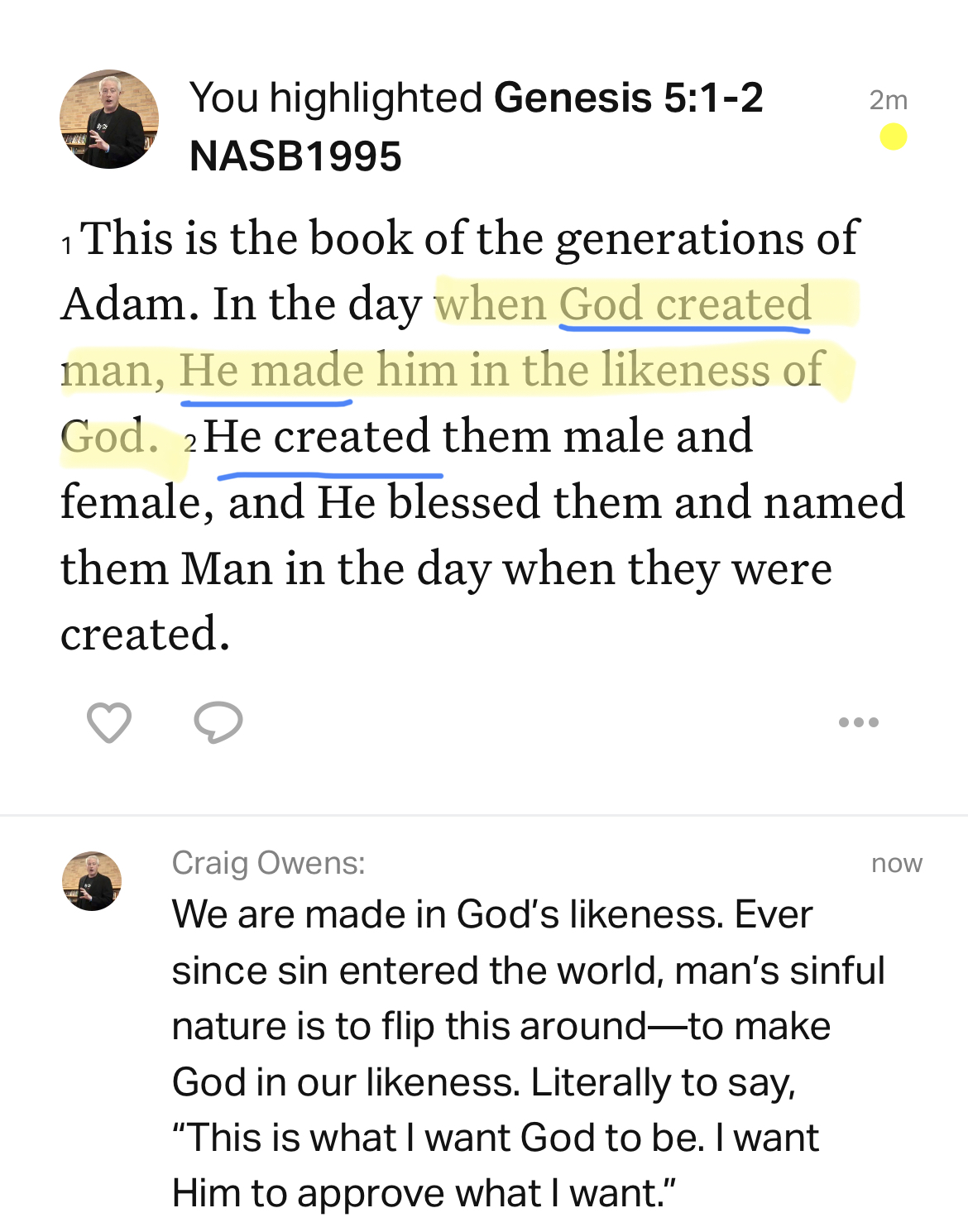
I shared this commentary on YouVersion this week: We are made in God’s likeness. Ever since sin entered the world, man’s sinful nature is to flip this around—to make God in our likeness. Literally to say, “This is what I want God to be. I want Him to approve what I want.”

“Pure humor is the most difficult of all of comedy. Late night humor is funny because it is mean. It is relatively easy to be crude, cynical, and sarcastic. It comes naturally to our fallen natures to criticize, tease, mock, and scoff. It’s much harder to make people laugh by lifting others up.” —Dick Brogden, in his book Proverbs: Amplified and Applied, commenting on Proverbs 1:22

Links & Quotes

William Perkins defined theology as, “The science of living blessedly forever.” He also had this word for pastors as they teach theology: “The ‘demonstration of the Spirit’ becomes a reality when, in preaching, the minister of the Word conducts himself in such a way that everyone—even those who are ignorant of the gospel and are unbelievers—recognize that it is not so much the preacher who is speaking but the Spirit of God in him and by him…. This is what makes his ministry living and powerful.”

“Self-trust is the first secret of success.” —Ralph Waldo Emerson

80 Years Ago: The Assemblies of God was a founding member of the National Association of Evangelicals, and remains the largest of the 40 denominations that are members of the NAE today.

John Piper identifies five digital dangers and gives us strategies for combating them. I especially thought these insights on pornography were powerful: “More insidious that X-rated videos, we can now not only watch but join the perversity in the privacy of our own den. Interactive porn will allow you to ‘do it’ or make them ‘do it’ virtually. I have never seen it. Nor do I ever intend to. It kills the spirit. It drives God away. It depersonalizes women. It quenches prayer. It blanks out the Bible. It cheapens the soul. It destroys spiritual power. It defiles everything. Resolution: I will never open any app or website for sexual stimulation, nor purchase or download anything pornographic.”

“I could well believe that it is God‘s intention, since we have refused milder remedies, to compel us into unity, by persecution even and hardship. satan is without doubt nothing else than a hammer in the hand of a benevolent and severe God. For all, either willingly or unwillingly, do the will of God: Judas and satan as tools or instruments, John and Peter as sons.” —C.S. Lewis

“The response of Jesus to those guilty of sexual sin is not to condemn nor condone the sin. I see in His example [John 8:10-12] a good pattern: (1) Love first—‘I don’t condemn you’; (2) Speak the truth—‘Sin no more.’” —Kevin Berry. The world has made “love” mean accepting whatever the other person is doing, and “truth” now means agreeing with the other person. With the Holy Spirit’s help, we can speak the truth in love without condemning nor condoning.