What God Do You Tru$t?

Listen to the podcast of this post by clicking on the player below, and you can also subscribe on AppleSpotify, or Audible.

Things seem to be going very, very well for Israel! Check out what Isaiah wrote:

Their land is full of silver and gold; there is no end to their treasures. Their land is full of horses; there is no end to their chariots.

Sounds like a success story to me!

But wait: the next verse sounds a bit ominous:

Their land is full of idols; the people worship things they have made with their own hands.

Money? Yes.

Influence? Lots.

Prosperity? For everyone.

Idolatry? Widespread.

They were no longer looking to God, but they were looking to what they had made with their own hands. In other words, they made Money their god.

Money can save us!

Money can fix all our problems!

Without Money we are lost!

Only those with Money can be saved!

Sadly, I believe what was said of Israel 2500 years ago could be said of the United States of America today. In God We Trust is printed on all our currency, but it really has become In Money We Trust. We have made Money our god.

Don’t believe me? How do you think most people would answer these fill-in-the-blanks:

  • I need _____________ to get clothes.
  • Without _____________ I cannot feed my family.
  • If I lost _____________ today I would be devastated.
  • I frequently think about how more _____________ in my life would make my life better.

But check out what Jesus says about clothes, food, and our means of survival.

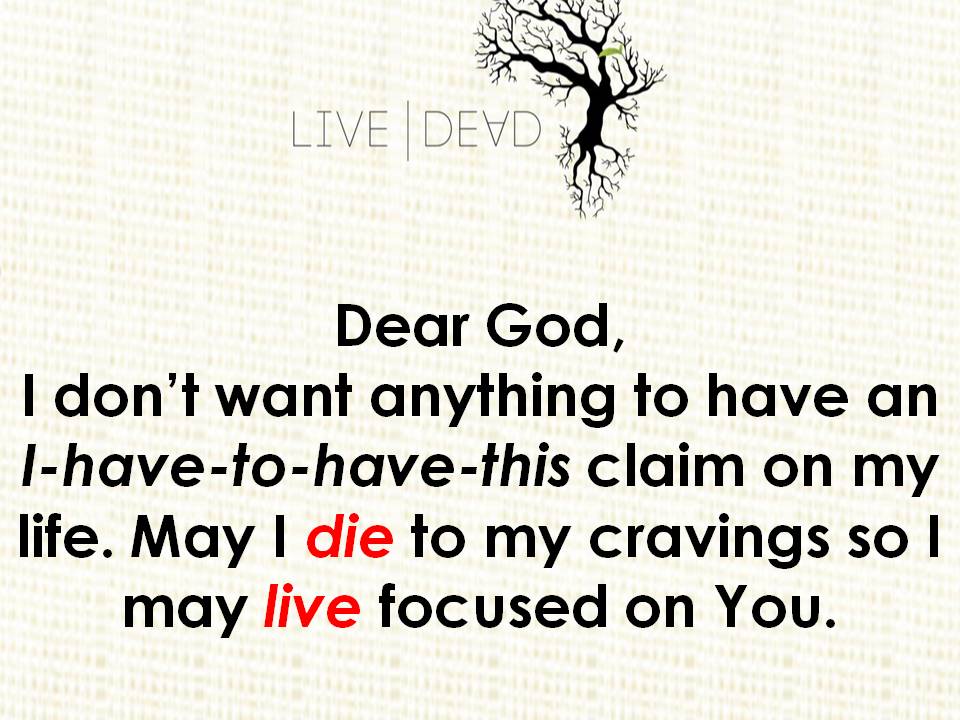
What should go in the blank: Money or God? Again, let’s let Jesus have the final word: “No one can serve two masters. Either you will hate the one and love the other, or you will be devoted to the one and despise the other. You cannot serve both God and money” (Luke 16:13).

►► Would you please prayerfully consider supporting this ministry? ◀︎◀︎

Thursdays With Oswald—Bad Theology

This is a weekly series with things I’m reading and pondering from Oswald Chambers. You can read the original seed thought here, or type “Thursdays With Oswald” in the search box to read more entries.

Bad Theology

Job’s friends came slowly to the conclusion that their view of God was right, therefore Job must be wrong. They had the ban of finality [the limitation or “curse” of having one’s mind made up] about their views, which is always the result of theology being put before God.

From Baffled To Fight Better

Putting theology before God makes a god out of my mind—and a very weak god at that. Or as G.K. Chesterton put it, “A weak mind is like a microscope, which magnifies trifling things but cannot receive great ones.”

Or maybe God said it best of all“As the heavens are higher than the earth, so are My ways higher than your ways and My thoughts higher than your thoughts.”

Job got it right. He continued to believe that God was doing something bigger than he could think or imagine. He didn’t close off his mind, or put his theology before God, or make a god out of his own ideas.

I pray that when the pressure is on, I can continue to trust God and not give in to the ban of finality.

Closed Door = Open Window

Yesterday God closed a pretty significant door in my life. It will mean some short-term changes, but I am confident that it also means some great long-term rewards! I’m not worried; just prayerful for the next steps I need to take.

Here’s where I base my confidence:

This didn’t take God by surprise: All the days ordained for me were written in Your book before one of them came to be.

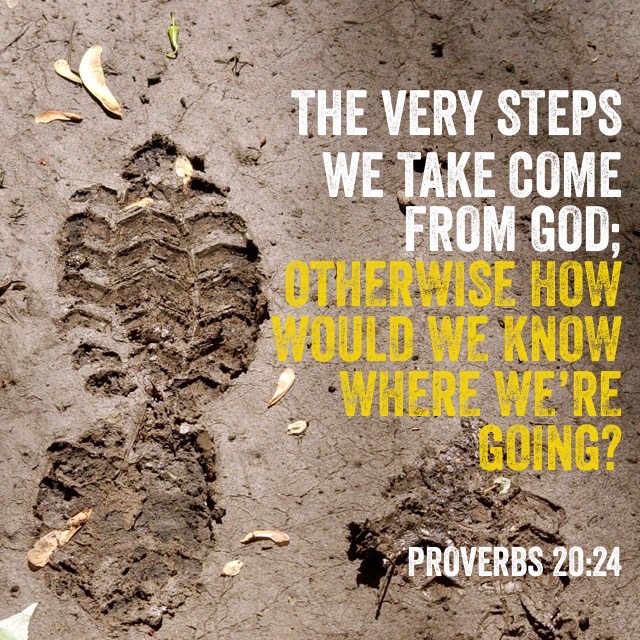
In fact, God was the One who closed this door: A man’s steps are directed by the Lord.

And now I’m just waiting: Behold, I am doing a new thing! Now it springs forth; do you not perceive and know it and will you not give heed to it? I will even make a way in the wilderness and rivers in the desert.

Or as Corrie ten Boom so beautifully said it:

“When God closes a door, He opens a window.”

White As Snow

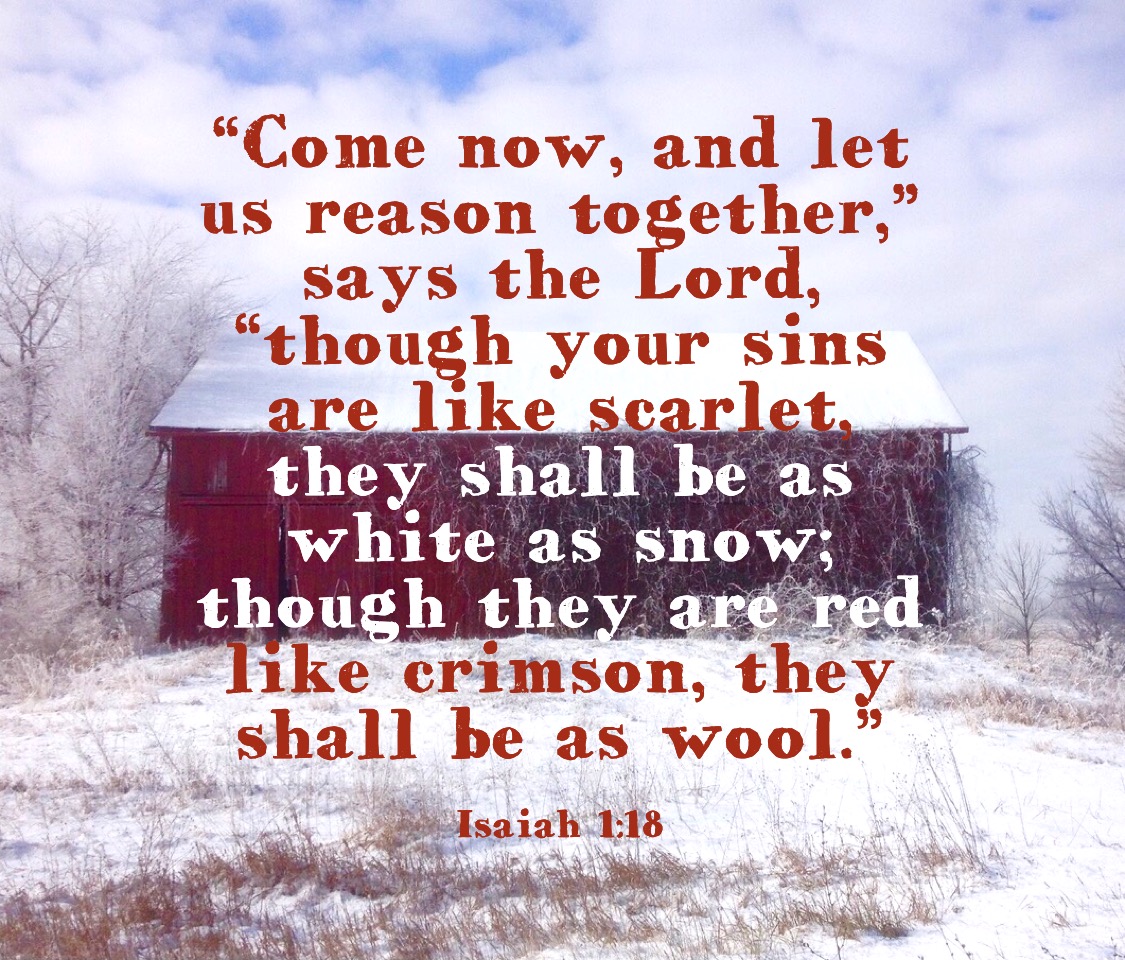
As I watch the snow falling outside today, slowly covering everything in a pure, unblemished whiteness, the same thought enters my mind every year at the first snowfall. God says,

Learn to do good. Seek justice. Help the oppressed. Defend the cause of orphans. Fight for the rights of widows. “Come now, let’s settle this,” says the Lord. “Though your sins are like scarlet, I will make them as white as snow. Though they are red like crimson, I will make them as white as wool.”

And this line from the great old hymn,

My sin, O the bliss of this glorious thought, my sin, not in part, but the whole, is nailed to the Cross and I bear it no more. Praise the Lord, praise the Lord, O my soul!

Doing good, seeking justice, helping the oppressed, defending orphans, and fighting for widows doesn’t cleanse my crimson sin, but when my sin has been covered I DESIRE TO do these things!

What do you think of the snow?

What do you think of God’s incredible whiteness applied to your life?

Fasting

We’re fasting today.

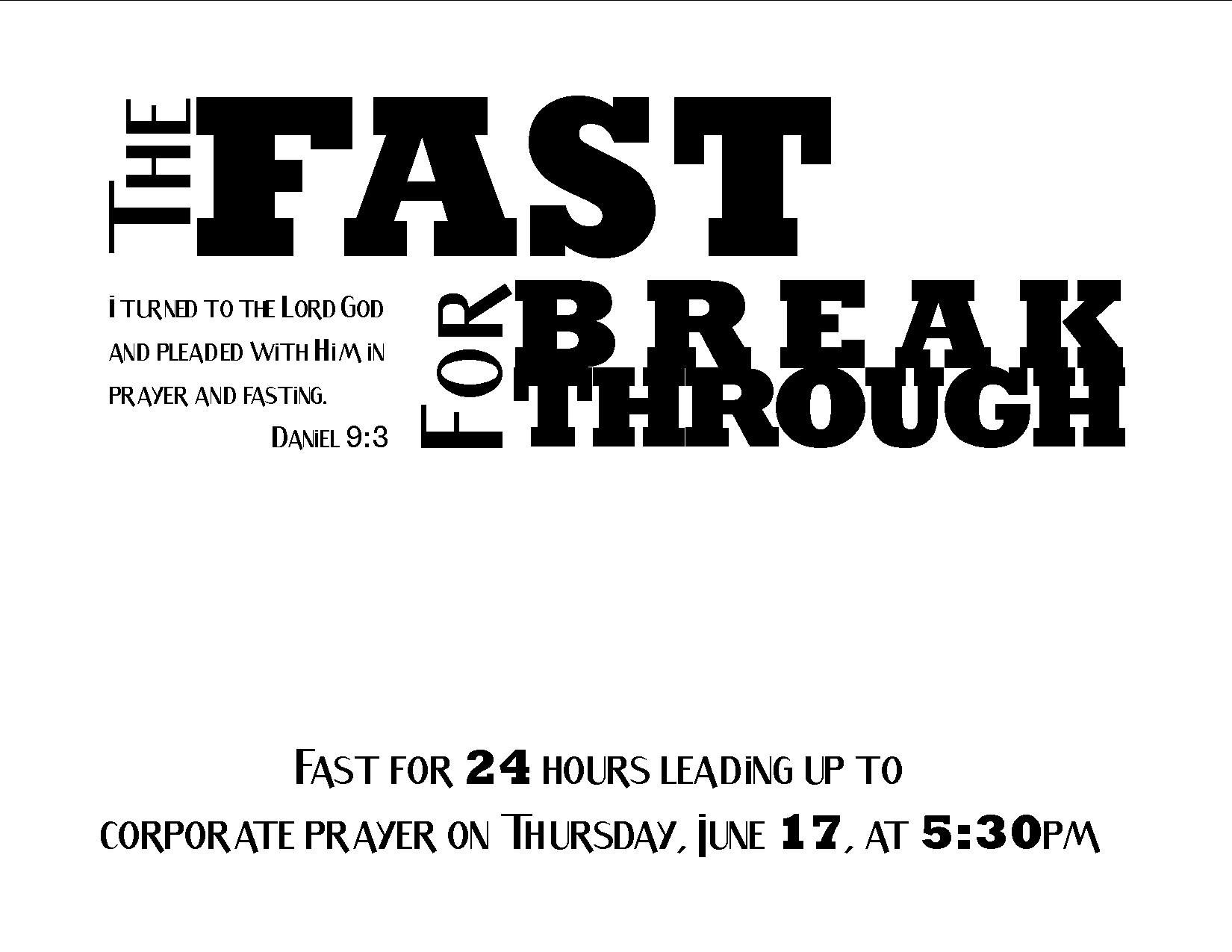
I believe in this: Prayer + Fasting = Breakthroughs.

Even though this looks like a mathematical formula, it doesn’t work like a formula. Jesus challenged religious people who fasted just because. Jesus was really echoing the words God spoke in Isaiah about religious people simply going through pious acts, but their hearts were still far away from God. They thought God operated on a formula: “If we fast, then God has to….” It doesn’t work that way.

We met together for a time of worship and Bible study last night, and we’ll conclude our fast with corporate prayer this evening. We are focusing on our heart attitude. Not fasting just because or even the pastor asked us to. But fasting because we are hungry for God to move … for Him to break chains … for Him to set people free … for breakthroughs!

I can’t wait to see what God is going to do in us and then through us as we spend this time seeking His heart. Prayer + Fasting = Breakthroughs.

A Voice Behind Me

In our series on Building Blocks, I’ve been talking about the basics of a relationship with Jesus Christ. An obvious foundation for any relationship is meaningful conversation.

If you think about any close relationship you have, the closeness was developed through conversation. Gradually you began to know their voice and know their heart. Our meaningful conversation with God produces the same increased intimacy. We talk with Him through reading His Word and through prayer.

The more you read the Bible and the more you pray, the clearer His voice becomes. Isaiah said it this way:

Your own ears will hear Him. Right behind you a voice will say, “This is the way you should go,” whether to the right or to the left. (Isaiah 30:21)

Earlier this week I was on a long road trip, so I took our dog Grace with me. After grabbing some lunch, I wanted to find a place for Grace to run around and stretch her legs, but I was in a town I didn’t know. As I came to the end of the driveway, my next appointment would have been right, but I felt I should turn left instead.

I did, and two blocks away was a huge, grassy park where I could sit and eat my lunch and Grace could frolic to her heart’s content.

Did I actually hear a Voice? No, but I felt a Voice. His Voice. Yes, I believe God even cares about helping me find a place for my lunch and for my dog to run. He cares that much about me. And you too!

He’s speaking to you all the time. Are you listening to the Voice behind you?

What’s So Good About Good Friday?

Good Friday? Good for whom?

For you and me? Yes.

Good for Jesus, no. It was Bad Friday for Him, wasn’t it?

Or was it?

The writer of Hebrews says, “For the joy set before Him, Jesus endured the Cross, scorning its shame.”

What joy?

It was for the joy of what was nailed to the Cross.

So what exactly was nailed to the Cross?

Isaiah records an usual statement from God –

Comfort, comfort My people, says your God. Speak tenderly to Jerusalem, and proclaim to her that her hard service has been completed, that her sin has been paid for, that she has received from the Lord’s hand double for all her sins.

That seems unfair! We receive double (!) for our sins! Here’s a brief video where I explain what this means culturally –

Only when invoices were paid-in-full did they get doubled-up.

The Bible tells us that we’ve all sinned, and that the invoice or penalty for our sin is death. We have the IOUs of sin nailed to the door of our heart where God says “You owe Me your life!” But we cannot pay this debt by ourselves.

But Jesus can. And Jesus did! Check this out –

He personally carried our sins in His body on the Cross…. (1 Peter 2:24, NLT)

Having cancelled and blotted out and wiped away the handwriting of the note with its legal decrees and demands which was in force and stood against us. This He set aside and cleared completely out of our way by nailing it to His Cross. (Colossians 2:14, AMP)

That’s what is good about Good Friday. Jesus knew that taking our sins on His body, and then allowing His body to be nailed to the Cross, would double-up and nail-down our sin once and for all!

When Jesus said, “It is finished!” He was really saying, “It is was paid-in-full!”

The Point Of The Gospel

While I was preparing for our Spiritual Self-Defense class, Rick Warren tweeted this timely reminder: “If you spend more time defending the truth than actually sharing it, you will have missed the point of the Gospel.”

What is the point of the Gospel? Isn’t it simply that mankind is lost without God, and that only a relationship with Jesus can bring true life? If that’s the point, we can never argue someone into this divine relationship.

Here are some other thoughts I’m trying to keep in mind for this exciting class:

  • Jesus never shouted down those who disagreed with Him. Isaiah’s prophesy about Jesus said, “He will not shout or cry out, or raise His voice in the streets.” And that’s exactly how Jesus conducted Himself.
  • Jesus said, “God didn’t go to all the trouble of sending His Son merely to point an accusing finger, telling the world how bad it was. He came to help, to put the world right again.” Jesus didn’t come to win an argument, but to win lost people to a relationship with His Father.
  • There are very few exclamation points in Christ’s dialogue in the Gospels, but there are a lot of question marks. He was interested in engaging people in conversation.
  • G. K. Chesterton said, “The principle objection to a quarrel is that it interrupts an argument.” We need to discuss, not argue.

I’m really looking forward to leading this class, but I’m also excited about what I’m learning in the process.

TomTom Directions

My wife is a beautiful, talented woman, but she tends to be, uh, directionally-challenged. That is to say, it’s not hard for her to get on the wrong road, heading the wrong direction. So a wonderful Christmas gift from my folks this year was a TomTom GPS unit.

Yesterday I took a trip and borrowed her TomTom. My first destination was a familiar one, but my second stop was somewhere I hadn’t been before. So I’m driving along when all of a sudden I hear a pleasant female voice tell me, “In two miles, exit to the right.”

Cool!

The Bible tells us that we can have a moral GPS system just like my wife’s TomTom. Check this out:

Whether you turn to the right or to the left, your ears will hear a Voice behind you, saying, “This is the way; walk in it.”

That Voice is the Holy Spirit. Jesus said the Holy Spirit would guide us in the right ways to go:

But when the Father sends the Advocate as My representative—that is, the Holy Spirit—He will teach you everything and will remind you of everything I have told you.

You have this moral GPS system at your disposal. Are you using it? Prayer is the power supply that activates the Voice. Turn Him on and make better decisions, live a better life, and do greater things for God.

The Wounded Healer (book review)

Wounded Healer, The

“For the minister is called to recognize the sufferings of his time in his own heart and make that recognition the starting point of his service. Whether he tries to enter into a dislocated world, relate to a convulsive generation, or speak to a dying man, his service will not be perceived as authentic unless it comes from a heart wounded by the suffering about which he speaks” (from the introduction).

Henri Nouwen was a man ahead of his time. Although this book was written in the early 1970s, it sounds so applicable for today. The Wounded Healer challenged me as a Christian leader to step into the pain-filled lives as others in a more authentic way. Nouwen argues that healers must first be personally acquainted with the same type of pain that other wounded people are experiencing.

Isaiah 53 says that Christ “was wounded for our transgressions, He was bruised for our guilt and iniquities; the chastisement [needful to obtain] peace and well-being for us was upon Him, and with the stripes [that wounded] Him we are healed and made whole.” Because Jesus was wounded in the same way we are wounded, He knows how to help (see Hebrews 2:18).

One closing quote from Nouwen: “If there is any posture that disturbs a suffering man or woman, it is aloofness. … No one can help anyone without becoming involved, without entering with his whole person into the painful situations, without taking the risk of become hurt, wounded or even destroyed in the process. The beginning and the end of Christian leadership is to give your life for others.”

This book reconfirmed my desire to—like Jesus—be a wounded healer for others.