Jesus Is Wonderful Counselor

Listen to the podcast of this post by clicking on the player below, and you can also subscribe on AppleSpotify, or Audible. 

Jesus made His first appearance as a fully human Man in a stable in Bethlehem. But His Advent—or appearing—had been anticipated for a long time before that. 

In fact, one of the darkest chapters in human history takes place shortly after human history began. Mankind sinned and was separated from God because of that sin. The initial separation foretold an eternal separation (Genesis 3:22), but God shines His light of hope in this darkest hour, foretelling the Advent of our rescue (3:15). 

(Check out all of the Scriptures in this post by clicking here.)

Seven hundred years before Christ’s birth in Bethlehem, the setting is still dark and getting darker. Sin is running rampant, God’s people are groping in darkness, and enemies are pressing in from every side. 

Out of the darkness, God speaks (Isaiah 8:5-10), giving us a glimpse of the Messiah’s glory. Notice the hope-filled words Immanuel (v. 8) and God with us (v. 10). This darkness is the inevitable result of not gazing on God’s glory (vv. 21-22), and yet there appears another glorious promise in a single word: Nevertheless (9:1-7). 

We get a glimpse of Immanuel’s glory in the titles that will describe our Messiah. Let’s look first at Wonderful Counselor. 

Wonder can have two definitions: 

  1. Something so extraordinary that it is hard for our finite human minds to comprehend—Exodus 15:11; Isaiah 25:1 NLT. 
  2. God’s awesome deeds: His works that leave us in absolute awe of His greatness—Jeremiah 32:17 AMPC. 

Counselor is someone who gives counsel; not just any counsel, but perfect counsel because He is omniscient (knows it all) and omnipotent (can do it all)—Isaiah 14:26-27; Psalm 139:1-6; Psalm 32:8. 

Job got a glimpse of this Awesome Counselor too in Job 42:1-6. 

Our First Testament friends only got a glimpse of the Messiah’s glory, but we have the glory revealed to us—Hebrews 1:1-3a; Matthew 1:22-23; John 1:5, 14, 18. 

We have His wonderful counsel revealed to us too—Luke 5:20-26; John 7:37-46. 

And we look forward to seeing His glory undimmed at His Second Advent—John 1:47-51; Mark 14:61-62. 

As we live now between the Advents, we have the joyful privilege and responsibility to proclaim this glory to those still living in darkness—Matthew 28:18; Acts 4:30.  

See how the saints proclaimed Christ’s glory, relying on His wonderful counsel in Acts 4:13, 20, 31; 5:12; 6:8, 10; 8:6-8. This is how we are to live too (2 Thessalonians 2:16-17). 

As you live between the Advents, I pray that the glory of our Wonderful Counselor will become more real to you and that it will shine out of every word you speak and everything you do! 

Check out the other posts in this series Jesus Is… here.

►► Would you please prayerfully consider supporting this ministry? My Patreon supporters get behind-the-scenes access to exclusive materials. ◀︎◀︎
The Gift Promised

Listen to the podcast of this post by clicking on the player below, and you can also subscribe on AppleSpotify, or Audible.

Have you ever seen kids tearing into a Christmas present and then being disappointed that what they got wasn’t what they wanted? They may say something like, “This isn’t what I put on my wish list!” 

From the response of the religious leaders in the Gospels, it appears that the gift of Jesus on that original “Christmas morning” was very similar. It’s almost like they were saying, “This isn’t the type of Messiah we wanted!” They wanted someone to give them freedom from the Romans, but their Heavenly Father wanted them to have something far bigger and greater: Eternal freedom from the penalty of sin. 

The first humans had the joy of being innocent in God’s presence, where they had everything they needed. But satan got Adam and Eve to focus on something they wanted, and that sin of disobedience brought an immediate separation. They now feared the nearness of God. 

There were immediate and painful consequences for their sin, but God wanted the heaviest of penalties to fall on Himself. To foreshadow this, God sacrificed an innocent animal to cover their nakedness, showing us what the gift of Jesus would do for us (Genesis 3:1-21). 

In The Holy War, John Bunyan tells the story of the town of Mansoul enslaved to Diabolus. The crafty serpent plays on their fears by reminding them how terrible it would be if they allowed Holy God to come near them while they were in their sinful state: 

“‘Gentlemen,’ quoth he, ‘and my faithful subjects, if it is true that this summoner hath said concerning the greatness of their King, by His terror you will always be kept in bondage, and so be made to sneak. Yea, how can you now, though He is at a distance, endure to think of such a Mighty One? And if not to think of Him while at a distance, how can you endure to be in His presence?’” 

Diabolus even tried to make their slavery to sin look like freedom: “I, your prince, am familiar with you, and you may play with me as you would with a grasshopper. Consider, therefore, what is for your profit, and remember the immunities that I have granted you.’”  

As John Piper reminds us, “Christmas is for freedom.” Indeed, that’s just what we see on the first “Christmas morning” in words like salvation, no fear, and great joy (Matthew 1:21; Luke 2:10-11). 

Turning again to The Holy War, here’s what the Father said to His Son: “Wherefore the King called to Him Emmanuel, His Son, who said, ‘Here am I, My Father.’ Then said the King, ‘Thou knowest, as I do Myself, the condition of the town of Mansoul, and what We have purposed, and what Thou hast done to redeem it. Come now, therefore, My Son, and prepare Thyself.’”  

Immanuel (or the Romanized spelling Emmanuel) is the One who removes the separation caused by our sin, and rejoins us to God. That prefix “im” means with, and the suffix “El” means God. The root word means God’s kinsmen. Immanuel comes to repair what was severed by taking sin’s penalty on Himself, and allowing us to once again enjoy the closeness of kinship with our Heavenly Father (Matthew 1:22-23; Galatians 4:4-7). 

When the people saw this Gift on Christmas morning, they said, “This isn’t what we wanted! We wanted a rich, powerful, conquering King. One who would send the Romans running in fear!” As a result, very few unwrapped this Heavenly Gift. But God reminded them, “That may be what you wanted, but I have given what you need. I want you to have not just temporary freedom from the Romans, but eternal freedom from your sin so that you can be forever in My presence!” 

This is what Jesus rejoiced to do for us with the Gift of His life, death, and resurrection. One more passage from The Holy War tells us, “Then said the King’s Son, ‘Thy law is within My heart: I delight to do Thy will. This is the day that I have longed for, and the work that I have waited for all this while. … I will go and will deliver from Diabolus, and from his power, Thy perishing town of Mansoul. My heart has been often pained within Me for the miserable town of Mansoul; but now it is rejoiced, but now it is glad.’” (The timing for the Incarnation of Jesus and even these words of Immanuel Himself are found in Hebrews 2:14-15; 10:5-7). 

God’s love is too great to be limited to just meeting our wants because in our immaturity and sinfulness we don’t know what we really need—but He does. So His love sent Immanuel to us. 

The Gift was given to us at Christmas, but in our immaturity and shortsightedness, we didn’t realize the full impact of this Gift until Jesus rose victoriously from the grave! Now by placing our faith in His completed work, we can be rejoined to God and live in unshakable hope of an eternity with Him! 

If you would like to follow along with all of the messages in this series called Christmas Unwrapped At Easter, please check out the links I’ve shared here.

►► Would you please prayerfully consider supporting this ministry? My Patreon supporters get behind-the-scenes access to exclusive materials. ◀︎◀︎
Thursdays With Spurgeon—God With Us

This is a weekly series with things I’m reading and pondering from Charles Spurgeon. You can read the original seed thought here, or type “Thursdays With Spurgeon” in the search box to read more entries.

God With Us

     ‘And you shall call His name Immanuel.’ …

     This is His name, ‘God with us.’ … He has not lost that name. Jesus had that name on earth, and He has it now in heaven! He is now ‘God with us.’ Believer, He is God with you to protect you! You are not alone, because the Savior is with you! … 

     But if you would know this name most sweetly, you must know it by the teaching of the Holy Spirit. … Unless the Holy Spirit takes the things of Christ and applies them to our heart, it is not ‘God with us.’ Otherwise, God is a consuming fire. …

     Immanuel—it is wisdom’s mystery, ‘God with us.’ Just look at it and wonder. Angels desire to see it. The plumb line of reason cannot reach halfway into its depth. The eagle wings of science cannot fly so high, and the piercing eyes of the vulture of research cannot see it! ‘God with us.’  It is hell’s terror! satan trembles at the sound of it. His legions fly apace; the black-winged dragon of the pit quails before it! Let satan come to you suddenly and do you but whisper that word, ‘God with us,’ and back he falls, confounded and confused! satan trembles when he hears that name, ‘God with us.’ It is the laborer’s strength. How could he preach the gospel, how could he bend his knees in prayer, how could the missionary go into foreign lands, how could the martyr stand at the stake, how could the confessor acknowledge his Master, how could men labor if that one word were taken away? ‘God with us’ is the sufferer’s comfort, it is the balm of his woe, it is the alleviation of his misery, it is the sleep that God gives to His beloved, it is the rest after exertion and toil.

     Ah, and to finish, ‘God with us’ is eternity’s sonnet, it is heaven’s hallelujah, it is the shout of the glorified, it is the song of the redeemed, it is the chorus of angels, and it is the everlasting oratorio of the great orchestra of the sky! ‘God with us!’

From The Birth Of Christ

Jesus is—always was and always will be—God with us! 

Do you know Jesus personally? He wants you to know Him. He came to earth so that you could know Him. His heart’s desire is to be with you today and have you with Him forever! 

If you have questions about this, please send me a message and let’s chat.


Jesus Is Immanuel

I am Immanuel—God with you—and I am enough! When things in your life are flowing smoothly, it is easy to trust in My sufficiency. However, when you encounter rough patches—one after another after another—you may sometimes feel that My provision is inadequate. This is when your mind tends to go into high gear: obsessing about ways to make things better. There is nothing wrong with seeking solutions, but problem-solving can turn into an addiction: your mind spinning with so many plans and possibilities that you become confused and exhausted.

“To protect yourself from this mental exhaustion, you need to remind yourself that I am with you always, taking care of you. It is possible to rejoice in Me—to proclaim My sufficiency—even during the most difficult times. This is a supernatural work, empowered by My Spirit who lives in you. It is also a decision that you make—day by day and moment by moment. Choose to be joyful in Me, your Savior, for I am indeed enough!” —Jesus Christ (in Sarah Young’s Jesus Calling For Christmas)

(You can check out some more quotes from Sarah Young’s book by clicking here.)

Is Jesus Immanuel?

Immanuel & sinI’ve read these two passages of Scripture so many times during the telling of the Advent story, but I never saw this apparent mistake. I’ve highlighted the troubling phrases below—

Therefore the Lord Himself will give you a sign: The virgin will be with Child and will give birth to a Son, and will call Him Immanuel. (Isaiah 7:14)

But after he had considered this, an angel of the Lord appeared to him in a dream and said, “Joseph, son of David, do not be afraid to take Mary home as your wife, because what is conceived in her is from the Holy Spirit. She will give birth to a Son, and you are you to give Him the name Jesus, because He will save His people from their sins.” (Matthew 1:20-21)

Did the angel make a mistake? Was he supposed to tell Joseph “give Him the name Immanuel”? Or maybe Immanuel and Jesus mean the same thing?

The answer to all three of those questions is NO. There wasn’t a mistake; His name should be Jesus; and Immanuel and Jesus don’t mean the same thing.

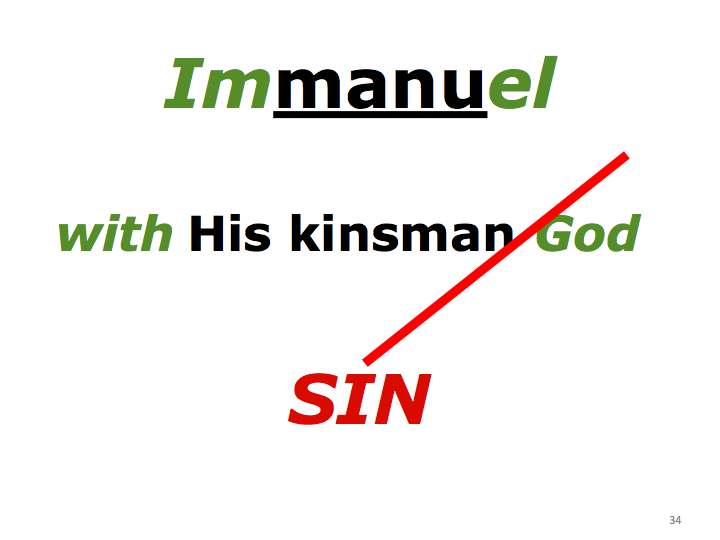
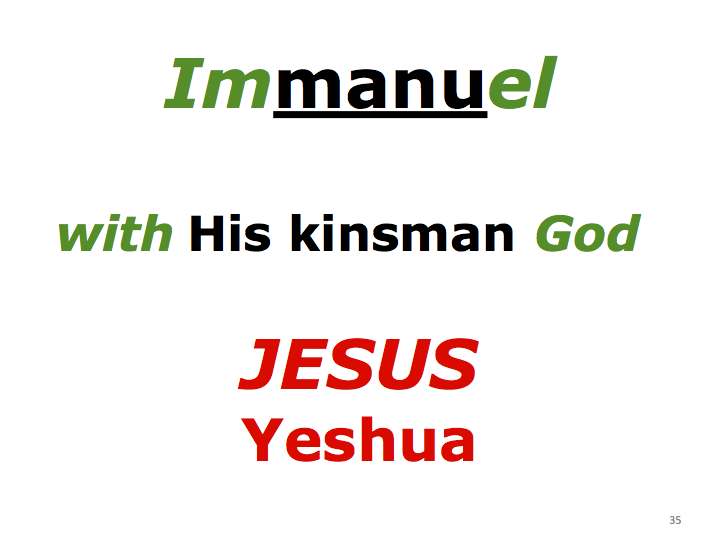
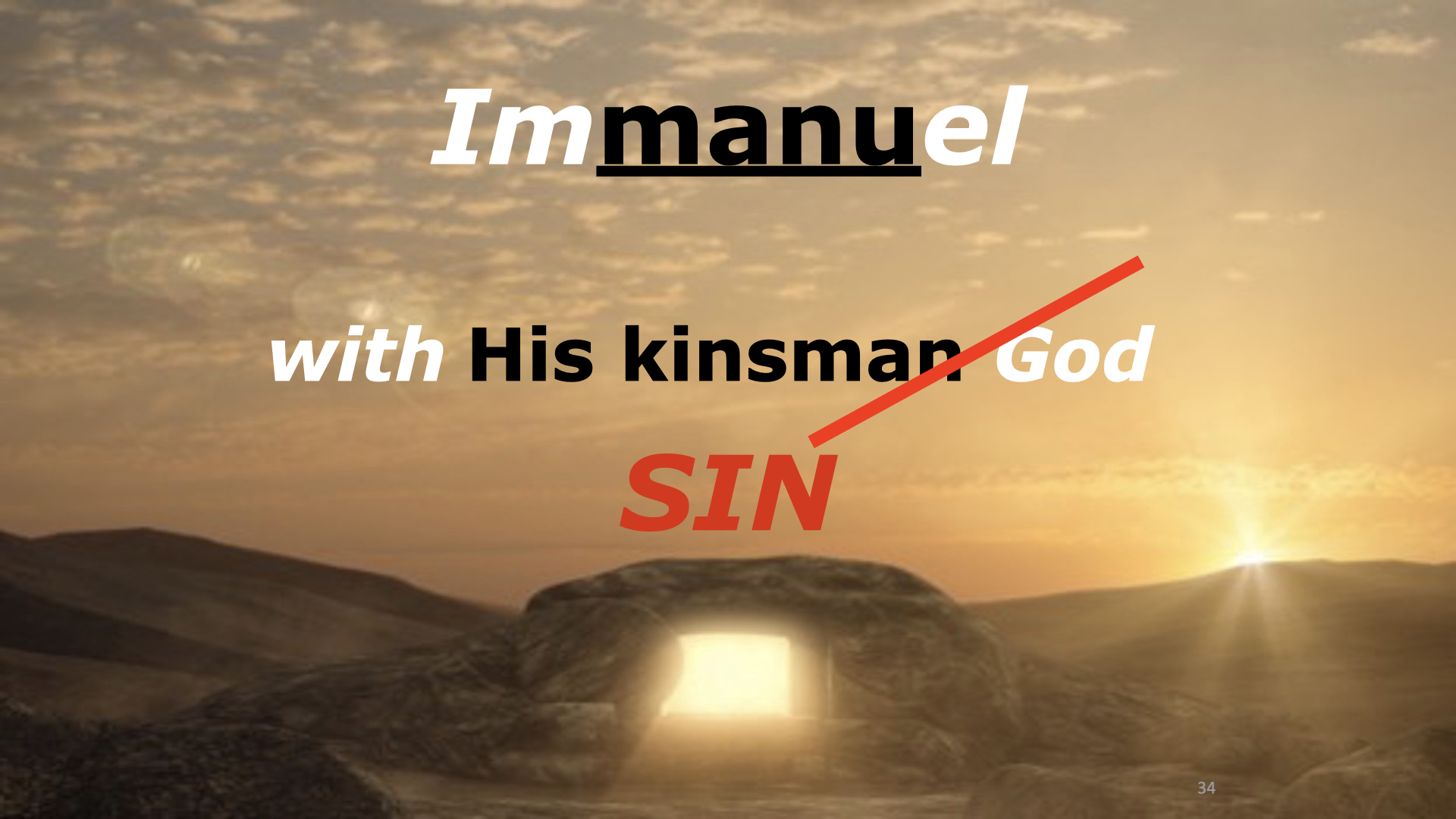
Immanuel & JesusImmanuel is a cool name, appearing only three times in the Bible. The prefix “im” means with, and the suffix “el” means God. The root word in its broadest sense means people, but when we’re talking about God saving “HIS people from their sins,” the best translation would be His kinsman. Thus Immanuel = with His kinsman God.

Just before giving us the prophesy about Immanuel, Isaiah experienced the horror of being with God. When Isaiah was in God’s presence he said, “Woe is me! I am ruined! For I am a sinful man and I have seen God Almighty” (Isaiah 6:5-6). Here’s the simple fact: Our sin separates us from God’s presence. Jesus (in the Hebrew Yeshua = God saves) is the only One Who could remove the penalty of our sin!

Only Jesus could atone for our sin and remove our guilt (see Isaiah 6:7), so that God could stay with us (Immanuel)! 

Jesus (our salvation) makes Immanuel (with His kinsman God) possible. So as the Christmas carol O Come, O Come, Emmanuel implores us: Rejoice! Rejoice! Immanuel shall come to thee!

May you live in the forgiveness of Jesus and the joy of His Immanuel presence this Christmas season!

If you’ve missed any of the messages in this series, you may check them out by clicking here.