What Are Rules For?

Listen to the podcast of this post by clicking on the player below, and you can also subscribe on AppleSpotify, or Audible. 

David is on the run from Saul. He leaves town so quickly that he didn’t have time to kiss his wife goodbye. He didn’t even have enough time to grab a weapon, a change of clothes, companions, or food. So he stops by Ahimelech’s house to see if this priest has any food.

Remember this old nursery rhyme?

Old Mother Hubbard
Went to the cupboard,
To give the poor dog a bone:
When she came there,
The cupboard was bare,
And so the poor dog had none.

That’s just about what happened here. Ahimelech said, “The only bread I have is the holy showbread.” This consecrated bread was 12 loaves laid out each Sabbath in God’s presence. When this bread was replaced each week, it became food for the priests. Ahimelech recognized he had a moral obligation to save David’s life which superseded the ceremonial rules.

Jesus used this incident as an example when the Pharisees accused Him of breaking the law concerning the Sabbath day. Jesus and His followers had been walking through a wheat field, plucking some pieces of grain on which they could munch. The rule-keeping Pharisees said this amounted to work, and a violation of Sabbath rules.

I think sometimes we get so caught up in keeping the rules (or following tradition, or preserving decorum) that we forget the meaning behind the rule. Or, more accurately, we forget God’s design behind the rule.

Every rule God gives is to keep us in a place where we can experience His presence. Rules are not life, but they are boundaries that keep us on the path to life.

Ahimelech kept David alive with showbread. Jesus and His disciples sustained themselves with wheat kernels. Jesus healed the sick on the Sabbath to bring life and wholeness.

Following rules just to follow rules misses the point. What is the point? Following God’s rules to find God’s heart is THE point.

So let me ask you: Do you get the point?

You may also want to check out series on God’s rules called The Love In The Law, or the post called Rules Are Overbearing—Love Never Is.

►► Would you please prayerfully consider supporting this ministry? My Patreon supporters get behind-the-scenes access to exclusive materials. ◀︎◀︎

A Maze Of Grace (book review)

I’m not one for “chick flicks,” and I’m usually not one for “chick books” either. But every once in a while a movie or a book comes along in these categories that grabs my attention. Trish Ryan’s A Maze Of Grace did just that.

This book is part II of Trish’s memoirs. At first, I thought I would be missing out on something by not having read part I, but that wasn’t the case. Right from the opening words where Trish confesses that her husband Steve has just lied to her, I was hooked.

I love the concept of God’s grace. I try to remember grace by using the acrostic: God’s Riches At Christ’s Expense. In other words, God lavishes us with more than we deserve. Trish’s memoir of her walk through grace is a constant reminder to not settle, to not give up or give in. Instead, Trish tells how she came right to the point of just accepting, “This is all there is,” and then daring to hope and trust in God’s grace again. Sometimes we read how God showed His grace to Trish and brought her into something bigger and better. And sometimes we’re left without a resolution, still hanging on in faith to God’s grace.

All in all, this is a delightful memoir. I told my wife that I think there are some emotions and insights that she would probably relate to more than I did, but I would still recommend this book to anyone who is still on the journey. Anyone who has ever come to the point where they thought, “This is it: I’ll just have to settle for this,” will be encouraged by reading this memoir to trust God for one more day.

As Trish says in her closing words:

“Not just for me, but any of us. A maze of grace. Amazing Grace. Amen.”

I am a Faith Words book reviewer.

Liberal Forgiveness

I was reading about how Moses and God responded to the grumbling of the Israelites. After the twelve spies came back from sniffing around Canaan, only two of the spies said, “It’s all good. Let’s go!” The other ten said, “Yeah, it’s good, but there are too many giants for us to be successful.” These ten were able to persuade all of the Israelites to say to Moses, “We don’t want to go any further with you. Take us back to Egypt!”

God spoke out and said, “Stand aside, Moses. I’m going to destroy all of these ungrateful, rebellious people and begin again with you.”

But Moses stepped forward to intervene. He reminded God that He was slow to anger, abounding in love and forgiving sin and rebellion.

And then comes this amazing response from God: “I have forgiven them, as you have asked.”

Did you catch that?

The depth of forgiveness was exactly as Moses had asked!

Forgiveness doesn’t mean that the consequences for sin are removed. God said, “I have forgiven them, nevertheless they are still not going to be able to enter the Promised Land.”

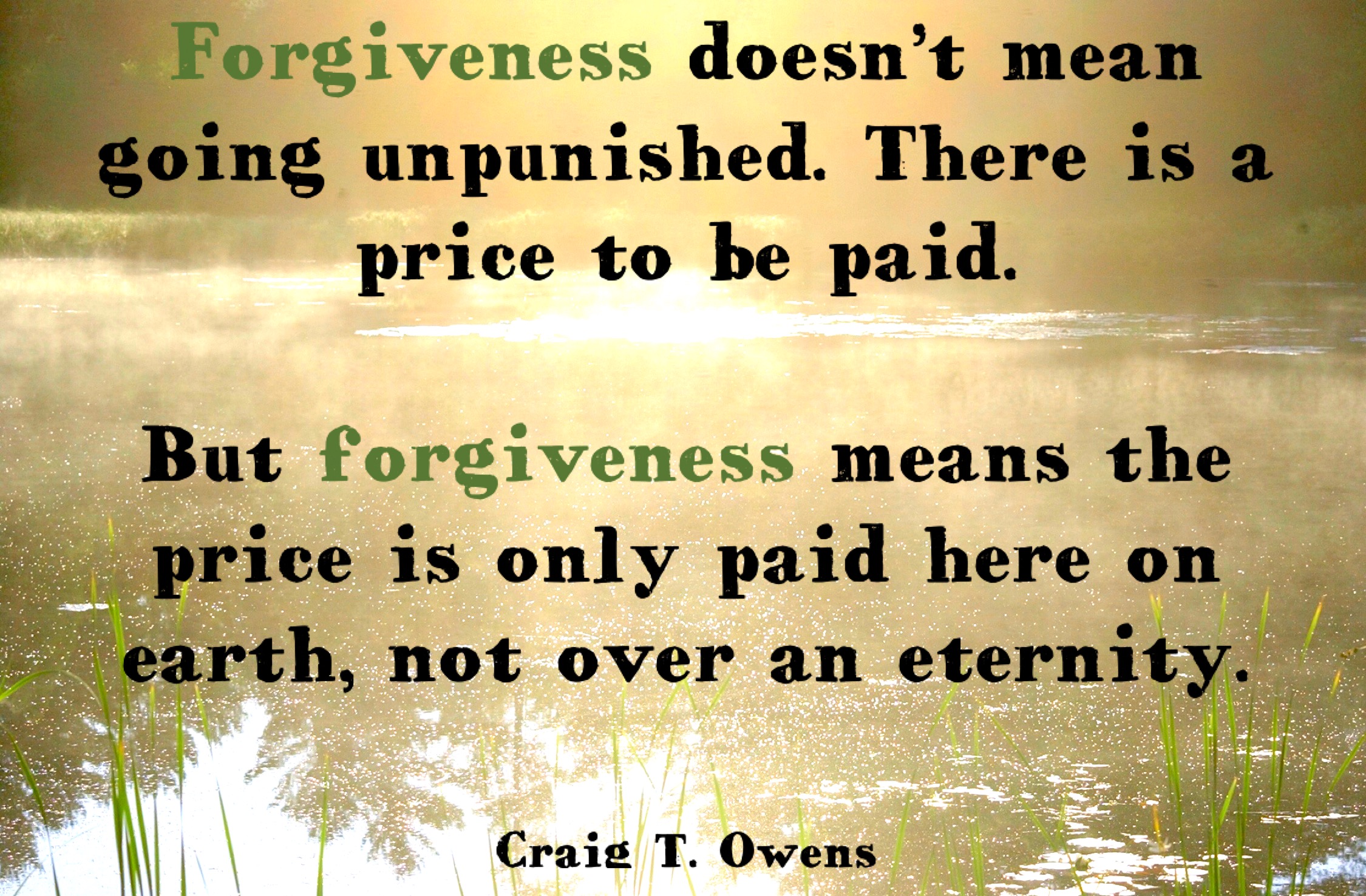
Being forgiven doesn’t mean going unpunished. There is a price to be paid. But forgiveness means the price is only paid here on earth, not over an eternity.

How liberally and deeply and completely do YOU want to be forgiven? Whatever that level is, ask God to just as liberally and deeply and completely forgive OTHERS. Hear Him say, “I have forgiven them, just as you have asked.”

What’s So Amazing About Grace (book review)

Philip Yancey calls grace “the last best word,” and I quite agree. What’s So Amazing About Grace is a challenging read because it is so painful. The truth of our almost daily practice of ungrace is confronting and convicting.

Throughout this book I wanted to say, “I’m glad I don’t behave that way.” And then I’d get a quick glance of myself in the mirror and realize how easily I slip into the same ungraceful behavior I despise. I so desperately want to be a grace-filled man.

Here are just a few of the passages that I’m meditating on, and trying to apply to my life:

  • “I yearn for the church to become a nourishing culture of grace.”
  • “Sociologists have a theory of the looking-glass self: you become what the most important person in your life (wife, father, boss, etc.) thinks you are. How would my life change if I truly believed the Bible’s astounding words about God’s love for me, if I looked in the mirror and saw what God sees?”
  • “I really only love God as much as I love the person I love the least.” (Dorothy Day)
  • “In a brilliant stroke Jesus replaces the two assumed categories, righteous and guilty, with two different categories: sinners who admit and sinners who deny.”
  • “Grace substitutes a full, childlike and delighted acceptance of our Need, a joy in total dependence. We become ‘jolly beggars.’” (C.S. Lewis)
  • “Having spent time around ‘sinners’ and also around purported ‘saints,’ I have a hunch why Jesus spent so much time with the former group: I think He preferred their company. Because the sinners were honest about themselves and had not pretense, Jesus could deal with them. In contrast, the saints put on airs, judged Him, and sought to catch Him in a moral trap. In the end it was the saints, not the sinners, who arrested Jesus.”

If you are challenged about living grace-filled in an increasingly grace-less society, you will find ample help in reading this book.

“Amazing Grace…

…how sweet the sound, that saved a wretch like me. I once was lost but now I’m found; was blind but now I see.”

I’ve heard it reported that John Newton’s song may be the most well-known song in the world, and yet it seems we still live in a world so dominated by ungrace.

Another verse of this beloved song says, “Twas grace that taught my heart to fear, and grace my fears relieved.” How could grace bring both fear and relief? I think it is because grace is freely given. We don’t deserve grace, and yet Jesus paid a terrible price for us to recieve it.

We’re more used to earning what we recieve. Sometimes looking at our own lives of ungrace we may feel like we’ve earned punishment, which is why the thought of grace brings fear. Yet the more we learn about God’s grace, the more those fears are relieved.

I need to learn more about grace. I want to soak in all that it means—the full impact—to be a recipient of God’s grace.

I love this definition of grace from Philip Yancey:
“There is nothing we can do to make God love us more.
There is nothing we can do to make God love us less.”

God’s grace truly is amazing!

Naked Before God

Imagine: You and your wife are the only people on the face of the earth. No bills, no employer, no economic downturn, no kids, no school, no traffic. Just you and God. That was Adam and Eve in the Garden of Eden. The Bible gives this commentary, “Now the man and his wife were both naked, but they felt no shame.”

Nothing to hide from God. Nothing to hide from each other. A perfect relationship with God. A perfect relationship with each other.

Then the temptation, and the bite of the forbidden fruit. Sin enters. Now, something changes when God comes to talk with His favorite couple: “Then the man and his wife heard the sound of God as He was walking in the garden in the cool of the day, and they hid from God among the trees.”

“Why are you hiding from Me?” God asks.

“Uh,” Adam stammers, “because we’re naked.”

Sin made mankind uncomfortable in God’s presence. Sin made them want to hide from God. They knew He was there, but they tried to pretend He wasn’t. This is why I think many of us don’t come into God’s presence in prayer: we’re uncomfortable because of our sin.

We should not run away from God, instead, we should run to Him. “If we confess our sins to Him, He is faithful and just to forgive us our sins and to cleanse us from all wickedness” (1 John 1:9).

What happens when we’re forgiven? We’re re-clothed. God Himself clothes us. He made clothes for Adam and Eve, and He clothes us, too, in the righteous robes of Jesus. “And all who have been united with Christ in baptism have put on Christ, like putting on new clothes” (Galatians 3:27).

And when we’re clothed in Christ, we no longer have to hide from God, nor feel uncomfortable in His presence. Instead, we can “come boldly to the throne of our gracious God. There we will receive His mercy, and we will find grace to help us when we need it most” (see Ephesians 3:12 and Hebrews 4:16).

Perhaps the reason we don’t spend enough time in prayer is that we feel self-conscious, sinful, uncomfortable… naked.

You don’t have to be naked. You can be clothed in Christ. You can enter into God’s presence without shame and find the mercy and grace and help that you need.

An Open Letter To My Daughter

My Dearest Samantha,

Last night as I watched your Mom teaching you how to put on makeup for the very first time, I couldn’t help but think how beautiful you are and what an incredible young woman you are becoming. It’s so wonderful to see that your beauty doesn’t come from anything you’ve done to the outside, but who you are on the inside. All the makeup did was enhance that beauty a little bit.

As you get older I know that fashionable clothes, the latest hairstyles, and the newest cosmetics will play more and more of a role in your life, but always remember where your true beauty comes from. The Bible says it this way, “Your beauty should not come from outward adornment, such as braided hair and the wearing of gold jewelry and fine clothes. Instead, it should be that of your inner self, the unfading beauty of a gentle and quiet spirit, which is of great worth in God’s sight.”

You already have such an inner beauty that God loves … and your Daddy loves! It shines out of your eyes, I can hear it in your voice, I can see it in your actions, I can feel it in your hugs. You are so beautiful!

To keep this unfading beauty shining brightly, remember this: “Charm and grace are deceptive, and beauty is vain [because it is not lasting], but a woman who reverently and worshipfully fears the Lord, she shall be praised!”

I couldn’t be more proud of you than I already am, so I will always be your loudest cheering section and chairman of your fan club! You are my beautiful Rose!

I love you,

   Dad

1

Let’s Make A Deal

Have you ever seen the 1970s game show Let’s Make A Deal? Contestants were given some tricky choices to make. They usually held something in their hand that was fairly valuable and were given the opportunity to trade what they could see for what they couldn’t see.

The anxiety about making this decision almost caused some people to have a nervous breakdown on the spot! And, oh, the emotional highs and lows when the contestants discovered what they won or lost!

I was reading about a let’s-make-a-deal moment in the Bible. Jerusalem is facing an imminent threat from an incredibly powerful man (2 Kings 18-19). Sennacherib sent this message to King Hezekiah, “Let’s make a deal” (18:23).

And he made a pretty compelling argument to take the deal. Sennacherib said, “No one who has ever stood up to me has survived before. I’m undefeated. I have a bigger, meaner army than you; more horses and chariots than you; and I’ve blocked your attempts to call on someone else to come rescue you. There’s no way out of this. C’mon, let’s make a deal!”

What makes a deal like this so appealing is that it’s all visible. It’s hard to say “no” to what you can see and say “yes” to what you can’t see.

Hezekiah knew God could deliver them, but would He deliver them? Hezekiah couldn’t see God, but he could see all of Sennacherib’s forces. What to do, what to do??

Hezekiah made the right deal. He put his trust in God! Although He was unseen, Hezekiah believed that God’s deal was better than Sennacherib’s deal. And Hezekiah was not disappointed in the deal he made (19:35-37).

What about you? Are you facing insurmountable odds today? Do you feel like you need to make a deal? Is what you can see more compelling than what you can’t see? I can promise you that any deal that you might make that doesn’t throw your trust entirely on God is a bad deal. A very bad deal!

So we’re not giving up. How could we! Even though on the outside it often looks like things are falling apart on us, on the inside, where God is making new life, not a day goes by without His unfolding grace. These hard times are small potatoes compared to the coming good times, the lavish celebration prepared for us. There’s far more here than meets the eye. The things we see now are here today, gone tomorrow. But the things we can’t see now will last forever. (2 Corinthians 4:16-18, The Message)

Don’t give up! Don’t make a bad deal! Trust God. His way is always the best deal!

Poetry

Just finished a nice book of poems by Ralph Waldo Emerson and I thought I’d share a few maxims with you—

  • “To be great is to be misunderstood.”
  • “Happy is the house that shelters a friend.”
  • “Nothing great was ever achieved without enthusiasm.”
  • “A friend is a person with whom I may be sincere. Before him, I may think aloud.”
  • “Beauty without grace is the hook without the bait.”
  • “Life is not so short but there is time for courtesy.”
  • “Beware when the great God lets loose a thinker on this planet. Then all things are at risk.”
  • “No man thoroughly understands a truth until he has contended against it.”
  • “In skating over thin ice, our safety is in our speed.”

If you haven’t read any poetry lately, I encourage you to give it a try. It sounds/reads differently, but the rhythm and pace sort of sings to your mind and heart as you read it. For Americans I recommend starting out with some American poets like Emerson or Henry Wadsworth Longfellow; for you Brits, try some Robert Browning.

Happy reading!

Puppy Love

Three weeks ago I had come to the end of a particularly rough week, so when I got home I told my family I was declaring the next day to be “National Be Kind To Craig Owens Day.” I figured that was one way to get some love!

That day was so wonderful I decided to extend NBKTCO Day through the weekend, and I talked Betsy into letting us buy a puppy. And so Grace became a part of our family.

Since I didn’t want to leave her home alone, I started bringing Grace with me to my office. While I’ve been trying to potty train her, she has been training me in a few areas too. Here are some of the lessons I’m rediscovering—

  • Always greet people warmly. Even if they only left the room a couple of minutes ago. It always makes people smile when they are greeted so warmly.
  • Treat everyone like a friend. It doesn’t matter if they are the one who feeds you or a perfect stranger, everyone deserves to be treated like they are the nicest person alive.
  • Genuine puppy “kisses” makes anyone’s day!

The Apostle Paul had a friend like Grace—someone always so welcoming and encouraging to others. Paul wrote to Philemon, “Friend, you have no idea how good your love makes me feel, doubly so when I see your hospitality to fellow believers.” (Philemon 1:7, The Message).

Thanks, Grace, for the lessons. I’m learning how to show some puppy love to everyone.