As a Christian, when you are sharing your testimony and someone wants to argue with you, remember that you are not fighting against people but you are fighting FOR people. Remind yourself of this over and over so that you respond in love.
“Now in history there is no Revolution that is not a Restoration. Among the many things that leave me doubtful about the modern habit of fixing eyes on the future, none is stronger than this: that all the men in history who have really done anything with the future have had their eyes fixed upon the past. I need not mention the Renaissance, the very word proves my case. The originality of Michael Angelo and Shakespeare began with the digging up of old vases and manuscripts.” —G.K Chesterton
Dr. Stephen Nichols tells of a national day of thanksgiving in 16th century England that began from a very unlikely source.
“Most of the important things in the world have been accomplished by people who have kept on trying when there seemed to be no hope at all.” —Dale Carnegie
When the Holy Spirit shines His light on a biblical promise, and you turn that into a prayer, write it down! You may need to go back to this again and again. When God answers your prayer, write it down again! This can become a testimony journal that you and others can use to recall God’s provision.
“The pathway to maturity and to solid biblical food is not first becoming an intelligent person, but becoming an obedient person.” —John Piper
“Somehow or other an extraordinary idea has arisen that the disbelievers in miracles consider them coldly and fairly, while believers in miracles accept them only in connection with some dogma. The fact is quite the other way. The believers in miracles accept them (rightly or wrongly) because they have evidence for them. The disbelievers in miracles deny them (rightly or wrongly) because they have a doctrine against them.” —G.K. Chesterton
“At every moment, we always have a choice, even if it feels as if we don’t. Sometimes that choice may simply be to think a more positive thought.” —Tina Turner
Every day should be a day of thanksgiving!
“We are strangers on Earth; our homeland is in Heaven. Our walk is here; our hearts are there.” —Dr. Henry Halley
I have already shared the first two posts in the latest archeological research on the biblical city of Jericho. Here is part three.
“Success is no accident. It is hard work, perseverance, learning, studying, sacrifice, and most of all, love of what you are doing or learning to do.” —Pelé
“The greatest leader is not necessarily the one who does the greatest things. He is the one who gets people to do the greatest things.” —Ronald Reagan
If I want to present my best ideas, I need to be open to the helpful, sharpening critique that people close to me have to offer. My first idea sounds great, until others come along to make it better.
“In so far as I am Man I am the chief of creatures. In so far as I am a man I am the chief of sinners.” —G.K. Chesterton
Cold case detective J. Warner Wallace applies the same scrutiny to examining the evidence of the New Testament as he does with a suspect. “There are four critical questions that must drive our examination of any eyewitness, ancient or modern: Were they actually present to see what they claim? Can their account be corroborated in some fashion, even indirectly? Have the key elements of their story shifted over time? And finally, do they possess ulterior motives or bias that would tempt them to lie or embellish? This is not a uniquely religious or anti-religious method; it is simply good investigative practice.”
“Few men, if any, step into responsible positions without preparation. Sometimes in our shortsightedness we seem to get the idea in regard to Bible characters that they come on the scene ready-made, fully prepared; here they are, God’s gift to the world! They take up the work, and that’s all there is to it. But if you will read more carefully, you will find that usually—I think we could even say always—there is a period of preparation behind them. God lays His plans well in advance.” —William Sanford LaSor
When you are waiting for God to fulfill His promise, keep watching with a smile. Let your childlike trust become your testimony as you entrust yourself to your heavenly Father.
“The case for the reliability of the New Testament Gospel eyewitness accounts is dependent on the trustworthiness of its authors. In cold-case criminal trials, eyewitness accounts are typically evaluated through the lens four critical questions.” J. Warner Wallace then gives a succinct overview of each of these four questions and the evidence supporting them.
“One can sometimes do good by being the right person in the wrong place.” —G.K. Chesterton
“A great leader never sets himself above his followers except in carrying responsibility.” —Jules Ormont
“There is a great difference between worry and concern. A worried person sees a problem, and a concerned person solves a problem.” —Harold Stephens
We have a culture where respect for others is eroding quickly. The Bible makes it clear that reverence for God results in respect for people, and respect for people helps us reverence the God who created them.
“The real great man is the man who makes every man feel great.” —G.K. Chesterton
Dr. Louis A. Markos has an insightful article on the works of C.S. Lewis that help us learn how to stay human. “Christians today who are committed to restoring a proper view of man have an ally in the greatest apologist of the twentieth century, C.S. Lewis (1898–1963). Though Lewis offers much help in his best-known apologetics books (Mere Christianity, The Problem of Pain, The Screwtape Letters, The Great Divorce) and his beloved Chronicles of Narnia, we would do well to expand our reading of Lewis to include his searing critique of modern educational philosophy (The Abolition of Man) and his anthropologically incisive science fiction novels, The Ransom (or Cosmic) Trilogy: Out of the Silent Planet, Perelandra, That Hideous Strength.”
The ICR has an article about a fascinating new dinosaur that was unearthed. “Even now in the twenty-first century, paleontologists are still at a loss as to the origin of the dinosaurs. As recently as 2024, five evolutionists stated, ‘Today, inspired by clues from fossils and footprints from a lost world, scientists continue to piece together the puzzle of how various dinosaur groups arose, behaved, and diversified.’ In contrast, the creation model argues that all dinosaur kinds were created during the same period—specifically on Day 6 of the creation week—several thousand years ago. From this perspective, the lack of definitive transitional forms or ancestral precursors in the fossil record aligns with the expectation that dinosaur kinds appeared fully formed and distinct, as observed in the fossil record.”
Axis’ Culture Translator discusses an article posted in Harper’s: “Many have written about how porn warps the expectations users have for relationships; this article demonstrates that, for young men in particular, pornography is often willingly embraced as a complete replacement for human connection. … Woven throughout this subculture is also conscious self-degradation; as the Harper’s article points out, ‘ruin your mind,’ ‘go deeper,’ and ‘give up on life’ are embraced as the movement’s rallying cries. Many young men and women are trapped in this spiritual prison, convinced there is nothing better to live for. Who will show them the way out?” Two helpful resources are Fight The New Drug and Pure Desire.
Leaders need to learn that disagreement on your team is normal and can be healthy. Disagreement doesn’t mean people distrust their leader, but it may mean that they want the bring out the best in their leader. Check out the full conversation Greg and I had on this subject.
Christian saints have the joyful privilege of being able to step up for fellow saints. It’s hard work at times, but if we remember who those saints really are, it’s never heavy work!
“A people that values its privileges above its principles soon loses both.” —Dwight D. Eisenhower
“[Jesus] draws us to Himself daily, to seek His beauty in Scripture, dwell before the beauty of His glorious face, bask in the beauty of His heavenly throne room, and become, increasingly, His beauty in and to the world. No matter how long we’ve known Him or how careful and earnest our study of Him has been, His fresh beauty remains fresher still.” —T.M. Moore
“Christianity is always out of fashion because it is always sane; and all fashions are mild insanities.” —G.K. Chesterton
Replace the “sandwich method” of feedback with this: (1) Tell the person why you are giving them feedback, (2) Give them the feedback, and (3) End with a belief statement.
G.K. Chesterton penned these words over a century ago. If they were true then, imagine how much more so they are now: “These are the days when the Christian is expected to praise every creed except his own.”
“The only way to do great work is to love what you do. If you haven’t found it yet, keep looking. Don’t settle.” —Steve Jobs
Epaphras literally put his life on the line to tell others about Jesus (Colossians 1:7; Philemon 23) and then tenaciously wrestled in prayer for the saints he led to the Lord (Colossians 4:12). That is a life worth emulating!
Sarah Young uses passages of Scripture and writes in the first-person voice as though Jesus Himself was speaking to us. “When you bring Me prayer requests, lay out your concerns before Me. Speak to Me candidly; pour out your heart. Then thank Me for the answers that I have set into motion long before you can discern results. When your requests come to mind again, continue to thank Me for the answers that are on the way. If you keep on stating your concerns to Me, you will live in a state of tension. When you thank Me for how I am answering your prayers, your mind-set becomes much more positive. Thankful prayers keep your focus on My Presence and My promises.”
G.K. Chesterton wrote, “The whole difference between construction and creation is exactly this: that a thing constructed can only be loved after it is constructed; but a thing created is loved before it exists, as the mother can love the unborn child.”
God loved you before you were born. He had a plan in mind for your life before you were conceived.
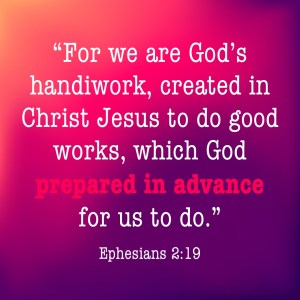
For we are God’s handiwork, created in Christ Jesus to do good works, which God prepared in advance for us to do. (Ephesians 2:10)
Even as God formed you in your mother’s womb, He implanted in you all that you would need to live for His glory.
Your eyes saw my unformed body; all the days ordained for me were written in Your book before one of them came to be. (Psalm 139:16)
God couldn’t love you any more than He already does because His love for you is infinite and eternal❣️
Have you felt under attack spiritually lately? Especially when things are going well, we need to stay on guard because the enemy of our soul is always looking for an opening. Don’t give him any opening at all—stay vigilant!
“All men are ordinary men; the extraordinary men are those who know it.” —G.K. Chesterton
I thoroughly enjoy reading the words of Oswald Chambers (check out my lengthy Thursdays with Oswald feature). Dr. Steve Nichols shared a mini-biography about this extraordinary pastor on his 5 Minutes In Church History podcast.
Over a week before the assassination of Charlie Kirk, Abdu Murray had a chilling prediction in his commentary From Cancel Culture to Assassination Culture.
“Practice, which some regard as a chore, should be approached as just about the most pleasant recreation ever devised.” —Babe Didrikson Zaharias
Using a question about the recreational uses of marijuana, John Piper notes something deeper: “The church for a long time has leaned too heavily on the overlap between the state and the church for the strength of our conviction concerning what is right and wrong.” This post is a call for Christians to dig into the Scriptures for what we believe, and not just follow what society says.
“The man who thinks he can live without others is mistaken; the one who thinks others can’t live without him is even more deluded.” —Hasidic Proverb
This 12-minute video from Daniel Pink has some solid insights on higher productivity.
T.M. Moore is sharing a fascinating series of posts on economics through a biblical worldview. “All the ancient laws of Israel contain principles like this, principles which, if rightly understood and faithfully practiced, could tap into the grace of God and bring more honesty, respect, fairness, justice, generosity, forbearance, and love into the economic practice of a powerful nation such as the United States—more of grace and less of greed to our economic life.”
“Christ had even a literary style of His own, not to be found, I think, elsewhere; it consists of an almost furious use of the a fortiori. His ’how much more’ is piled one upon another like castle upon castle in the clouds. The diction used about Christ has been, and perhaps wisely, sweet and submissive. But the diction used by Christ is quite curiously gigantesque; it is full of camels leaping through needles and mountains hurled into the sea.” —G.K. Chesterton
David Mathis writes that the Bible is not just “a Book.” He says, “In my mind, one of the greatest imaginable tragedies is a professing Christian who is bored with the Bible. Could a truly loving husband cherish his wife but not care for her words? Could an adoring wife respect her husband but not what he says? What are words anyway? They are the breathed-out expressions of the person himself. Words are audible revelations of the otherwise unknown heart.”
Another archeological study supports the historicity of the Bible. This one identifies the battle preparations that King Joash made.



 As a Christian, when you are sharing your testimony and someone wants to argue with you, remember that you are not fighting against people but you are fighting FOR people. Remind yourself of this over and over so that you respond in love.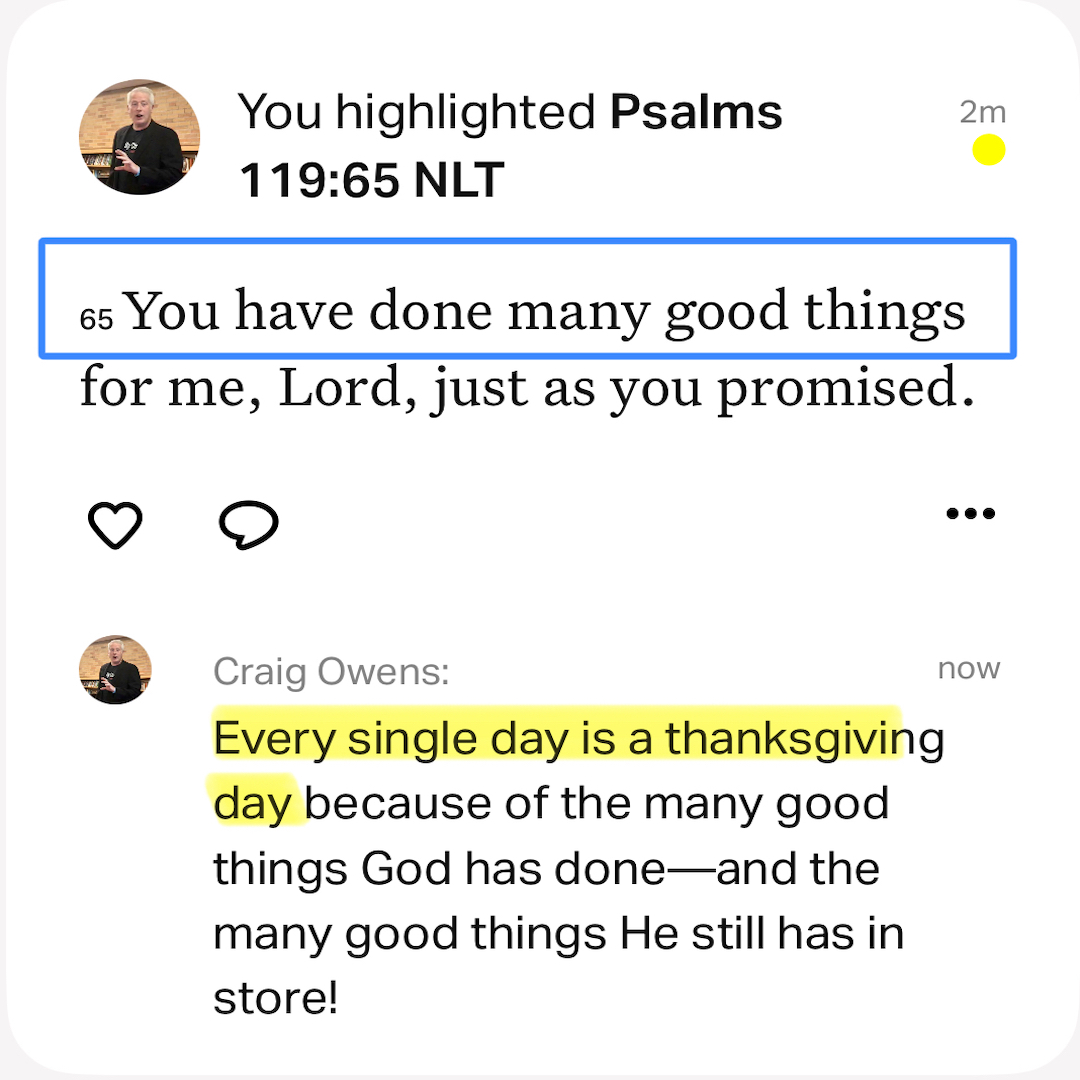







 Craig T. Owens