Confusing Signals

The other day I met a friend for coffee at Biggby Coffee and noticed this sign. In reality, the door did take you behind the counter (that’s the “Employees Only” part), and from the behind-the-counter area is the only other exit door from the coffee shop that could be used in case of an emergency (that’s the “Emergency” part).

But when I put the two parts together, it struck me funny. “Are they saying only employees can use the emergency exit? What happens to the rest of us?”

Is this the message Christians send? “Only Christians who know how to behave themselves in a Christian way can come into the Christians-only area of our church and hear how to exit this world.” Sadly, many Christians act this way.

Or should I call them “Christianists”? After all, true Christ-followers act like Jesus and invite everyone behind the counter to hear the good news. All those who truly love Jesus want everyone to know how to find the exit from all the baggage they’ve been carrying around.

Jesus said, “Come to Me, all of you who are weary and carry heavy burdens, and I will give you rest.” Did you catch that? All of you. The good news about Jesus is for everyone everywhere. Let’s not put a confusing sign on the door, but invite them into freedom in Christ.

Happy Birthday To My Son

Dear Harrison,

It’s hard for me to believe that you are a decade-and-a-half old. Wow, time seems to fly by, but the memories I’ve made watching you grow up are always with me. What an incredible young man you are!

Believe it or not, you have been a huge factor in my own growth and maturity. I can remember the moment you were born how I cried with an absolutely unspeakable joy! I had never known such an immediate explosion of love before. Falling in love with your Mom was a love that grew little by little—and still is growing today. But the love that burst upon me the moment you were born was a Niagara Falls of love all at one instant. As I held you in the first couple of days, it dawned on me in such a new way, “This is how my Heavenly Father must feel about me.”

That’s the day that my relationship with God went to an entirely different level. Partly contributing to this was the responsibility of being your Dad, and knowing how I had to be a better man to train you up in the way you should go. But part of my motivation to get closer to God was that you taught me what kind of love God had for me. I didn’t want to fail you or Him, so I made a conscious decision to rededicate myself to getting even closer to God. And in the process, I got even closer to you, to your Mom, and to everyone else I loved.

And that passion to keep growing hasn’t stopped. You still motivate me today to get better and better as a follower of Jesus and as your Dad. The more I see you mature, the prouder I become of you, and the more I feel the need to push through to the next level. I want to keep on growing so that I can always be there for you.

I love you, Harrison. Thank you for challenging me to be a better Dad and a more passionate follower of Christ.

Happy Birthday,

Dad

Life On Life

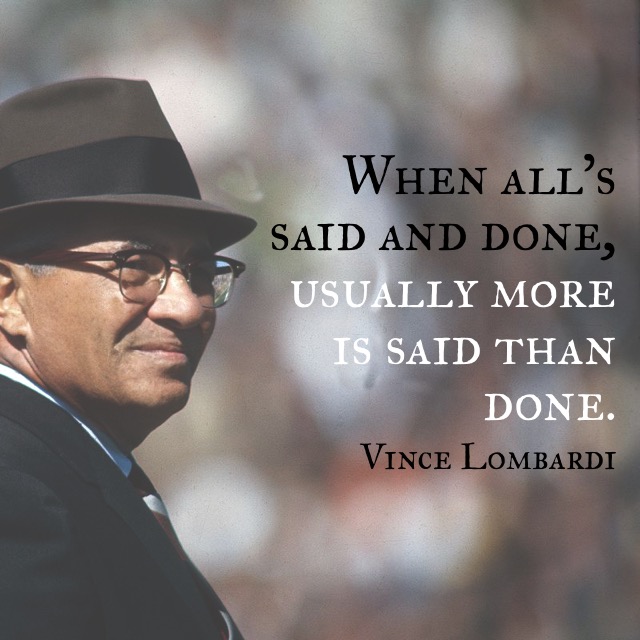
In my remarks at the funeral in which I was officiating on Wednesday, I quoted the great Green Bay Packers coach Vince Lombardi. He was reportedly addressing a couple of under-performing players when he said, “When all’s said and done, usually more is said than done.” In other words, don’t talk about what you’re going to do, just do it.

One of my passions is to mentor and equip other people to do great things. I’ve found that the best way to do this is not to just talk about what they should be doing, but to step into their life and do those things with them—to do more than I say.

This life-on-life mentoring is challenging but so incredibly rewarding. The Apostle Paul wrote, “Follow me as I follow Christ. C’mon, let’s pursue this relationship with Jesus together. I’m going to keep you close to me so that you can look in on what I’m doing, and I’m going to be right here for you too. Let’s draw closer to Jesus together” (see 1 Corinthians 11:1)

I love the one-on-one times with my kids … brainstorming with the young leaders-in-training at church … having challenging conversations with an accountability friend … opening our home to a young single mom. These interactions keep me focused on staying as close to Christ as I can. Because if I lose sight of Him, so might the others who are connected with me life-on-life.

It’s pretty hard to say, “Follow me while I do my own thing.” So I’m redoubling my efforts to stay close to the Master today.

Mixed Signals

The Methodist church by my house has a marquee that faces a busy expressway. Today, as I drove by I, read their latest message: “Pay attention to your destination, not your speed.”

“Hmmm,” thought, “I wonder how the police department feels about that?”

No sooner had the thought passed through my head and I saw the flashing lights of a police officer with a car pulled over on the shoulder! I can almost imagine the driver’s frantic plea to the officer, “But, officer, the church back there told me…!”

This humorous scene reminded me of two quotes:

  • “It is no use walking anywhere to preach unless our walking is our preaching.” —Francis of Assisi
  • “Where one man reads the Bible, a hundred read you and me.” —Dwight L. Moody

May the “signs” of our lives never send mixed signals to the people “reading” us.

Gaining Reason By Becoming Mad

An excerpt from Kahlil Gibran’s The Madman

Once there ruled in the distant city of Wirani a king who was both mighty and wise. And he was feared for his might and loved for his wisdom.

Now, in the heart of that city was a well, whose water was cool and crystalline, from which all the inhabitants drank, even the king and his courtiers; for there was no other well.

One night when all were asleep, a witch entered the city, and poured seven drops of strange liquid into the well, and said, “From this hour he who drinks this water shall become mad.”

Next morning all the inhabitants, save the king and his lord chamberlain, drank from the well and became mad, even as the witch had foretold.

And during that day the people in the narrow streets and in the market places did naught but whisper to one another, “The king is mad. Our king and his lord chamberlain have lost their reason. Surely we cannot be ruled by a mad king. We must dethrone him.”

That evening the king ordered a golden goblet to be filled from the well. And when it was brought to him he drank deeply, and gave it to his lord chamberlain to drink.

And there was great rejoicing in that distant city of Wirani, because its king and its lord chamberlain had regained their reason.

When I was in high school some of my peers from my “Christian” school were behaving in ways I thought un-Christlike. So I challenged them on their behavior. Their response was something like, “Quit being like John the Baptist—quit being so holier-than-thou. Why can’t you just go along with us?”

In other words, they were mad (in regard to biblical behavior) and they wanted me to drink from the same cup to ‘regain their reason.’

When confronted with their poor decisions or less-than-desirable behaviors most people would rather pull the wise, reasoned man down to their level of ‘madness’ than aspire to a higher level of ‘reason.’

Check out Erwin McManus’ thoughts on this, “When we live below a standard, it is simply human nature to redefine the standard as unreasonable and establish standards that our patterns are already accomplishing. We keep lowering the bar until we clear it.”

Instead, why don’t you raise your standard today? Don’t partake of the madness of others just to be accepted by them—you set the standard for decency, holiness, nobleness, self-sacrifice, self-control, and temperance!

Live right,
speak the truth,
despise exploitation,
refuse bribes,
reject violence,
avoid evil amusements.
This is how you raise your standard of living!
A safe and stable way to live.
A nourishing, satisfying way to live.
(Isaiah 33:15-16, Message)

What Jesus Didn’t Say

All throughout the first four books of the New Testament—Matthew, Mark, Luke, and John—there are lots of “red letters” (words spoken by Jesus). But as each of these gospel writers begins to recount the arrest and sham trial of Jesus, I’m struck by how many “black letters” there are. This fulfilled an Old Testament prophesy—

He was oppressed and treated harshly, yet He never said a word. He was led like a lamb to the slaughter. And as a sheep is silent before the shearers, He did not open His mouth (Isaiah 53:7).

The chief priests and the Sanhedrin brought out a string of witnesses to falsely accuse Jesus, but even then these witnesses couldn’t get their stories to jive, so Jesus remained silent. In exasperation the chief priest Caiaphas lashed out at Jesus, “Aren’t You going to answer these charges? Don’t You hear what they’re saying about You? Why won’t You defend Yourself?”

So here’s how Jesus responded to His accusers: But Jesus remained silent (Matthew 26:63). His silence resonated louder than any words could have!

How could Jesus do this? How could He stand silently when all of these nasty things were being said about Him?

He looked back—”…He had done no violence, nor was any deceit in His mouth…” (Isaiah 53:9). All four Gospels record Jesus saying, “You heard Me speaking in public all the time. My life has been on display for You. If I had said or done anything wrong, you could have arrested Me earlier, but the facts are: I haven’t said or done anything sinful.”

He looked forward—”…Because of the joy awaiting Him, He endured the Cross, disregarding its shame…” (Hebrews 12:2). He knew that one wrong word could undo all of the good words which He previously spoke, so He looked forward to the joy that would come after this was over.

I just went through a period of my life where people threw incredibly hurtful lies at me, but what was that compared to the horrific abuse heaped upon Jesus? If He could remain silent, how much more should I?

While I was in the midst of this difficult time, a prayerful friend handed me a notecard which I have kept close to me. Perhaps these words will be helpful to you, too—

May kindness be the response in you
where such a response is not expected.
May gentleness have the power
to overrule an offense and the power to heal. (David Teems)

May this Good Friday be a time of reflection in what Jesus didn’t say. And may I, along with you, learn this power of silence when falsely accused.

Destinations

“Lord, make me a channel of Thy peace, that
where there is hatred, I may bring love;
where there is wrong, I may bring the spirit of forgiveness;
where there is discord, I may bring harmony;
where there is error, I may bring truth;
where there is doubt, I may bring faith;
where there is despair, I may bring hope;
were there are shadows, I may bring light;
where there is sadness, I may bring joy.” —Francis of Assisi

There are times when I go through a difficult spot in my life and I can see the areas where I am growing as a result of successfully navigating the challenge. However, the tough time I just went through wasn’t one of those times.

The quote above resonates with me. I want to be someone who brings out love, forgiveness, harmony, truth, faith, hope, light, and joy in other people. So although this challenging time I’ve gone through hasn’t been pleasant for me, it has been such a joy to see others “step up,” mature, stretch, and grow as they have been alongside me.

One more quote—”It is a serious thing to live in a society of possible gods and goddesses, to remember that the dullest and most uninteresting person you talk to may one day be a creature which, if you saw it now, you would be strongly tempted to worship, or else a horror and a corruption such as you now meet, if at all, only in a nightmare. All day long we are, in some degree, helping each other to one of these destinations.” —C.S. Lewis

To which destination are you helping those around you? What characteristics are you bringing out in those alongside you?

Shining Like Stars

Do everything without complaining and arguing, so that no one can criticize you. Live clean, innocent lives as children of God, shining like bright stars in a world full of crooked and perverse people. (Philippians 2:14-15)

Those who follow Jesus are supposed to be different.

The word holy means different; it means “set apart from everything else for a special purpose.” But holy shouldn’t be a repelling different, but a winsome, appealing, attractive different. Instead, our holy lives should shine like bright stars.

When we first had kids, people began to talk to Betsy and me about where our kids would go to school, and their first assumption was that we would send them to a “Christian” school. But we felt differently about this. We have been called by Jesus to let our light shine before men that they may see our good deeds and praise our Father in heaven. So our desire is that our kids may let their light shine in their public schools.

While I am grateful for the A’s and B’s on all of their third-quarter report cards, there are other statements on my kids’ report cards that make me even prouder—

  • “You are a pleasure to have in class.”
  • “I am so blessed to have him in class.”
  • “You have proven yourself to be a responsible, respectful, and hard working student.”
  • “She does a fantastic job of helping out other students in class.”
  • “He is extremely respectful towards others and a pleasure to have in class!”
  • “He is always willing to lend a helping hand to others if needed.”
  • “You are a joy to be around, and I look forward to your smile every morning!”

These comments reflect lifestyles that are different—a winsome, appealing, attractive different.

This light shining out from our kids has opened the door for us to share our faith in Jesus with both teachers and students. In fact, my daughter has been able to lead one of her classmates to faith in Christ, and she and her family are now attending our church!

My kids challenge me to do everything in a way that shines. I want to be different … I want to shine … I want to live in a way that attracts others to Jesus Christ. What about you?

Choice Four-Letter Words

Listen to the podcast of this post by clicking on the player below, and you can also subscribe on AppleSpotify, or Audible.

Have you ever been “cursed out” by someone? I mean had a stream of four-letter obscenities hurled at you? What happens inside you? Isn’t your natural reaction to strike back? To begin to a counter-attack with a few choice four-letter words of your own?

It’s natural to feel this way; it’s a very human response.

On the other hand, have you ever been “blessed out” by someone? Had someone shower you with niceties and accolades and compliments? What happens inside you this time? Isn’t your natural reaction the complete opposite? Don’t you want to say, “Well, I think you’re pretty special, too”?

It’s natural to feel this way; it’s a very human response.

But Jesus commanded us to do something counter-cultural, something which requires a spiritual response: “Bless those who curse you” (Luke 6:28). Paul amplified this thought: “Bless those who persecute you; bless and do not curse” (Romans 12:14).

These words curse and bless are challenging for me. Curse means to hope for someone’s downfall; bless means to say good words to or about someone. Cursing can be done internally or verbally; blessing has to be done verbally. Eugene Peterson captures the essence of this in his paraphrase of Romans 12:14: “Bless your enemies; no cursing under your breath.”

If my natural response is to match curse for curse, obscenity for obscenity, then to respond in a Christ-like fashion is going to take a change of character. To respond with the right four-letter words, I have to do the opposite of my natural response.

In the Old Testament, the Hebrew word for bless carried the understanding that it all hinged on God—He is the focal point. All of the definitions of this word involve a close relationship with God: (a) bless God; (b) bless men in the name of God; (c) ask for divine favor for persons or things created by God; or (d) salute someone because we know God has saluted us.

In the New Testament, the Greek word for bless makes it clear that this has to be done verbally, out loud. It is impossible to bless under your breath. In the Greek, bless is the compound word eulogeo = eu- (good) + –logos (words): saying good words out loud.

Only God is good, so only a closer relationship with our good God will help us say good words to others. Especially to those who curse us.

The right four-letter words to use—the un-natural words to use—are: Good words.

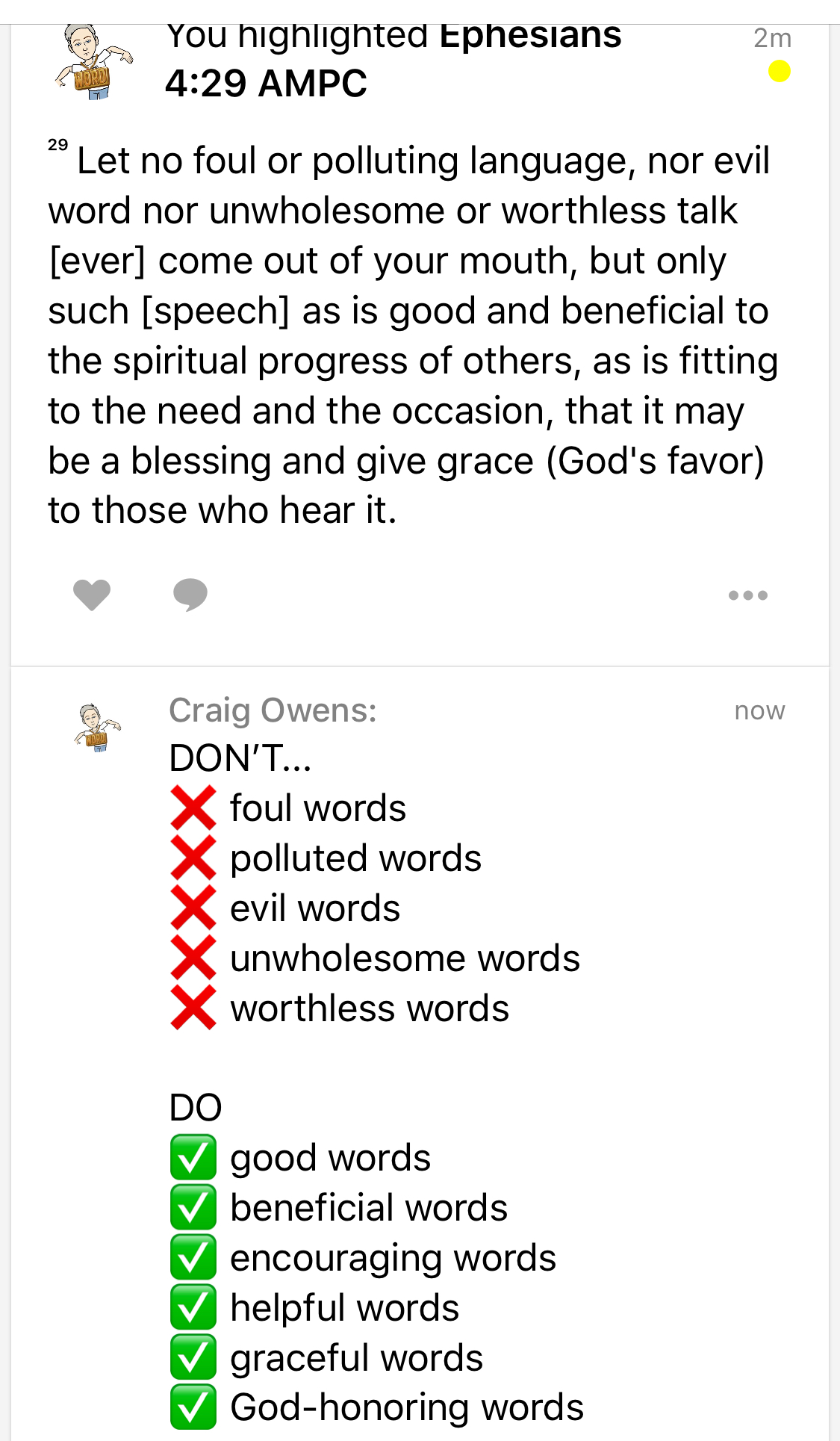
I’m challenging myself today to bless others, especially those who curse me. I only want to say good to and about others today. I’m attempting to live out Ephesians 4:29—

  • Do not let any unwholesome talk come out of your mouths, but only what is helpful for building others up (New International Version)
  • Let no foul or polluting language, nor evil word nor unwholesome or worthless talk ever come out of your mouth, but only such speech as is good and beneficial to the spiritual progress of others (Amplified Bible)
  • Watch the way you talk. Let nothing foul or dirty come out of your mouth. Say only what helps, each word a gift (The Message)
  • When you talk, do not say harmful things, but say what people need—words that will help others become stronger (New Century Version).

So let me ask you: How will you say the right four-letter words to others today?

►► Would you please prayerfully consider supporting this ministry? My Patreon supporters get behind-the-scenes access to exclusive materials. ◀︎◀︎

Moderate Back Thrusts

How would you like to have this written on your tombstone—

Appointed by God to be king
Caused all Israel to sin against God
Doomed my family line to extinction

That is exactly the epitaph of King Jeroboam (see 1 Kings 13-14). In God’s indictment of Jeroboam He says, “Because of the sins you have committed, and the sins you have caused Israel to commit, you have provoked Me to anger and thrust Me behind your back.”

I find that phrase—thrust Me behind your back—intriguing. The word thrust means to throw something away. How exactly does one go about throwing God away? Can you crumple Him up like a piece of paper and toss Him in a garbage can? Can you grab Him and shove Him behind you? Is He like a stack of old newspapers thrown in a recycling bin? Clearly not!

One only thrusts God behind one’s back little by little. Just moderate back thrusts.

John Maxwell was exactly right when he said that whatever good things a leader does in excess, those following will do in moderation. Whatever poor things the leader does in moderation, those following will do in excess. The “moderate” ways in which Jeroboam thrust God behind his back caused all of Israel to sin excessively. And that became Jeroboam’s eternal legacy!

People are watching me—my kids, my neighbors, my friends, the baristas at Starbucks—what example am I setting for them? There are only two examples I can set: (1) Pursue God with all my heart, all my soul, all my mind, and all my strength; in other words, love God to excess. Or (2) Moderately thrust God behind my back little by little by little.

Search me, O God, see if there is ANY moderate back thrusting in me and lead me in the way everlasting (see Psalm 139:23-24).