Finding God In Hidden Places (book review)

Finding GodThe life of Joni Eareckson Tada is a marvel! The way she has transparently lived out her disability, with all its challenges and opportunities, has been encouraging to many, including myself. In her book Finding God In Hidden Places I got even more insight into this godly woman’s unique paradigm.

This book is really a collection of short stories in which Joni shares how God has revealed Himself to her through the people she’s met and the experiences she’s had. The title of the book sounds like God is hidden, but as Joni shares, God is actually revealing Himself all the time, if we will only have open eyes and hearts to see Him.

In fact, near the end of the book Joni shared how she has grown through all of her experiences—“God is always revealing Himself to us through His Word and through the works of His hands. He’s an intentional God, brimming over with purpose, infusing meaning into everything around us. But we need to open ‘the eyes of our heart’ before we can see; and that, my friend, begins with a prayer from Ephesians 1:17-18.”

Not too long I ago I realized that most of the books I was reading were authored by men and I determined that I needed to be intentional in getting a feminine perspective in my reading material. Find God is the first book I selected after making this decision, and I don’t think I could have picked anything more eye-opening than these sensitive, thought-provoking insights from Joni.

Links & Quotes

link quote

These are links to articles and quotes I found interesting today.

Wise words from John Maxwell: A Leader′s Need For Humility

“Many people preach and teach. Many take part in the music. Certain ones try to administer God’s work. But if the power of God’s Spirit does not have freedom to energize all they do, these workers might just as well stay home. Natural gifts are not enough in God’s work. The mighty Spirit of God must have freedom to animate and quicken with His overtones of creativity and blessing.” —A.W. Tozer

Very thoughtful post from Frank Viola: Rethinking The Second Coming Of Christ. Frank references the book he co-authored with Leonard Sweet entitled Jesus: A Theography; I highly recommend this book!

Max Lucado writes in Like A Child, “Quit looking at life like an adult.  See it through the eyes of a child.”

[VIDEO] Greg Koukl on Discussing The Age Of The Earth With Other Christians

5 Reasons To Attend Church Regularly

“To be humble, and, like a little child, afraid of taking a step alone, and so conscious of snares and dangers around us, as to cry to [God] continually to hold us up that we may be safe, is the sure, the infallible, the only secret of walking closely with Him.” —John Newton

“One of principle that today’s intellectuals most passionately disseminate is a vulgar relativism, ‘Nihilism with a happy face.’ For them it is certain that there is no truth, only opinion: my opinion, your opinion. They abandoned the defense of the intellect…. Those who surrender the domain of the intellect make straight the road to fascism. Totalitarianism…is the will-to-power unchecked by any regard for truth. To surrender the claims of truth upon humans is to surrender Earth to thugs…. Vulgar relativism is an invisible gas, odorless, deadly, that is now polluting every free society on earth. It is a gas that attacks the central nervous system of moral striving…. ‘There is no such thing as truth,’ they teach even the little ones. ‘Truth is bondage. Believe what seems right to you. There are as many truths as there are individuals. Follow your feelings. Do as you please. Get in touch with yourself….’ Those who speak in this way prepare the jails of the twenty-first century. They do the work of tyrants.” —Michael Novak

Cool story on how The Detroit Tigers Hired Sparky Anderson

Miracle Or “Cheating”?

C.S. Lewis at his deskI recently re-read C.S. Lewis′ book Miracles (you can read my full book review by clicking here). As you may have noticed, after reading and reviewing books on this blog, I also like to share some quotes that caught my attention. Doing this with Lewis is difficult, because in order to get the context of a particular quote, I think I would have to cite almost a full page or more. So over the next few weeks I plan to share some quotes from Miracles that require not as much context, or I will provide a bit of background to set the stage.

This particular quote is fairly long in itself, but I think you will understand the context within the quote—

“It is certain that the billiard balls will behave in a particular way, just as it is certain that if you divide a shilling unequally between two recipients then A’s share must exceed the half and B’s share fall short of it by exactly the same amount. Provided, of course, that A does not by sleight-of-hand steal some of B’s pennies at the very moment of the transaction. In the same way, you know what will happen to the two billiard balls—provided that nothing interferes. If one ball encounters a roughness in the cloth which the other does not, their motion will not illustrate the law in the way you had expected. Of course what happens as a result of the roughness in the cloth will illustrate the law in some other way, but your original prediction will have been false. Or again, if I snatch up a cue and give one of the balls a little help, you will get a third result: and that third result will equally illustrate the laws of physics, and equally falsify your prediction. I shall have ‘spoiled the experiment.’ All interferences leave the law perfectly true. But every prediction of what will happen in a given instance is made under the proviso ‘other things being equal’ or ‘if there are no interferences.’ Whether other things are equal in a given case and whether interferences may occur is another matter. The arithmetician, as a arithmetician, does not know how likely A is to steal some of B’s pennies when the shilling is being divided; you had better ask a criminologist. The physicist, as a physicist, does not know how likely I am to catch up a cue and ‘spoil’ his experiment with the billiard balls: you had better ask someone who knows me. In the same way, the physicist, as such, does not know how likely it is that some supernatural power is going to interfere with them: you has better ask a metaphysician. But the physicist does know, just because he is a physicist, that if the billiard balls are tampered with by any agency, natural or supernatural, which he has not taken into account, then their behavior must differ from what he expected. Not because the law is false, but because it is true. The more certain we are of the law the more clearly we know that if new factors have been introduced the result will vary accordingly. What we do not know, as physicists, is whether Supernatural power might be one of the new factors. … Miracle is, from the point of view of the scientist, a form of doctoring, tampering, (if you like) cheating.”

Miracles (book review)

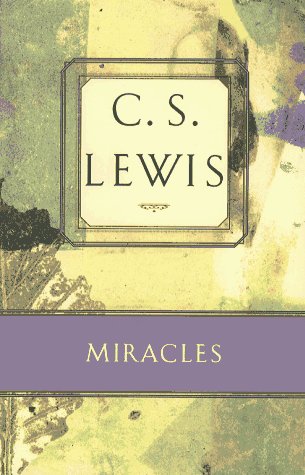
MiraclesReading C.S. Lewis elaborate on theology is no easy task. But for those willing to work through his profound thoughts, a treasure trove of new insights into Scripture await. Miracles: How God Intervenes In Nature And Human Affairs is no exception to this.

“Miracle” is directly mentioned so 30 times in Scripture, but the Bible never explicitly defines miracle. Lewis gives this definition: “I use the word Miracle to mean an interference with Nature by supernatural power.” He then proceeds to explain what philosophers such as Socrates, Plato and Aristotle meant by “nature” and “super-nature” and how those understandings have been dismissed, adapted or corrupted throughout history.

Lewis moves through several chapters without admitting miracles are probable (or even possible) and without ascribing any possible miracles to God. When he finally reveals that there is a God, he states, “From the admission that God exists and is the author of Nature, it by no means follows that miracles must, or even can, occur.” He then moves to the Scripture to show how God could—and indeed, does—work miraculously.

Even after all of Lewis’ brilliant arguments, I appreciate one of his final admissions in this book: “If you find that [these ideas] so distract you, think of them no more. I most fully allow that it is of more importance for you or me today to refrain from one sneer or to extend one charitable thought to an enemy than to know all that angels and archangels know about the mysteries of the New Creation.”

Even for those who accept his arguments, Lewis offers this counsel: “My work ends here. If, after reading it, you now turn to study the historical evidence for yourself, begin with the New Testament and not with the books about it.” Ultimately I recommend this book for this one reason—Miracles creates a hunger to study God’s Word more.

Archeological Study Bible (book review)

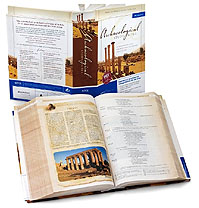
Archeological Study BibleNormally I post book reviews after I have completely read a book. But since I’m going to be working my way through The Archeological Study Bible for quite some time, I thought now was as good a time as any to share my thoughts.

I have never been able to read through the Bible in a year. I find too many fascinating subjects that keep me locked into a passage, and so it ends up putting me hopelessly behind such a rigorous reading schedule. In this study Bible, I’m finding even more fascinating reading that is making God’s Word come alive (and consequently causing me to pause even longer on certain passages)!

Since archeology and anthropology put human history in order, I am reading through the Scripture in its chronological order (i.e. not in the order the books appear in the Bible, but in the order the historical events occurred. There is a helpful chronological list on BibleGateway.com). The Archeological Study Bible is adding such a richness to the places and people and customs that are chronicled in Scripture. With each commentary, map, chart, graph, or in-depth article, I am learning about the cultures in which the people of the Bible lived, and the prevailing thoughts and customs in which biblical writers wrote the Spirit-inspired Scriptures. It is quite fascinating!

If you would like to add a new level of richness to your Bible study, this study Bible should definitely be a part of your library.

14 Quotes From “Pentecost”

Pentecost

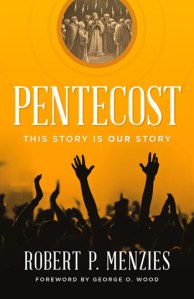
I thoroughly enjoyed reading Pentecost by Robert P. Menzies, and learned quite a bit. You can read my full book review by clicking here. Here are a few quotes that stood out to me.

“It’s because Pentecostals fuse the biblical and contemporary horizons that we link baptism in the Holy Spirit with speaking in tongues, since that’s what Acts 2 does. It’s why we associate Spirit-baptism with empowerment for mission rather than with spiritual regeneration. And it’s why we expect God to perform ‘signs and wonders’ and to manifest spiritual gifts in worship services. All these things happened in the first Pentecostal community, and their story is our story.” 

“At its heart, the Pentecostal movement is not Spirit-centered but Christ-centered. The work of the Spirit, as Pentecostals understand it, centers on exalting and bearing witness to the Lordship of Christ.”

“Pentecostals are ‘people of the Book.’ Although Pentecostals certainly encourage spiritual experience, they do so with a constant eye to Scripture.”

“So, the stories of Acts are our stories, and we read them with expectation and eagerness: stories of the Holy Spirit’s power, enabling ordinary disciples to do extraordinary things for God. … The hermeneutic of the typical Pentecostal believer is straightforward and simple: the stories in Acts are my stories—stories that were written to serve as models for shaping my life and experience.”

“In Luke’s view, every member of the church is called (Luke 24:45–49; Acts 1:4–8/Isaiah 49:6) and empowered (Acts 2:17–21; cf. 4:31) to be a prophet. Far from being unique and unrepeatable, Luke emphasizes that the prophetic enabling experienced by the disciples at Pentecost is available to all of God’s people. … Through his two-volume work, Luke declares that the church, by virtue of its reception of the Pentecostal gift, is nothing less than a community of prophets. It matters not whether we are young or old, male or female, rich or poor, black or white; the Spirit of Pentecost comes to enable every member of the church, each one of us, to fulfill our prophetic call to be a light to the nations.” 

“Not long ago a Chinese house church leader commented, ‘When Western Christians read the book of Acts, they see in it inspiring stories; when Chinese believers read the book of Acts, we see in it our lives.’”

“Luke’s theology of the Spirit is different from that of Paul. Unlike Paul, who frequently speaks of the soteriological dimension of the Spirit’s work, Luke consistently portrays the Spirit as a charismatic or, more precisely, a prophetic gift, the source of power for service.” 

“Luke crafts his narrative so that the parallels between Jesus’ experience of the Spirit (Luke 3–4) and that of the disciples on the day of Pentecost (Acts 1–2) cannot be missed. Both accounts: 1. Are placed at the outset of Luke’s Gospel on the one hand, and the book of Acts on the other; 2. Associate the reception of the Spirit with prayer; 3. Record visible and audible manifestations; 4. Offer explanations of the event in the form of a sermon that alludes to the fulfillment of Old Testament prophecy.”

“Luke’s understanding of baptism in the Holy Spirit, I have argued, is different from that of Paul. It is missiological rather than soteriological in nature. … The tendency in Protestant churches has been to read Luke in the light of Paul. Paul addresses pastoral concerns in the church; Luke writes a missionary manifesto.” 

“Bold witness for Jesus is recognized as our primary calling and the central purpose of our experience of the Spirit’s power. Missions is woven into the fabric of our DNA.”

“I do not wish to minimize in any way the significance of the great doctrinal truths of Paul’s writings. I merely point out that since Paul was, for the most part, addressing specific needs in various churches, his writings tend to feature the inner life of the Christian community. His writings, with some significant exceptions, do not focus on the mission of the church to the world. … It is probably fair to say that while Paul features the ‘interior’ work of the Spirit (e.g., the fruit of the Spirit, Gal. 5:22–23); Luke features His ‘expressive’ work (Acts 1:8). Thus, by appropriating in a unique way the significant contributions of Luke-Acts, Pentecostals have developed a piety with a uniquely outward or missiological thrust.”

“The clarity of the Pentecostal message flows from the simple, straightforward manner in which we read the Bible. As I have noted, Pentecostals love the stories of the Bible. We identify with the stories that fill the pages of the Gospels and Acts, and the lessons gleaned from these stories are easily grasped and applied in our lives. For Pentecostals, the New Testament presents models that are to be emulated and guidelines that are to be followed. It should be noted that our approach to doing theology is not dependent on mastering a particular set of writings, say, the works of Luther; or coming to terms with a highly complex theological system. Pentecostals also do not worry much about cultural distance or theological diversity within the canon. We do not lose sleep over how we should understand the miracle stories of the Bible or how we might resolve apparent contradictions in the Bible. Our commitment to the Bible as the Word of God enables us to face these questions with a sense of confidence.”

“We must remember that whatever we do, God is measuring the work we do for Him in a qualitative, not quantitative way. … Only the work which is done by the power of the Holy Spirit can be acceptable in the Kingdom of God.” —David Yonggi Cho

“Some will still remain skeptical. They will ask: Is not this approach to church life, with its emphasis on ecstatic experience, emotional response, and spiritual power, filled with inherent dangers? Might it not encourage us to feature emotionally manipulative methods and to focus on superficial matters? Yes, undoubtedly, there are dangers. However, there is more danger in an approach that fails to make room for the full range of human experience, including the emotions, in our encounter with God.”

Pentecost (book review)

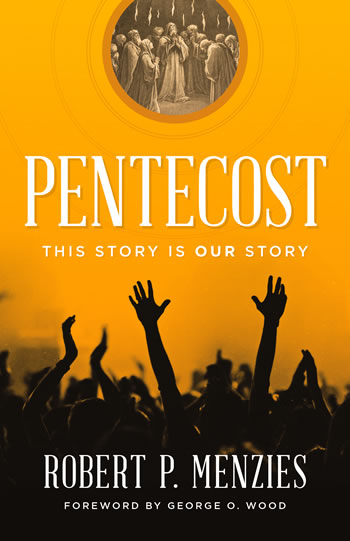
PentecostI grew up with this stuff: I’m a fourth-generation Pentecostal, so I cut my teeth on this distinctive doctrine. But I was still amazed at the depth of insight into this dynamic theology that Dr. Robert Menzies shares in Pentecost: This Story Is Our Story.

Although Dr. Menzies shares a number of anecdotal stories to help illustrate certain points, this book is really a serious doctrinal work. Many people have written-off the operational gifts of the Holy Spirit seen in the book of Acts as something that ceased at the death of the apostles, or at the closing of the cannon of Scripture. But Dr. Menzies points out from the outset that Luke’s writings in the Gospel that bears his name and in the book of Acts are not just historical, but doctrinal too.

Many times people look at Paul’s writings as doctrinal, and the four Gospels and Acts as simply historical; thus giving more “weight” to the Pauline epistles. Dr. Menzies persuasively shows that Luke’s writing in Luke-Acts is just as doctrinal, and just as Holy Spirit-inspired, as every other book of the New Testament. In fact, he really goes beyond that to show how Luke’s writing is heavily influenced by Old Testament prophesies about the coming of the Messiah and the subsequent outpouring of the Holy Spirit.

This is not a sensational book, but a scholarly work. It is extensively referenced, as evidenced by the ample endnotes. But don’t let this scare you off as a book just for pastors and theologians, as Dr. Menzies’ writing style is very readable by all.

Anyone who is interested in this distinctive doctrine of the Holy Spirit should read Pentecost.

6 Quotes From “The Global War On Christians”

The Global War On ChristiansYesterday I shared some eye-opening statistics from The Global War On Christians by Jeff L. Allen, Jr. Below are some of the quotes which especially stood out to me. If you want to read my full review of this book, please click here.

“Spectacular outbreaks of violence are often produced by less intense incidents, such as believers being harassed on the streets, slurred in the media, shunned in the workplace, and hassled as they gather to worship. The usual cycle is for complaints to be made about these incidents, which are then ignored or dismissed. That failure to act usually serves to emboldened the perpetrators, who then may become more likely to move on to even more lethal assaults, in effect testing the limits of official tolerance.”

“The bottom line is that the global war on Christians will never be won as long as the myth persists that nobody’s really responsible for it.”

“Perpetuating the idea that Islam is by far the primary threat facing Christians in the early twenty-first century also stokes the idea of a ‘clash of civilizations’ between the two faiths, adding fuel to the fire of those who long for a new holy war. That doesn’t do justice to the complex reality of the situation, as there are examples of both conflict and coexistence, and for every virulent and dangerous current in the Islamic world there are also movements and individuals devoted to peace.” 

“Politically correct silence does no one any good, and arguably insults the dignity of those who run risks to life and limb on a daily basis to keep the faith alive.”

“Politics distorts perceptions of the global war on Christians in another sense. Ideological bias tempts observers in the West to see only part of the picture. Those on the political left may celebrate martyrs to corporate greed or to right-wing the police states, but fear to speak out about the suffering of Christians behind the lines of the Islamic world. Conservatives may be reluctant to condemn the situation facing Christians in the state of Israel or in regimes that are presently in fashion on the right has allies in the ‘war on terror.’ Either way, the result is a reductive reasoning of the true score of anti-Christian persecution, and a double standard when it comes to engaging its protagonists. If we want to see the global war on Christians clearly, we have to stop looking at it through the funhouse mirror of secular politics.”

“Historically, waves of persecution have fueled major advances for Christianity. … Today, it’s no accident that zones where persecution of Christians is the most intense… are also the places where Christianity is growing the most dramatically.”

8 Statistics From “The Global War On Christians”

The Global War On ChristiansI found some of the statistics reported in The Global War On Christians by John L. Allen, Jr., to be quite eye-opening. You can read my full book review by clicking here, but these are some of the stats that caught my attention—

“Open Doors… estimates that one hundred million Christians worldwide presently face interrogation, arrest, torture, or even death because of their religious convictions.” 

“Two of the world’s leading demographers of religion, David B. Barrett and Todd Johnson, have performed an exhaustive statistical analysis of Christian martyrdom, reaching the conclusion that there have been 70 million martyrs since the time of Christ. Of that total, fully half, or 45 million, went to their deaths in the twentieth century, most of them falling victim to either Communism or National Socialism. More Christians were killed because of their faith in the twentieth century than in all previous entries combined. … Christians today are, by some order of magnitude, the most persecuted religious body on the planet, suffering not just martyrdom but all the forms of intimidation and depression mentioned above in record numbers. That’s not a hunch, or a theory, or in anecdotal impression, but an undisputed empirical fact of life.”

“In 1919, just 9 percent of Africa was Christian. As of early 2013 it was 63 percent, for a grand total of 380 million Christians on the continent. These folks are scattered across a stunning 552,000 congregations and 11,500 denominations…. Most of this growth has occurred since the last quarter of the twentieth century and is the result of indigenous African evangelizing efforts rather than Western missionaries.”

The top five most hazardous nations on earth in which to be a Christian:

  1. North Korea
  2. Afghanistan
  3. Saudi Arabia
  4. Somalia
  5. Iran

“One estimate is that there are 47 million Pentecostals in China alone, despite the best efforts of the officially atheistic government to rein in their expansion. … The Center for the Study of Global Christianity, which issues the much-consulted World Christian Database, says there are 111 million Christians in China, roughly 90 percent Protestant. That would make China the third largest Christian country on earth, following only the United States and Brazil.” 

“Open Doors… estimates the total number of Christians in North Korea to range from 200,000 to half a million, with at least a quarter of those believers currently behind bars in prison camps.”

“In the 1990s… conversions from Catholicism to Protestantism in Latin America during the twentieth century actually surpassed the Protestant Reformation in Europe in the sixteenth century.”

“A September 2012 report by the Pew Forum concluded that ‘a rising tide of restrictions on religion [has] spread around the world.’ Among other points, the study found that 37 percent of nations in the world have high or very high restrictions on religion, up from 31 percent a year ago, a six-point spike in just 12 months, and that three-quarters of the world’s population of 7 billion, meaning 5.25 billion people, live in countries with high or very high restrictions on religion. That’s up from 70 percent from the previous year.”

You can also read some quotes from this amazing book by clicking here.

The Global War On Christians (book review)

The Global War On ChristiansThe reports of violence against Christians is in the news almost daily, but it should be something which dominates our headlines. Less than five pages into The Global War On Christians by John Allen, Jr. I was smacked between the eyes with this statistic: “One hundred million Christians worldwide presently face interrogation, arrest, torture, or even death because of their religious convictions.” Talk about a wake-up call!

Allen does sound the wake-up call quite clearly. The first section of the book reads a little like Fox’s Book Of Martyrs from the 16th century, except these dispatches are happening right now! Allen takes us around the globe in this section with general statistics for each region, and stories of individuals that put a “face” on the already-sickening statistics. After reading this section, you may wonder, as I did, why these reports aren’t the lead news story every single day.

In the second section Allen debunks the five most common myths used to keep people comfortably numb to the atrocities happening to our Christians brothers and sisters around the globe. This is an excellent refutation to those who may say, “It’s not our problem” or “How could I do anything about this anyhow.”

In the final section of the book, Allen brings all of the stories and statistics right onto your front doorstep. He vividly and, I believe, accurately describes what will happen if we continue to allow this persecution to take place unchallenged and unreported. Truly this book is a wake-up call, and should be read by every liberty-loving, religion-cherishing, thoughtful person in America.

I am an Image book reviewer.