We Are: Pentecostal

Pentecost for over 1500 years was a celebration in Jerusalem that brought in Jews from all over the world. But on the Day of Pentecost that came just ten days after Jesus ascended back into heaven, the meaning of Pentecost was forever changed! 

Followers of Jesus—now empowered by an infilling of the Holy Spirit—began to take the good news of Jesus all over the world. These Spirit-filled Christians preached the Gospel and won converts to Christ even among hostile crowds, performed miracles and wonders, stood up to pagan priests and persecuting governmental leaders, and established a whole new way of living as Christ-followers. 

We, too, can be Pentecostal followers of Jesus Christ today. We can experience an anointing and an empowering in our lives that turns ordinary Christianity into extraordinary Christianity! 

Please join me this Sunday as we rejoin this series. You can check out what I taught in this series in 2019 by clicking here, and the topics I covered in 2020 are on this list.

Check out the messages in the 2021 series:

Confirmation Of The Baptism In The Holy Spirit

Listen to the podcast of this post by clicking on the player below, and you can also subscribe on Apple or Spotify.

The baptism in the Holy Spirit is what Pentecostal Christians frequently refer to as our distinctive doctrine. Notice I said distinctive, not better. Can someone go to heaven without being baptized in the Spirit? Yes! But I’ve found that living in this distinctive empowerment makes the journey to heaven so much more productive and joyful.   

After the resurrection of Jesus, everything took on a whole new meaning, because the “light” had been turned on in the Old Testament palace. All of the practices that Jews had been observing for thousands of years suddenly had a new illumination in the New Testament.  

Pentecost had always been a celebration 50 days following the Passover. In the Old Testament, the law was given from Sinai on the fiftieth day after the deliverance from Egypt, so in a sense, the appearance of God on Sinai was the birthday of the Jewish nation. In the New Testament, the first outpouring of the Holy Spirit on the first Pentecost after Jesus ascended to heaven was the birthday of the Christian nation for all people. 

One of our foundational truths says: “All believers are entitled to and should ardently expect and earnestly seek the promise of the Father, the baptism in the Holy Spirit and fire, according to the command of our Lord Jesus Christ. This was the normal experience of all in the early Christian Church.” 

And another foundational truth is a corollary: “The baptism of believers in the Holy Spirit is witnessed by the initial physical sign of speaking with other tongues as the Spirit of God gives them utterance.” 

God has always confirmed His presence with signs and wonders. From the signs in Egypt to convince Pharaoh that Jehovah was greater than the Egyptian gods to the ministry of Jesus. In fact, Peter said that the signs and wonders done by Jesus were God’s authentication of His ministry (see Luke 5:17-26; Acts 2:22; Acts 10:38). 

Jesus said this should characterize our ministry too (see Mark 16:15-20; Acts 1:5, 8).  

R.A. Torrey noted, “The baptism of the Holy Spirit always imparts power for service…. The baptism of the Holy Spirit is the Spirit of God falling upon the believer, taking possession of his faculties, imparting to him gifts not naturally his own, but which qualify him for the service to which God has called him.” 

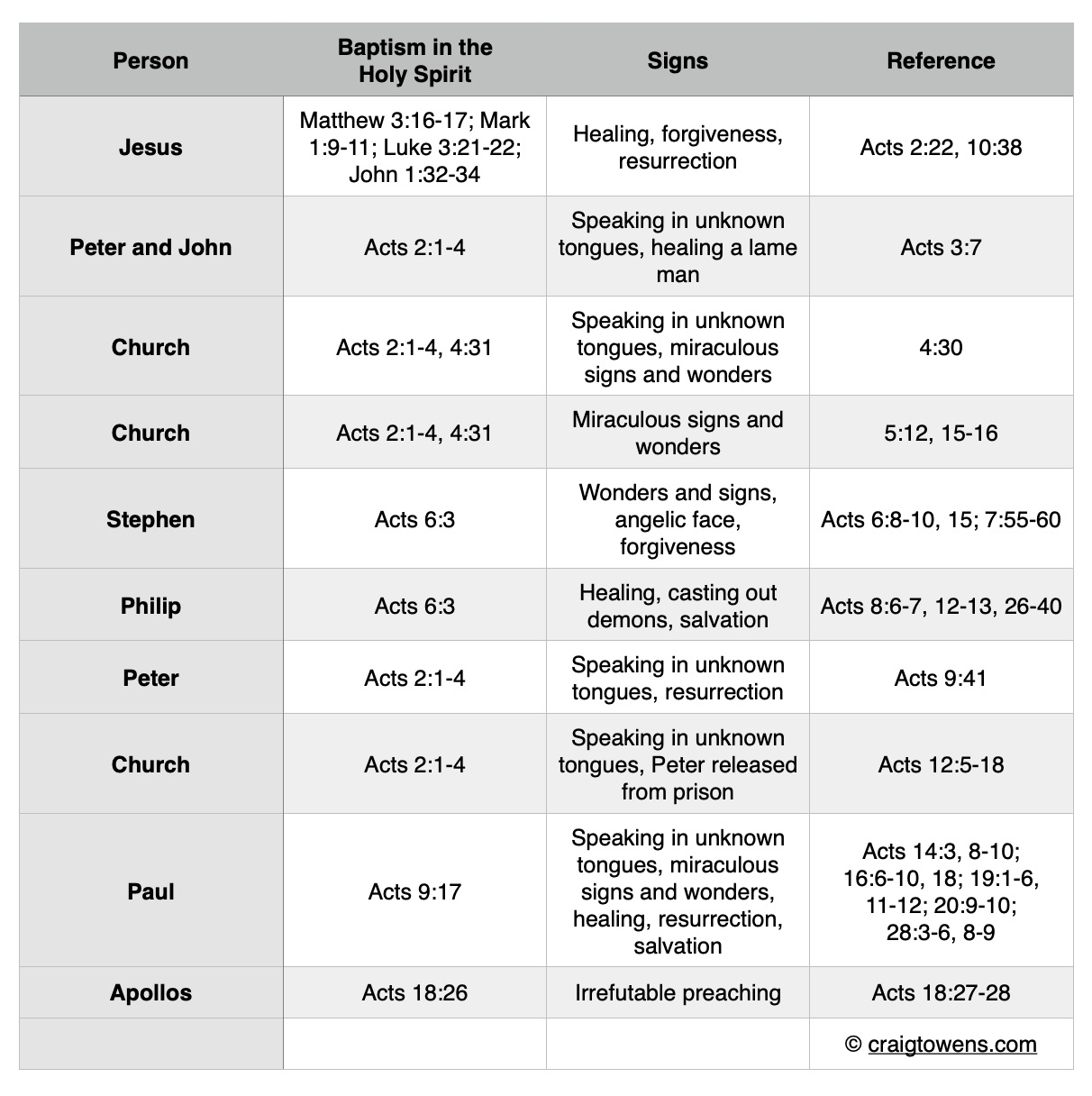
Check out this chart that walks us through the book of Acts to see how God authenticated the ministry of those who were baptized in the Holy Spirit by performing signs and wonders through them:

You may download this chart in a PDF format by clicking here Chart of signs in Acts ←

When a Christian is baptized in the Holy Spirit there are two types of evidence:

  1. Initial evidence—typically speaking in a language that hasn’t been studied but has been supernaturally given by God. 
  2. Ongoing evidence—I would sum this up in the word sanctification (or as I like to remember it by saying “saint-ification”). This is the lifestyle change, the empowered living, and even the miraculous that cannot be counterfeited by man’s efforts alone. 

Let’s not try to put God in a box—telling Him when, where, how, and through whom He can work. Instead, let’s yield ourselves entirely to Him by letting the Holy Spirit empower us to be effective, unmistakable witnesses for Jesus Christ. 

►► Would you please prayerfully consider supporting this ministry? ◀︎◀︎

I will be relaunching our series called We Are: Pentecostal in two weeks. Please follow along with all of the messages in this series by clicking here for the details.

And if you would like to check out the other messages in our series looking at our foundational belief statements, you can find the full list by clicking here.

Thursdays With Spurgeon—The Wonderful Works Of God

This is a weekly series with things I’m reading and pondering from Charles Spurgeon. You can read the original seed thought here, or type “Thursdays With Spurgeon” in the search box to read more entries.

The Wonderful Works Of God

Now there were staying in Jerusalem God-fearing Jews from every nation under heaven. … Utterly amazed, they asked “Are not all these men who are speaking Galileans…declaring the wonders of God in our own tongues!” (Acts 2:5-11) 

     The Holy Spirit being thus at work, what was the most prominent subject that these full men begin to preach about with words of fire? Suppose that the Holy Spirit should work mightily in the church. What would our ministers preach about? We should have a revival, should we not, of the old discussions about predestination and free agency? I do not think so! These are happily ended, for they tend toward bitterness, and, for the most part, the disputants are not equal to the task. We should hear a great deal about the premillennial and the postmillennial advent, should we not? I do not think so! I never saw much of the Spirit of God in discussions or dreams upon times and seasons that are not clearly revealed. Should we not hear learned essays about advanced theology? No, sir. When the devil inspires the church, we have modern theology—but when the Spirit of God is among us, that rubbish is shot out with loathing! 

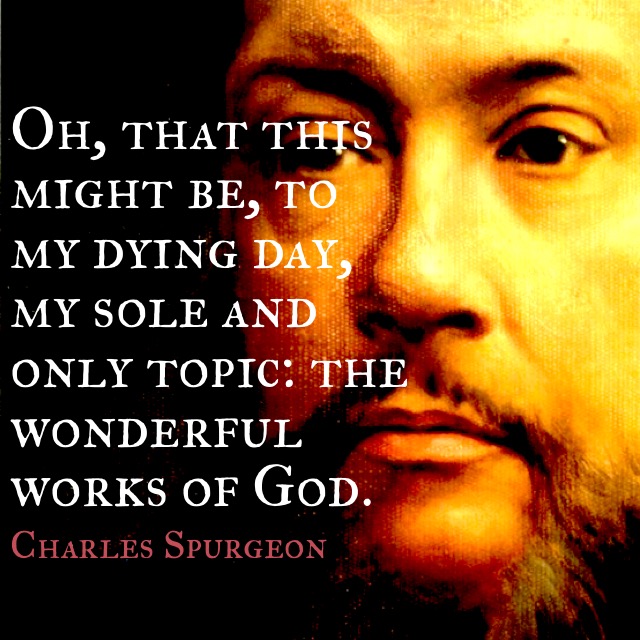
     What did these men preach about? Their hearers said, ‘We hear them speaking in our own tongues the wonderful works of God’ (Acts 2:11). The subject was the wonderful works of God! Oh, that this might be, to my dying day, my sole and only topic: ‘the wonderful works of God.’

From Pentecostal Wind And Fire

Whether we are pastors or parishioners, may our heart cry echo that of Charles Spurgeon: May all that comes from my lips be words that tell of the wonderful works of God! 

After the Church was born on that Pentecost Sunday, their message wasn’t one of doctrinal differences or the ills of society. No! These Spirit-baptized Christians went everywhere proclaiming how wonderful it was to be in a personal relationship with our Heavenly Father through the way opened to us by the death and resurrection of Jesus. 

May we emulate their example today: Empowered by the Holy Spirit to go everywhere and tell everyone how wonderful our God is!


Thursdays With Spurgeon—Church On Fire

This is a weekly series with things I’m reading and pondering from Charles Spurgeon. You can read the original seed thought here, or type “Thursdays With Spurgeon” in the search box to read more entries.

Church On Fire

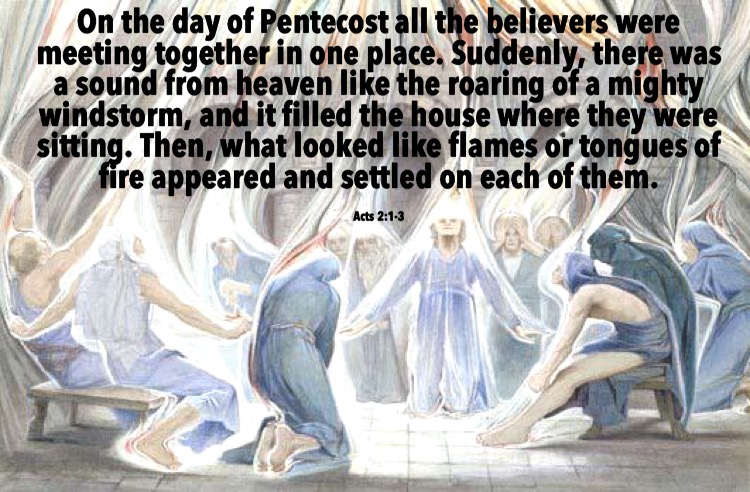
On the day of Pentecost all the believers were meeting together in one place. Suddenly, there was a sound from heaven like the roaring of a mighty windstorm, and it filled the house where they were sitting. Then, what looked like flames or tongues of fire appeared and settled on each of them. (Acts 2:1-3) 

     We are poor, empty things by nature, and useless while we remain so. We need to be filled with the Holy Spirit. Some people seem to believe in the Spirit of God giving utterance only, and they look upon instruction in divine things as of secondary importance. Dear, dear me! What trouble comes when we act upon that theory! How the empty vessels clatter, rattle, and sound! … Where the Spirit of God is truly at work, He first fills and then gives utterance—that is His way. …  

     Full! Then they were not cold, dead, and empty of life as we sometimes are. Full. Then there was no room for anything else in any one of them! They were too completely occupied by the heavenly power to have room for the desires of the flesh! Fear was banished; every minor motive was expelled! The Spirit of God, as it flooded their very beings, drove out of them everything that was extraneous. They had many faults and many infirmities before, but that day, when they were filled with the Spirit of God, faults and infirmities were no more perceptible! They became different men from what they had ever been before. Men full of God are the reverse of men full of self! …  

     The next Pentecostal symbol was utterance. … When the Spirit of God really comes upon a man, he does not wait till he has gathered an audience of the size that he desires, but he seizes the next opportunity! He speaks to one person. He speaks to two. He speaks to three—to anybody. …  

     When the Spirit of God fills a man, he speaks so as to be understood. … The crowd not only understood, they felt. There were lancets in this Pentecostal preaching, and the hearers ‘were pricked in their heart’ (Acts 2:37). … Those are the two effects of the Holy Spirit—a fullness of the Spirit in the ministry and the church, and next, a fire ministry and a church on fire, speaking so as to be felt and understood by those around!

From Pentecostal Wind And Fire

Oh, how I want this today! 

Let’s seek the fullness and the utterance that can only come through the baptism in the Holy Spirit! Let’s be set on fire so that we can impact the world around us! 

Thursdays With Spurgeon—The Purpose Of The Baptism In The Holy Spirit

This is a weekly series with things I’m reading and pondering from Charles Spurgeon. You can read the original seed thought here, or type “Thursdays With Spurgeon” in the search box to read more entries.

The Purpose Of The Baptism In The Holy Spirit

On the day of Pentecost all the believers were meeting together in one place. Suddenly, there was a sound from heaven like the roaring of a mighty windstorm, and it filled the house where they were sitting. Then, what looked like flames or tongues of fire appeared and settled on each of them. (Acts 2:1-3) 

     Ordinary winds blow from this or that quarter of the skies, but this descended from heaven itself. It was distinctly like a downdraft from above. This sets forth the fact that the true Spirit, the Spirit of God, comes from neither this place nor that, neither can His power be controlled or directed by human authority. His working is always from above, from God Himself! The work of the Holy Spirit is, so to speak, the breath of God, and His power is always, in a special sense, the immediate power of God. …  

     Tongues of flame sitting on each man’s head symbolized a personal visitation to the mind and heart of each one of the chosen company. The fires came not to consume them, for the flaming tongue injured no one. To men whom the Lord has prepared for His approach, there is no danger in His visitations. They see God and their lives are preserved. They feel His fires and are not consumed. This is the privilege of only those who have been prepared and purified for such fellowship with God. The intention of the symbol was to show them that the Holy Spirit would illuminate them as fire gives light. ‘He will guide you into all truth’ (John 16:13). … 

     But the fire does more than give light; it inflames, and the flames that sat upon each show them that they were to be ablaze with love, intense with zeal, burning with self-sacrifice, and that they were to go forth among men to speak not with the chill tone of deliberate logic, but with burning tongues of passionate pleading, persuading, and entreating men to come to Christ that they might live! The fire signified inspiration. God was about to make them speak under a divine influence, to speak as the Spirit of God should give them utterance. …  

     O You who are our God, answer us by fire, we pray! Answer us both by wind and fire and then we will see You to be God indeed. The kingdom comes not and the work is flagging. Oh, that You would send the wind and fire! You will do this when we are all of one accord: all believing, are expecting, and all prepared by prayer. Lord, bring us to this waiting state!

From Pentecostal Wind And Fire

As I said earlier, Pentecost is not the culmination of God’s power, it is the initiation of His power that is necessary to empower us to be witnesses for Jesus. 

If Jesus said that we needed this power to live and testify for Him, why would we ever want anything but the full outpouring of this Holy Spirit power?! Jesus Himself relied on the power of the Holy Spirit during His earthly ministry, so how much more so do we need this baptism into the fire and wind of the Spirit!

Thursdays With Spurgeon—The Initiation Of Power

This is a weekly series with things I’m reading and pondering from Charles Spurgeon. You can read the original seed thought here, or type “Thursdays With Spurgeon” in the search box to read more entries.

The Initiation Of Power 

     Whatever the Holy Spirit was at the first, He is that now, for as God, He remains forever the same. … We would greatly grieve the Holy Spirit if we supposed that His might was less today than in the beginning. …  

     If at the commencement of the gospel we behold the Holy Spirit working great signs and wonders, may we not expect a continuance of and, if anything, increased displays of His power as the ages roll on? … 

     It ought not to be forgotten that Pentecost was the feast of firstfruits. It was the time when the first ears of ripe corn were offered to God. If, then, at the commencement of the gospel harvest we see so plainly the power of the Holy Spirit, may we not most properly expect infinitely more as the harvest advances and, most of all, when the most numerous sheaves will be gathered? May we not conclude that if the Pentecost was thus marvelous, the actual harvest will be still more wonderful?

From Pentecostal Wind And Fire

When Jesus was approaching the Cross, He gathered His disciples together to tell them what was coming. One of the assurances He gave His followers was this: “I assure you, most solemnly I tell you, if anyone steadfastly believes in Me, he will himself be able to do the things that I do; and he will do even greater things than these, because I go to the Father” (John 14:12). 

The empowering force for these “greater things” would be the Holy Spirit indwelling the Christian (Matthew 3:11; Luke 24:49; Acts 1:8, 2:1-4). 

Pentecost wasn’t the culmination, it was the initiation. 

Pentecost was the launching point for followers of Jesus to be filled with dunamis power that would enable them to go into all the world and preach the gospel, and to have signs and wonders follow to confirm the preaching of the Word. 

As Spurgeon said, we greatly grieve the Holy Spirit when we attempt to put Him in a box as to what He can or can’t do today, or if we try to limit Him to one era of long-past history. The Holy Spirit is as vital for a Christian today as He was on that Pentecost Sunday described in Acts 2! 

Thursdays With Spurgeon—God’s Part, Our Part

This is a weekly series with things I’m reading and pondering from Charles Spurgeon. You can read the original seed thought here, or type “Thursdays With Spurgeon” in the search box to read more entries.

God’s Part, Our Part

     The lesson is clear to all: The wind turns mills that men make. It fills sails that human hands have spread. And the Spirit blesses human effort, crowns with success our labors, establishes the work of our hands upon us, and teaches us all through that ‘the hand of the diligent makes rich’ (Proverbs 10:4). And ‘if anybody will not work, neither shall he eat’ (2 Thessalonians 3:10). … 

     Let us do our part faithfully, spread every sail, make all as perfect as human skill and wisdom can direct, and then in patient continuance in well-doing await the Spirit’s propitious gales, neither murmuring because He tarries nor being taken unawares when He comes upon us in His sovereign pleasure to do that which seems good in His sight.

From The Holy Spirit Compared To The Wind 

We cannot do what only God can do, and God will not do what we are supposed to do. It is the Holy Spirit who can help us keep those two thoughts clear. 

It’s wrong to say, “God only helps those who help themselves.” But it’s equally as wrong to say, “I don’t need to do anything except wait for God.” In example after example in the Bible we see people doing their part while at the same time believing for God to do something miraculous:

We don’t take matters into our own hands, but neither do we sit idle waiting for something miraculous to happen. We plant, and water, and tend, and then God brings the harvest.

Thursdays With Spurgeon—Getting Into The Truth

This is a weekly series with things I’m reading and pondering from Charles Spurgeon. You can read the original seed thought here, or type “Thursdays With Spurgeon” in the search box to read more entries.

Getting Into The Truth 

     The difficulty is the truth is not so easy to discover. There is no man born in this world by nature who has the truth in his heart. … Then since we are not born with the truth, we have the task of searching for it. … But here is the difficulty, that we cannot follow without a guide the winding path of truth. Why is this?

     First, because of the very great intricacy of truth itself. Truth itself is no easy thing to discover. … The most earnest student of Scripture will find things in the Bible that puzzle him. However earnestly he reads it, he will see some mysteries too deep for him to understand. He will cry out, ‘Truth! I cannot find you.’ … But we bless God it is said, ‘When the Spirit of truth has come, He will guide you into all truth’ [John 16:13]. … 

     We also need a guide because we are so prone to go astray. … David says, ‘I have gone astray like a lost sheep’ (Psalm 119:176). … If grace did not guide a man, he would go astray though there were hand-posts all the way to heaven. 

     The ‘Spirit of truth’ [is] not an influence or an emanation but actually a Person. ‘When the Spirit of truth has come, He will guide you into all truth.’ … He is infallible. … He is ever-present. …  

     Man can guide us to a truth, but it is only the Holy Spirit who can guide us into a truth. ‘When He, the Spirit of trying has come, He will guide you into’—mark that word—‘truth.’ … You may be brought to a chamber where there is an abundance of gold and silver, but you will be no richer unless you effect an entrance. It is the Holy Spirit’s work to unbar the two-leaved gates and bring us into a truth so we may get inside it. 

From The Holy Spirit: The Great Teacher 

I have often said that the greatest Expositor of Scripture is the Holy Spirit. He is the One who inspired the biblical authors, and He is also the One living in a Christian to illuminate the biblical texts. 

Before you open your Bible, pray this prayer from the psalms, “Open my eyes to see wonderful things in Your Word” (Psalm 119:18). And then listen to the Spirit’s voice as He takes you into the truth that will enrich your life and bring God greater glory. Just like those first Christians who were baptized in the Holy Spirit became skilled in their understanding of Scripture, you can experience the exact same thing today!

I have a whole series of messages on the power of Pentecostal Christians that you can read by clicking here and here.

Thursdays With Spurgeon—In Pursuit Of Truth

This is a weekly series with things I’m reading and pondering from Charles Spurgeon. You can read the original seed thought here, or type “Thursdays With Spurgeon” in the search box to read more entries.

In Pursuit Of Truth 

     The disciples had been instructed concerning certain elementary doctrines by Christ, but He did not teach His disciples more than what we should call the ABCs of religion. He gives His reasons for this in the twelfth verse: ‘I still have many things to say to you, but you cannot bear them now’ [John 16:12]. His disciples were not possessors of the Spirit. They had the Spirit so far as the work of conversion was concerned, but not as to the matters of bright illumination, profound instruction, prophecy, and inspiration. Jesus says, ‘I am now about to depart, and when I go from you, I will send the Comforter to you. You cannot bear these things now. Howbeit, when He, the Spirit of truth, is come, He will guide you into all truth’ [John 16:13]. The same promise that He made to His apostles stands good to all His children. …  

     We think it is right that the Christian ministry should be not only arousing but instructing, not merely awakening but enlightening, that it should appeal not only to the passions but to the understanding. We are far from thinking doctrinal knowledge to be of secondary importance. We believe it to be one of the first things in the Christian life, to know the truth and then to practice it. …  

     What we call curiosity is something given us of God impelling us to search into the knowledge of natural things. That curiosity, sanctified by the Spirit, is also brought to bear in matters of heavenly science and celestial wisdom. … A true Christian is always intently reading and searching the Scriptures that he may be able to certify himself as to its main and cardinal truths. …  

     Depend on this: The more you know of God’s truth, all things being equal, the more comfortable you will be as a Christian. …  

     Knowledge of truth will make us very serviceable in this world. We will be skillful physicians who know how to take the poor distressed soul aside, to put the finger on his eye and take the scale off for him that heaven’s light may comfort him. … There is nothing like the real truth and the whole truth to make a man useful.  

From The Holy Spirit: The Great Teacher 

Throughout the public ministry of Jesus, the Gospels tell us of His apostles simply not understanding that Jesus was fulfilling Old Testament prophecy in all that He was doing. But all of that changed after the Day of Pentecost when then followers of Jesus were baptized in the Holy Spirit! 

Beginning with Peter’s sermon on the Day of Pentecost and throughout the rest of the New Testament, we see how the Christians took Old Testament Scriptures and applied them in the new understanding the Holy Spirit gave them of the work of Jesus. As a result, radical changes began to take place not only within the Church but throughout society as well. 

As Spurgeon noted, “The same promise that He made to His apostles stands good to all His children.” That promise of the Holy Spirit’s empowerment, illumination, creativity, and application of Scripture is still available for all Christians today! 

Don’t limit your Christian testimony or your effectiveness in the world by keeping the Holy Spirit relegated to some unknowable, mysterious work. Allow Him to be the driving force in all that you think and do! 

I have a whole series of messages on the power of Pentecostal Christians you can read by clicking here and here.
’…And Yet We May Not Be Christians’

Something serious for all Christians to ponder…

The disciples had life before our Lord breathed on them, but then they attained more. They had life before Pentecost, but then they obtained more. … Thus a man may be very like a saint and yet not be one. A church or a congregation may be very like a Christian one, with a fair appearance and compact organization; all in excellent bustling order, numerous, liberal, united, earnest after a sort; and yet lack one thing which neutralizes and paralyzes all the rest—the breath of life.

“Our creed may be sound, and yet we may not be Christians.

“Our religion may be externally complete, and yet we may not be Christians. … Mechanical religion may do for the gods of Greece and Rome, but not for the living and true God. … Your sanctuary attendance may be regular and reverent; but what if there be no breath in it? Your prayers and praises may be punctual and unexceptionable, but what if there be no breath in them? Will God accept them? Will they satisfy you? Will they make you happy? Will they not be irksome and intolerable? And the more you multiply them, the more intolerable.

“Our good works may be numerous and praiseworthy, yet we may not be Christians. It is not the work that makes the Christian, but the Christian that makes the work.

Our life may be exemplary, and yet we may not be Christians.” —Horatius Bonar, in Light & Truth—The Old Testament

[see Ezekiel 37:8, and this post that talks about the difference between the Holy Spirit being on a Christian versus in a Christian]