This morning on John Maxwell’s “Minute With Maxwell” he said: “Winners know they have to do the right thing and then they’ll feel good. Whiners want to feel good before they do the right thing.”
I have learned this is true in my life. If I wait until I feel like do something, I’ll make all kinds of excuses to avoid doing it. But if I do what I know I’m supposed to do I’ll feel good that I did it.
Good feelings follow good actions.
Winners do right to feel good.
Whiners wait to feel right before they do anything.
Behavioral psychologist William James wrote: “Action seems to follow feeling, but really action and feeling go together; and by regulating the action, which is under the more direct control of the will, we can indirectly regulate the feeling, which is not. Thus the sovereign voluntary path to cheerfulness, if our cheerfulness be lost, is to sit up cheerfully and to act and speak as if cheerfulness were already there.” (emphasis mine)
So let me ask you: Are you going to be a winner or a whiner today?
Why is it that a bad morning at school follows you and becomes a bad afternoon at home?
Why is that a bad day at work follows you and becomes a bad evening at home?
We all have a tendency to hang on to things. But the problem is we end up taking out our problems on those who didn’t create the problem. In other words, our family takes the heat from us because we know they will still love us, even after we unload on them. So we make our problem their problem.
Yes, we all need someone to listen to us vent when we’ve had a bad day, or we’ve been snubbed by someone, or we’ve gotten an after-school detention, or we’ve been chewed out by the boss. But venting is different from transferring. Venting is when we expressour hurts to someone who loves us; transferring is when we take out our hurts on someone who loves us.
Dr. Richard Dobbins gave some wise counsel on how to avoid doing this:
“Develop the mental and spiritual ability to put space between your workplace [or school] and your home life. Treat your home life like a sanctuary. Don’t bring the feelings created by being treated unfairly in the workplace [or school] home with you.”
Maybe this will help you. Here’s what I do: I have created a boundary line (in my case it’s a road) over which bad attitudes created during the day cannot cross. As I approach home I remind myself that my family was not who gave me trouble, so I’m not going to bring my trouble home to them. If I need to, I’ll stop my car and sit for a few minutes before I cross that boundary, just to make sure my attitude is right before I cross that boundary line.
Where’s your boundary? Where can you make some space, so that your home becomes (and remains) a sanctuary?
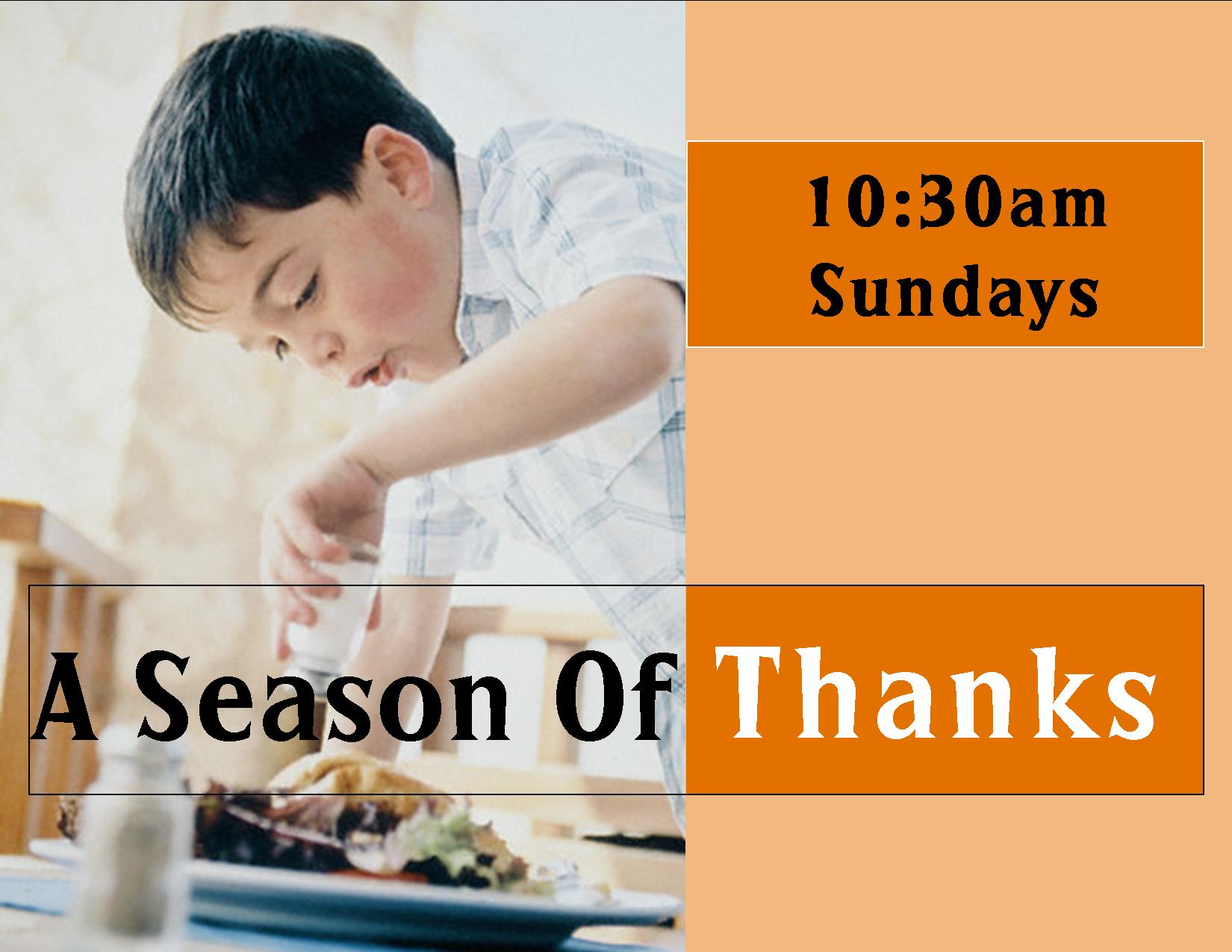
On Sunday we kicked off a new series A Season Of Thanks looking at this verse:
Since you have been raised to new life with Christ, set your sights on the realities of heaven, where Christ sits in the place of honor at God’s right hand. Think about the things of heaven, not the things of earth.
Here’s the deal: If you elevate your thinking to positive things, your life will be more positive. The best place to start is thank-fullness = being full of thanks. Make it a habit in your life to find more things for which you can give thanks.
I searched the Twitterverse for some thoughts about elevated thinking…
If you don't like something change it; if you can't change it, change the way you think about it.
I love studying leadership—leadership principles, leadership practices, and leadership people. There’s a great leadership case study in the Bible in the life of Joshua that always intrigues me.
Joshua had been through extensive preparation to become Moses’ successor. He was a recognized leader in his tribe, the general of the army, and an aide-de-camp to Moses for a number of years. But his most important leadership qualification: He was called by God.
As the story of his leadership opens in the first chapter of the Book of Joshua, God gives four requirements for Joshua (and you and me) to be effective in our leadership roles.
1. Be yourself. God didn’t say, “Be like Moses.” In fact, the only time God talks about Moses to Joshua is to reassure him, “I will be with you like I was with Moses.” But never once does God uses a “Moses Grading Scale” for Joshua. God simply says, “You will lead these people.”
2. Have an objective measuring stick. Feelings may change, but God’s Word never does. So God counsels Joshua to always rely on the Book of the Law.
3. Guard your thoughts. Leaders have so many people “in their ear” wanting to lobby for their way. So God tells Joshua to not only read the Bible but meditate on it as well. One definition of meditation is to hum God’s Word. In other words, humming God’s Word will help a leader know which lobbying voice is in harmony with God’s Voice, and which lobbying voice is off-key.
4. Guard your attitude. God repeats this to Joshua, “Do not be afraid; do not be discouraged.” Even doing everything they are supposed to be doing, leaders can become afraid to make a change, or discouraged because people aren’t following along. These feelings must be driven out with one firm declaration: “I know the Lord has called to this leadership position, so I know the Lord is with me. He will enable me to complete what He has called me to do.”
God’s direction to Joshua is still great counsel for leaders today.
Listen to the podcast of this post by clicking on the player below, and you can also subscribe on Apple, Spotify, or Audible.
“Dear Lord, I pray that You will help me be successful on my job today. Help me to make that sale [close that deal, get the promotion, earn the raise]. Bless me today. Amen.” All over the world today people at work are praying something similar to this. Does God notice? Is this a prayer God wants to answer?
I’ve been thinking about this a lot lately. I’ve been wondering if asking God to bless my efforts is praying a selfish prayer.
That well-known prayer by Jabez sounds very similar, doesn’t it? “Oh, that You would bless me and enlarge my territory!” This prayer must have pleased God because the verse ends with, “And God granted his request” (1 Chronicles 4:9-10).
In the life of Joseph, the phrase about his on-the-job success is repeated again and again. First in Potiphar’s house, and then in prison, and then in the royal court we see the phrase “Joseph prospered” (for those of you keeping track at home, that means Joseph was a success at the office). We don’t see Joseph praying for this success, but we see him walking in it nonetheless.
But here’s the key component: it’s all about your heart attitude. In other words, it’s all about how you intend to become successful and what you plan to do with your success.
When Jabez and Joseph were successful on the job, everyone around them knew it was because they did things God’s way. And everyone around them got to share in the blessings of their successes.
Do you want success on the job? Go ahead and pray for God to “enlarge your territory” or help you to “prosper.” Then do things God’s way, and be sure to give Him the credit for your success. I believe that God wants to give you more and more on-the-job success so that He is glorified, and so that others around you recognize God’s provision.
Keep praying for success. I’m praying that for myself and for you too.
This Sunday at Calvary Assembly of God we start a brand new series called Fall: We all fall, but falling doesn’t have to be fatal. If we have the right attitude about it, the times that we fall can be some of the most instructional times of our lives.
A man with a great fall down attitude was Thomas Alva Edison. Check out these snippets from this inventor’s life:
“If I find 10,000 ways something won’t work, I haven’t failed.” —Edison’s answer to a newspaper reporter’s question about how he felt about his 10,000 failed attempts to perfect the incandescent light bulb
“Son, there’s great value in disaster. All our mistakes are burnt up. Thank God we can start all over again.” —Edison, at age 67, speaking to his son Charles while they were watching his laboratory being destroyed by fire
“I’ve had a lot of success with failure.”
Falling down doesn’t have to be fatal. With the right attitude, falling down can be one of the most instructional times of our lives. Come join me on Sunday morning at 10:30am to hear more about the attitude that makes success out of failure.
I know that you had a very important conversation yesterday. And I also know that you are going to have an extremely important conversation again today. The question is not if you had the conversation, it’s whether or not you heard the conversation clearly?
The most important conversation you will have today is the ongoing conversation you will have all day long with yourself.
But are you clearly listening to what you are saying to yourself?
I was helping Betsy grade some papers from her fourth-grade students and I noticed something consistently appearing on one of her student’s papers. This student performs well academically, and Betsy says her behavior in the classroom is “angelic.” So I don’t think it’s coincidental that this young lady talks to herself positively all day long. On her papers she writes notes to herself like “You R The Best” and “I rock!”
The way you speak to yourself matters.
The way you speak to yourself determines your attitude.
The way you speak to yourself will determine how you treat others.
Jesus said it this way, “Love the Lord your God with all your heart and with all your soul and with all your mind and with all your strength. …[And] love your neighbor as yourself” (Mark 12:30-31).
The way you love yourself determines how you love others.
The way you speak to yourself determines your performance. Dr. James Hardy of the University of Wales says, “Athletes who talk to themselves in a positive way perform better. Thinking good thoughts isn’t enough you have to say them, either muttered or out loud.”
Some of you may be saying some really harsh things to yourself. Some of the things you say to yourself would earn someone else a smack in the mouth if they said the same thing to you.
Listen to what you are saying to yourself! Stop beating yourself up!
Maybe like Betsy’s student, you might even have to write yourself a note or two to remind yourself how valuable you are. You are one-of-a-kind—there’s never been anyone like you before, no one is like you now, and no one will duplicate you in the future.
Make sure that’s the message that’s getting through loud and clear today.
If I just eat the right foods but don’t exercise, my physical metabolism will not be stoked to the proper levels. To put it another way, a good diet may lower my LDL (bad) cholesterol, but it takes exercise to raise my HDL (good) cholesterol. I need both to be healthy.
So, too, for my heart and mind. If I hear good preaching and think good thoughts (diet), but never put those words or thoughts into action (exercise), I’m not going to grow in a well-balanced, healthy way.
Here’s a couple of things I have learned for body, spirit, and mind exercise.
Set challenging but realistic goals
I don’t run without a goal. (1 Corinthians 9:26 CEV)
“You must have long-range goals to keep from being frustrated by short-term failures.” —Charles N. Noble
Exercise a little bit when you can
There’s no need to jump into lengthy workouts.
Exercisedaily in God—no spiritual flabbiness, please! Workouts in the gymnasium are useful, but a disciplined life in God is far more so, making you fit both today and forever. (1 Timothy 4:7, The Message)
“Let him then think of God the most he can; let him accustom himself, by degrees, to this small but holy exercise; nobody perceives it, and nothing is easier than to repeat often in the day these little internal adorations.” —Brother Lawrence, in The Practice Of The Presence Of God
Make exercise a fun habit
Remember that you may not feel like exercising, but you will feel better after you exercise.
“Life goals are reached by setting annual goals. And annual goals are reached by reaching daily goals. And daily goals are reached by doing things which may be uncomfortable at first but eventually become habits. And habits are powerful things. Habits turn actions into attitudes, and attitudes into lifestyles.” —Charlene Armitage
For a healthy body, a healthy heart, and a healthy thought life, watch the diet you consume and then exercise for maximum benefit. Feel free to share any exercise tips you have learned.



 This morning on John Maxwell’s “Minute With Maxwell” he said: “Winners know they have to do the right thing and then they’ll feel good. Whiners want to feel good before they do the right thing.”





 Craig T. Owens