In Name Only

Brennan ManningPhiladelphia, as most people know is “The City of Brotherly Love.” The original Philadelphia in Asia Minor was founded in the second century BC by a man named Attalus who, quite the contrary to cultural norms, kept his brother in a position of power and influence alongside him.

Where many leaders were suspicious of anyone who could make a claim on the throne, Attalus loved (the Greek word is phileo) his brother (Greek adelphos meaning “from the same womb”), so the city took on this name and attitude as well. After the city was leveled by an earthquake in 17 AD, Emperor Tiberius sent the funds needed to rebuild. Out of gratitude to the emperor’s generosity there was a movement to rename the city Neocaesarea in his honor. But the people liked being known for their brotherly kindness, so the name Philadelphia stuck.

At least it stuck in name only. As the first century progressed, Philadelphians bowed more and more to Rome’s influence and this city once known for kindness to all began to persecute Christians.

This reminds me of the United States of America today. Our pledge of allegiance still includes “one nation under God,” and “in God we trust” is still on our currency, and we haven’t repealed the First Amendment which gives us freedom of religion. It appears that we are a “Christian nation,” but in name only.

Many cast the blame far and wide, but as Jesus addressed the people in the first city of Philadelphia (see Revelation 3:7-13), we see the blame is on those self-professing Christians who didn’t live Christ-like lives. They were Christians in name only.

For those who “have kept My Word and not denied My name” Jesus promises a list of rewards longer than the list for any of the other seven churches addressed in the book of Revelation! Those promises are still in effect for those who will not deny Christ. More specifically for those who by their words and their lifestyle hold true to Jesus Christ.

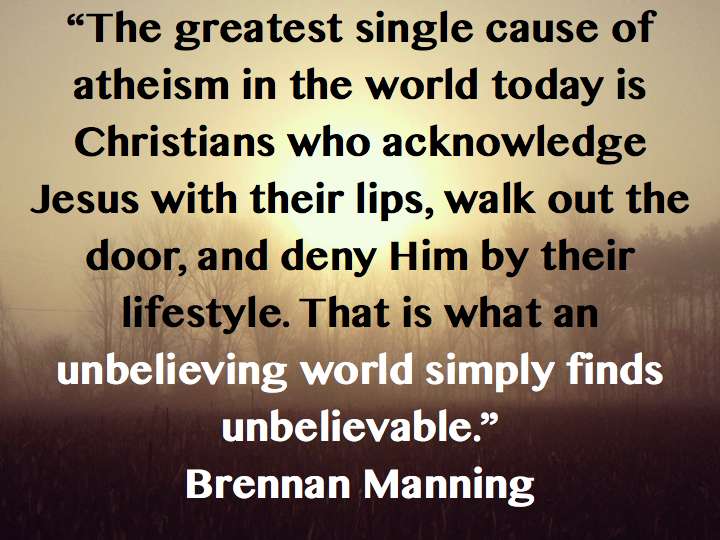
Brennan Manning was exactly right when he said, “The greatest single cause of atheism in the world today is Christians: who acknowledge Jesus with their lips, walk out the door, and deny Him by their lifestyle. That is what an unbelieving world simply finds unbelievable.”

My prayer is that Christians everywhere would be known not just by the name Christian, but by the way they hold true to Christ and His Word!

Please join me next Sunday as we look at the last of the churches in our series The 7-Star Church.
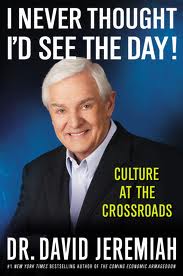
8 Quotes From “I Never Thought I’d See The Day”

I Never Thought I'd See The DayYou can read my book review of Dr. David Jeremiah’s I Never Thought I’d See The Day by clicking here. These are eight quotes that especially caught my attention in this book. Unless the quotes are otherwise attributed, they are from Dr. Jeremiah.

“I’ve shaken my fist in anger at stalled cars, storm clouds, and incompetent meteorologists. I’ve even, on one terrible day, that included a dead alternator, a blaring tornado-warning siren, and a horribly wrong weather forecast, cursed all three at once. I’ve fumed at furniture, cursed at crossing guards, and held a grudge against Gun Barrel City, Texas. I’ve been mad at just about anything you can imagine.

“Except unicorns. I’ve never been angry at unicorns.

“It’s unlikely you’ve ever been angry at unicorns either. We can become incensed by objects and creations both animate and inanimate. We can even, in a limited sense, be bothered by the fanciful characters in books and dreams. But creatures like unicorns that don’t exist—that we truly believe not to exist—tend not to raise our ire. We certainly don’t blame the one-horned creatures for our problems.

“The one social group that takes exception to this rule is atheists. They claim to believe that God does not exist and yet, according to empirical studies, tend to be the people most angry at Him.” —Joe Carter

“While the atheist arrogantly persists in the delusion that his reason is fully capable of figuring out all that there is, the religious believer lives in the humble acknowledgment of the limits of human knowledge, knowing that there is a reality greater than, and beyond, that which our senses and minds can ever apprehend.” —Dinesh D’Souza

“God brought two perfect, sinless people together in the Garden of Eden, a man and a woman who knew the perfect love of God. They did not get married to find love but to walk together in the unity and purpose God created them to fulfill: the primary task of birthing and raising the next generation. And in the process, love happened.”

“It is significant that while Adam was single, satan did not approach him or tempt him to disobey God. He waited until after Adam’s marriage to launch his attack. You would think it easier to attack one person instead of two, but by waiting he was able to attack not just an individual, but also God’s foundational building block for harmony and stability—marriage. By attacking marriage, he was able to create division and disharmony between humans themselves as well as between humans and God.”

“The oneness found in marriage is the same kind of oneness found in the Trinity.”

“We can be lulled into complacency by adopting uncritically the principle of submission to government on the assumption that the Christian history of our nation makes it safe to let our leaders do our thinking for us. But we cannot do this in our post-Christian nation where God’s Word is being marginalized. Nothing could be more dangerous for Christians and churches than to wander thoughtlessly down this path of increasing biblical indifference—a path that could well lead to a place where the Bible is not merely marginalized, but banned outrightly.”

“If the Church is being ignored because we preach the message of ‘Jesus Christ and Him crucified’ (1 Corinthians 2:2), or because the Gospel has become ‘a stumbling stone and rock of offense’ (Romans 9:33) to the world, that’s one thing. But if we are deemed irrelevant because we’re an anemic version of the world’s entertainment options or because we aren’t playing the world’s game nearly as well as the world does, then that’s another thing. That’s a tragedy.”

“William Tyndale wisely sought to avoid the confusion between ‘Church” and ‘church’ by translating ekklesia as ‘congregation’ instead of ‘church.’ …We must maintain a clean understanding of the difference between Church and church—and the priority of the former over the latter. Church buildings can necessitate huge investments of resources for construction and maintenance, and they are only temporary. Keeping the focus on people is the biblical priority and will result in the Church’s remaining relevant.”

I Never Thought I’d See The Day (book review)

I Never Thought I'd See The DayThe subtitle of Dr. David Jeremiah’s book is the most telling—I Never Thought I’d See The Day: Culture At The Crossroads. It is true that our American culture is at a crossroads, and decisions will have to be made now that could very well effect the direction of the church, and of this nation.

As a side note, I have a bit of an issue with the title of the book. To think we’d never see the day where our culture was sliding away from God’s standard is a bit of hyperbole. Any student of history knows that cultures have always gone through such things many, many times. What is true with American culture now has been true with other cultures, in other eras, on other continents. However, this by no means that Dr. Jeremiah has misdiagnosed where America is now.

Before a cure can be realized, a patient must first know he is sick. Then he must go to a doctor and be willing to follow the prescribed course of treatment. In many ways, Americans know something’s “not quite right” with our society, but have been unable to pinpoint the root cause. Dr. Jeremiah correctly diagnoses an American culture that has become increasingly humanistic, antagonistic toward Jesus, pluralistic, and obstinate toward the teachings of the Bible. In each chapter, Dr. Jeremiah diagnoses one symptom of our disease, and lays out a God-honoring cure.

Here’s the million dollar question: Will we follow the course of treatment?

In the last chapter, Dr. Jeremiah says,

I am pessimistic about man’s ability, independent from his Creator-God, to solve the problems he creates—especially problems of enormous scale such as those our nation and the world face today. I am, however, an optimist about God. And it is toward Him that we must turn our attention….

I Never Though I’d See The Day is a sobering read. Each chapter shows us just how far from God we’ve slid (that’s the pessimistic part), but then Dr. Jeremiah lays out a plan to bring us back to a God-fearing society (that’s the optimistic part). It’s a very interesting read which I especially think church leaders and God-fearing civic leaders must read.

I am a Faith Words book reviewer.

Check out some quotes from this book here.

Thursdays With Oswald—The Thinking Of A Christian And An Atheist

This is a weekly series with things I’m reading and pondering from Oswald Chambers. You can read the original seed thought here, or type “Thursdays With Oswald” in the search box to read more entries.

The Thinking Of A Christian And An Atheist 

     All scientific finds have at one time been modern. Science is simply man’s attempt to explain what he knows. …

     I can explain the world outside me by thinking; then if I can explain the world outside me by my mind, there must have been a Mind that made it. That is logical, simple and clear; consequently atheism is what the Bible calls it, the belief of a fool. “The fool has said in his heart, ‘There is no God’” (Psalm 53:1). An atheist is one who says, “I can explain by my mind to a certain extent what things are like outside, but there is not a mind behind that created them.” … 

     We [Christians] have no business to be ignorant about the way God created the world, or to be unable to discern “the arm of the Lord” behind things. …

     If we [Christians] will bring our thinking into captivity to the Holy Spirit, we form what is termed “nous.” Nous is a Greek word meaning responsible intelligence. Whenever we get to this point of responsible intelligence, we have come to a sure line of thinking. Until the nous is formed in natural life and in spiritual life, we get at things by intuition, by impulse, but there is no responsible intelligence. …We have not only to be good lovers of God, but good thinkers, and it is along this line that we can “try the spirits whether they are of God.” 

From Biblical Psychology

Christians—above anyone else—should be first-rate thinkers, because we have a natural mind AND the Holy Spirit. We should constantly study, read, discuss, debate, and meditate to sharpen our thinking. The Holy Spirit will stimulate our thinking along the right lines, but we have to put some thoughts into our minds first!

“We have not only to be good lovers of God, but good thinkers.”

5 Quotes From “Questions Christians Hope No One Will Ask”

Earlier this week I reviewed Questions Christians Hope No One Will Ask Them (you can read my review here).

I wanted to share some of my favorite quotes from this book:

“When we fail to answer someone’s questions and objections, we become just one more excuse for them to disbelieve.” —Walter Martin

“I cannot believe that our existence in this universe is a mere quirk of fate. … We are truly meant to be here.” —Paul Davies, a physicist, cosmologist, and atheist

“Consider what you’d need for a protein molecule to form by chance. First, you need the right bonds between the amino acids. Second, amino acids come in right-handed and left-handed versions, and you’ve got to get only left-handed ones. Third, the amino acids must link up in a specified sequence, like letters in a sentence. Run the odds of these things falling into place on their own and you find that the probabilities of forming a rather short functional protein at random would be one chance in a hundred thousand trillion trillion trillion trillion trillion trillion trillion trillion trillion trillion. That’s a ten with 125 zeroes after it! And that would only be one protein molecule—a minimally complex cell would need between three hundred and five hundred protein molecules. … To suggest chance against those odds is really to invoke a naturalistic miracle.” —Stephen Meyer, a Cambridge-trained philosopher of science

“Here’s the key point to remember: there never was a time when the earliest community of followers of Jesus did not regard Him as far, far more than a good teacher.” —Mark Mittelberg

“If a good God made the world, why has it gone wrong? … My argument against God was that the universe seemed so cruel and unjust. But how had I got this idea of just and unjust? A man does not call a line crooked unless he has some idea of a straight line. What was I comparing this universe with when I called it unjust? If the whole show was bad and senseless from A to Z, so to speak, why did I, who was supposed to be part of the show, find myself in such violent reaction against it? … Thus in the very act of trying to prove that God did not exist—in other words, that the whole of reality was senseless—I found I was forced to assume that one part of reality—namely my idea of justice—was full of sense. Consequently, atheism turns out to be too simple. If the whole universe has no meaning, we should never have found out that it has no meaning: just as, if there were no light in the universe and therefore no creatures with eyes, we should never know it was dark. Dark would be without meaning.” —C.S. Lewis

The Perfection Of The Universe

Listen to the podcast of this post by clicking on the player below, and you can also subscribe on AppleSpotify, or Audible.

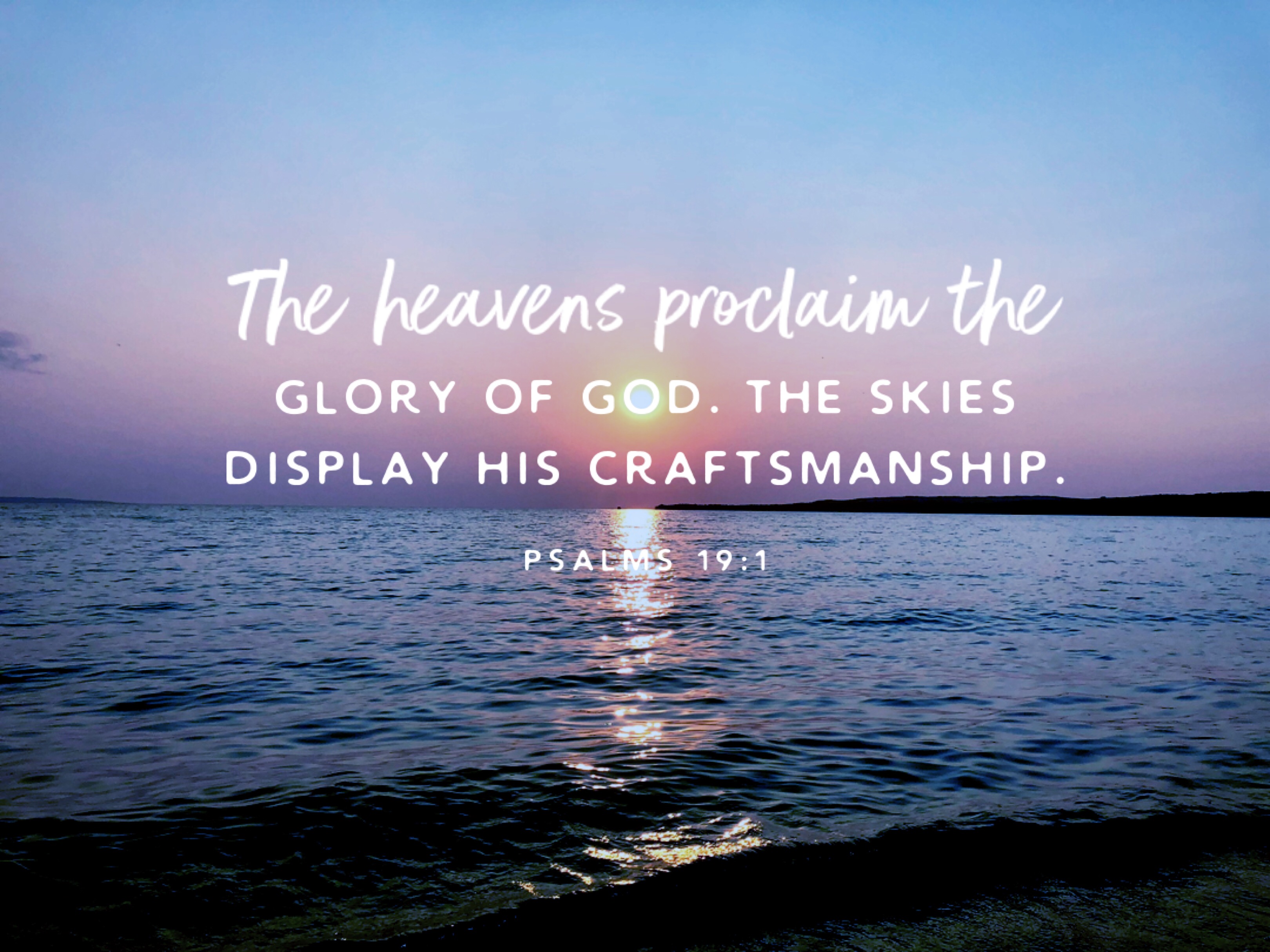
The heavens declare the glory of God; the skies proclaim the work of His hands. (Psalm 19:1)

I find it somewhat ironic that the scientists who study our universe, and constantly tell us how perfectly everything works, are the same men and women who claim that God is non-existent!

To look at the absolute intricacy of the universe … to ponder how everything works together just so … to study how the massive and the microscopic coordinate activities to create perfect balance … these things all seem to show the glory of God and the work of His hands.

How absolutely ludicrous to think that something so perfectly formed came about by accident. In fact, C.S. Lewis wrote this:

If the solar system was brought about by an accidental collision, then the appearance of organic life on this planet was also an accident, and the whole evolution of Man was an accident too. If so, then all our present thoughts are mere accidents—the accidental by-product of the movement of atoms. And this holds for the thoughts of the materialists and astronomers as well as for anyone else’s. But if their thoughts—i.e., of Materialism and Astronomy—are merely accidental by-products, why should we believe them to be true? I see no reason for believing that one accident should be able to give me a correct account of all the other accidents. It’s like expecting that the accidental shape taken by the splash when you upset a milk jug should give you a correct account of how the jug was made and why it was upset.

I have already written about God’s Big Hands, but also consider God’s amazing and perfect Creation:

  • Gravity: if the force or pull of gravity were to change by one quadrillionth of a percentage (that’s 0.00000000000001), the universe would cease to function the way it does now.
  • Electromagnetism: neutrons are 1.001 times the mass of the proton. If this weren’t so, all protons would decay into neutrons. Positive electromagnetism would be gone, leaving only negative. Again the universe would cease to function as it does now.

The more I study our universe, the more praise I give to our Creator! 

His wisdom created this amazing world in which we live, and all of His creation is joining together in contant praise. I don’t know about you, but I choose to join creation in its praise of our Creator.

►► Would you please prayerfully consider supporting this ministry? My Patreon supporters get behind-the-scenes access to exclusive materials. ◀︎◀︎

See The Invisible

Noted New Atheist Richard Dawkins says,

“Faith is the great cop-out, the great excuse to evade the need to think and evaluate evidence. Faith is belief in spite of, even perhaps because of, the lack of evidence. … Faith is not allowed to justify itself by argument.”

I wholeheartedly—and even respectfully—disagree.

The Bible does define faith as “Being sure of what we hope for and certain of what we do not see.” Just a few verses later there is an even stronger statement about faith: “Without faith it is impossible to please God.

I have evaluated the evidence. I have thought long and hard about the options. I can justify all of the arguments. And my faith stands strong!

God wants all who call on Him to grow in God-pleasing faith. So I’m really excited to dive into our brand new series called SEE THE INVISIBLE this Sunday.

I hope you can join me at 10:30am this Sunday at Calvary Assembly of God.

Why God Won’t Go Away (book review)

Allister McGrath is a genius at pointing out the flaws in the arguments that atheists use. So if you would like to know how to pick apart the theories of the leading atheists of our age, Why God Won’t Go Away: Is The New Atheism Running On Empty is just the book for you.

One of the things I appreciate about Dr. McGrath is his humble attitude. He is an extremely learned man, and could probably not only win a debate, but emotionally crush his debating partner in the process. Instead, you can sense the love and humility underlying all of his arguments. But make no mistake: his love in no way diminishes the sheer force of his intellectual prowess.

Why God Won’t Go Away gives the reader some valuable insights into the “four horsemen” of the New Atheism movement: Richard Dawkins, Christopher Hitchens, Sam Harris and Daniel Dennett. Then Dr. McGrath systematically breaks-down their arguments using reason, science, history and fact. Although he points out the intimidation and ridicule that the New Atheists seem to resort to, Alister McGrath never even hints at a Christian using these tactics.

Another thing I appreciate about this book, is that there is enough information here to help the reader learn how to defend themselves against the arguments of an atheist friend, but the topics aren’t so complicated that it requires an advanced college degree to grasp.

I thoroughly enjoyed reading this book, and I think you will too.

I am a Thomas Nelson book reviewer.

The Case For Christmas (book review)

Virgin birth? The accuracy of the biblical account? God in flesh? These are all intriguing questions that crop up especially around the Christmas season, which is why The Case For Christmas by Lee Strobel is a timely read.

Lee Strobel investigates the fantastic claims that Christians make about the birth of Jesus Christ with all of the cool-headed dispassion of a newspaper journalist. Beginning with his own skepticism about the miracle of the virgin birth of Christ, Mr. Strobel seeks out the sharpest minds who have thoroughly researched the key areas surrounding this subject. In a book that reads a little like a detective story, we get to sit in on some of the fascinating interviews Mr. Strobel conducted for this book.

Whether you are an atheist, a doubter, or a wholehearted believer, there is much to ponder in The Case For Christmas. At only 96-pages long, you can read this book prior to Christmas Day, and gain a better appreciation for the true meaning behind CHRISTmas.

The Christian Atheist (book review)

Every time I read a Craig Groeschel book, I know I’m going to read words that cut right across all of my excuses for not changing. And I was not disappointed to find this pattern continued with his latest book The Christian Atheist.

If the title sounds like an oxymoron (you can read the definition of this funny-sounding word here), that’s because it is. Or is it? The subtitle of the book gives the right-on-target definition of a Christian atheist: believing in God but living as if He doesn’t exist.

So every chapter is titled, “When you believe in God, but…

  • …you don’t really know Him.”
  • …you are ashamed of your past.”
  • …you aren’t sure He loves you.”
  • …you don’t think you can change.”
  • …you don’t share your faith.”
  • and many more!

It reminds me of what James wrote in his letter to the church, where he called them out for being Christian atheists: “You believe in God? Good for you! Even the demons believe in Him. But you’re not living like you believe in Him.”

Brennan Manning wrote,

“The greatest single cause of atheism in the world today are Christians who acknowledge Jesus with their lips and walk out the door and deny Him by their lifestyle. That is what an unbelieving world simply finds unbelievable.”

But Craig doesn’t just identify the symptoms, he gives his readers the prescriptions too. In easy-to-apply concepts, Craig tells those who believe in God how they can make the changes that won’t deny God by their atheistic lifestyle.

I highly recommend this book to you.

I am a Zondervan book reviewer.