There Is A God (book review)

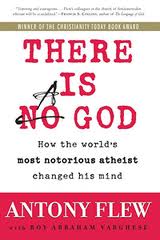
There Is A GodIt’s a mark of a strong, confident person that can admit, “I was wrong. I made a mistake.” Anthony Flew is just such a strong man. His book is called There Is A God: How the world’s most notorious atheist changed his mind.
The one sentence summary of this book could be: Anthony Flew was a noted philosopher who concluded there was no God, but then was persuaded to rethink his position and came to a complete reversal. But that would sell his story short.

The real meat-and-potatoes of the book are the arguments which helped change Anthony Flew’s mind. This, I must warn you, is no easy reading. The arguments are so nuanced and metaphysical at times, that it really requires a careful reading. This was not a book I could speed read, because the chain of logic in the arguments was simply too good to miss anything.

I throughly appreciated the candor with which Flew shared his metamorphosis from atheist to Theist. The book also includes two appendices which address the current state of modern atheism, and an interview with N.T. Wright on Jesus being God Incarnate.

If you are ready to study some of the atheistic and theistic arguments that the brightest apologists for both viewpoints are presenting today, then this is the book for you! I thought the journey of discovery was fantastic and mind-expanding!

Pouring Holy Water On Strange Fire (book review)

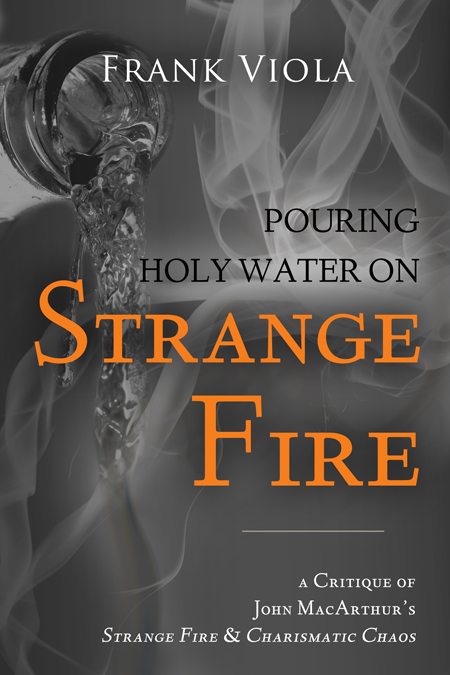
Pouring Holy Water On Strange FireI fully admit that I’m a little biased on this one. After all, what would you expect from a fourth generation Pentecostal? But even with that disclaimer, I thought Frank Viola did a masterful job in his critique called Pouring Holy Water On Strange Fire.

Viola’s book is a critique of John MacArthur’s book Strange Fire, in which MacArthur attempts to make the case that the way Pentecostals and Charismatics advocate and practice their faith is unscriptural. MacArthur would fall into the camp of the cessationists, who claim that all of the operational gifts of the Holy Spirit enumerated in the New Testament ceased when the apostles died, or when the canon of Scripture was closed. I’ve always found this a strained argument at best, or as Mark Driscoll says, one needs to do “exegetical origami” to reach the cessationists’ conclusion.

Frank Viola systematically critiques Strange Fire thought-by-thought, section-by-section. He does so fairly and academically, using respected Bible commentators, the writings of Church fathers, logic, personal examples, as well as other respected contemporary voices who express similar concerns against MacArthur’s arguments.

This is a good book for any student of the Bible to read. It’s not a lengthy tome, so you will not get bogged down in reams of academia, but you will be able to weigh the evidence that both cessationists and Pentecostals use. You can download the ebook version by clicking here.

Embracing Conflict

Listen to the podcast of this post by clicking on the player below, and you can also subscribe on AppleSpotify, or Audible.

A quick survey: Please raise your hand if any of these pertain to you:

  • Have you ever had a disagreement with someone?
  • Have you had a disagreement with someone you love?
  • Have you had a disagreement with someone you love, who also called themself a Christian?

If you raised your hand, you joined 100% of my congregation who answered “yes” to all three.

When we are in close proximity to anyone, there will be conflict. In fact, close proximity usually leads to more conflict because closeness increases friction. For a Christian the issue is not if we will have conflict with others in the Church, but how will we navigate and resolve these conflicts.

The apostle Paul wrote a thank you letter to the church at Philippi, in which he speaks in some of the most glowingly loving terms of any of his letters. Clearly, this was a group of people close to his heart. So when he heard about a conflict between two ladies in this congregation, he took time to address it publicly in his letter—

I plead with Euodia and I plead with Syntyche to be of the same mind in the Lord. (Philippians 4:2)

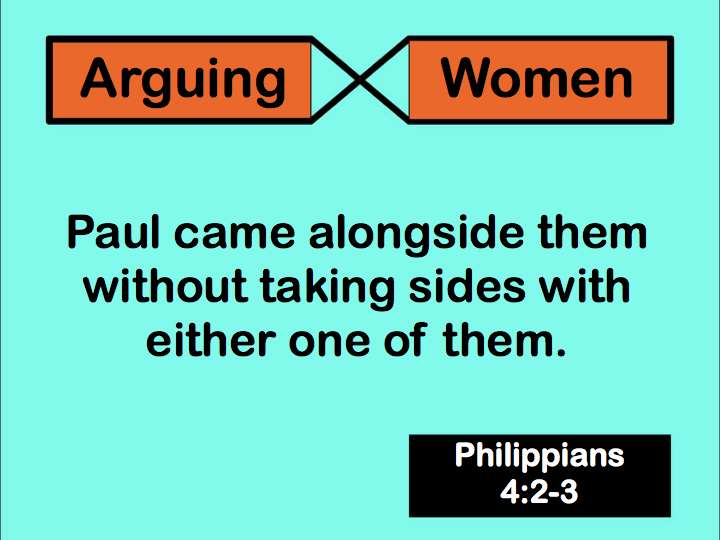
We don’t know why these ladies were arguing but notice that Paul doesn’t take sides. He simply says, “I please with Euodia AND I plead with Syntyche.” The word for plead means someone who comes alongside to help. In using this terminology, Paul gives us an important principle:

We can come alongside those in conflict without taking sides with either one of those in conflict.

In the next verse, Paul implores the rest of the church to join him in this alongsided-ness

And I exhort you too, my genuine yokefellow, help these two women to keep on cooperating…. (v. 3 in the Amplified Bible)

In other words, Paul wants the rest of the church to embrace these at-odds sisters, also without taking sides. He addresses the members of the church as yokefellow. It’s not a word we use too often today (although it is still in the dictionary), but it paints a crystal clear picture of our role. Here’s what we CAN’T do as yokefellow:

  • Look away
  • Mind our own business
  • Hope the situation will work itself out
  • Try to navigate around the problem

Instead, we embrace the conflict by embracing those in the conflict. We help them to cooperate and to work in harmony in the Lord (v. 2 in the Amplified Bible). It’s our responsibility to help maintain the bonds of peace so that the Body of Christ can grow in a way that is healthy and God-honoring.

Do you know someone in conflict right now? Are you in the conflict yourself? Ask God to show you how you can come alongside—not take sides—with those in this conflict so that you can help bring about peace.

If you have missed any messages in this series called Life Together, you can find them all by clicking here.

►► Would you please prayerfully consider supporting this ministry? My Patreon supporters get behind-the-scenes access to exclusive materials, like a map and an app I just shared to help with your personal Bible study time. ◀︎◀︎

Did The Resurrection Happen … Really? (book review)

Did The Resurrection HappenJosh McDowell is an amazing apologist! He has a tremendous knack for being able to “put the cookies on the bottom shelf.” By that I mean that he can make complex topics accessible to a wider audience than most authors. In Did The Resurrection Happen … Really? he and Dave Sterrett do just that with some great arguments for and against the death and resurrection of Jesus Christ.

This book is classified as fiction, because fictional characters are having a discussion at a fictional university about the deep subjects of life and death, and life after death. Although the characters are fictional, the questions being discussed are real, and the sources quoted in defense of each side of the argument are all non-fictional.

McDowell and Sterrett (who are Christian apologists) don’t dumb-down the arguments against the claims of an actual physical death and an actual physical resurrection. They quote from some of the most well-known proponents of these arguments, and then thoughtfully and persuasively rebut those claims.

Because this book is written in a conversational style, it bring the reader right into the coffee chats of the characters. It also helps the reader see how he/she could have a similar dialogue with others who question the biblical account of the crucifixion and resurrection of Jesus Christ.

The book is well footnoted, so curious readers can dig deeper and research further. But don’t let this fact lead you to believe that this is a heady, academic book. As I mentioned earlier, McDowell and Sterrett definitely make these concepts accessible to a wide audience.

This would be an excellent book to read if you have friends who are skeptical to the biblical account. It would also be a very good resource for those preparing to attend a university where the faculty might be more antagonistic toward the biblical worldview. In any case, it was a very enjoyable and educational book.

Thursdays With Oswald—Stay Away From Controversies

This is a weekly series with things I’m reading and pondering from Oswald Chambers. You can read the original seed thought here, or type “Thursdays With Oswald” in the search box to read more entries.

Stay Away From Controversies

     That is the danger of putting theology first; it leads a man to tell a lie in order to be consistent with his point of view. …In a theological dispute the theologian is apt to put his point of view in the place of God. … Only one man in a thousand can maintain his spiritual life and controvert; he may increase his intellectual vim, but he does not increase his spiritual grasp of things. Dr. Alexander Whyte put this better than any other when he said:

     “…Eschew controversy, my brethren, as you would eschew the entrance to hell itself. Let them have it their way; let them talk; let them write; let them correct you; let them traduce you; let them judge and condemn you; let them slay you. Rather let the truth of God suffer itself, than that love suffer. You do not have enough of the divine nature in you to be a controversialist.”

From Baffled To Fight Better

Augustine prayed: “Heal me of this lust of mine of always vindicating myself.”

When David was attacked he prayed: “I cry out to God Most High, to God, who vindicates me” (Psalm 57:2).

Who cares what others say? Who cares if you “lose” the argument? What does God say? Let Him—and Him alone—vindicate you.

Disagreeing Agreeably

Listen to the podcast of this post by clicking on the player below, and you can also subscribe on Apple or Spotify.

Why do disagreements have to become so, well, disagreeable?

Is it possible to disagree agreeably?

It’s not easy, but I think it’s possible.

When I was younger I couldn’t stand the idea of “losing” an argument: I always had to be right. I think I’ve matured a bit (at least, I hope I have), and I no longer feel the same way. So here are a few lessons I’ve learned:

(1) Remember the person I’m disagreeing with is my brother or sister. God has created both of us, so that makes us siblings.

(2) Always go for win-win. Don’t look out only for your own interests, but take an interest in others, too (Philippians 2:4).

(3) Choose your battles wisely. You can’t make everything an issue worth dying over. Thomas Jefferson wisely said, “In matters of principle, stand like a rock; in matters of taste, swim with the current.”

(4) Redefine the “win.” What does it mean to win? Is it to put someone else in their place? That doesn’t seem very healthy. Perhaps a “win” is when values or principles are agreed to, although the way they are applied may be very different from person to person.

(5) Leave the baggage behind. Don’t bring previous hurts into a new situation. Don’t assume this new person will act like someone else from your past.

We’re all different people, so we’re going to have disagreements. The key: let’s find a way to disagree agreeably.

If you have other thoughts about how to disagree agreeably, I would love it if you would share them in the comments.

►► Would you please prayerfully consider supporting this ministry? ◀︎◀︎

The Point Of The Gospel

While I was preparing for our Spiritual Self-Defense class, Rick Warren tweeted this timely reminder: “If you spend more time defending the truth than actually sharing it, you will have missed the point of the Gospel.”

What is the point of the Gospel? Isn’t it simply that mankind is lost without God, and that only a relationship with Jesus can bring true life? If that’s the point, we can never argue someone into this divine relationship.

Here are some other thoughts I’m trying to keep in mind for this exciting class:

  • Jesus never shouted down those who disagreed with Him. Isaiah’s prophesy about Jesus said, “He will not shout or cry out, or raise His voice in the streets.” And that’s exactly how Jesus conducted Himself.
  • Jesus said, “God didn’t go to all the trouble of sending His Son merely to point an accusing finger, telling the world how bad it was. He came to help, to put the world right again.” Jesus didn’t come to win an argument, but to win lost people to a relationship with His Father.
  • There are very few exclamation points in Christ’s dialogue in the Gospels, but there are a lot of question marks. He was interested in engaging people in conversation.
  • G. K. Chesterton said, “The principle objection to a quarrel is that it interrupts an argument.” We need to discuss, not argue.

I’m really looking forward to leading this class, but I’m also excited about what I’m learning in the process.

Winning The Argument Or The Battle

When I entered college, I did so as a science major: pre-med biomedical chemistry, to be exact. I still really enjoy all of the medical sciences: biology, microbiology, organic chemistry, inorganic chemistry, and the like.

As you might be aware many of the scientists today have a bent toward the theory of evolution. That means that a few of my professors and several of the authors I was reading taught and wrote from that paradigm.

This set up the environment for me to want to debate for my Creationist beliefs.

I had one professor who would specifically challenge me during lectures to refute what he had just said about evolution. An author who wrote a lengthy book about evolution carried on a year-long correspondence with me where we each brought out our best arguments. In all instances—although we believed passionately in our positions and could adequately defend them—the discussions never became shouting matches.

The Bible taught me how to do this.

(This week I’m discussing my favorite book—the Bible—from a couple of different aspects. You can read some of those thoughts here, here and here.)

At times I was tempted to “cross the line” to win the argument. And I may have won the argument, but I would have put myself in a position to lose the overall battle. There are two key passages of Scripture that I keep in mind to help me with this.

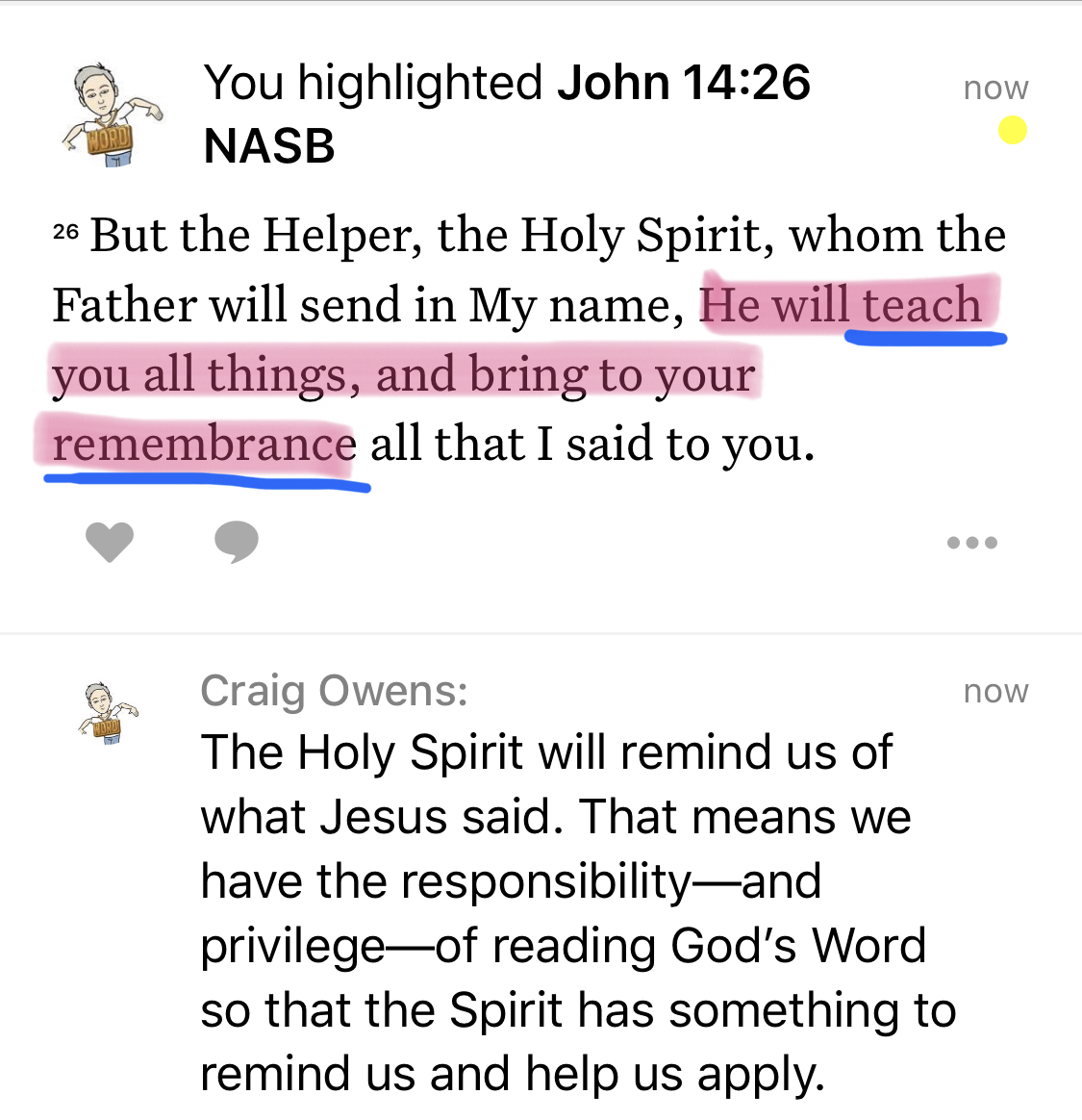
(1) In telling His followers about the Holy Spirit (John 14-16), Jesus said, “But when He, the Spirit of truth, comes, He will guide you into all truth” (John 16:13). And also, “But the Counselor, the Holy Spirit, whom the Father will send in My name, will teach you all things and will remind you of everything I have said to you” (John 14:26).

The Holy Spirit helps me apply biblical truths and principles to my everyday life. He guides me and reminds me of what I have studied.

(2) The second key passage is, “But in your hearts set apart Christ as Lord. Always be prepared to give an answer to everyone who asks you to give the reason for the hope that you have. But do this with gentleness and respect, keeping a clear conscience, so that those who speak maliciously against your good behavior in Christ may be ashamed of their slander” (1 Peter 3:15-16).

Yes, it is important for me to be prepared to give an answer, but this is the middle thought. First, I have to make sure what I’m saying is exalting Christ as Lord. Then I do my best to study and prepare to give an answer, but I must give that answer gently and respectfully.

Allowing the Holy Spirit to help you prepare from the Bible, and allowing Him to guide you into answering questions/critics gently and respectfully honors Christ. And that always wins the battle.