“We have to treat the body as the servant of Jesus Christ: when the body says ‘Sit,’ and He says ‘Go,’ go! When the body says ‘Eat,’ and He says ‘Fast,’ fast! When the body says ‘Yawn,’ and He says ‘Pray,’ pray!”
I do not run like a man running aimlessly; I do not fight like a man beating the air. No, I beat my body and make it my slave so that after I have preached to others, I myself will not be disqualified for the prize. (1 Corinthians 9:26-27)
Wow! Time for me to redouble my efforts to Go, Fast, and Pray.
As I was wrapping up our Thanksgiving series, I was struck by the verb tense that Paul used in all of the verses I was studying.
When the Apostle Paul writes that we are to be overflowing with thankfulness, and let the peace of Christ rule in our hearts, and stay on our guard against slipping away from this, the verb tense is present tense. Simply put, he says, “Do it now.”
Not: Wait for better conditions … get things in order next Sunday at church … schedule a spiritual retreat.
The verbs are also in the active voice, which means I have to do it.
Not: Wait for a friend encourage me … hope my pastor can pump me up spiritually next Sunday … tune in to some sort of motivational speaker.
There is no better time than NOW, and there’s no better person than ME to do it.
“It is by little procrastinations that men ruin their souls. They have no intention to delay for years—a few months will bring the more convenient season—tomorrow if you will, they will attend to serious things; but the present hour is so occupied and altogether so unsuitable, that they beg to be excused. Like sands from an hour-glass, time passes, life is wasted by driblets, and seasons of grace lost by little slumbers.” —Charles Spurgeon
Thanksgiving Day 2011 is over, but the days for giving thanks should never be over. Although that sounds humorous, for many of us it is an important reminder. We need to remind ourselves because it is so easy for us to go from overflowing with thankfulness, to feeling depleted and empty.
This is exactly what Paul reminded the Colossians in part 3 of our Overflowing With Thanks series—
Devote yourselves to prayer, being watchful and thankful. (Colossians 4:2)
Here’s how the cycle works:
When we are thank-full to God for His blessings, we enthrone Christ in our hearts.
When we are Christ-full, He brings with Him all of the peace we will need.
When we are peace-full, the peace of God, which transcends all understanding, will guard your hearts and minds in Christ Jesus (Philippians 4:7).
When our hearts and minds are clear, we can better see the blessings for which we can thank God.
And when we are thank-full to God for His blessings, we start the cycle all over again.
We don’t have to run dry, or become depleted, or lose our joy, or be robbed of our peace. If we will remain watch-full to be thank-full, we will remain Christ-full, which will keep us peace-full.
As we approaching Thanksgiving Day later this month, it is important for us to pause to consider a couple of important issues: (1) to whom/what am I thankful, and (2) why am I thankful.
In his letter to the church at Colossae, the Apostle Paul had a lot to say about thank-fullness. It is very instructive for us to see how being full of thanks builds our faith, gives us peace, and keeps us alert against joy-stealers.
I hope you can join me at Calvary Assembly of God over the next three Sundays as we explore all the benefits of living lives Overflowing With Thanks.
When I was a kid, I had a set of big cardboard blocks that looked like bricks. I built all sorts of cool things out of these blocks, and had hours of fun! Today my sons have the same kind of fun with Legos. They build really cool things for hours on end.
But occasionally, as I’m tip-toeing through the dark in bare feet, I step on a stray Lego. That is—to put it mildly—not so much fun. In fact, it’s almost crippling!
The Apostle Paul said, “Make up your mind not to put any stumbling block or obstacle in your brother’s way.”
None of my interactions with people today will be neutral. I’m either a building block, or I’m a stumbling block.
Paul says it quite simply: Make up your mind to build up, never to trip up.
This is a weekly series with things I’m reading and pondering from Oswald Chambers. You can read the original seed thought here, or type “Thursdays With Oswald” in the search box to read more entries.
You Must Say, “You Must”
If we do not fit ourselves by practice when there is no crisis, we shall find that our nature will fail us when the crisis comes. The grace of God never fails, but we may fail the grace of God. Unless our nervous system is made the ally of the new life from God it becomes a humiliation to us, and we sit down under a tyranny of nerves. Once we receive the Holy Spirit we must sit down to nothing. … When your nervous system, which has been ruled by the wrong disposition, is inclined to say “I can’t,” you must say, “You must,” and to your amazement you find you can!
The time to learn how to do the God-honoring thing is when there is no crisis in my life. That’s my training time, to prepare me for when the heat is on. The apostle Paul learned this too. As a result of his training, he learned to tell himself, “You must,” in every circumstance:
I have learned to be content whatever the circumstances. I know what it is to be in need, and I know what it is to have plenty. I have learned the secret of being content in any and every situation, whether well fed or hungry, whether living in plenty or in want. I can [I must!] do everything through Him who gives me strength. (Philippians 4:11-13)
Don’t waste your non-crisis times. Learn from them how God wants to help you in the midst of your crisis.
For the past few years, October has been designated as Pastor Appreciation Month. Honestly, I feel appreciated by the great folks at Calvary Assembly of God every single week! I can only pray that other pastors feel the same love I feel.
Here’s a simple way you can show your pastor appreciation both in October, and all year long: Pray for him or her. Multiple times the Apostle Paul wrote pray for us (Colossians 4:3; 1 Thessalonians 5:25; 2 Thessalonians 3:1). Prayer is SO NEEDED for your pastor!
Here’s what the eminent pastor Charles Spurgeon wrote:
The members of the body of Christ should have a care for one another, but especially should the minister receive the prayers of his flock. I have sometimes heard his duties called arduous, but that word is not expressive enough. The works in which he is occupied lie quite out of the region of human power. The minister is sent to be God’s messenger for the quickening of the dead. What can he do in it? He can do nothing whatever unless the Spirit of God be with him through the prayer of his brethren.
He is sent to bring spiritual food to the multitude, that is to say, he is to take the loaves and fishes, and with them, few as they are, he is to feed the thousands. An impossible commission! He cannot perform it. Apart from divine help, the enterprise of a Christian minister is only worthy of ridicule. Apart from the power of the Eternal Spirit, the things which the preacher has to do are as much beyond him as though he had to weld the sun and moon into one, light up new stars, or turn the Sahara into a garden of flowers. We have a work to do concerning which we often cry, “Who is sufficient for these things?” and if we be put to this work but have not your prayers, and in consequence have not the supply of the Spirit, we are of all men the most miserable.
Show how much you appreciate your pastor by upholding him/her in prayer every day.
This is a weekly series with things I’m reading and pondering from Oswald Chambers. You can read the original seed thought here, or type “Thursdays With Oswald” in the search box to read more entries.
Judging A Life
God holds us responsible for the way we judge a young [Christian] life; if we judge it by the standards by which we would judge a mature life, we will be grossly unjust. … Be as merciless as God can make you towards the vices of a mature life, but be very gentle and patient with the defects of a growing life.
It’s a delicate balance that requires true discernment from the Holy Spirit. The ‘defects’ that we see in those who are new in the Christian walk need gentle correction, but the ‘vices’ of those who should know better by now need to be dealt with forcefully.
I see both the gentle and forceful in Paul’s words to the Corinthian church:
Dear brothers and sisters, when I was with you I couldn’t talk to you as I would to spiritual people. I had to talk as though you belonged to this world or as though you were infants in the Christian life. I had to feed you with milk, not with solid food, because you weren’t ready for anything stronger. And you still aren’t ready, for you are still controlled by your sinful nature. You are jealous of one another and quarrel with each other. Doesn’t that prove you are controlled by your sinful nature? Aren’t you living like people of the world? (1 Corinthians 3:1-3)
My prayer: God, help me to be perfectly balanced and directed by You. I don’t want to be too forceful with the young, nor too gentle with the mature. I want to see everyone growing in their relationship with You.
Did you know that the origin of the word clergy comes from the Latin meaning “learned men”? These are the men and women who are supposed to lead our churches, because they have the education that others don’t. They are professionals.
Now compare that with the definition of laity: “the people outside of a particular profession, as distinguished from those belonging to it.”
Did you catch that? The laity are outside and uneducated. They are amateurs.
The origins of clergy is traced back to the 12th century, and laity first appears in the 16th century. But long before this, the Apostle Paul had a different idea —
Take a good look, friends, at who you were when you got called into this life. I don’t see many of “the brightest and the best” among you, not many influential, not many from high-society families. Isn’t it obvious that God deliberately chose men and women that the culture overlooks and exploits and abuses, chose these “nobodies” to expose the hollow pretensions of the “somebodies”? (1 Corinthians 1:26-28 from The Message, emphasis added)
There is a HUGE PROBLEM when we think that only the professional clergy is equipped to do the ministry of the church! What makes a healthy church (like the first century church we read about in the book of Acts) is when EVERYONE is actively involved in ministry.
These words from Howard Hendricks are tough to hear, but right on target:
“I believe a great problem in evangelicalism today—whether in the local church, missions, seminary education, or what have you—is we have too many big-time operators! And too few servants. …
“The typical church hires a clergyman to rob them of the privilege of exercising Christ’s gifts. … The greatest curse on the Church today is that we are expecting a small group of professionals to get God’s work done.”
I hope I haven’t stepped on too many toes with this one. My intent is not to offend, but to get the church thinking. I want to see EVERYONE that calls themselves a Christian actively involved in ministry.
In order to grow muscle, it has to be stretched beyond what we usually use. Muscles don’t grow unless they are worked out.
The same is true for us spiritually, emotionally, and mentally. If we only do easy things—if everything is rosy all the time—we’ll never grow. In fact it’s worse than that: if we’re not challenged, we will actually atrophy and shrink back.
So with that in mind, here are some encouraging words for your spiritual work out.
“By affliction God teaches us many precious lessons, which without it we should never learn. By affliction He shows us our emptiness and weakness, draws us to the throne of grace, purifies our affections, weans us from the world and makes us long for heaven.” —J.C. Ryle
Consider it pure joy, my brothers, whenever you face trials of many kinds, because you know that the testing of your faith develops perseverance. Perseverance must finish its work so that you may be mature and complete, not lacking anything. …Blessed is the man who perseveres under trial, because when he has stood the test, he will receive the crown of life that God has promised to those who love Him. —Apostle James
“God does not give us overcoming life—He gives us life as we overcome. The strain of life is what builds our strength. If there is no strain, there will be no strength. Are you asking God to give you life, liberty, and joy? He cannot, unless you are willing to accept the strain. And once you face the strain, you will immediately get the strength.” —Oswald Chambers
We can rejoice, too, when we run into problems and trials, for we know that they help us develop endurance. And endurance develops strength of character, and character strengthens our confident hope of salvation. And this hope will not lead to disappointment. For we know how dearly God loves us, because He has given us the Holy Spirit to fill our hearts with His love. —Apostle Paul
I pray that you will gain strength in your spiritual work out today.



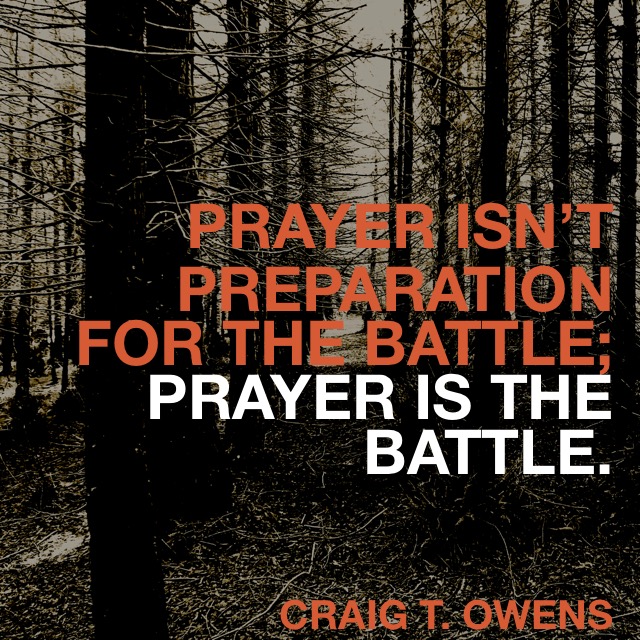 A challenging quote from Oswald Chambers—





 Craig T. Owens