Should We Listen To Critics?

Listen to the podcast of this post by clicking on the player below, and you can also subscribe on AppleSpotify, or Audible. 

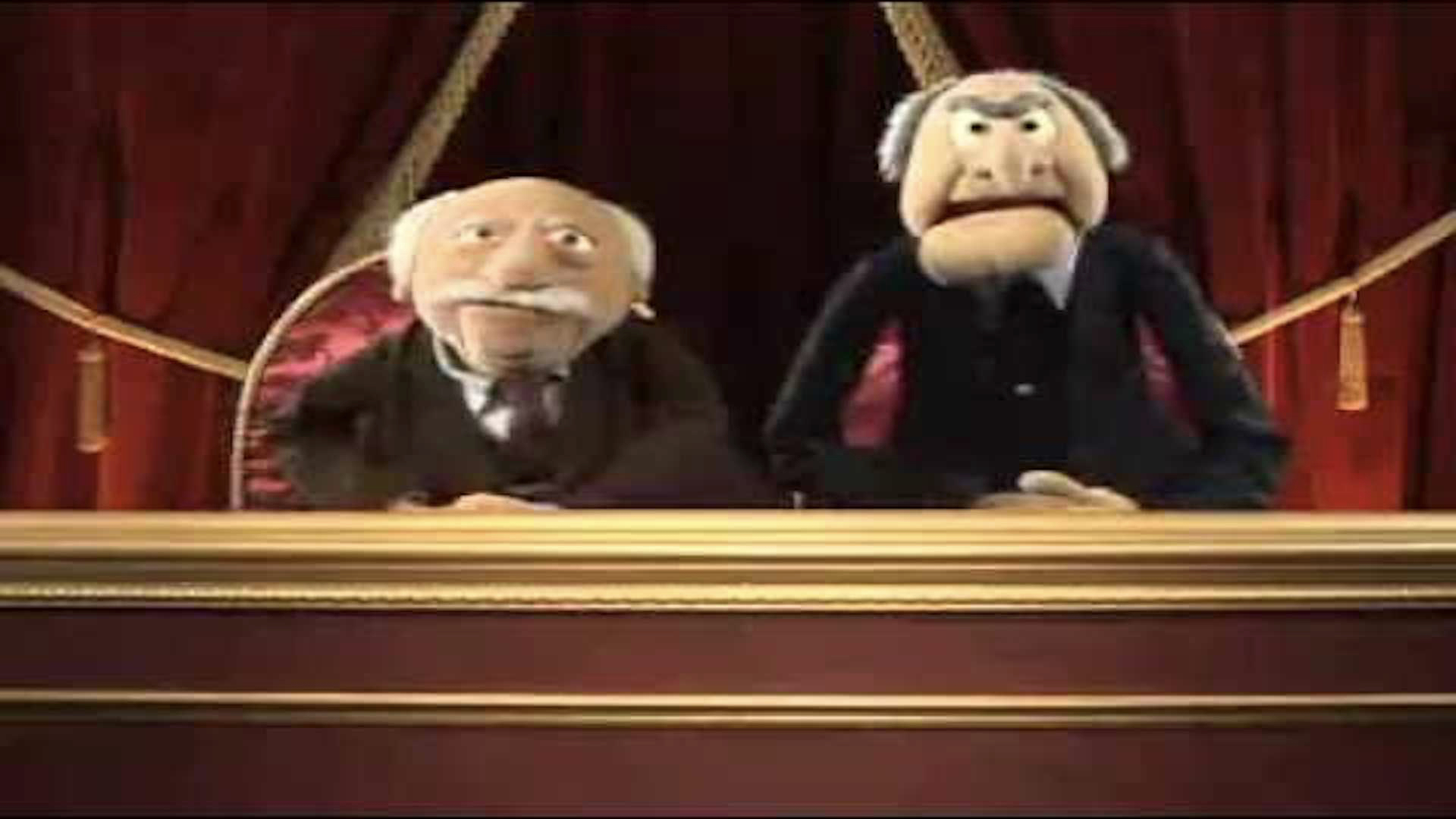
Do you know this pair of cantankerous men from the Muppets? Statler and Waldorf sit in the balcony of the theatre and criticize everything that is happening on the stage. I mean everything! They have a good laugh at their barbs, but no one on the stage seems to find it humorous. 

Have you ever met people like this? How do you typically respond to their criticism? 

Unfortunately, those who are trying to do the right thing are often the targets of almost constant criticism. Abraham Lincoln said, “If I were to attempt to answer all the criticisms and complaints I receive, I would have no time for any other business.” 

President Lincoln was a great leader but he wasn’t without fault, so to certain extent we could expect a little bit of criticism from people who didn’t like his policies. But what about Jesus? It was prophesied about Him that He would be the target of criticism (Isaiah 53:3). 

(Check out all of the Scriptures in this post by clicking here.) 

Those out to get Jesus even criticized those who attended to Him. In Mark 14:1-5, they are criticizing a woman who poured perfume on Jesus out of her sincere desire to honor Him. Yet they spoke about her and her actions “indignantly” (v. 4), and they rebuked and criticized her (v. 5). The Greek word in this verse literally means he snorting of horses! 

Jesus stepped in to protect this God-fearing woman, “Why are you bothering her? Why are you criticizing this beautiful thing she had done for Me?” 

Notice that Jesus responded to the critics, but the woman did not respond. Does that mean that we never answer critics? Are we supposed to ignore them? 

First, let’s go back in time to the origin of the words critic and criticism. These words originally meant someone capable of giving a meaningful—perhaps even constructive or helpful—judgment. Think of a trained and skilled chef critiquing your recipe, as opposed to someone who cannot tell the difference between nutmeg and ginger. 
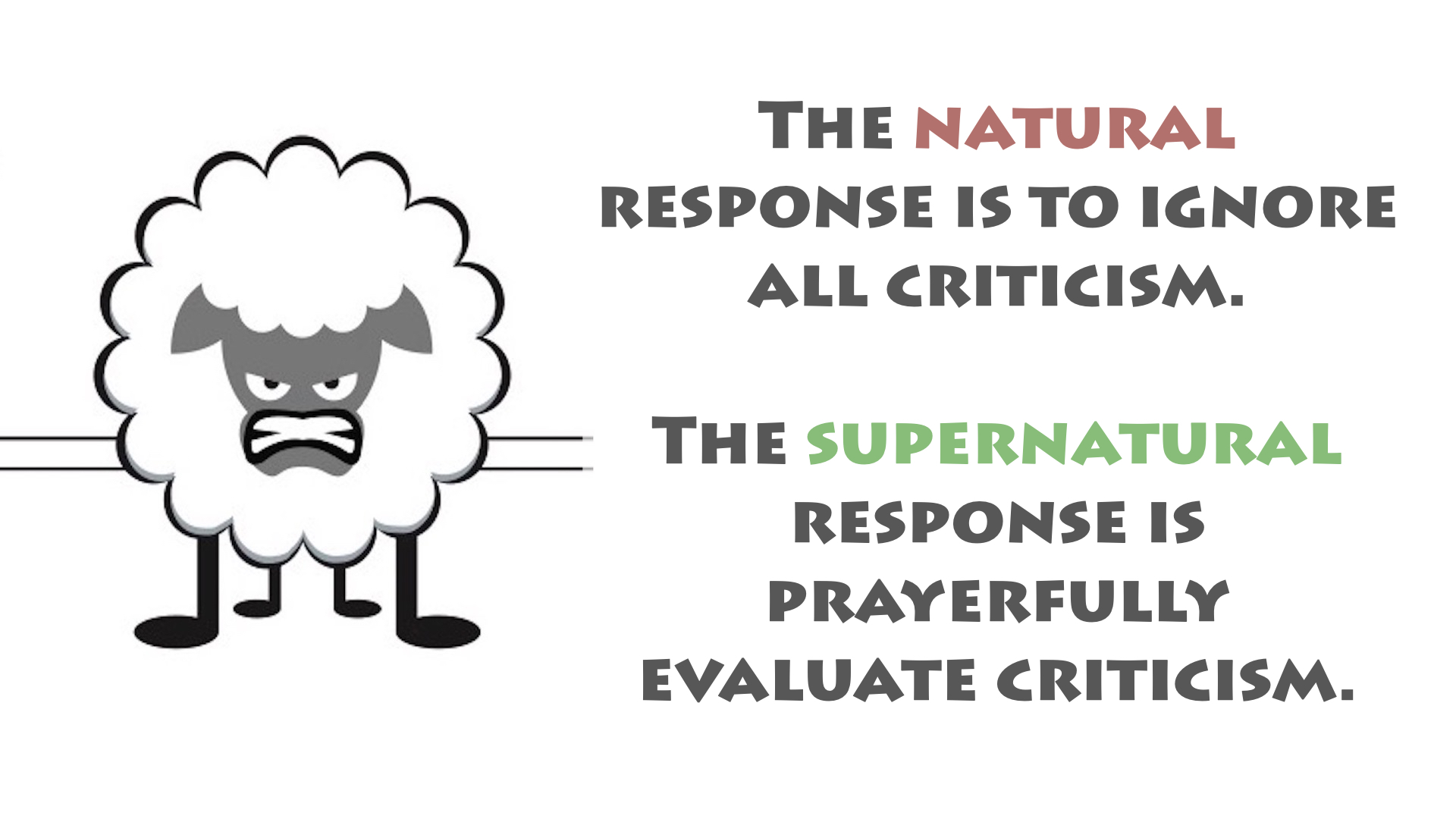
The natural response is to ignore all criticism. The supernatural response is prayerfully evaluate criticism. Solomon says there is such a thing as valid criticism (Proverbs 25:12). 

So who is a valid critic? 

(1) Someone who loves me (Proverbs 27:17; Ephesians 4:15). Paul loved Peter and respected his leadership role in the church, but he still criticized Peter when he messed up (Galatians 2:9, 11).  

(2) Someone who has experience or godly wisdom that we don’t yet have (Ecclesiastes 7:5). Micaiah had a word from God, even though King Ahab thought Micaiah simply didn’t like him (1 Kings 22:1-18). 

(3) Someone who wants to hurt me. Really!? Dick Brogden wrote, “The Lord uses critics to show us our own hearts, even if what they say is not fully true, informed, or even fair. There is almost always a germ of truth in what our critics (in their own pain and disappointment) shout at us. The wise [person] will humble himself and look for the truth embedded in every oppositional interaction.” As we saw previously from Psalm 26:2, when we hear words of criticism, we need to make it a matter of prayer. 

Jesus told the woman’s critics to “leave her alone” but He never defended Himself against the childish barbs (Isaiah 53:7; Matthew 27:13-14). I think we would do well to follow His example. So when criticized, take a deep breath, smile, hear them out, ask clarifying questions, and then say, “Thank you for sharing that with me. I’ll make this a matter of prayer.” 

They might accuse you, but you should turn it over to God (Psalm 109:4). 
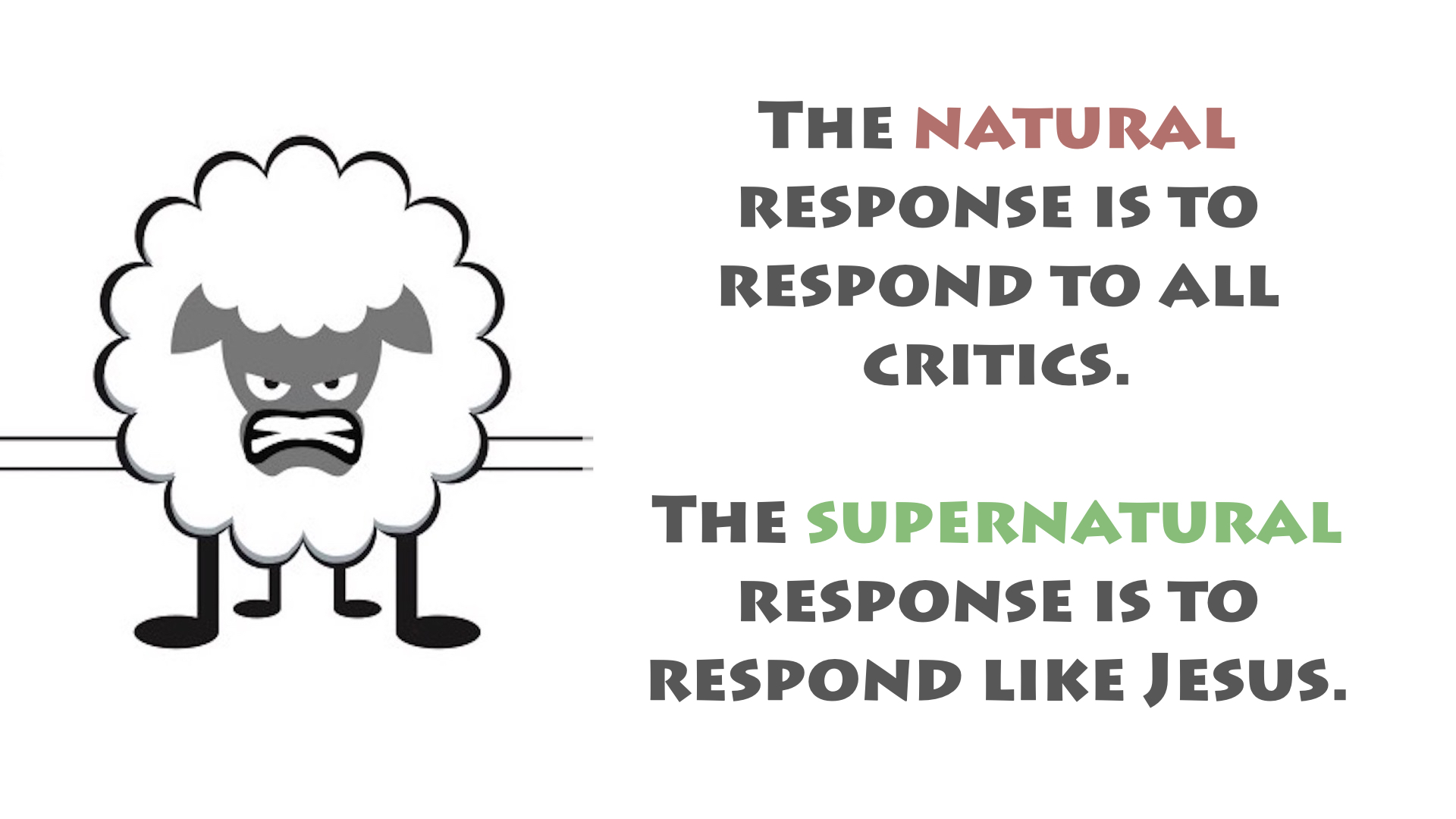
The natural response is to respond all critics. The supernatural response is to respond like Jesus (see 1 Peter 2:21-23). 

Remember that quote from Abraham Lincoln we saw earlier? Here’s the rest of his quote—

“From day to day I do the best I can and will continue to do so till the end. If in the end I come out all right, then the complaints and criticisms and what is said against me will make no difference. But, if the end brings me out wrong, then ten angels coming down from heaven to swear I was right would still make no difference.” 

Ultimately, we are longing to hear Jesus say, “Well done.” If He cannot say that to us, does it really matter if everyone else praised us? But if Jesus says, “Well cone,” does it really matter the criticism others said about us? 

Let’s ask the Holy Spirit to help us respond supernaturally to our critics—listen prayerfully to ever critic, but only respond to them as Jesus did. 

If you have missed any of the other messages in this series When Sheep Bite Sheep, you can find them all here. And if you’re a pastor, be sure to check out my book When Sheep Bite. 

►► Would you please prayerfully consider supporting this ministry? My Patreon supporters get behind-the-scenes access to exclusive materials. ◀︎◀︎

Is That In The Bible?

Listen to the podcast of this post by clicking on the player below, and you can also subscribe on AppleSpotify, or Audible.

A meme that makes me chuckle every time I see it is a “quote” attributed to Abraham Lincoln in which he says, “The problem with quotes found on the internet is that they are often not true.” 

(Not to spoil the joke for you, but unless Lincoln knew how to time travel to the future, I don’t think he knew about the modern internet! 😂) 

I love this meme because it captures something that so many people fall into: a quick acceptance of a statement without verifying its source or thinking through the implications of the statement’s truthfulness. 

Some insightful comments sound Shakespearean, but William never wrote them. 

Some pieces of wisdom sound Socratic, but Socrates never taught them. 

Some religious maxims sound godly, but the Bible never recorded them. 

I would like to invite you to join me as we relaunch this series called Is That In The Bible? I think you may be surprised to discover just how many phrases we call biblical aren’t, and how many phrases there are that we never realized are actually in the Bible. 

By the way, if you have a phrase that you would like to have us explore in this series, please leave it in a comment below. You may want to check out the questions we have already addressed:

In this installment of this series, we asked: Is this in the Bible…

Links & Quotes

“But friendship is precious; not only in the shade, but in the sunshine of life.” —Thomas Jefferson

“People are just about as happy as they make up their minds to be.” —Abraham Lincoln

“Humility is the foundation of all the other virtues hence, in the soul in which this virtue does not exist there cannot be any other virtue.” —Augustine

When you praise God, despite your surroundings, you magnify Him. And when you magnify God, you invite others to magnify Him with you!

“Manhood first and then gentleness.” —Ralph Waldo Emerson

I have blogged quite a bit about the historicity of the Bible. The Bible Archeology Report has a very informative post of the top 10 historical references to Jesus outside the Bible. These sources are from the first or second century AD, and specifically mention Jesus of Nazareth, not just Christians.

Dan Reiland wrote, “Church leadership always carries with it seasons of success and setbacks, momentum and grind, joy and discouragement. Yet, we all do better through those seasons when we have learned the rhythms of resilience—the lifelines we need.” Check out the 6 sustaining lifelines for leaders that he shared.

The Institute for Creation Research reported, “Two separate studies claim massive tsunamis and earthquakes from an asteroid impact profoundly affected the rock record. … [Yet] these global phenomena are better explained by the global Flood described in Genesis.”

“Anger makes dull men witty, but it keeps them poor.” —Francis Bacon

Is That In The Bible?

Listen to the podcast of this post by clicking on the player below, and you can also subscribe on AppleSpotify, or Audible.

A meme that makes me chuckle every time I see it is a “quote” attributed to Abraham Lincoln in which he says, “The problem with quotes found on the internet is that they are often not true.” 

(Not to spoil the joke for you, but unless Lincoln knew how to time travel to the future, I don’t think he knew about the modern internet! 😂) 

I love this meme because it captures something that so many people fall into: a quick acceptance of a statement without verifying its source or thinking through the implications of the statement’s truthfulness. 

Some insightful comments sound Shakespearean, but William never wrote them. 

Some pieces of wisdom sound Socratic, but Socrates never taught them. 

Some religious maxims sound godly, but the Bible never recorded them. 

I would like to invite you to join me as we relaunch this series called Is That In The Bible? I think you may be surprised to discover just how many phrases we call biblical aren’t, and how many phrases there are that we never realized are actually in the Bible. 

By the way, if you have a phrase that you would like to have us explore in this series, please leave it in a comment below. You may want to check out the questions we addressed in both the first installment and second installment of this series. 

In this installment of this series, we asked: Is this in the Bible…

Saved From The Consequences Of Folly

Listen to the podcast of this post by clicking on the player below, and you can also subscribe on AppleSpotify, or Audible. 

I am so grateful for the blessings of a godly mother and a godly wife! I can relate to Abraham Lincoln who said, “All I am, or can be, I owe to my angel mother. … I remember my mother’s prayers and they have always followed me. They have clung to me all my life.” 

Mothers—both the natural, physical, and adoptive mothers—can save the rest of us from a world of hurt. We see this in a story in the Bible of a mother that saved innumerable people from the consequences of folly. This is an amazing story in 1 Samuel 25, so please take some time to read it for yourself.  

King Saul and David have finally separated from each other, with Saul returning home to Gibeah and David returning to his stronghold at En Gedi. Eventually, David moved west from En Gedi to the Desert of Moan, where the town of Carmel was nearby. 

A prominent citizen of Carmel was a man named Nabal. He is described as “very wealthy,” owning 1000 goats and 3000 sheep. But he apparently gained his wealth through less-than-honorable means because he is described as “surly and mean in his dealings.” We find out later in the story that he’s also hard-hearted and hard-headed, not listening to any counsel others may offer him. 

That fits him because his name means “fool.” I find it hard to believe that his parents named him this from birth. If they did, it reminds me of the opening words of C.S. Lewis’ book The Voyage Of The Dawn Treader: “There was a boy named Clarence Eustace Scrubb, and he almost deserved it.” Instead, I think Nabal’s dealings were so mean, surely, and foolish that the name stuck. Perhaps he even wore that name as a badge of honor. 

It came sheep-shearing time—which is really payday for shepherds—so David sends some of his servants to Nabal to ask for whatever he might find to give as a gift to “your servants and your son David.” David’s men had been a constant source of protection for Nabal’s herdsmen, so a gift of gratitude does seem appropriate. 

Nabal doesn’t just say, “No,” but he insults David. As his foolish nature controlled him, he not only insulted David, but he insulted God too by implying that David wasn’t anointed by God, but was merely ruthlessly climbing a ladder of success. Probably Nabal thought this way because that’s how he himself gained his fortune. 

Nabal’s response lit David’s fuse! In fact, David’s response to his men was just four words long: “Put on your swords!” 

Fortunately, one of Nabal’s servants informed his wife Abigail of this. 

In the same verse where Nabal is described as mean and surely, Abigail is described as “intelligent and beautiful.” Whereas Nabal’s name means fool, Abigail’s name means “my father’s joy.” She must have been born at just the right time for her father and she continues to be a just-in-time woman! 

This servant brought Abigail word of Nabal’s foolish response, telling her that David’s men were indeed “a wall around us” while they were in the desert. And then he says, “Think carefully about what you should do because disaster is hanging over us!” 

Abigail acts quickly, wisely, and humbly. 

The first thing she does is send hundreds of pounds of food to David and his men. She sends the gift that Nabal probably should have sent. Then Abigail herself follows the gifts on her own donkey. When she encounters David and his armed men coming down the mountain pass, she humbly falls at his feet asking David to reconsider. 

Abigail doesn’t tell David he shouldn’t be angry, but she points him to something bigger and more long-lasting than his immediate thought of revenge. She reminds him that he is God’s anointed leader, and she asks, “When you become king, do you want this bloodshed on your conscience?” 

Abigail’s words have an immediate effect on David, who calls off the attack, praises Abigail, and praises God for sending Abigail to him. Abigail rescued Nabal’s family and workers from imminent destruction, and she saves David from the consequences of his rash response. 

The next morning, when she relates this story to Nabal, he has either a stroke or a heart attack, and then dies ten days later. Justice is served, but it’s served by God and not by David.

Later on, David takes the now-widowed Abigail as his wife. 

Abigail’s name scarcely appears anywhere else in the Bible, but there is one notable appearance: 

Sons were born to David in Hebron: His firstborn was Amnon the son of Ahinoam of Jezreel; his second, Kileab the son of Abigail the widow of Nabal of Carmel; the third, Absalom the son of Maakah daughter of Talmai king of Geshur; the fourth, Adonijah the son of Haggith; the fifth, Shephatiah the son of Abital; and the sixth, Ithream the son of David’s wife Eglah. (2 Samuel 3:2-5) 

Amnon, first in line for the throne, raped his half-sister Tamar and was then killed by Absalom, who was Tamar’s brother. Absalom, third in line for the throne, not only avenged his sister’s disgrace but led a coup against David, where he was killed in battle. 

That leaves Kileab as the obvious heir to King David’s throne, yet this is the only place he is mentioned in the Bible. I think Abigail’s wise influence saved Kileab from the drama of aspiring to be king, a painful future, and perhaps a premature death. 

From this amazing story, I would like to offer three takeaways for Moms:

  1. Use your inner beauty to persuade foolhardy men—1 Peter 3:2-3 
  2. Use your Holy Spirit-given wisdom to dissuade foolishness—Matthew 10:19 
  3. Use your prayer life to bring a legacy of peace—Psalm 116:16  

(Please read all of the above verses by clicking here.)

Godly mothers, please be encouraged today at how much influence you exert over others in your life. Your inner beauty, God-given wisdom, humility, and prayers are making more of an impact than you may ever know. I believe in heaven the full story will be shared, and you will be praised for being a wise and faithful servant. 

May God continue to bless, empower, and use our Moms to save us from the consequences of our foolishness! 

►► Would you please prayerfully consider supporting this ministry? My Patreon supporters get behind-the-scenes access to exclusive materials. ◀︎◀︎

Mother’s Day 2022

Our foolishness can get us into a lot of trouble, so thank God for mothers!

We are going to celebrate Moms by sharing three valuable lessons from a mother we meet in the Bible, as we learn how she saved her family from the consequences of their foolishness.

How wonderful to be able to say with Abraham Lincoln, “All I am, or can be, I owe to my angel mother. … I remember my mother’s prayers and they have always followed me. They have clung to me all my life.”  

If you don’t have a church home, we would love to have you join us.

Is That In The Bible?

Listen to the podcast of this post by clicking on the player below, and you can also subscribe on AppleSpotify, or Audible.

A meme that makes me chuckle every time I see it is a “quote” attributed to Abraham Lincoln in which he says, “The problem with quotes found on the internet is that they are often not true.” 

(Not to spoil the joke for you, but unless Lincoln knew how to time travel to the future, I don’t think he knew about the modern internet! 😂) 

I love this meme because it captures something that so many people fall into: a quick acceptance of a statement without verifying its source or thinking through the implications of the statement’s truthfulness. 

Some insightful comments sound Shakespearean, but William never wrote them. 

Some pieces of wisdom sound Socratic, but Socrates never taught them. 

Some religious maxims sound godly, but the Bible never recorded them. 

I would like to invite you to join me as we relaunch this series called Is That In The Bible? I think you may be surprised to discover just how many phrases we call biblical aren’t, and how many phrases there are that we never realized are actually in the Bible. 

By the way, if you have a phrase that you would like to have us explore in this series, please leave it in a comment below. If you would like to check out the questions we addressed previously, please click here

In this installment of this series we asked: Is this in the Bible…

10 Quotes From “Reading The Bible With The Founding Fathers”

Listen to the podcast of this post by clicking on the player below, and you can also subscribe on AppleSpotify, or Audible. 

For any students of American history or of the role the Bible has played in affecting world affairs, Reading The Bible With The Founding Fathers is an eye-opening book. You can check out my full book review by clicking here. Unless otherwise noted, quotes are from author Daniel Dreisbach. 

“Following an extensive survey of American political literature from 1760 to 1805, political scientist Donald S. Lutz reported that the Bible was referenced more frequently than any European writer or even any European school of thought, such as the Enlightenment or Whig intellectual traditions. Indeed, the Bible accounted for about one-third of all citations in his sample. According to Lutz, ‘Deuteronomy is the most frequently cited book, followed by Montesquieu’s The Spirit of the Laws.’ … Saint Paul is cited about as frequently as Montesquieu and [William] Blackstone, the two most-cited secular authors, and Deuteronomy is cited almost twice as often as all of [John] Locke’s writings put together.”

“The founders often quoted the Bible without the use of quotation marks or citations, which were not necessary for a biblically literate society but the absence of which fail to alert a biblically illiterate modern audience to the Bible’s invocation.” 

“Increasing unfamiliarity with the Bible makes it harder and harder for Americans to understand their origins and their mores, or to put words to their experiences. … Lacking knowledge of the Bible, Americans are likely to be literally inarticulate, unable to relate themselves to American life and culture as a whole.” —Wilson Carey McWilliams

“Knowledge of the Bible and its place in the American experience, in short, helps Americans better understand themselves and their history.” 

“In regard to this Great Book [the Bible], I have but to say, it is the best gift God has given to man. All the good the Saviour gave to the world was communicated through this book. But for it we could not know right from wrong. All things most desirable for man’s welfare, here and hereafter, are to be found portrayed in it.” —Abraham Lincoln 

“[T]he Bible has had a literary influence not because it has been considered as literature, but because it has been considered as the report of the Word of God.” —T.S. Eliot 

“[William] Tyndale, who was the first to translate the Bible into English from the original Hebrew and Greek, can be rightly called the father of the King James Bible. Approximately ‘eighty percent of his Old Testament and ninety percent of his New Testament’ were adopted by the King James translators. …  

“There is much truth in the remark that ‘without Tyndale, no Shakespeare.’ It is also true that ‘without Tyndale, no King James Bible.’ ‘Without the King James Bible,’ Alister McGrath observed, ‘there would have been no Paradise Lost, no Pilgrim’s Progress, no Handel’s Messiah, no Negro spirituals, and no Gettysburg Address. … Without this Bible, the culture of the English-speaking world would have been immeasurably impoverished.’” 

“The size of the vocabulary found in the King James Bible is not extensive. [William] Shakespeare, it is estimated, used between fifteen and twenty thousand different words. Milton’s verse draws on a lexicon of about thirteen thousand words. The Old Testament, in the Hebrew and Aramaic, has approximately fifty-six hundred words. The New Testament, in the Greek, has around forty-eight hundred words. In the entire King James Bible, by contrast, there are only about six thousand different words, according to one accounting.” 

“The opinion that human reason, left without the constant control of divine laws and commands, will preserve a just administration, secure freedom and other rights, restrain men from violations of laws and constitutions, and give duration to a popular government, is as chimerical as the most extravagant ideas that enter the head of a maniac. … Where will you find any code of laws, among civilized men, in which the commands and prohibitions are not founded on Christian principles? I need not specify the prohibition of murder, robbery, theft, [and] trespass. … Every wise code of laws must embrace the main principles of the religion of Christ.” —John Adams 

“Moral principles and precepts contained in the Scriptures ought to form the basis of all our civil constitutions and laws. These principles and precepts have truth, immutable truth, for their foundation; and they are adapted to the wants of men in every condition of life. They are the best principles and precepts, because they are exactly adapted to secure the practice of universal justice and kindness among men; and of course to prevent crimes, war and disorders in society. No human laws dictated by different principles from those in the gospel, can ever secure these objects. All the miseries and evils which men suffer from vice, crime, ambition, injustice, oppression, slavery and war, proceed from their despising or neglecting the precepts contained in the Bible. … For instruction then in social, religious and civil duties resort to the scriptures for the best precepts and most excellent examples of imitation.” —Noah Webster

Self-Evident

“It happens that we meet together once every year, sometime about the 4th of July. … We run our memory back over the pages of history [to 1776]. We find a race of men living in that day whom we claim as our fathers and grandfathers. They were iron men. They fought for the principle that they were contending for; and we understand that by what they then did, it has followed that the degree of prosperity that we now enjoy has come to us. We hold this annual celebration to remind ourselves of all the good done, of how it was done and who did it, and how we are historically connected with it. …

“We have [among us immigrants] who are not descendants at all of these men. … If they look back through this history to trace their connection with those days by blood, they find they have none. … But when they look through that old Declaration of Independence, they find that those old men say that ‘We hold these truths to be self-evident, that all men are created equal.’ And then they feel that that moral sentiment taught in that day evidences their relation to those men, that it is the father of all moral principle in them, and that they have a right to claim it as though they were blood of the blood, and flesh of the flesh of the men who wrote that Declaration. And so they are. That is the electric cord in that Declaration that links the hearts of patriotic and liberty-loving men together, that will link those patriotic hearts as long as the love of freedom exists in the minds of men throughout the world.” —Abraham Lincoln

Is That In The Bible?

A meme that makes me chuckle every time I see it is a “quote” attributed to Abraham Lincoln in which he says, “The problem with quotes found on the internet is that they are often not true.” 

(Not to spoil the joke for you, but unless Lincoln knew how to time travel to the future, I don’t think he knew about the modern internet! 😂) 

I love this meme because it captures something that so many people fall into: a quick acceptance of a statement without verifying its source or thinking through the implications of the statement’s truthfulness. 

Some insightful comments sound Shakespearean, but William never wrote them. 

Some pieces of wisdom sound Socratic, but Socrates never taught them. 

Some religious maxims sound godly, but the Bible never recorded them. 

I would like to invite you to join me in a new series we are beginning this Sunday called Is That In The Bible? I think you may be surprised to discover just how many phrases we call biblical aren’t, and how many phrases there are that we never realized are actually in the Bible. 

By the way, if you have a phrase that you would like to have us explore in this series, please leave it in a comment below. 

In this installment of this series, we asked: Is this in the Bible…