Still Learning

I live by the axiom, “If you’re through learning, you’re through.” So I try to learn something new every day.

I just finished a class called New Testament Survey: a quick overview of the 27 books that compromise the New Testament of the Bible. Here’s a couple of interesting factoids I picked up from my studies:

  • The earliest-written book was James. Interesting, because at one point James thought Jesus (his half-brother) was nuts.
  • Only Matthew uses the term kingdom of heaven; all of the other writers use kingdom of God.
  • Mark uses the word immediately more times than anyone else. Perhaps because his source (Peter) was always doing things so quickly… sort of a ready, FIRE!, aim kinda guy.
  • Luke wrote what is called “the global gospel” for everyone, so he included 45 teachings/events that no one else records.
  • John doesn’t record any of Jesus’ parables.
  • John uses the word believe nearly 100 times— way more than any other writer.
  • Luke talks about the Holy Spirit nearly 60 times in the 28 chapters of Acts.
  • Romans is the longest of Paul’s epistles with 7101 words; Philemon is the shortest with just 355 words.
  • With the exception of the pastoral epistles (1 Timothy, 2 Timothy, Titus) Paul’s letters are arranged in the Bible from longest to shortest.
  • In 1 & 2 Thessalonians (only 136 verses) Paul refers to God, Christ, the Holy Spirit, or a combination thereof more than 150 times.
  • Paul gives Timothy seven word pictures to describe the kind of pastor he should be: son, soldier, athlete, farmer, workman, instrument, and servant.
  • Hebrews is called “the book of better things” so better is used 13 times. This word is used only six times in the remaining 26 books of the New Testament.
  • James wrote 108 verses but issues 50+ direct commands.
  • In John’s three short epistles he uses the word know 33 times, and the word dear ten times.

Keep on learning! There’s a lot of good stuff out there. What have you learned lately?
The Not-So-Little Stuff

Listen to the podcast of this post by clicking on the player below, and you can also subscribe on AppleSpotify, or Audible.

My youngest son showed up at the dinner table one evening with a swollen left eyelid. I looked at it a little more closely and could see what looked to be a bug bite in the corner of his eye.

“No big deal,” I thought. “It’s just a mosquito bite. Happens all the time in Michigan.” (After all the mosquito is slated to become our new state bird!)

But when he woke up the next morning, his left eye was only open a slit. By the time I got him to the urgent care, his eyelid was a deep pink color and he was feeling very lethargic.

Guess what? It’s not such a little thing anymore!

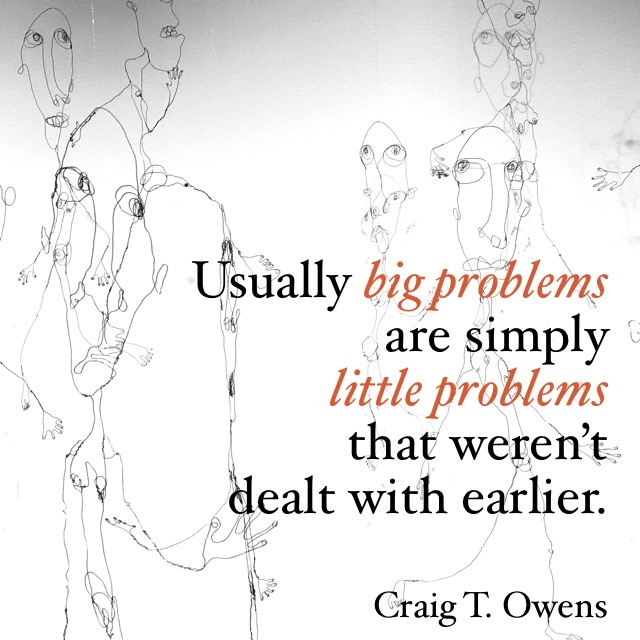
Frequently I hear people saying, “Don’t sweat the small stuff.” And I suppose to a certain extent that’s true. But typically the big stuff started off as the little stuff. Usually big problems are simply little problems that weren’t dealt with earlier.

  • Someone says, “My marriage failed last night” (big stuff). But the small warning signs had been there for months, but they weren’t taken care of.
  • Someone says, “My finances just hit rock bottom” (big stuff). But the small unnecessary purchases over time led to this moment.
  • Someone says, “I gave in to temptation” (big stuff). But the little flirting with the temptation created just the right environment for the big tumble.

Charles Simmons wrote —

“Life is made up of little things. It is very rarely that an occasion is offered for doing a great deal at once. True greatness consists in being great in the little things.”

On the flip side, rarely is a big problem presented all at one; it’s usually just the little things compounded over time.

The apostle Paul warned the church at Corinth about the little things that can blow up into the big things:

Your flip and callous arrogance in these things bothers me. You pass it off as a small thing, but it’s anything but that. Yeast, too, is a “small thing,” but it works its way through a whole batch of bread dough pretty fast. So get rid of this “yeast.” (1 Corinthians 5:6-7, The Message paraphrase)

A final thought from Paul to his protégé Timothy: “Keep a close watch on how you live” (1 Timothy 4:16 NLT). Great advice!

By the way, my son was fine after a little steroid treatment and some Benadryl, but some people never recover from their lack of attention to the little things.

Don’t let this happen to you! Watch out for the little things because you may find that they’re not so little after all!

►► Would you please prayerfully consider supporting this ministry?  My Patreon supporters get behind-the-scenes access to exclusive materials, like a 10-minute video I just shared on study tips for the poetic books of the Bible. ◀︎◀︎

Diet + Exercise = Healthy Growth

The right diet will start you on the road to excellent health, but to keep growing in a healthy way you will need to incorporate some regular exercise too. This is true physically, spiritually, and emotionally.

If I just eat the right foods but don’t exercise, my physical metabolism will not be stoked to the proper levels. To put it another way, a good diet may lower my LDL (bad) cholesterol, but it takes exercise to raise my HDL (good) cholesterol. I need both to be healthy.

So, too, for my heart and mind. If I hear good preaching and think good thoughts (diet), but never put those words or thoughts into action (exercise), I’m not going to grow in a well-balanced, healthy way.

Here’s a couple of things I have learned for body, spirit, and mind exercise.

Set challenging but realistic goals

  • I don’t run without a goal. (1 Corinthians 9:26 CEV)
  • “You must have long-range goals to keep from being frustrated by short-term failures.” —Charles N. Noble

Exercise a little bit when you can

  • There’s no need to jump into lengthy workouts.
  • Exercise daily in God—no spiritual flabbiness, please! Workouts in the gymnasium are useful, but a disciplined life in God is far more so, making you fit both today and forever. (1 Timothy 4:7, The Message)
  • “Let him then think of God the most he can; let him accustom himself, by degrees, to this small but holy exercise; nobody perceives it, and nothing is easier than to repeat often in the day these little internal adorations.” —Brother Lawrence, in The Practice Of The Presence Of God

Make exercise a fun habit

  • Remember that you may not feel like exercising, but you will feel better after you exercise.
  • “Life goals are reached by setting annual goals. And annual goals are reached by reaching daily goals. And daily goals are reached by doing things which may be uncomfortable at first but eventually become habits. And habits are powerful things. Habits turn actions into attitudes, and attitudes into lifestyles.” —Charlene Armitage

For a healthy body, a healthy heart, and a healthy thought life, watch the diet you consume and then exercise for maximum benefit. Feel free to share any exercise tips you have learned.

Conjunction Junction: BUT

Do you remember the School House Rocks videos? Fun and yet so educational! One of my favorite ones is called “Conjunction Junction.”

Conjunctions are very powerful connectors. Especially when I’m reading the Bible I slow down when I see and, or, or but. These conjunctions can open up a wealth of Scriptural knowledge.

Another thing that stands out to me when I’m reading God’s Word is the (parentheses). Little sidebars that can add so much richness. Today I saw a parenthetical comment followed by one of these powerful conjunctions.

Here’s the parenthetical comment: (There was never a man like Ahab, who sold himself to do evil in the eyes of the LORD, urged on by Jezebel his wife. He behaved in the vilest manner by going after idols, like the Amorites the LORD drove out before Israel) (1 Kings 21:25-26).

Ahab is not just evil—he’s not just bad—he’s the evilest, worst king… ever!

BUT = not one thing, but an entirely different thing.

But Ahab—the evilest king ever—humbled himself before God: “Have you noticed how Ahab has humbled himself before Me? Because he has humbled himself, I will not bring this disaster in his day, BUT I will bring it on his house in the days of his son” (v. 29).

I’m so glad God recognizes our humility and then extends His mercy. BUT is a great conjunction! Check out these passages with BUT

Do you not know that the wicked will not inherit the kingdom of God? Do not be deceived: Neither the sexually immoral nor idolaters nor adulterers nor male prostitutes nor homosexual offenders nor thieves nor the greedy nor drunkards nor slanderers nor swindlers will inherit the kingdom of God. And that is what some of you were. BUT you were washed, you were sanctified, you were justified in the name of the Lord Jesus Christ and by the Spirit of our God. (1 Corinthians 6:9-11)

Here is a trustworthy saying that deserves full acceptance: Christ Jesus came into the world to save sinners—of whom I am the worst. BUT for that very reason I was shown mercy so that in me, the worst of sinners, Christ Jesus might display His unlimited patience as an example for those who would believe on Him and receive eternal life. (1 Timothy 1:15-16)

It doesn’t matter if you were the vilest, meanest, worst-person-ever, when you humble yourself to ask for God’s forgiveness, He pronounces that great conjunctionBUTthat completely cancels your past!!

Wow! What a merciful, loving God! And what a great conjunction He inserts in our lives—BUT!

I’m happy today that I’ve been to God’s Conjunction Junction and He’s hooked a BUT between my former life and my present life. How about you?