Lifter Or Leaner

It’s a pretty simple question:

…but it requires some serious in-the-mirror introspection to answer.

Honestly:

…when times are tough,

…when it’s inconvenient for you,

…when it’s out of your comfort zone,

…when you’ve had a hard day yourself,

…can others count on you to come through?

It really boils down to this:

…are you a lifter or a leaner?

“There are two kinds of people on earth today;
Just two kinds of people, no more, I say.
 
Not the sinner and saint, for it’s well understood
That the good are half-bad and the bad half-good.
 
Not the rich and the poor, for to rate a man’s wealth,
You must first know the state of his conscience and health.
 
Not the humble and the proud, for in life’s little span,
Who puts on vain airs, is not counted a man.
 
Not the happy and sad, for the swift flying years
Bring each man his laughter and each man his tears.
 
No; the two kinds of people on earth I mean,
Are the people who lift and the people who lean.
 
Wherever you go, you will find the earth’s masses,
Are always divided in just these two classes.
 
And oddly enough, you will find too, I ween,
There’s only one lifter to twenty who lean.
 
In which class are you? Are you easing the load,
Of overtaxed lifters, who toil down the road?
Or are you a leaner, who lets others share
Your portion of labor, and worry and care?”
—Ella Wheeler Wilcox, Which Are You? 

Turtle On A Fencepost

My evening visitor

My evening visitor

My studies last night were interrupted by some commotion on my front lawn. Neighborhood kids playing in our yard is nothing new (I’m usually the one outside instigating all of the noise!), but this just sounded different. There was a buzz of excitement. I glanced out the window and saw a rather large turtle in my front yard and several kids gathered around it.

I went outside to see my new visitor. After getting the kids to stand back we watched as the turtle made her journey all the way to the garden next to my house. She sat in the garden for a few minutes and then made a big u-turn. Across the street from my house is a wetland preserve and I was sure that was where she was returning. Most of the kids had gotten bored watching this slowpoke and were off doing other things, but a couple of boys and I watched the turtle as she headed for the road.

When she reached the edge of the road she waited. And waited. And waited.

Once she ventured her front two legs onto the pavement only to feel the vibration of an oncoming car. She quickly pulled her head, all four legs, and her tail into her protective shell.

I decided to intervene. I picked her up and carried her safely across the road. Even before I could set her down in front of the marshy area, she already had her legs fully extended and was “walking” in the air, anxious to get back home. I place her on the ground and watched her disappear under the raspberry vines and into the cattails.

And then I heard it. <CLUNK!>

I pushed back the prickly vines to check on her. What I saw was just the underside of my turtle. She had fallen off the edge of a drainage pipe and was laying flat on her back.

Helpless!

I braved the briars of the raspberry vines and the biting mosquitoes to climb down into the drainage pipe and flip her right side up. Immediately her short little legs carried her farther into the wetlands. Home at last!

As I walked back home I thought about a quote I heard once, “If you see a turtle on top of a fence post, you know it had some help.”

In so many areas of my life, I’ve been helped. Whether across dangerous “roads” or lifted out of places where I was flat-on-my-back stuck, others have lifted me and carried me. Today I’m going to contact a couple of those lifters to say “Thanks!”

Maybe you should, too. Aren’t there a few lifters and carriers you could thank today?


sHAkE it uP

The other day my son Harrison and I were talking about the books he was reading. Like a chip off the old block, he loves to read almost as much as I do (just makes a Dad so proud!). Our discussion about reading was about the variety of genres. I suggested that just like a healthy diet for our bodies includes a variety of healthy foods, so should our mental diet include a healthy variety.

We are all creatures of habit. In fact, some scientists estimate that as much as 90% of our daily routines are things we do by unconscious habit. We just do it because we’ve always done it.

You know when your daily routine has been messed up, don’t you? You feel agitated and out-of-sorts. You think, “I just don’t feel like myself today.” Because you are not yourself: your routines, your habits have been shaken up.

So if unplanned things mess up your routine and make you grumpy, can I propose something else? Instead of waiting for something unexpected to shake up your routine, go ahead and sHAkE it uP on purpose.

Do something far from the norm, completely different, out of the box. Who knows, you may uncover an unhealthy routine that needs to be changed, or you may find there’s something new that you never realized you would have liked so much.

  • Instead of reading the same books by the same authors, grab something new.
    • …or try nonfiction instead of fiction, or classic instead of contemporary.
  • Instead of watching TV after dinner, go for a walk.
    • …or play Monopoly with your family.
  • Instead of going to your usual spot for lunch, brown bag it and eat outside on the grass.
    • …or fast your lunch and spend the lunch hour in quiet meditation.
  • Instead of sitting in the same seat at church, sit in a different section.
    • …or make a rotating plan to sit somewhere new every month.
  • Instead of allowing the same topics to trigger an argument with your spouse, find a new way to handle the emotion.
    • …or read a book together to help you resolve the issue.
  • Instead of returning your empty pop cans to buy more pop, donate the cash to charity.
    • …or find a cause your whole family can support together.
  • Instead of scooping ice cream at home, take a family walk to the ice cream shop.
    • …or buy popsicles for all the neighborhood kids when the ice cream truck rolls by.
  • Make breakfast for dinner
  • Listen to the music your kids like or your parents like
  • Ride your bike to work
  • Visit a museum
  • Watch a black-and-white movie
  • sHAkE it uP!!

As Mark Twain said, “Take your mind out every now and then and dance on it. It is getting all caked up.”

I’d love to hear about your adventures in shaking up your routines. What are you going do to sHAkE it uP this week?

Esse Quam Videri

Guest Author: Dick Brogden

Dr. Warren Newberry is the head of my PhD Program in Intercultural Studies at the Assembly of God Theological Seminary. He has the Latin phrase Esse Quam Videri on his office wall. It means “To be rather than to seem.”

The phrase is first found in Cicero’s essay On Friendship. Aeschylus used a similar phrase in Seven Against Thebes, at which the scout says of the priest, “His resolve is not to seem the best but in fact to be the best.” Plato quoted this line in Republic (361b). It is also the State motto of North Carolina.

Coming back to America for the summer (studies and some meetings) has reinforced this precept. America on the surface seems whole and healthy. As a family, we have enjoyed McDonald’s, Lake Michigan, vibrant worship services, and incredible public libraries, among many other wonderful things. Last week however I took a trip on a Greyhound bus. Every American should be so lucky.

Greyhound bus stations in Middle America are fascinating places “to be.” There was a nervous young Amish couple. There was an African American street preaching pair: The woman had her Bible out, loudly laughing, scolding, and reading Scripture to all who did or did not want to listen. Her companion was a monster of a man, tattoo-covered, gold tooth glinting in the neon light. He did not speak often, but when he did you were afraid to not pay attention. Hippies, druggies, bums, out-of-work mechanics and returning U.S. Marines. Thin and fat. Old and young. Black, brown, yellow, and white. It was a living mosaic reminding me of what America is, not just what America seems.

It makes me reflect on the dichotomy between who I am and who I seem to be. In God’s mysterious grace, opportunities for higher profile ministry and service are coming our way. In front of pulpits, cameras, microphones, interviewers, and even in front of you through newsletters and emails we can seem to be a certain way.

In The Prince, Niccolò Machiavelli twists this phrase to Videri Quam Esse (to seem rather than to be) with respect to how a ruler ought to act. This is such a danger for missionaries… for me… for you.

I write to ask for prayer and for accountability. I want to ask you to pray for the judgment of God on my life. I want to ask that all falsehood and pretension is exposed and removed. I want to ask that there is no hypocrisy or pride left in me. I ask this fearfully, but it is my desire to walk humbly before God, before you, and before Muslims in Sudan. I long to be—not just seem to be—a lowly follower of Christ.

Dick Brogden and his family have served as missionaries in numerous Arabic nations for over 20 years.

Random

Betsy has no summer school today so we’re just chillin’ around the house. This is also one of the rare weekends that I’m not speaking anywhere. To celebrate the start of a long, lazy weekend, I thought I’d post some random thoughts about me.

Here goes…

  • I also blog short quotes and pictures on Tumblr. Check me out!
  • I don’t drink coffee.
  • I love tea: black, green, white, red, hot or cold.
  • My favorite author is C.S. Lewis.
  • My favorite book is the Bible.
  • A life-goal of mine is to read an autobiography or biography of every U.S. President.
  • I enjoy my Coke Zero with fresh-squeezed lime.
  • My favorite Detroit team is the Tigers.
  • My favorite all-time Tigers player is Ty Cobb.
  • Betsy and I dated for 5 years, 8 months, and 2 days before we got married.
  • I still love going out on a date with Betsy!
  • My ideal vacation is sitting by a lake with a huge stack of books and a big glass of iced tea.
  • I get jazzed by closing all my circles on my Apple Watch every single day.
  • I am more in love with Jesus today than I ever have been in my life!

There you go: a whole bunch of stuff you probably never knew or even cared to know! Have a great weekend!

Beat Up

Some snippets from a few conversations I have had the past week—

  • “What’s the point?”
  • “My life doesn’t make sense.”
  • “I probably deserve this.”
  • “I don’t know how I got here … I don’t know how to get out of here.”
  • “Why me?”
  • “I feel beat up.”

C.S. Lewis got it exactly right when he wrote, “If satan’s arsenal of weapons were restricted to a single one, it would be discouragement.”

Have you ever worked with someone whose attitude changed after giving his 2-week notice? His job performance slips … his attitude stinks … he does things against company policy … and he justifies it all by saying, “What are they going to do, fire me?” He’s got nothing to lose by acting like a complete jerk!

satan has already been “fired”—he knows he’s got a terrible end coming. And all he wants to do is make other people feel rotten … beat up … discouraged … defeated. He wants to take you down. He’s a jerk!

Did you know that the word devil means slanderer? By his very nature, he only tells lies. Everything he says is intended to harm you. He slings mud at your character, tries to get you thinking you’re no good, turns your attention to anything that’s dark, picks on your faults, jumps on your weaknesses. Like a jerk, he beats you up and beats you down until you start believing his lies.

He is a LIAR!

You are invaluable.

You are a masterpiece.

You are desperately loved by God.

You are integral to God’s plan.

I know you may want to ignore satan’s slandering, to tune out his lies, but can I suggest something else? Listen to them. Listen very carefully. If you are listening closely, you will be able to identify the lies and then demolish them. satan is hoping you will simply accept what he’s saying without analyzing it.

Here’s the next step. After you’ve identified the lies, you have to speak the truth OUT LOUD that contradicts those lies. The Bible says that we defeat satan’s slander by the power of Jesus AND the true words from our mouth. If you’re not sure what biblical truth counteracts the lies that are discouraging you, email me and I’d be happy to help you.

You are so very valuable! There’s a bully who wants to intimidate you, but your Big Brother Jesus is ready to take care of him!

Finishing Well

Asa started so well, accomplished so many things, was known for his greatness, won an unbelievable victory, made the tough choices that the people loved, and then faded into disrepute.

Starting well is important; finishing well is so much more important. After we’re gone, people usually remember us for how we went out.

Asa was a great king of Judah (see 2 Chronicles 14-16). He began to clean out all of the false gods and pull down the places where these idols were worshipped. The people were so unified behind Asa that none of their enemies even dared to attack them. And Asa recognized this. He said, “The land is ours and is at peace because we have sought God; we’ve sought Him and He’s given us peace everywhere.”

An army from Cush (modern-day Sudan and Libya) marched up to challenge Asa in battle. The Cushites came with an army too large to even count, while Asa had about 500,000 fighting men. Asa and his men called on God, and God helped them win an incredible victory. In fact, they inflicted such heavy casualties on the Cushites that they never returned to their former strength.

Then something happened.

Baasha, the king of Israel, began fortifying the city of Ramah. This wasn’t hostile in itself, but it did look to Asa like the build-up to war. Israel’s army wasn’t nearly the size of the army of Cush that Asa had just seen God help him defeat. But instead of calling on God, Asa bribed Ben-Hadad, king of Aram, to break his treaty with Israel. This political turnabout caused Baasha to quit building up Ramah to move his forces to protect himself from Aram.

At first glance, it looks like Asa won. He was the clever one. He did it himself. And there’s the problem: he did it himself—he didn’t rely on God.

Why did Asa do this? Why did he abandon God? Why didn’t he seek God as he did before?

The prophet Hanani came to ask Asa these very questions. Hanani told Asa it was foolish of him to turn his back on God. Instead of this prompting Asa to recognize he had slipped away from God, he got angry and threw Hanani in prison. Then in his guilt-provoked rage, Asa began to oppress his own people.

A short time later Asa contracted some sort of disease in his feet. The Bible says, “Though his disease was severe, even in his illness he did not seek help from the Lord, but only from the physicians.”

Asa started out so well, yet finished so poorly. Starting well is important; finishing well is so much more important.

The Lord is with you when you are with Him. If you seek Him, He will be found by you, but if you forsake Him, He will forsake you (2 Chronicles 15:2).

What are you doing today to make sure you finish well? The best thing you can do is seek God with all your heart. Do that and you will finish well. People usually remember us for how we go out.

Finish well.

The Right Questions

“The uncreative mind can spot wrong answers, but it takes a creative mind to spot wrong questions.” —Sir Anthony Jay

This has always been a challenge for me—maybe for you, too. I can easily spot when someone gives me a wrong answer, but it’s harder to spot when I’ve asked a wrong question. It could very well be that the answer I’m hearing is correct in light of the question I asked.

But spotting wrong questions requires a humility on my part to admit I may be wrong. Spotting wrong questions requires creativity, a new way of looking at things.

There is a short story about the life of King Abijah recorded in 2 Chronicles 13 in the Bible. Abijah is the second king to reign in Judah after the 10 northern tribes had seceded. He is vastly outmanned and out-spent by King Jeroboam of the northern tribes (called Israel). When it comes to a battle between north and south, Abijah can only field half as many men as Jeroboam.

Yet it is Abijah who takes charge of the battlefield before the fighting begins. He climbs to the top of Mount Zemaraim to make sure all of the northern tribes can hear him. The wrong question would have been, “Which side is God on: Israel’s or Judah’s?” The correct question which Abijah must have asked and answered for himself—is, “Are we on God’s side?

Abijah begins to recount how God chose for a descendant of David to sit on the throne (Abijah), but northern Israel was following a rebel (Jeroboam). God intended for the descendants of Aaron to oversee the sacrifices and religious practices; Judah was doing this, but Israel had their own priests. God was to be worshipped exclusively; Judah was doing this, but Jeroboam made golden calves for Israel to worship.

So Abijah correctly concludes, “God is with us; He is our leader.”

Abijah didn’t assume God was with Judah. Abijah didn’t ask, “Does God lead us or them?” Abijah asked, “Are we doing the things that God has asked of us?” Since Judah was following God, Abijah could then state with confidence, “God is with us.”

The question is not, “Is God on your side?” It’s better to ask, “Am I on God’s side?

The question is not, “What would Jesus do if He was here?” It’s better to ask, “What did Jesus already do that I can follow?

What questions are you asking? Change your questions and you just may change your life.

Gentle Restoration

I’m struggling with this one. I have a dear friend who is perplexed by an ongoing drug addiction. He appeared to have it under control until things in his life started spiraling out of his control, and he gave in to his old habit again.

So the Bible says that if one of my brothers slips up I’m supposed to restore him gently. How exactly does one do that? I bounced between so many emotions during the last 48 hours: anger at this addiction, sorrow for what my friend is going through, heaviness at what he’s doing to himself and his family, hatred at the devil for his evil tricks, and a passion to see him whole and healthy and free again. Then my own thoughts have baffled me: “How do I gently restore my brother? What does restoration look like?”

Restoration is an interesting Greek word. It can mean setting a broken bone; mending torn fishing nets; manning a fleet of ships; or supplying an army with its provisions.

Restoration is NOT canceling a debt or removing the consequence for someone’s actions. I like what Dave Anderson wrote, “One of the best lessons you can teach your people is that when they choose a behavior they choose the consequences for that behavior.”

Restoration is feeling the pain of what’s been broken or defeated, learning the lesson from that, and then repairing the break or deficiency in such a way that it won’t break or be defeated again. I have the responsibility and the privilege of doing some mending for my friend.

What about gentle? Over time this word has come to mean something like wishy-washy, no backbone, no guts. Gentle originates from the Latin word gentilis which means belonging to the same family or clan. To be gentle is to be strong enough to respond in a controlled manner to someone who is just like me. Gentleness is strength under control.

I hope I’m gentle enough to restore my friend, to mend what is broken in him so he never has to be defeated by this addiction again. He has some consequences to face. But I am committed to helping him carry this heavy load all the way to the finish line.

Check it out—

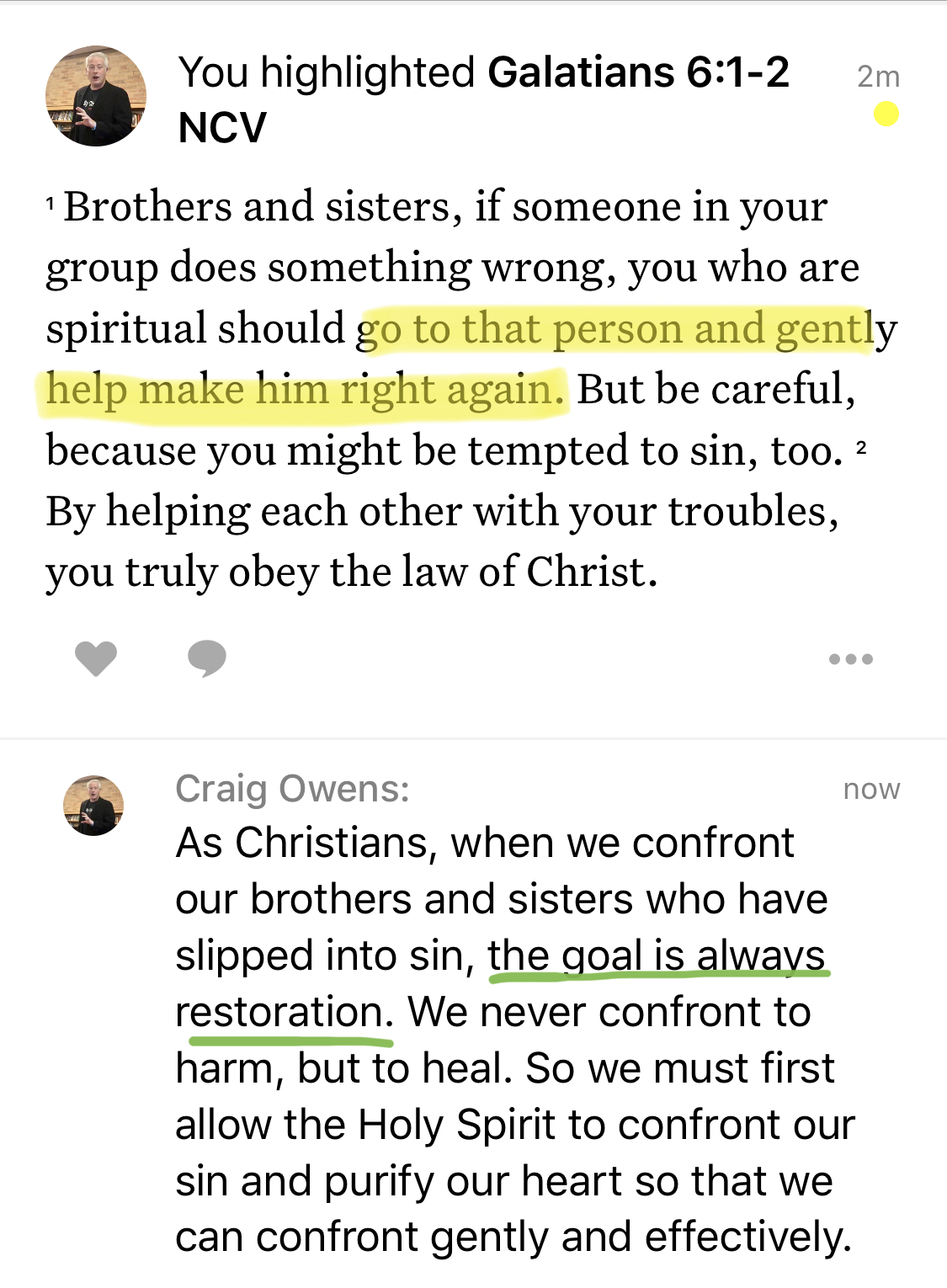
Brothers, if someone is caught in a sin, you who are spiritual should restore him gently. But watch yourself, or you also may be tempted. Carry each other’s burdens, and in this way you will fulfill the law of Christ. (Galatians 6:1-2)

Gentle restoration is hard work. But it’s so worth the effort!

If you have any thoughts on how to gently restore a friend, I’d love to have you share them with me in the comments section.

What’s Your Work?

When I’m at business functions, I along with all of the other attendees are typically walking around with the “Hello, My Name Is” label stuck to my chest. The idea is that as I shake hands with new people I can glance down and say, “Nice to meet you, uh, Bob!”

Nine times out of ten, after the initial introduction is made the very next question people have for me is, “So, what do you do?” All of us usually give an answer related to our jobs: I’m a pastor, I’m a graphic designer, I’m a teacher, I’m a blogger, etc. Yes, that’s what you do; that’s your job. But what do you work at?

I’ve been thinking about this over the past couple of days. And what got me thinking were two “interruptions” to my job.

On Wednesday night I was teaching a Bible study. I was just getting to the pay-off—the part of the lesson where the attendees would really be challenged to apply the lesson to their real-life situations—when my lesson was interrupted. A friend had slipped out of his seat and was standing at the back. All of a sudden he was clutching his chest and saying, “I need help!” Immediately my lesson stopped, I was at his side trying to recall some of my medical training, and then asking someone to call 911.

I didn’t finish my “job” on Wednesday evening, but I did my work as a friend.

Today I had planned to devote the better part of my day to preparing a message for Sunday morning. It’s my “job” as a pastor to come to church prepared with a timely, relevant message. But after talking with a friend on the phone, I could hear the heavy despondency in his voice, and I knew I needed to go see him face-to-face.

I put my job on hold to go do my work as a friend.

Bill Hybels wrote, “Keep the ‘church’ in church work.” My work—as a member of the Church, as a friend—should always trump my “job.”

The Apostle Paul wrote, “Carry each other’s burdens, and in this way you will fulfill the law of Christ” (Galatians 6:2).

At the end of my life, I don’t think God is going to ask me how good my sermons were. But He is going to ask me how well I did my work as His servant.

Then the King will say to those on His right, “Come, you who are blessed by My Father, inherit the Kingdom prepared for you from the creation of the world. For I was hungry, and you fed Me. I was thirsty, and you gave Me a drink. I was a stranger, and you invited Me into your home. I was naked, and you gave Me clothing. I was sick, and you cared for Me. I was in prison, and you visited Me. … I tell you the truth, when you did it to one of the least of these My brothers and sisters, you were doing it to Me!” (Matthew 25:34-36, 40).

How’s your work going today?