I’m not one who’s into psycho-babble, but I do like trying to understand human nature a little better. A great book to help on this learning journey is Oswald Chambers’ Biblical Psychology.
As you might imagine, Chambers has a heavy emphasis on the biblical part. In fact, he makes the case that no one can really know themselves. But we can know God better, and He will reveal our real selves to us. Chambers delves into Scripture to teach how our body, soul, and spirit interact with each other, with outside influences, and with the Spirit of God.
It was an absolutely fascinating book to read. This is one of Oswald Chambers’ longest books, and also one of his most technical books. So be forewarned that you will have to really concentrate and apply yourself to grasp all he discusses, but if you persevere through it, you will be richly rewarded.
This is a weekly series with things I’m reading and pondering from Oswald Chambers. You can read the original seed thought here, or type “Thursdays With Oswald” in the search box to read more entries.
Thinking Or Doing
We perceive Truth by doing the right thing, not by thinking it out.
From Baffled To Fight Better
Oswald Chambers was not anti-thinking; neither am I. But there is a problem when I insist on something making sense to me before I act on it. If God says, “This way,” my first response shouldn’t be, “I’ll think about it.” But it should be, “Yes, I will obey.”
The words of the old hymn ring true:
Trust and obeyFor there’s no other wayTo be happy in JesusBut to trust and obey
It sounds like a long time, but it’s only 1095 weeks. That’s just enough time for my life to have been irrevocably changed for the better, and just enough time to know that we’ve only scratched the surface.
Betsy, I cannot wait to see what the next 1095 weeks are going to bring us!
I’m glad that my family shares at least a little bit of my passion for reading. My oldest son reviewed book one of this trilogy (you can read his review by clicking here), and he continues with his review of the second book.
Learning and Loving is the second book of the Spirit War trilogy by Frenando Quirós. Over his three-part series Quirós explores the life of Jesus. This book focuses on the time period of Jesus’ visit to the temple until His temptation by satan, and His miracle of driving out the demons into the pigs.
For anyone who read my last review you know I thought it was a very good book. With this book I was much less impressed. To begin with the demons have a horrible language problem. There was also some nudity and multiple people are described as being “perfectly possessed.”
Another issue I had with the book was a theological one. In part of this book it is explained that Jesus received His training from monks. When He returns He tells His mother Mary about having an out-of-body experiences with the monks. Also it is very explicitly stated that Jesus is NOT the Son of God and that His power was just given to Him by God. I understand that real life is not like a Sunday School story but I felt that this book just went too far.
I also feel that this book could be very misleading to people who have never heard the story of Jesus. In the preface Quirós writes, “There are scripture footnotes along the way… but this is neither a scholarly nor a formally religious work.” So even though he does claim this as a work of fiction, someone who has never read the Bible could interpret this book the wrong way. So with this many content issues I don’t think I could recommend this book because I don’t feel that God would be happy with us for taking in this much bad content, even if it’s a story about Jesus.
In order to grow muscle, it has to be stretched beyond what we usually use. Muscles don’t grow unless they are worked out.
The same is true for us spiritually, emotionally, and mentally. If we only do easy things—if everything is rosy all the time—we’ll never grow. In fact it’s worse than that: if we’re not challenged, we will actually atrophy and shrink back.
So with that in mind, here are some encouraging words for your spiritual work out.
“By affliction God teaches us many precious lessons, which without it we should never learn. By affliction He shows us our emptiness and weakness, draws us to the throne of grace, purifies our affections, weans us from the world and makes us long for heaven.” —J.C. Ryle
Consider it pure joy, my brothers, whenever you face trials of many kinds, because you know that the testing of your faith develops perseverance. Perseverance must finish its work so that you may be mature and complete, not lacking anything. …Blessed is the man who perseveres under trial, because when he has stood the test, he will receive the crown of life that God has promised to those who love Him. —Apostle James
“God does not give us overcoming life—He gives us life as we overcome. The strain of life is what builds our strength. If there is no strain, there will be no strength. Are you asking God to give you life, liberty, and joy? He cannot, unless you are willing to accept the strain. And once you face the strain, you will immediately get the strength.” —Oswald Chambers
We can rejoice, too, when we run into problems and trials, for we know that they help us develop endurance. And endurance develops strength of character, and character strengthens our confident hope of salvation. And this hope will not lead to disappointment. For we know how dearly God loves us, because He has given us the Holy Spirit to fill our hearts with His love. —Apostle Paul
I pray that you will gain strength in your spiritual work out today.
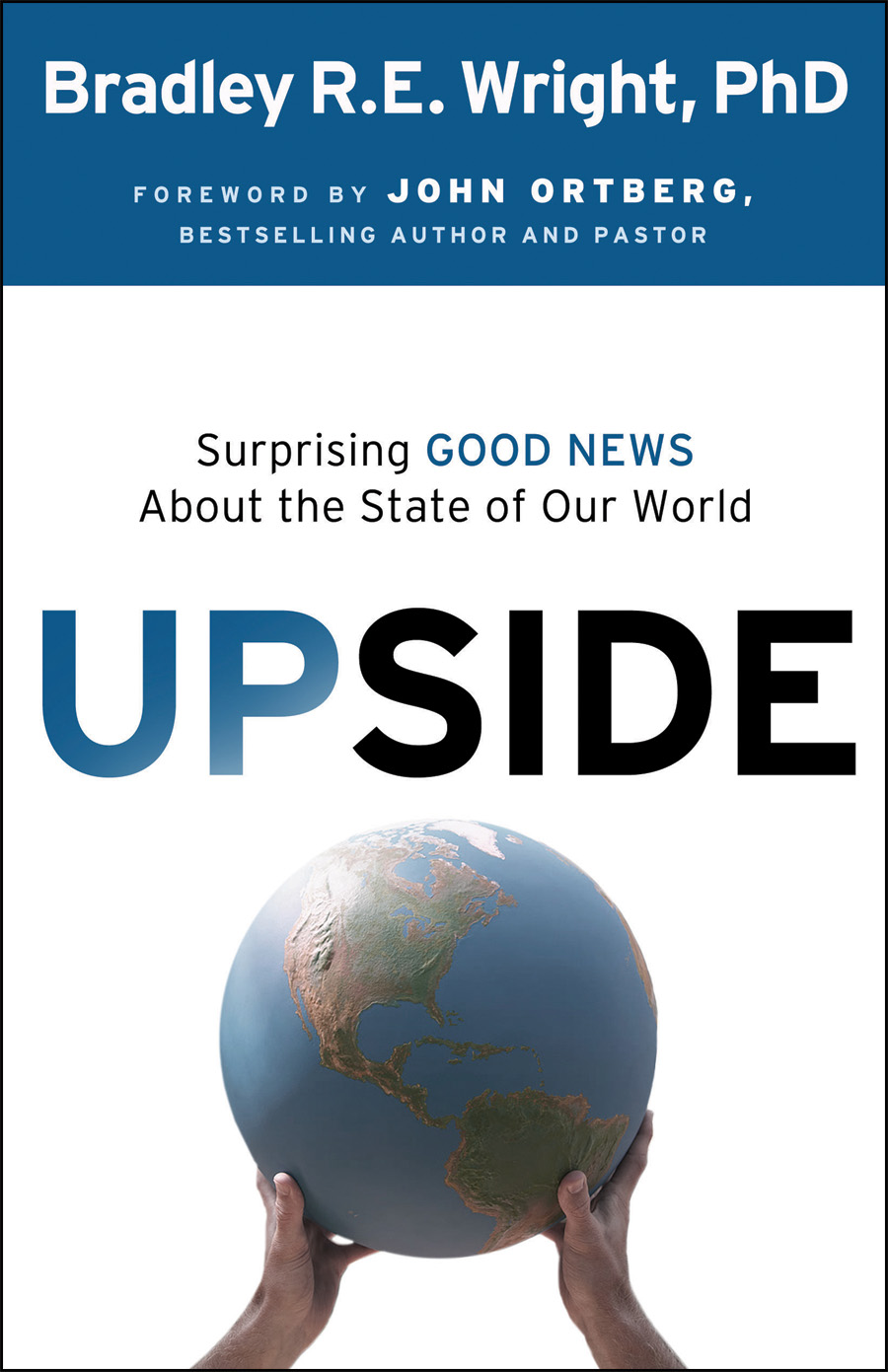
Have you ever heard how a TV news producer decides what the lead story will be? Or how a managing editor decides which stories get the front page of the newspaper? It comes down to this: “If it bleeds, it leads.” Sad, but too often true. With all of this negative news leading, Dr. Bradley R.E. Wright’s book Upside: Surprising Good News About the State of Our World is indeed surprisingly good news!
Dr. Wright notes that sociologist Joel Best “classifies the different types of bad statistics as follows: some numbers are bad to begin with; some numbers get bad as they are passed along; and some numbers are chosen because they are bad.” In other words, there’s just a lot of bad news out there!
But despite all of this negative press, people around the world are surprisingly upbeat. That’s because when a sociologist like Dr. Wright gets a hold of all of these statistics, he can put them into the proper perspective. He looks at the data on a variety of topics:
Personal finances
Education
Health
Crime and war
Marriage and divorce
The environment
“The trouble with this country is that there are too many people going about saying ‘the trouble with this country is….’” —Sinclair Lewis
Do bad things happen? Yes. Are there some issues that still need to be addressed? Absolutely. Is the world ready to collapse all around us? It doesn’t appear so. Christians should have the clearest and keenest worldview because it’s a biblical worldview. Dr. Wright does an excellent job of helping the reader find the perspective that is realistic, yet balanced.
Economist professor Julian Simons summarized it this way—
Almost every economic and social change or trend points in the positive direction, as long as we view the matter over a reasonably long period of time. That is, all aspects of material human welfare are improving in the aggregate.
“Faith is the great cop-out, the great excuse to evade the need to think and evaluate evidence. Faith is belief in spite of, even perhaps because of, the lack of evidence. … Faith is not allowed to justify itself by argument.”
I wholeheartedly—and even respectfully—disagree.
The Bible does define faith as “Being sure of what we hope for and certain of what we do not see.” Just a few verses later there is an even stronger statement about faith: “Without faith it is impossible to please God.”
I have evaluated the evidence. I have thought long and hard about the options. I can justify all of the arguments. And my faith stands strong!
God wants all who call on Him to grow in God-pleasing faith. So I’m really excited to dive into our brand new series called SEE THE INVISIBLE this Sunday.
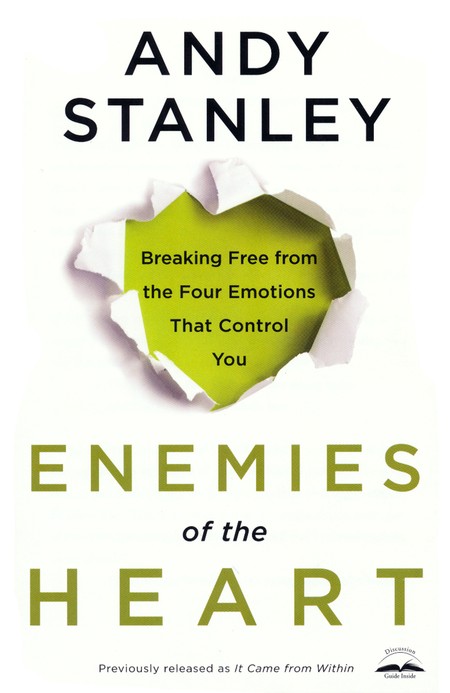
Andy Stanley has a God-given talent to explain things in ways that not only help them “stick,” but in ways that are easily applicable too. In Enemies Of The Heart, Andy helps identify and confront four things that could derail anyone’s life.
Guilt, anger, greed, and jealousy are the four enemies Andy confronts. In a theme that runs throughout the book, Andy describes how each of these can be viewed as a debt-to-debtor relationship. This dynamic is a huge growth impediment to any relationship — whether with God or mankind.
Andy points out:
Guilt says, “I owe you.”
Anger says, “You owe me.”
Greed says, “I owe me.”
Jealousy says, “God owes me.”
In the first half of the book, Andy teaches the reader not only how to diagnose these heart problems, but also the danger in allowing these enemies to stay lodged in our hearts. In the second half of the book, Andy shares how to rid our hearts of these enemies, and how to improve the long-term health of our heart.
Since all four of these enemies are relationship killers, and tend to isolate us from other people, the study guide at the back of the book is especially helpful. Because this study guide is designed to be used in discussions with one or more people, there is an instant accountability process built in to rooting out these heart enemies.
Just as our physical heart health affects the rest of our lives, so too does our spiritual/emotional heart health. Don’t wait until it’s too late! This book can help you live a much, much healthier life.
Last week I shared about the outstanding movie Courageouswhich opens on September 30. This movie will be enjoyed by everyone in the family, but Dads especially are going to be challenged to take their fatherhood to a whole new level.
I recently read Secure Daughters, Confident Sons by Glenn Stanton, and these two quotes from that book tie-in so well to the message of Courageous—
“When a relationship between a boy and his father is loving and warm, as opposed to critical and stoic, those boys are indeed more likely to develop healthily in more masculine ways.”
“The girl who doesn’t have the power and beauty of her femininity affirmed by the first and most important man in her life [her Dad] will grow into a woman driven to flaunt it in the face of every young and older man, constantly making the very public and insecure statement, ‘I desperately need you to notice me as a woman!’”
Here’s a powerful 1-minute clip from Courageous…
Make your plans NOW to see Courageous when it opens on September 30.
This is a weekly series with things I’m reading and pondering from Oswald Chambers. You can read the original seed thought here, or type “Thursdays With Oswald” in the search box to read more entries.
Learning From My Experiences
It is all very well to have experiences, but there must be a standard for measuring them, and a standard more worthy than my own on the line on which I know I am worthy. The standard for Christian experience is not the experience of another Christian, but God Himself.
On the ground of the Redemption I am saved and God puts His Holy Spirit in me, then He expects me to react on the basis of that relationship. …The only way to understand the Scriptures is not to accept them blindly, but to read them in the light of a personal relationship to Jesus Christ.
From Baffled To Fight Better
Some people have said that experience is the best teacher.
That’s incorrect.
My experience is just that… MY experience. I have to have a standard other than myself to judge that experience. As a Christian I have this: God’s Word, and the Holy Spirit to help me apply that Word to my experience. If I will use this as my standard for all of my experiences, only then will I learn something eternally useful from my experiences.
As C.S. Lewis so right stated, “All that is not eternal is eternally useless.”



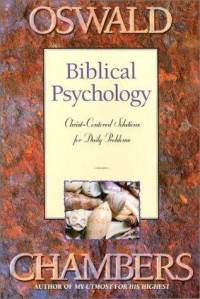 I’m not one who’s into psycho-babble, but I do like trying to understand human nature a little better. A great book to help on this learning journey is Oswald Chambers’ Biblical Psychology.