This is a weekly series with things I’m reading and pondering from Oswald Chambers. You can read the original seed thought here, or type “Thursdays With Oswald” in the search box to read more entries.
The People God Can Do Nothing With
We say, “It seems out of all proportion that God should choose me—I am of no value”; the reason He chooses us is that we are not of any value. It is folly to think that because a man has natural ability, he must make a good Christian. People with the best natural equipment may make the worst disciples because they will “boss” themselves. It is not a question of our equipment, but of our poverty; not what we bring with us, but what He puts in us; not our natural virtues, our strength of character, our knowledge, our experience; all of that is of no avail in this matter; the only thing that is of avail is that we are taken up into the big compelling of God (1 Corinthians 1:26-28). His comradeship is made out of men who know their poverty. God can do nothing with the men who think they will be of use to Him.
From The Place Of Help
God cannot impart wisdom to a know-it-all, but He can impart it to someone hungry to learn.
God cannot use someone who believes the world revolves around them, but He can use someone who believes the world revolves around Him.
Which are you?
“‘Put out into deep water’ (Luke 5:4). The Lord did not say how deep. The depth of the water into which we sail depends upon how completely we have cut our ties to the shore, the greatness of our need, and our anxieties about the future. …
Our needs are to be met in the deep things of God. We are to sail into the deep of God’s Word, which the Holy Spirit will open to us with profound yet crystal-clear meaning. And the words we knew in the past will have an ocean of new meaning, which will render their original message very shallow. …
The Holy Spirit desires that our self become completely submerged—not merely ankle-deep, knee-deep, waist-deep, but self-deep. He wants us hidden and bathed under this life-giving stream. Let loose the lines holding you to the shore and sail into the deep. And never forget, the Man who does the measuring is with us today.” —J. Gresham Machen
A former abortionist shares the unvarnished truth about how second-trimester babies are aborted. This is gut-wrenching to watch, but please look closely. How is this legal?! How can someone argue that this should be allowed to happen?!
In our elections, I am becoming more and more a single-issue voter: Which candidate is the most pro-life. As Sen. Ted Cruz recently noted, if an elected official won’t stand up for the rights of the most vulnerable of human beings, how can we expect him/her to stand up for anyone else’s rights?
Yesterday I shared 7 must-have Bible study tools. Here are three powerful quotes on how and why we should make studying our Bibles an ongoing, lifelong pursuit.
“Search the Scriptures. Do not merely read them—search them; look up the parallel passages; collate them; try to get the meaning of the Spirit upon any one truth by looking to all the texts which refer to it. Read the Bible consecutively: do not merely read a verse here and there—that is not fair.” —Charles Spurgeon
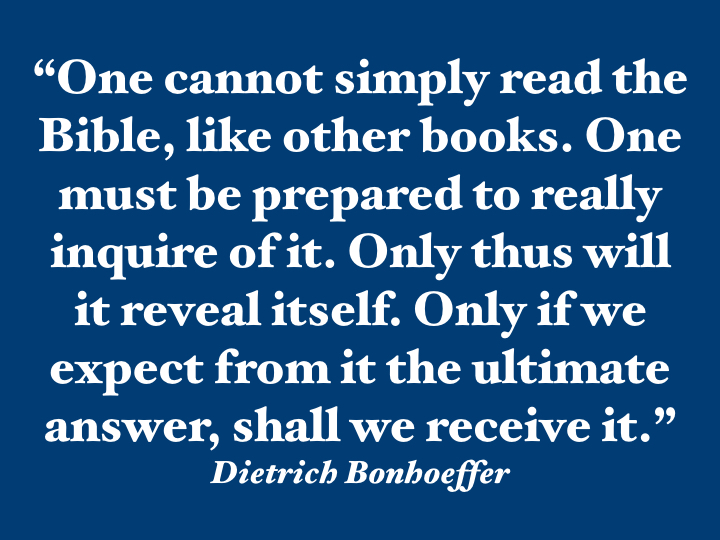
“One cannot simply read the Bible, like other books. One must be prepared really to enquire of it. Only thus will it reveal itself. Only if we expect from it the ultimate answer, shall we receive it.” —Dietrich Bonhoeffer
“Let us resolve to read the Bible more and more every year we live. Let us try to get it rooted in our memories, and engraved into our hearts. … Let us resolve to be more watchful over our Bible reading every year that we live. Let us be jealously careful about the time we give to it, and the manner that time is spent. Let us be aware of omitting our daily reading without sufficient cause. Let us not be gaping, and yawning and dozing over our book, while we read. … Let us be very careful that we never exalt any minister, or sermon, or book, or tract, or friend above the Word. Cursed be that book, or tract, or human counsel, which creeps in between us and the Bible, and hides the Bible from our eyes! … Let us resolve to talk more to believers about the Bible when we meet them. Sorry to say, the conversation of Christians, when they do meet, is often sadly unprofitable! How many frivolous, and trifling, and uncharitable things are said! Let us bring out the Bible more, and it will help to drive the devil away, and keep our hearts in tune.” —J.C. Ryle
It’s been said that if the only tool a man has in his toolbox is a hammer, he tends to see every problem as a nail. In other words, we try to force every project to be handled in the exactly same way.
Sadly, for many Christians, the same is true with our knowledge of the Bible. If we have limited tools, we try to make every situation look like something we can fix with that smaller toolbox. It’s not enough for us to know only a couple of verses or a few biblical principles, and then try to use those tools to handle all of life’s situations. So let me share some basic tools that will help you expand your biblical toolbox.
Time and culture—Think about how much your culture has changed just in the 70-80 years since your grandparents were born. Think about how wardrobes have changed, and technology, and manners and customs. The earliest book of the Bible was written about 1400 BC, and the most recent book was written about 100 AD. To better understand the things I read in the Bible, here are some tools I like to use:
Language—Even the English language has changed a lot since William Shakespeare penned his famous plays. But consider that the Bible was written in languages that are even older (not to mention they’re languages other than English!). To really get the full meaning of a passage, here are some tools I use:
Chain of pearls—The Bible is not a collection of isolated, independent stories or concepts, but it is a beautiful string of pearls. Every part connects to the rest of the Scripture. So some resources I use to help me discover how the pearls are strung together include:
What did I miss? What are your favorite Bible study tools? In the comments, please share books, commentaries, or online resources that you use to maximize your study of God’s Word.
This Sunday I’ll be sharing some different styles of Bible studies we can all do. If you live in the Cedar Springs area, please come join a really great group of people at Calvary Assembly of God. Otherwise, watch us on Periscope.
“My child, I have a message for you today. Let me whisper it in your ear so any storm clouds that may arise will shine with glory, and the rough places you may have to walk will be made smooth. It is only four words, but let them sink into your inner being, and use them as a pillow to rest your weary head: this is My doing [1 Kings 12:24].
Have you ever realized that whatever concerns you concerns Me too? For whoever touches you touches the apple of My eye [Zechariah 2:8]. You are precious and honored in My sight [Isaiah 43:4]. Therefore it is My special delight to teach you. I want you to learn when temptations attack you, and the enemy comes in like a pent-up flood [Isaiah 59:15], that this is My doing and that your weakness needs My strength, and your safety lies in letting Me fight for you.
Are you in difficult circumstances, surrounded by people who do not understand you, never ask your opinion, and always push you aside? This is my doing. I am the God of circumstances. You did not come to this place by accident—you are exactly where I meant for you to be. Have you not asked Me to make you humble? Then see that I have placed you in the perfect school where this lesson is taught. Your circumstances and the people around you are only being used to accomplish My will.
Are you having problems with money, finding it hard to make ends meet? This is My doing, for I am the one who keeps your finances, and I want you to learn to depend upon Me. My supply is limitless and I will meet all your needs [Philippians 4:19]. I want you to prove My promises so that no one may say you did not trust the Lord your God [Deuteronomy 1:32].
Are you experiencing a time of sorrow? This is my doing. I am a Man of sorrows, and familiar with suffering [Isaiah 53:3]. I have allowed your earthly comforters to fail you, so that by turning to Me you may receive eternal encouragement and good hope [2 Thessalonians 2:16].
Have you longed to do some great work for Me but instead have been set aside on a bed of sickness and pain? This is my doing. You were so busy I could not get your attention, and I wanted to teach you some of My deepest truths. They also serve who only stand and wait. In fact, some of My greatest workers are those physically unable to serve, but who have learned to wield the powerful weapon of prayer.” —Your loving Heavenly Father (as recorded by Laura A. Barter Snow)
There are two Greek words in the New Testament that have to do with trying to figure things out. One of them leads to less knowledge, and one opens the way for greater learning. Not surprisingly, Jesus never used the first way, but He confronts people who try to.
The first Greek word is defined as learning through self-calculation. In other words, I try to get at the right answer by either teaching myself, or by talking with people who don’t know any more than I do. This way leaves me in the dark.
For example, notice the phrase “discussed among themselves” in Matthew 16:7 and Mark 11:31. These are people who wanted to try to get answers without going to someone who could teach them. So that leads to four terrible ways to study your Bible—
These are not only terrible ways to learn, but they are the exact opposite of what God desires. God says things like, “Come, let us reason together” (Isaiah 1:18), and “Call to Me and I will tell you things you do not know” (Jeremiah 33:3).
There is another Greek word which means to learn by having a conversation with someone more knowledgable than myself. So that means four great ways to study your Bible are—
Luke records an important story for us that took place on the day Jesus was raised from the dead. Two men were walking along “discussing these things with each other,” but not consulting the Scriptures. The result: they were sad and confused. Jesus join them on their journey (although they didn’t recognize Him at first), and took them to the Scriptures that showed them the answers for which they were yearning. They even said, “When He talked to us from the Scriptures, that’s when our hearts burned within us!” (see Luke 24:13-32).
You can try to figure life out on your own, and you will probably end up stymied like the religious leaders in Mark 11, or downcast like the disciples in Luke 24. Or you can ask the Holy Spirit to show you truths from the Scriptures, and have your eyes opened, like the two disciples after Jesus met with them. I think the choice is obvious!
Join me next week as we continue our series How To Study Your Bible.