Listen to the podcast of this post by clicking on the player below, and you can also subscribe on Apple, Spotify, or Audible. Check out the video content in this post by clicking here.
Greg and I had been talking about resiliency vs. resignation, but then Greg asked if there is a place for resigning. The short answer is yes, but check out the proper way for leaders to help facilitate this in a healthy way.
Listen to the podcast of this post by clicking on the player below, and you can also subscribe on Apple, Spotify, or Audible.
Peter wrote to Christians—
If you are insulted because of the name of Christ, you are blessed, for the Spirit of glory and of God rests on you. If you suffer, it should not be as a murderer or thief or any other kind of criminal, or even as a meddler. However, if you suffer as a Christian, do not be ashamed, but praise God that you bear that name. (1 Peter 4:14-16)
I noticed the word “if” three times in those three verses, which means those calling themselves Christians need to check why the insults have come their way.
(1) Is it because I have acted like everyone else?IF it is because I have acted in a way unbecoming a citizen of heaven, then I need to apologize and repent.
(2) Is it because I stand for Jesus? “IFyou are insulted because of the name of Christ,” I need to both forgive the one insulting me and be thankful that I am “blessed, for the Spirit of God rests on you.”
(3) Is it because I have acted un-Christlike?IF I am suffering because I have not acted in a manner fitting the name of CHRISTian, I must accept the attack as God’s judgment, acknowledging my sin and repenting of it.
(4) Is it because I have acted Christlike?IF the suffering is because my attitude and actions are Christlike, then I must “praise God that [I] bear that name,” and use the attack as an opportunity to tell others about Jesus.
In no setting is it permissible for Christians to retaliate against the ones insulting them or attacking them. Earlier in this letter, Peter tells us that Jesus gave us “an example, that you should follow in His steps” (1 Peter 2:21): “When they hurled their insults at Him, He did not retaliate; when He suffered, He made no threats. Instead, He entrusted Himself to Him who judges justly” (v. 23).
Charles Spurgeon said—
“In Peter’s day, the Christians were called, not only to what might he metaphorically termed, ‘the fiery trial’ [1 Peter 4:12], but they had literally to suffer thus for Christ’s sake. Nero had multitudes of Christians brought to his gardens, and tied to stakes, that he might light up his midnight revelries by the burning of these godly men and women smeared with pitch. They had to bear even that fiery trial for the name of Christ. Many periods of martyrdom have passed since then, in which the saints of God have willingly died rather than deny their Lord. We have fallen upon comparatively silken times; a jest, a slander, a calumnious observation—these are the only weapons with which our enemies can smite most of us.”
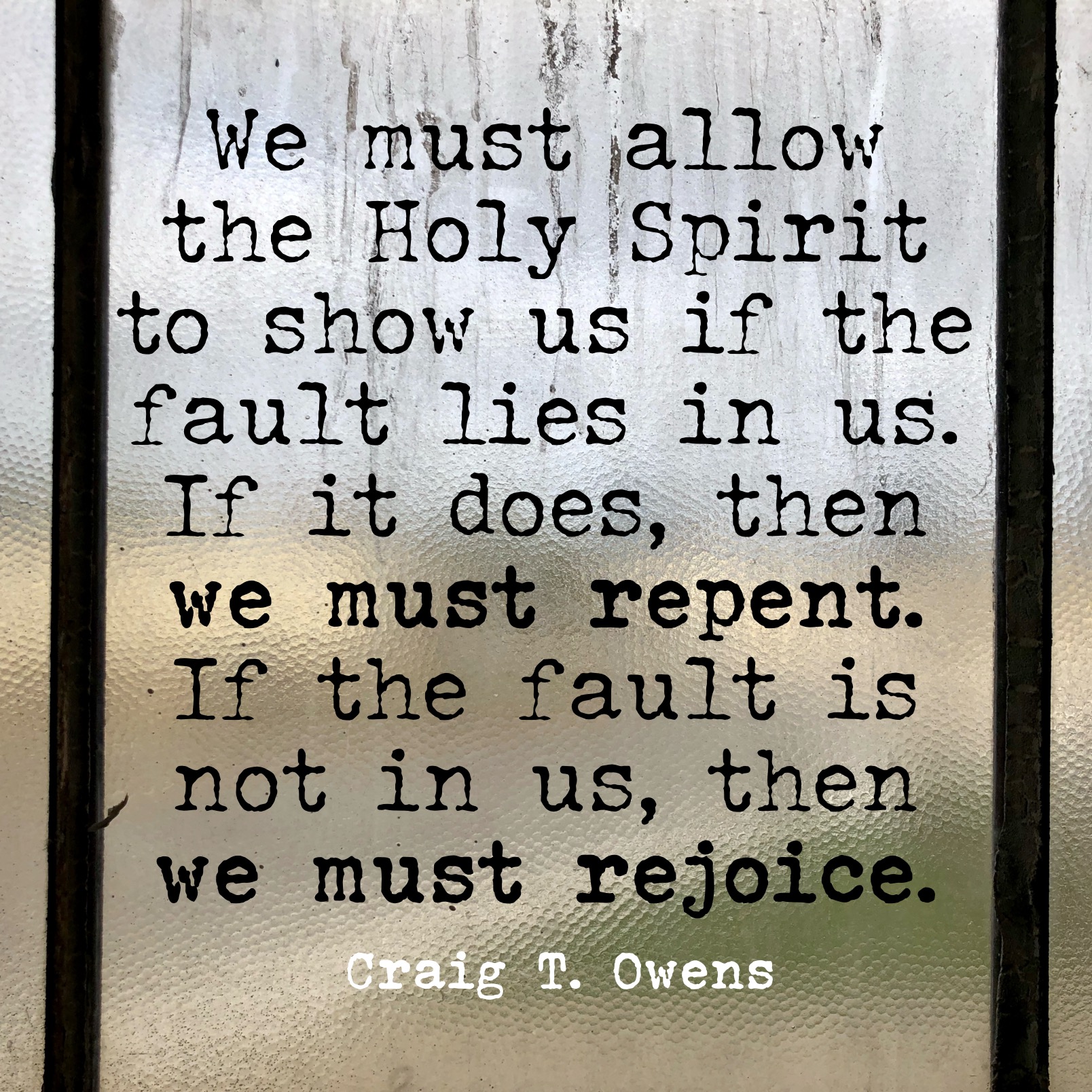
We must allow the Holy Spirit to show us if the fault lies in us. If it does, then we must repent. If the fault is not in us, then we must rejoice. This requires supernatural empowerment from God—the same supernatural power that Jesus used when He chose not to retaliate against His attackers. If we trust Him, we can respond in the same supernatural way.
Then the Pharisees met together to plot how to trap Jesus into saying something for which He could be arrested. They sent some of their disciples, along with the supporters of Herod, to meet with Him. “Teacher,” they said, “we know how honest You are. You teach the way of God truthfully. You are impartial and don’t play favorites. Now tell us what You think about this: Is it right to pay taxes to Caesar or not?” But Jesus knew their evil motives. “You hypocrites!” He said. “Why are you trying to trap Me?” (Matthew 22:15-18)
Screenshot
In my book When Sheep Bite, I call flattery the sneaky bite. Jesus was certainly aware when people crossed the line from compliment to flattery, and wise leaders will do the same. In the chapter on flattery, I wrote—
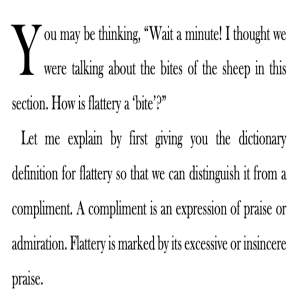
You may be thinking, “Wait a minute! I thought we were talking about the bites of the sheep in this section. How is flattery a ‘bite’?”
Let me explain by first giving you the dictionary definition for flattery so that we can distinguish it from a compliment. A compliment is an expression of praise or admiration. Flattery is marked by its excessive or insincere praise. …
Flattery crosses a line.
The compliment become flattery when the words begin to sound like, “This is the best sermon I have ever heard,” or “Everyone in the world who needs counseling should come to you,” or “No one could have done what you did for our family.” Flattery begins to put the shepherd on a pedestal. …
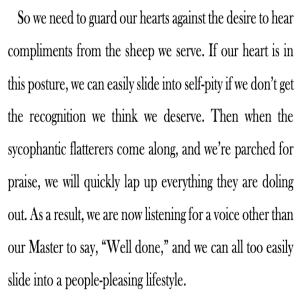
So we need to guard our hearts against the desire to hear compliments from the sheep we serve. If our heart is in this posture, we can easily slide into self-pity if we don’t get the recognition we think we deserve. Then when the sycophantic flatterers come along, and we’re parched for praise, we will quickly lap up everything they are doling out. As a result, we are now listening for a voice other than our Master to say, “Well done,” and we can all too easily slide into a people-pleasing lifestyle.
Learn more about the sneaky bite of flattery, as well as the biblical way to handle all of the other ways that sheep bite their shepherd. Pick up a copy of When Sheep Bite today.
Listen to the podcast of this post by clicking on the player below, and you can also subscribe on Apple, Spotify, or Audible. Check out the video content in this post by clicking here.
The apostle Paul makes an interesting point with a little play on words—two words, to be specific: peace and God. Check out Philippians 4:4-8. Paul says, “the peace of God” (Greek: eirene Theos) and “the God of peace” (Theos eirene). Surrounding these titles are reminders to be grateful. Throughout Scripture we see this link between our gratitude to the God of peace, and the peace of God which guards our hearts.
A natural byproduct of the peace of God is contentment. But contentment can also be our undoing, if we aren’t careful to use it the right way.
Watch out for contentment that becomes complacency—taking our blessings for granted. If we do this, complacency leads to forgetfulness. And as soon as anything is not going right, our forgetfulness produces anxiety.
Charles Spurgeon said, “When we have much of God’s providential mercies, it often happens that we have but little of God’s grace, and little gratitude for the bounties we have received. We are full and we forget God: satisfied with earth, we are content to do without Heaven.”
The wrong things to feel contented about:
My possessions
Absence of enemies or troubles
Things going my way
Psalm 107 is a history lesson for us. Notice a repeated pattern for Israel that is still operational today.
give thanks (v. 1) → complacency which leads to hunger (v. 5) → calling to God for deliverance (v. 6)
give thanks (vv. 8-9) → rebellion which leads to trouble (vv. 11-12) → calling to God for salvation (vv. 13-14)
give thanks (v. 15) → foolishness which leads to rebellion (v. 17) → calling to God for help (vv. 19-20)
give thanks (v. 21) → drunkenness which leads to being at their wits’ end (v. 27) → calling to God for deliverance (v. 28)
Finally, in v. 31 we have a “give thanks” that doesn’t proceed to complacency and trouble. If contentment fuels expressed gratitude, that keeps not just eirene Theos on our minds, but also Theos eirene. This keeps us watchful for God (v. 43): In this verse “heed” means to keep a close watch, and “consider” means to have increased discernment and insight. This restarts the right contentment cycle.
The right things to feel contented about:
Not my possessions, but God possessing me—Psalm 131:1-2
Not the absence of troubles, but not being troubled by troubles—Proverbs 19:23
Not things going my way, but things going God’s way—Job 1:21-22; Philippians 4:11-13; Deuteronomy 8:3 AMPC
When our thoughts about God begin to fade, so does our gratitude to God. When our gratitude to God begins to fade, so does our reliance on Him.
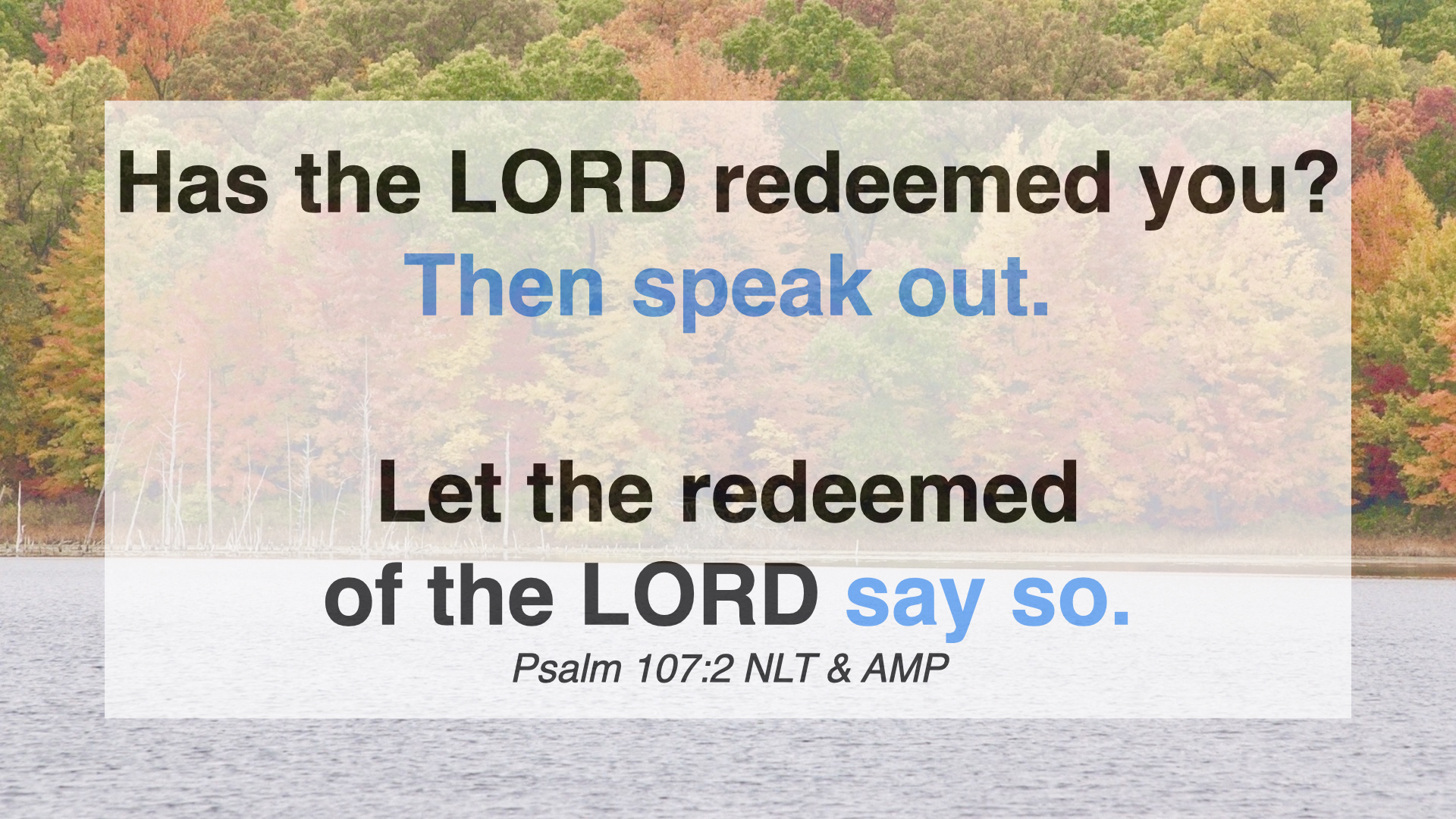
The strategy for how we keep our thoughts on God is embedded throughout Psalm 107: We must use our mouth to recount His blessings—exalt and praise (v. 32), tell (v. 22), say so (v. 2).
You need to hear your “say so” in your own ears to energize your faith (science backs this up). The enemy needs to hear your “say so” to defeat him (Revelation 12:10-11). Others around you need to hear your “say so” to encourage them (Philippians 4:9).
My challenge to you: At the end of everyday, write down one thing you are grateful for. Try to find a unique thing each day. Then put a box next to that thing. The next day, find someone to whom you can “say so”—to tell them, “I’m so grateful for _______.”
Let’s be known as the “say so” people, constantly telling, exalting, and praising the every-day blessings that God showers on us.
Check out the other messages in this series called The Peace in Gratitudehere.