Don’t Get Ahead Of God’s Blessing

When David was settled in his palace, he summoned Nathan the prophet. “Look,” David said, “I am living in a beautiful cedar palace, but the Ark of the Lord’s Covenant is out there under a tent!”

Nathan replied to David, “Do whatever you have in mind, for God is with you.”

But that same night God said to Nathan, “Go and tell My servant David, ‘This is what the Lord has declared: You are not the one to build a house for me to live in.’” (1 Chronicles 17:1-4)

David’s desire to build a home for the Ark of the Covenant was a noble desire, and David’s passion for God was contagious! So much so that Nathan the prophet gave a hearty “Amen!” without a moment’s pause. 

Except no one—not good King David or Nathan the righteous prophet—consulted God about this. 

Nathan had to return to David with God’s word: “You’re not the one to build the Temple.”

Note this—

No matter how noble or God-honoring something sounds to us, God must be the one to give us permission to proceed. 

DON’T say, “God, this is what I’m going to do, please bless it.” 

But DO say, “God, what would You have me do? Because that is what You will bless.”

The Great Danger Facing Us Today

“The trouble isn’t so much that we don’t know enough, but it’s as if we aren’t good enough. The trouble isn’t so much that our scientific genius lags behind, but our moral genius lags behind. The great problem facing modern man is that, that the means by which we live have outdistanced the spiritual ends for which we live. So we find ourselves caught in a messed-up world. The problem is with man himself and man’s soul. …

“The great danger facing us today is not so much the atomic bomb that was created by physical science. Not so much that atomic bomb that you can put in an aeroplane and drop on the heads of hundreds and thousands of people—as dangerous as that is. But the real danger confronting civilization today is that atomic bomb which lies in the hearts and souls of men, capable of exploding into the vilest of hate and into the most damaging selfishness—that’s the atomic bomb that we’ve got to fear today. …

“My friends, all I’m trying to say is that if we are to go forward today, we’ve got to go back and rediscover some mighty precious values that we’ve left behind.” —Martin Luther King, Jr., February 28, 1954 (empahsis added)

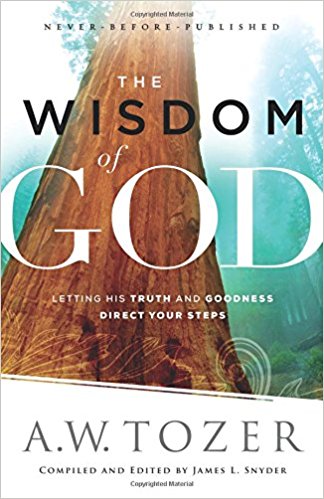
9 More Quotes From “The Wisdom Of God”

The Wisdom Of God is a collection of never-before-published sermons from A.W. Tozer, in which he makes the case that true Wisdom is a Person to be known not a quality to be gained. 

“Wisdom and power cannot be separated from the Cross. If we do not obey, we blind ourselves, and we become dependent upon our own intellect, which will be in no way sufficient to teach others.” 

“Today, Christians need to learn how to worship, and instead of having all this religious claptrap and modern entertainment to hold people together, have the fire of God and the presence of the Holy Spirit, which, by the way, will be enough.” 

“The one thing God has to offer us and the only thing we absolutely need is His wisdom. Flowing from that wisdom is the solution to all the problems that we could ever face. To know the wisdom of God in its fullness is to experience life as God intended it to be.” 

“Our relationship with God must be based upon God’s ways and not our ways.” 

“To fear God, out of which flows wisdom, is to submit myself to God unconditionally and without any personal agenda. When I come to God as He invites me to come, I will have what God intends for me to have.” 

“This effusion of superior wisdom is a gift imparted by God in addition to the gift of wisdom that He gives the birds so they know to fly south and that which He gives man to invent a spaceship or an electric light. This effusion of superior wisdom is something you either have or you don’t. It does not come gradually to anyone. So a man is either born or he is not. He is either born-again or he has not been born again; he cannot come into that gradually. The doctrine of gradualness is from the devil to keep the church of Christ from going forward.” 

“For wisdom dwells with God and He pours her out upon all His works in the degree they are able to absorb it, and the wisest man is the one who turns to the Lord in repentance and faith.” 

“Christ is that ancient, most excellent wisdom incarnated in our nature and making atonement for all our moral infamy. Any emphasis that makes sin less infamous than that is not biblical. Any interpretation of grace and mercy that allows sin to appear even reasonably excusable in the eyes of God is not a proper interpretation. Any doctrine, any view of sin that allows it to be excused in anyway is not biblical. It is not God’s way of looking at it, for God looks at sin as alienation. … God sent His only Son to make atonement for our infamy and saves those that turn to the wisdom of the just through repentance.” 

“We Christians are a strange crowd. We make a more of the invisible than the visible. We talk constantly to Someone we cannot see. We act as if thing were real that people do not believe are real and waive aside things that some people attach great value to. We sing about a Man who was rejected and crucified, and we say, ‘We find the yoke easy.’” 

You can read my review of The Wisdom Of God by clicking here. And be sure to check out some other quotes from this book here. 

Argument Vs. Experience

There is a curious word that shows up about 70 times in the Bible (almost all of them in the Psalms)—Selah. The best scholars can figure is that this word has some sort of musical meaning: 

  1. Pause / Interlude—to rest in silence. This might even be where the singers stopped while the music continued. 
  1. Accentuation—to lift up or exalt; as in the renewed vigor of the singer or musician after pausing for a deep breath. 
  1. Consideration—the root word for Selah means to weigh on a balance, with the idea of despising the things that are light or trivial, and valuing the things that carry weight or substance. The Amplified Bible uses the phrase “pause and calmly think of that.” 

All three are valid definitions, and all three are used in the Psalms. I think the context of the Psalm makes it clear which one is meant. Sometimes more than one meaning is implied, and sometimes all three meanings are implied. 

Selah first shows up in Psalm 3. This is also one of the few psalms that uses Selah multiple times. We also get a clue to the context in the introduction: A psalm of David. When he fled from his son Absalom [see 2 Samuel 15]. 

David has a lot of enemies ganging up on him? The Message says, “enemies past counting!” And David laments that his enemies are whispering something very negative: “There is no God” or “God is too disinterested or weak to help you” or “You don’t deserve to have God’s help.” 

In the midst of this noise, David pens his first  SELAH—David needs a pause. The enemies past counting have got his thoughts swirling. He needs to pause and calmly think: “I KNOW God can and will help me because He has already helped me in the past. You may have your arguments and reasons, but I have my personal experience with God!” 

Notice the very next word: But (v. 3). You ARE [not were or will be] a shield around me…. To the Lord I CRY aloud [not I used to cry or I will cry], and He ANSWERS [not He answered or He will answer] me… (v. 4).

The second SELAH (v. 4) is the renewed vigor after the pause. The Message says, His answers thunder from the holy mountain. This corresponds with what David wrote when God delivered him previously (see Psalm 18:4-13). Then in the next four verses, David lists all the blessings that come when God answers: 

    • sleep 
    • sustaining power 
    • no fear of the tens of thousands on every side
    • deliverance
    • retribution for enemies 
    • God’s blessing—Real help comes from God. Your blessing clothes Your people! (v. 8 in MSG) 

David concludes this psalm with one final SELAH (v. 8)—to weigh on a balance. On one side: accusations and threats (only words). On the other side: personal experience of past deliverance and confident assurance of God’s present presence and rock-solid hope in God’s future grace. Pause and calmly consider those scales: which side are you on? Do you have only words, or do you have personal experience? 

The one with an experience with God is NEVER at the mercy of the one with only an argument against God. 

Join me next Sunday as we continue our look at the Selahs in the Book of Psalms. You can join me in person or on Facebook Live. 

Saturday In The Proverbs—Fools Talk A Good Game, But… (Proverbs 14)

[Each chapter in the Book of Proverbs contains thoughts that fit into a theme; they are not just random thoughts gathered together. In this “Saturday In The Proverbs” series, I will share a theme that I see in each chapter. But the cool thing about God’s Word is that you may see an entirely different theme. That’s great! If you do, I would love for you to share it in the comments below.]

Where no oxen are, the trough is clean; but much increase come by the strength of an ox (Proverbs 14:4).

You can have something that looks pristine on the outside, but it is all show and no production. Eventually, it will all come crashing down. 

Or you can have the messiness of productivity which will result in lasting success. 

The wise make the productive mess, knowing that they are building something lasting. The fool only tries to make it look good on the outside, but they are undermining themselves (see vv. 1, 11). 

The fool talks a good game, but…

  • their perversity is despised by God
  • their pride injures themselves and others 
  • they lie to keep up appearances 
  • they never learn from their mistakes
  • they are deceitful 
  • they are on the path to death
  • they are self-confident and quick-tempered, which alienates them from others 
  • they will eventually serve the wise
  • they despise others’ needs 
  • they are poor
  • they are fearful of the future
  • they don’t leave a good legacy for their children
  • they rot with envy
  • the oppress poor people
  • then will end up in utter shame

…all for the sake of trying to make others think they have lives that are perfect! 

Keeping up appearances is hard, painful, unrewarding, and will ultimately end in disaster. 

When Problems Arise…

Selah

The word Selah appears nearly 70 times in the Bible, almost exclusively in the Psalms. Although it is primarily a musical term, it applies beautifully to our new summer series. 

Selah can mean…

  • a pause from the noise to reflect;
  • a preparation for an exciting accent; or 
  • a reflective time of consideration

Throughout the Psalms, Selah appears at the end of a verse, at the end of the psalm, or sometimes even mid-sentence. But each one of them is perfectly placed by the Spirit-inspired authors to get us to take a breath and deeply contemplate what we just read or sang. 

Summertime is typically a time for us to pause from our regular routine. Perhaps it’s a vacation, time with friends and family, driving around with the windows down and the music blasting, or just a quiet walk through woods or along a beach. In any case, whether we realize it or not, we’re actually doing Selah in these break-from-the-routine activities. 

Join me beginning this Sunday for our summertime look at each of the Psalms that ask us to Selah. I think you will find that this Sunday summertime pause will be both refreshing and encouraging. You can join me either in person or on Facebook Live. 

If you missed any of the messages in this series, check them out here:

Thursdays With Oswald—Jeremiah 9

Oswald ChambersThis is a weekly series with things I’m reading and pondering from Oswald Chambers. You can read the original seed thought here, or type “Thursdays With Oswald” in the search box to read more entries.

Jeremiah 9

[These are notes from Oswald Chambers’ lecture on Jeremiah 9.] 

    Jeremiah states that wisdom and enlightenment are not to be found among the infatuated people, they have been swept away from right judgment by false prophets who taught that everything develops along a natural rational line. That was the infatuation in Jeremiah’s day, and in our own day the proclaimers of the truth of God are in the minority; men won’t listen to them.

     There are those who say there is no such thing as the supernatural incoming of Jesus Christ, either in history or in the human heart. Our Lord Jesus Christ is not Someone Who has sprung from human nature by evolution: He is Someone Who has come crushing into the human nature by the superb miracle of the Incarnation. The supernatural is the only explanation of our lives if we are right with God, and at any moment God may tumble our lives up as He likes. The question is, are we willing to let Him? We have to maintain our personal relationship to God in Christ Jesus, no matter what happens. The one thing that is of value to God in a human life is a personal relationship of holiness to God, and every part of physical, mental, moral life and of Christian work that is not so related will be desolated and burnt as rubbish.

     The characteristic of life today is that the gospel of, ‘Cheer up, look on the bright side,’ is being preached on all sides. Our Lord says, in effect, that every happiness and peace and well-being that is based on the ignoring of a relationship to God will end in dirges and woes, disasters and terrors.

From Notes On Jeremiah

This statement arrested my attention—At any moment God may tumble our lives up as He likes. The question is, are we willing to let Him?

That is the true question for all followers of Jesus Christ: Am I willing to let Him have His way with my life?

Love Gives

For this is how God loved the world: He gave(John 3:16 NLT)

My beloved friends, let us continue to love each other sincelove comes from God. Everyone who loves is born of God and experiences a relationship with God. The person who refuses to love doesn’t know the first thing about God, because God is love—so you can’t know Him if you don’t love. This is how God showed His love for us: God sent His only Son into the world so we might live through Him. (1 John 4:7-9 MSG)