Links & Quotes

Is it okay to pray a prayer written by someone else? Sure! But let’s use those prayers merely as guides to help us form our own personalized prayers to our loving Heavenly Father. I shared a whole series on prayer that you may want to check out.

I have lots of new content every week, which you can check out on my YouTube channel.

T.M. Moore wrote, “The Holy Spirit comes to dwell in believers with an agenda. His agenda is not ours, and unless we can put our agendas aside, we will never line up with His to realize more of the presence, promise, and power of the Kingdom of God. The Spirit has not come to make us ecstatically happy. He has not come to fulfill our every wish. He comes to bring forth in us distinctly Kingdom values and virtues: love, joy, peace, patience, kindness, goodness, faithfulness, gentleness, and self-control. He comes to distribute among us spiritual gifts, God-given abilities to serve one another in caring and sharing ways. He comes to empower us as witnesses for Jesus, both in how we live and what we say. And He comes to build our churches up into Christlikeness by our unified and focused work.”
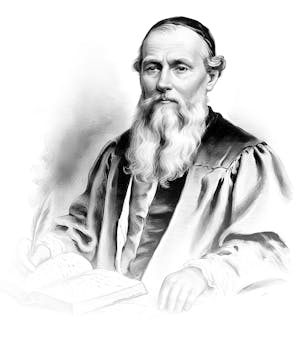
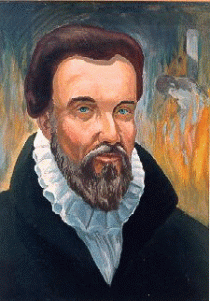
I am really enjoying these mini-biographies of key leaders in the Reformation presented by Desiring God. One that I found especially fascinating is about Menno Simons—“If you are familiar with the contemporary Mennonites, you may be surprised to learn that the group’s founder started as a Catholic priest who had never read the Bible.” Yet, near the end of his life, Menno wrote, “Although I resisted in former times Thy precious Word and Thy holy will with all my powers…nevertheless, Thy fatherly grace did not forsake me, a miserable sinner, but in love, received me…and taught me by the Holy Spirit until of my own choice I declared war upon the world, the flesh, and the devil…and willingly submitted to the heavy cross of my Lord Jesus Christ that I might inherit the promised kingdom.”

“What strikes me is that there’s a very fine line between success and failure. Just one ingredient can make the difference.” —Andrew Lloyd Webber 
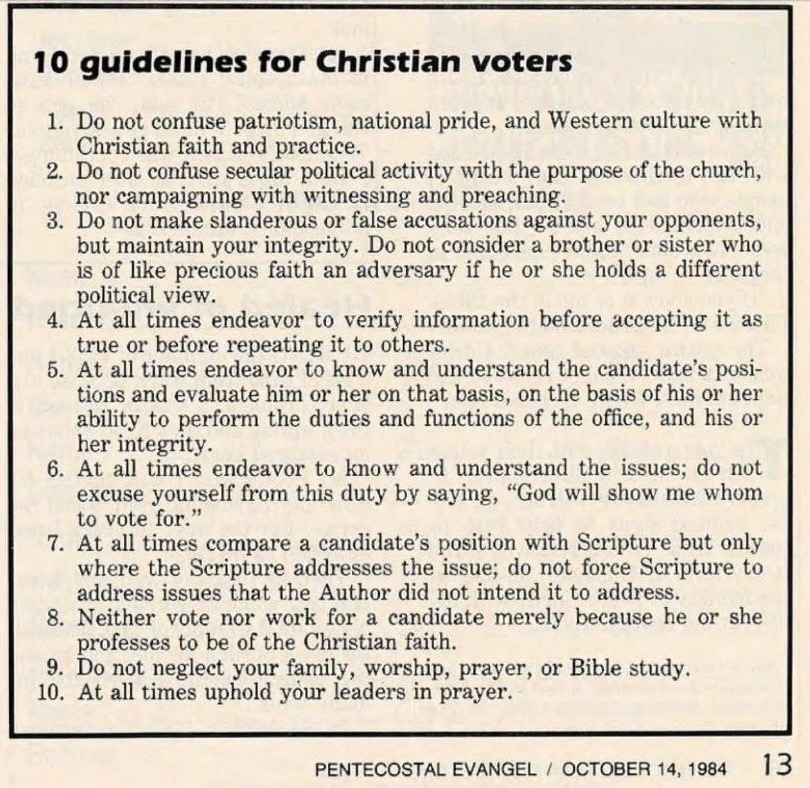
This past Sunday I spoke to my congregation about how Christians should behave biblically during an election season. Someone forwarded to me a related graphic from the Pentecostal Evangel magazine (a publication of the Assemblies of God) from 1984. I love these reminders for Christians!

Researchers unveiled the largest brain map ever completed. It was of a fruit fly, whose brain “includes nearly 140,000 neurons and captures more than 54.5 million synapses”! It took four years to complete this map. “All told, the researchers identified 8,453 types of neuron—much more than anyone had expected. Of these, 4,581 were newly discovered.” This level of complexity and order in a fruit fly is astounding to me. Can you imagine what it would take to map the much larger and more complex human brain?! Truly, David was right when he said that we are wonderfully made by our Creator!

“Freely, willingly and joyfully do good to everyone, serve everyone, suffer all kinds of things, love and praise the God who has shown such grace. Thus, it is just as impossible to separate faith and works as it is to separate heat and light from fire!” —Martin Luther

“Faith the mother of all good works justifieth us, before we can bring forth any good work: as the husband marryeth his wife before he can have any lawful children by her.” —William Tyndale
God’s Pleasure In Our Work

Listen to the podcast of this post by clicking on the player below, and you can also subscribe on AppleSpotify, or Audible. 

A couple of weeks ago I asked a question about a fictitious job. Which job would you rather have: a job that’s (a) boring, not utilizing your skills, where you’re treated as a cog in the wheel, or (b) energizing, calling out your best talents, a place where you are making a difference? 

As a follow up I asked, “Which of those jobs are you more likely to be happy to go to? Which job is going to inspire you to give your best work ethic?” 

We all want that ideal job, but the reality is that in this fallen world there are no perfect jobs, so it’s very likely that we’re going to have the challenging jobs. Even when we have that kind of job, Christians are called to work with excellence and to find joy in that work (Colossians 3:23). 

Work originated with God. At the conclusion of every day of Creation, God looked at His magnificent handiwork and pronounced it good. When God placed Adam and Eve in the Garden of Eden, He gave them instructions to work, and even after their sin, He repeated the call to work (Genesis 2:15, 3:17-19). 

Whether we are called to be gardeners or evangelists, plumbers or salespeople, teachers or doctors, we are to work well. William Tyndale wrote, “There is no work better than to please God; to pour water, to wash dishes, to be a cobbler, or an apostle, all are one; to wash dishes and to preach are all one, as touching the deed, to please God.” 

Let me give you two examples of good workers. 

The first is Joseph whom we meet in the first book of the Bible. Out of their jealousy of their father’s preferential treatment of Joseph, his brothers sold him into slavery. Joseph ended up in Egypt working for a man named Potiphar. I don’t think anyone would have blamed Joseph for grumbling about his condition and giving the least effort possible, but instead, Joseph so excelled in his work that Potiphar promoted him over all his household. 

After being framed for a crime he didn’t commit, Joseph found himself in prison. Once again, this innocent man could have sulked and complained and shirked his work responsibility. But once again, Joseph did such excellent work that the warden promoted him to a trustee position over all the other prisoners. 

Eventually, Joseph was promoted to second in command in all of Egypt, where he continued to do excellent and innovative work. Joseph’s good attitude and impeccable work ethic allowed God to place him in a position where he could save his people from starvation (see Genesis 39-50). 

What about the example of Jesus? He was fully God, yet He gave up His divine prerogatives to work as a carpenter and to eventually perform the most important work of all: the willing sacrifice for the sins of all humankind. Paul describes the servanthood and willing attitude of Jesus in Philippians 2, adding an important “therefore” when he tells us that the excellent work of Jesus allowed God to place Him in a position where He could save His people from eternal separation from God (Philippians 2:6-11). 

But Paul also has an important word for us in the verse preceding this passage: “Let this same attitude and purpose and humble mind be in you which was in Christ Jesus” (v. 5 AMP). 

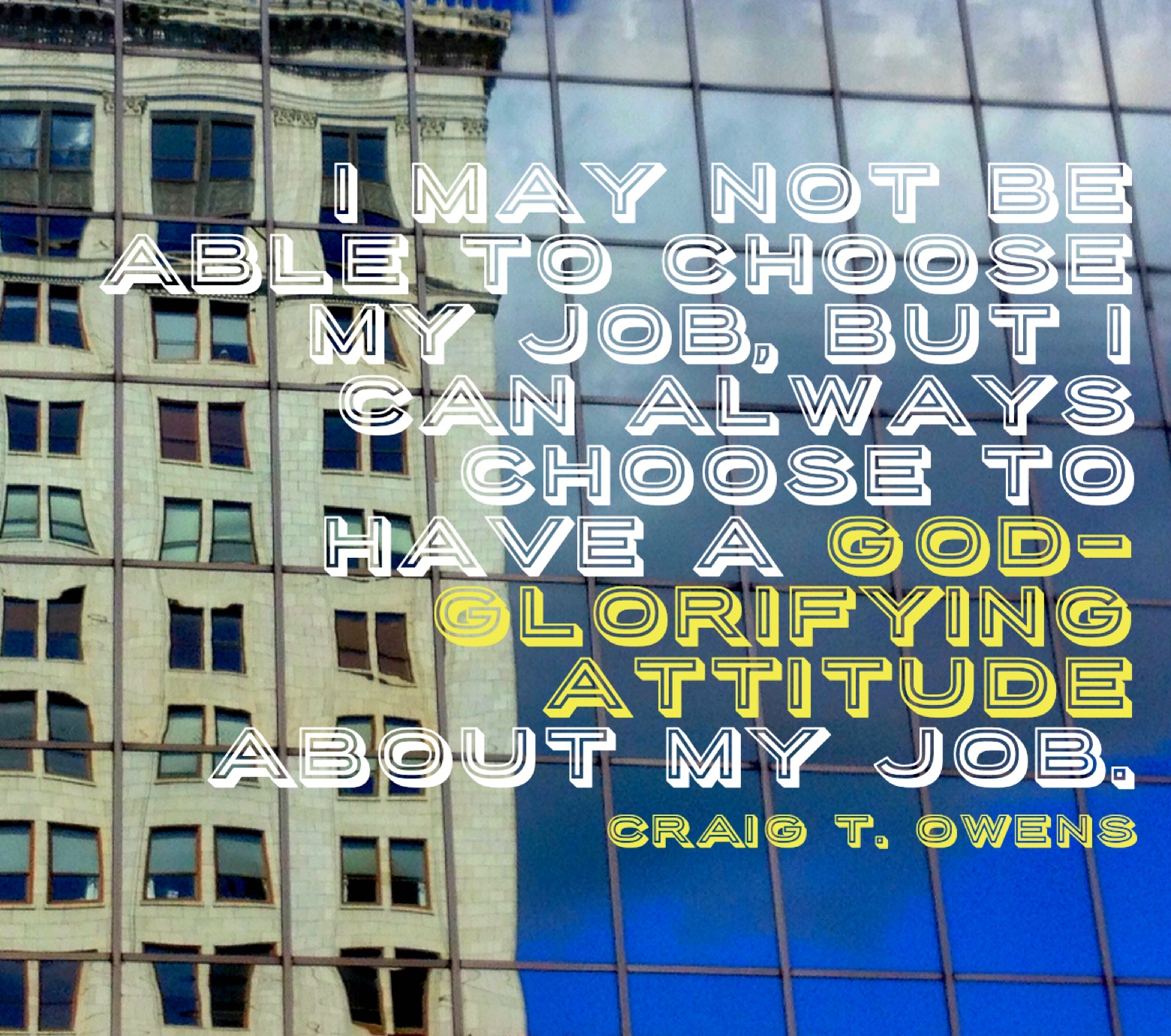
I may not be able to choose my job, but I can always choose to have a God-glorifying attitude about my job. When I choose this attitude and live it out with an excellent work ethic, God is pleased. 

So allow me to give you four attitude-checking questions about your own work ethic:

  1. Do I feel like I have to go to work? I should so crave God’s glory and God’s rewards that I have a get to attitude about my work. 
  2. Do I complain about my work? The Bible makes it very clear that God disapproves of grumbling, and uses our good attitude to point others to Himself (Numbers 11:1; 1 Corinthians 10:10; Philippians 2:14-15). 
  3. Am I “quiet quitting”? This should never, ever be said of Christians! Our work ethic should be as exemplary as Joseph’s and Christ’s (Ephesians 6:5-8).
  4. Am I living for T.G.I.F.? We shouldn’t be focused on just getting things done, but we should make the most of every day of work that we have been given. We should be living out T.G.I.T.—Thank God It’s Today (Psalm 90:12, 17)! 

Let me repeat an important principle: I may not be able to choose my job, but I can always choose to have a God-glorifying attitude about my job. When you have this kind of attitude, you will experience the joy of a fulfilled craving that God has put in all of us—the desire to do meaningful and God-honoring work. This is the attitude and work ethic God delights to reward. 

If you’ve missed any of the other messages in our series called Craving, you can find a list of all of those messages by clicking here. 

►► Would you please prayerfully consider supporting this ministry? My Patreon supporters get behind-the-scenes access to exclusive materials. ◀︎◀︎

William Tyndale & Charles Spurgeon On Sacred Words And Deeds

William TyndaleThis morning in my message, we looked at the example of William Tyndale.
William Tyndale believed the Bible should be read by all (not just by the “enlightened” clergy), and he undertook the process of translating the Hebrew and Greek into English. In the preface to the first five books of the Old Testament, he wrote, “I had perceived by experience, how that it was impossible to stablish the lay people in any truth, except the Scripture were plainly laid before their eyes in their mother tongue, that they might see the process, order, and meaning of the text.”

  • The clergy tried to intimidate Tyndale into stopping his work, but he said, “I defy the Pope and all his laws. If God spare my life, ere many years I will cause a boy that driveth the plough to know more of the Scripture, than he doust.”
  • Eventually he was put on trial for heresy, where he was also accused of trying to profit from his work. He replied, “I call God to record against the day we shall appear before our Lord Jesus, that I never altered one syllable of God’s Word against my conscience, nor would do this day, if all that is in earth, whether it be honor, pleasure, or riches, might be given me.”
  • Ultimately Tyndale was strangled to death, and then burned at the stake. But his dying words were, “Lord, open the eyes of the king.”

William Tyndale was notable in his struggle to break down the unbiblical clergy/laity (or sacred/secular) divide. Another great man who addressed this topic over 300 years after the death of Tyndale was Charles Spurgeon—

C.H. Spurgeon“To a man who lives unto God nothing is secular, everything is sacred. He puts on his workday garment and it is a vestment to Him. He sits down to his meal and it is a sacrament. He goes forth to his labor, and therein exercises the office of the priesthood. His breath is incense and his life a sacrifice. He sleeps on the bosom of God, and lives and moves in the divine presence. …The Lord hath cleansed your houses, He has cleansed your bed chambers, your tables, your shops, He has made the bells upon your horses holiness to the Lord, He has made the common pots and pans of your kitchens to be as the bowls before the altar, if you know what you are and live according to your high calling. You housemaids, you cooks, you nurses, you ploughmen, you housewives, you traders, you sailors, your labor is holy if you serve the Lord Christ in it, by living unto Him as you ought to live. The sacred has absorbed the secular.”

8 Quotes From “I Never Thought I’d See The Day”

I Never Thought I'd See The DayYou can read my book review of Dr. David Jeremiah’s I Never Thought I’d See The Day by clicking here. These are eight quotes that especially caught my attention in this book. Unless the quotes are otherwise attributed, they are from Dr. Jeremiah.

“I’ve shaken my fist in anger at stalled cars, storm clouds, and incompetent meteorologists. I’ve even, on one terrible day, that included a dead alternator, a blaring tornado-warning siren, and a horribly wrong weather forecast, cursed all three at once. I’ve fumed at furniture, cursed at crossing guards, and held a grudge against Gun Barrel City, Texas. I’ve been mad at just about anything you can imagine.

“Except unicorns. I’ve never been angry at unicorns.

“It’s unlikely you’ve ever been angry at unicorns either. We can become incensed by objects and creations both animate and inanimate. We can even, in a limited sense, be bothered by the fanciful characters in books and dreams. But creatures like unicorns that don’t exist—that we truly believe not to exist—tend not to raise our ire. We certainly don’t blame the one-horned creatures for our problems.

“The one social group that takes exception to this rule is atheists. They claim to believe that God does not exist and yet, according to empirical studies, tend to be the people most angry at Him.” —Joe Carter

“While the atheist arrogantly persists in the delusion that his reason is fully capable of figuring out all that there is, the religious believer lives in the humble acknowledgment of the limits of human knowledge, knowing that there is a reality greater than, and beyond, that which our senses and minds can ever apprehend.” —Dinesh D’Souza

“God brought two perfect, sinless people together in the Garden of Eden, a man and a woman who knew the perfect love of God. They did not get married to find love but to walk together in the unity and purpose God created them to fulfill: the primary task of birthing and raising the next generation. And in the process, love happened.”

“It is significant that while Adam was single, satan did not approach him or tempt him to disobey God. He waited until after Adam’s marriage to launch his attack. You would think it easier to attack one person instead of two, but by waiting he was able to attack not just an individual, but also God’s foundational building block for harmony and stability—marriage. By attacking marriage, he was able to create division and disharmony between humans themselves as well as between humans and God.”

“The oneness found in marriage is the same kind of oneness found in the Trinity.”

“We can be lulled into complacency by adopting uncritically the principle of submission to government on the assumption that the Christian history of our nation makes it safe to let our leaders do our thinking for us. But we cannot do this in our post-Christian nation where God’s Word is being marginalized. Nothing could be more dangerous for Christians and churches than to wander thoughtlessly down this path of increasing biblical indifference—a path that could well lead to a place where the Bible is not merely marginalized, but banned outrightly.”

“If the Church is being ignored because we preach the message of ‘Jesus Christ and Him crucified’ (1 Corinthians 2:2), or because the Gospel has become ‘a stumbling stone and rock of offense’ (Romans 9:33) to the world, that’s one thing. But if we are deemed irrelevant because we’re an anemic version of the world’s entertainment options or because we aren’t playing the world’s game nearly as well as the world does, then that’s another thing. That’s a tragedy.”

“William Tyndale wisely sought to avoid the confusion between ‘Church” and ‘church’ by translating ekklesia as ‘congregation’ instead of ‘church.’ …We must maintain a clean understanding of the difference between Church and church—and the priority of the former over the latter. Church buildings can necessitate huge investments of resources for construction and maintenance, and they are only temporary. Keeping the focus on people is the biblical priority and will result in the Church’s remaining relevant.”