Thursdays With Oswald—My Spiritual Personality

This is a weekly series with things I’m reading and pondering from Oswald Chambers. You can read the original seed thought here, or type “Thursdays With Oswald” in the search box to read more entries.

Spiritual Personality

     When we receive the Holy Spirit, He so energizes our spirit that we are able to detect things that are wrong, and we are able to rectify them if we ‘mind’ the Holy Spirit. This is the Scotch use of the term ‘mind,’ and it means ‘remember to obey.’ It carries with it the meaning of another Scotch word, ‘lippen,’ that is, ‘trust.’ Mind the Holy Spirit, mind His light, mind His convictions, mind His guidance, and slowly and surely the sensual personality will be turned into a spiritual personality. 

From Biblical Psychology

It’s not too often that I think of personality in a spiritual light. But God created me as a unique person, complete with my own personality. He gave me the personality He did on purpose: to glorify Him.

Left to myself, my personality is highly self-serving. But when I “mind” the Holy Spirit, He helps me live out my God-given personality in a way that is more and more God-serving and God-glorifying.

I love Chambers’ list:

  • Mind the Holy Spirit
  • Mind His light [illumination]
  • Mind His convictions
  • Mind His guidance

I’m working on “minding” better. How about you?

Thursdays With Oswald—Thinking Or Doing

This is a weekly series with things I’m reading and pondering from Oswald Chambers. You can read the original seed thought here, or type “Thursdays With Oswald” in the search box to read more entries.

Thinking Or Doing

     We perceive Truth by doing the right thing, not by thinking it out.

From Baffled To Fight Better

Oswald Chambers was not anti-thinking; neither am I. But there is a problem when I insist on something making sense to me before I act on it. If God says, “This way,” my first response shouldn’t be, “I’ll think about it.” But it should be, “Yes, I will obey.”

The words of the old hymn ring true:

Trust and obey
For there’s no other way
To be happy in Jesus
But to trust and obey

Thursdays With Oswald—A Strong Weakness

This is a weekly series with things I’m reading and pondering from Oswald Chambers. You can read the original seed thought here, or type “Thursdays With Oswald” in the search box to read more entries.

A Strong Weakness

Are not my days few? cease then, and let me alone, that I may take comfort a little, before I go whence I shall not return, even to the land of darkness and the shadow of death. (Job 10:20-21)

     “I see no way out,” says Job. He lies down, not in weakness, but in absolute exhaustion. Job is not talking in a petted mood, but saying that unless God will be a Refuge for him, there is no way out, death is the only thing. In every crisis of life, as represented in the Old Testament as well as in the teaching of Our Lord, this aspect of God is emphasized—“God is our Refuge”; yet until we are hit by sorrow, it is the last thing we seek for God to be. There is a difference between the weakness of refusing to think and the weakness that comes from facing facts as they really are. Job is seeing for the first time that God is the only Refuge, the only way out for him; yet he cannot get at Him through his creed, it is all confusion; the only thing to do is to fling himself on God.

From Baffled To Fight Better

“The only thing to do is to fling [myself] on God.”

Alas, how many times does this become my last resort! Why don’t I learn to fling myself on God my Refuge as my first resort? I must remember this: For when I am weak, then I am strong. (2 Corinthians 12:10)

Thursdays With Oswald—Stronger

This is a weekly series with things I’m reading and pondering from Oswald Chambers. You can read the original seed thought here, or type “Thursdays With Oswald” in the search box to read more entries.

Stronger

       If we believe in a state of mind He produces in us, we will be disappointed, because circumstances will come in our lives when these works of Jesus Christ are shadowed over; but if we believe in Him, no matter how dark the passage is we shall be carried right through, and when the crisis is passed our souls will have been built into a stronger attitude towards Him.

From Facing Reality

Job certainly went through a “dark passage”! Yet in the midst of it he said, “But principled people hold tight, keep a firm grip on life, sure that their clean, pure hands will get stronger and stronger” (Job 17:9).

And as David passed through his “dark passage” he confidently stated—

I prayed to the Lord, and He answered me.
      He freed me from all my fears.
Those who look to Him for help will be radiant with joy;
      no shadow of shame will darken their faces.
In my desperation I prayed, and the Lord listened;
      He saved me from all my troubles.
For the angel of the Lord is a guard;
      He surrounds and defends all who fear Him….

The righteous person faces many troubles,
      but the Lord comes to the rescue each time. (Psalm 34:4-7, 19)

My friend, hold on to Jesus. Hold on! He will carry you through, and you will build a stronger faith.

Signing A Blank Check

In our current series on prayer, we’re using the prayer that Jesus taught as our pattern. Yesterday we looked at this part of the pattern:

Your kingdom come, Your will be done on earth as it is in heaven.

This is all about trust. It’s about acknowledging to God that He is in control and He knows what’s best. It’s not about me coming into His presence and telling Him how things should work. I love the quote from C.S. Lewis:

There are two kinds of people: those who say to God “Thy will be done” and those to whom God says, “All right then, have it your way.”

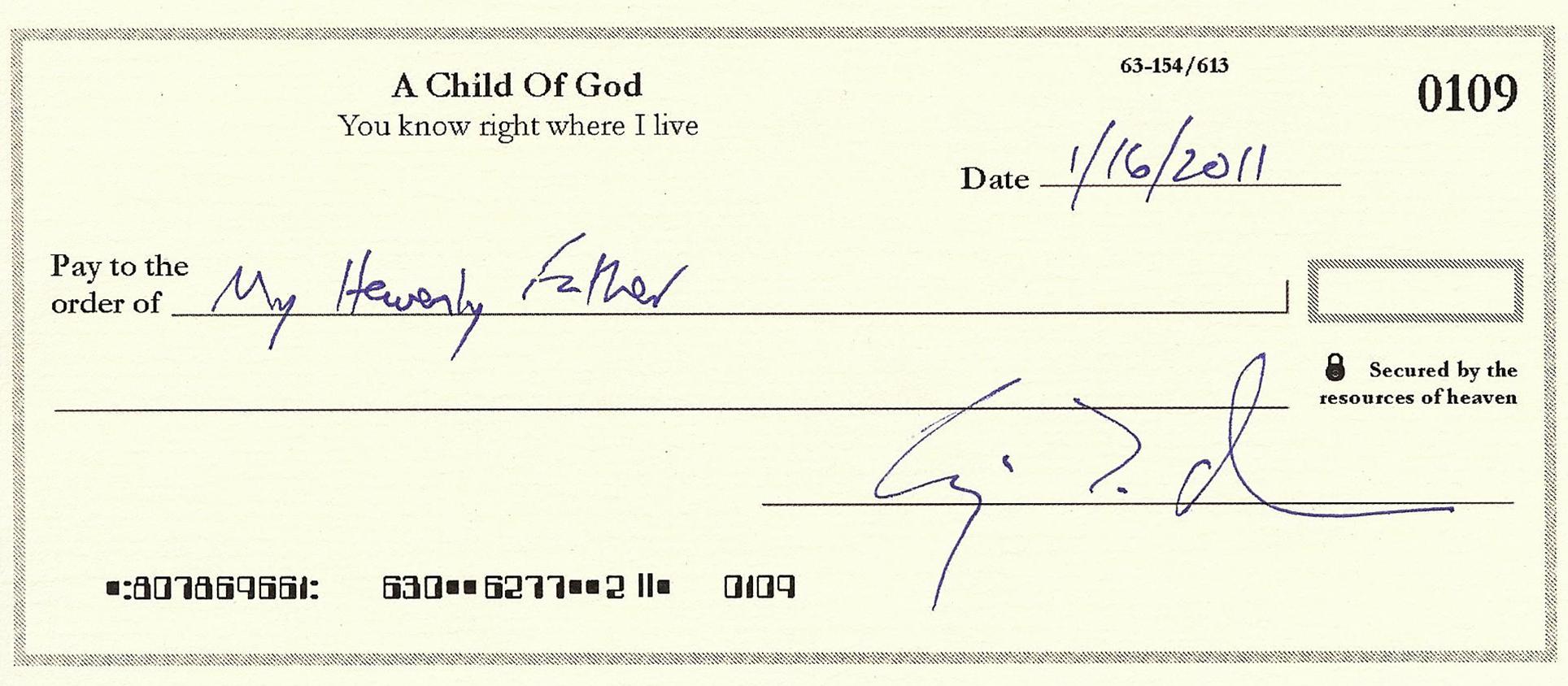
When we come into God’s presence in prayer, we say, “Before I ask You for what I need, I want You to know that I trust You. No matter what.” In essence, we sign a blank check and trust God to fill in the amount.

And, by the way, the verb for “Your kingdom come” in this model prayer is an imperfect verb. That means that we have to keep on signing those blank checks, as we keep on submitting to His will and His kingdom.

Are you willing to sign a blank check to God?

Thursdays With Oswald—Why Should I Do What I Ought To Do?

This is a weekly series with things I’m reading and pondering from Oswald Chambers. You can read the original seed thought here, or type “Thursdays With Oswald” in the search box to read more entries.

Why Should I Do What I Ought To Do?

      We imagine that if we obey authority we limit ourselves, whereas obedience to authority is not a limitation but a source of power; by obeying we are more. Naturally we are built to command, not to obey; man was originally constituted by God to have dominion—“And God said, Let Us make man in Our image, after Our likeness: and let them have dominion…” (Genesis 1:26 ); consequently there is the natural desire to want to explain things, because everything we can explain we can command. Spiritually, we are built not to command, but to obey. Always beware of the tendency to want to have things explained; you may take it as an invariable law that when you demand an explanation in connection with a moral problem it means you are evading obedience.

From Biblical Ethics

“God, if You will just tell me why I have to do this, then I’ll do it” doesn’t work. I simply must trust and obey.

How A Leader Should Bring Correction

Listen to the podcast of this post by clicking on the player below, and you can also subscribe on AppleSpotify, or Audible.

Bringing correction is one of the toughest jobs for those in leadership, but it’s a responsibility that cannot be delegated or ignored. In order for correction to be effective, it must not be too light or too heavy. Unfortunately, many of us have experienced far too many ineffective forms of leadership correction.

I read a great example of how to properly correct in the life of Samuel. In 1 Samuel 12, the people had gotten off track, and Samuel lovingly and effectively brought them back into line. Here’s what his example teaches us on how to correct followers:

1.  Shared history (v. 2). Samuel reminded them of what had happened in their history, and even what they had experienced together. “Newbie” leaders need to be cautious about bringing correction that violates an organization’s established culture.

2. Integrity (v. 3). Samuel’s words and lifestyle lined up. That doesn’t mean he never made a mistake, but it does mean that he was willing to acknowledge and repair his mistakes. Nothing is worse than a leader who says, “Do as I say, not as I do!”

3. Common ground (vv. 6-11). A leader needs to get everyone on the same page. Find something somewhere on which everyone can agree, and then move forward from there.

4. Just say it (vv. 12-13). Don’t beat around the bush; don’t try to bring correction through a parable; don’t soften the blow. Just say it: “This is where I believe you made a mistake.” Far too many leaders talk too much and leave their followers saying, “Huh?” If you are going to bring correction, make sure your followers know exactly what it is you are correcting.

5. Give the remedy (vv. 14-15, 20-21). Samuel pointed out the error, and he just as clearly told them how to get back on track. The remedy should be as clear and simple as possible.

6. Remove the fear (vv. 20, 22). Don’t let the corrected follower be afraid of you! Fear will never re-establish trust. Samuel couldn’t have been more clear on this. He literally said to the Israelites, “Do not be afraid.”

7. Demonstrate servant leadership (v. 23). At the close of the meeting, Samuel said he would do two things: “I will continue to pray for you, and I will continue to teach you.” In telling them this, Samuel was really saying, “Let’s walk through this together.”

If you lead your family, your church, your company, or your team, you are going to have to bring correction at some point. When you need to do this, take some time to review this list and bring correction the way Samuel did: lovingly and effectively.

P.S. You can also check out this post where the apostle Paul gives us another example of how to handle correction properly.

►► Would you please prayerfully consider supporting this ministry? My Patreon supporters get behind-the-scenes access to exclusive materials. ◀︎◀︎

Too Good To Be True

You know the old cliché: If something sounds too good to be true, it probably is. Yet time after time we buy into the hype…

  • “I get all of this for free!”
  • “I’ll be able to make this big score and it’s gonna cost me next to nothing.”
  • “He agreed to help me out with this just because he likes me. He’s not charging me a dime.”
  • “I think they really want to be my friend.”

It never works out that way, does it? Because if it sounds too good to be true, it probably is.

Do you know when those with these great offers show up? Right after you’ve done something well. Like Abraham in the Bible when he had just won a dramatic victory.

Here’s what happened. The bad guys swept in, defeated the good guys, and in carrying off the loot from their victory, they took Abraham’s nephew Lot with them. Abraham called out his special forces team and conducted a surprise night raid on the bad guys’ lair. He not only rescued Lot but all of the other captives too.

Abraham comes back loaded with everything he’s just recovered, and the King of Sodom comes out to meet him. This king is a big shot. It would be a career-advancing move to get in good with him. The King of Sodom says to Abraham, “Great work! Just let me have all the hostages, but you can keep all of the other loot. Even the stuff that was mine that the bad guys stole, I’m going to let you keep it.”

But Abraham knew that if it sounded too good to be true, it probably was.

Abraham wisely answered, “I’m God’s man. I’ve given Him my word: I will accept nothing that belongs to you, not even a thread or the thong of a sandal so that you will never be able to say, ‘I made Abram rich.’”

Smart move. Those things that seem to be free always come with strings attached. How much better to simply trust God for everything. So when God makes you successful, no one else gets the credit but Him.

Here’s the simple decision: Trust God or rely on “freebies” from men. Who are you going to trust?

Unintended Consequences

Sometimes even with the best of intentions, our actions can create a series of events that we never anticipated. What’s worse, like a row of neatly arranged dominos, once the first one has been knocked over, it’s hard to stop the tumble of the other dominos.

Case in point: Abram (or Abraham, as he would come to be known later).

He followed God’s call to leave his homeland of Ur and travel to Canaan—the Promised Land. He came to Canaan as a fairly wealthy man, having built quite a portfolio in his home country. After he arrived, he built a couple of altars to God and things appeared to be going well.

Until the famine. [you can read the story for yourself here]

Then without asking God, Abram left Canaan and traveled to Egypt. This was the first domino to be knocked down. The rest that fell were the unintended consequences of this single decision.

Abram lied to the Egyptians about his wife, telling them that she was his sister. As a result, she was taken into Pharaoh’s harem. Did Pharaoh sleep with her? The Bible doesn’t say for sure. Was Sarai mad at Abram? The Bible doesn’t answer this one either, but I think we all know the answer to this question!

Abram got richer. Because Pharaoh was so happy with Sarai, Pharaoh gave him sheep and cattle, donkeys and camels, and servants.

But this newly acquired wealth caused yet another domino to fall.

Abram and his nephew Lot began to have arguments about their large herds of animals. To settle their dispute, they split up.

Another domino fell.

Lot, without Abram’s mentorship, moved near Sodom. He got caught up in its sinful lifestyle and lost everything he owned. All he had left were two daughters, who were wicked, manipulative young ladies.

And yet another domino.

Abram and Sarai couldn’t have children. So Sarai suggested that Abram sleep with Hagar, their Egyptian maid. Would Sarai have suggested this if Abram hadn’t abandoned her to Pharaoh? If they hadn’t gone to Egypt, Hagar wouldn’t even have been there!

And the final domino.

Hagar did get pregnant. But her son Ishmael became the father of the Arabic people. A race of people that is openly hostile to the Jewish people to this day.

So many unintended consequences. So many dominos knocked down because of just one decision.

I’m grateful that God made something good out of this, but what incredible pain and hardship exist to this day because of one decision 4000 years ago.

My takeaway: I need to lean on, trust in, and be confident in the Lord with all my heart and mind and do not rely on my own insight or understanding.

Let’s Make A Deal

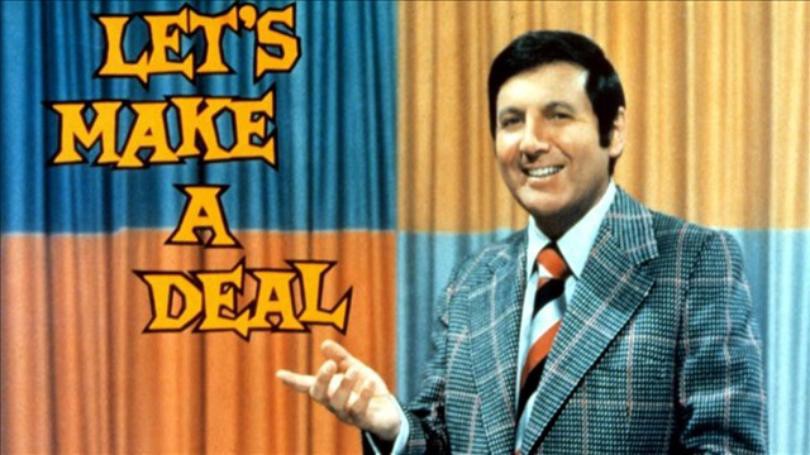
Have you ever seen the 1970s game show Let’s Make A Deal? Contestants were given some tricky choices to make. They usually held something in their hand that was fairly valuable and were given the opportunity to trade what they could see for what they couldn’t see.

The anxiety about making this decision almost caused some people to have a nervous breakdown on the spot! And, oh, the emotional highs and lows when the contestants discovered what they won or lost!

I was reading about a let’s-make-a-deal moment in the Bible. Jerusalem is facing an imminent threat from an incredibly powerful man (2 Kings 18-19). Sennacherib sent this message to King Hezekiah, “Let’s make a deal” (18:23).

And he made a pretty compelling argument to take the deal. Sennacherib said, “No one who has ever stood up to me has survived before. I’m undefeated. I have a bigger, meaner army than you; more horses and chariots than you; and I’ve blocked your attempts to call on someone else to come rescue you. There’s no way out of this. C’mon, let’s make a deal!”

What makes a deal like this so appealing is that it’s all visible. It’s hard to say “no” to what you can see and say “yes” to what you can’t see.

Hezekiah knew God could deliver them, but would He deliver them? Hezekiah couldn’t see God, but he could see all of Sennacherib’s forces. What to do, what to do??

Hezekiah made the right deal. He put his trust in God! Although He was unseen, Hezekiah believed that God’s deal was better than Sennacherib’s deal. And Hezekiah was not disappointed in the deal he made (19:35-37).

What about you? Are you facing insurmountable odds today? Do you feel like you need to make a deal? Is what you can see more compelling than what you can’t see? I can promise you that any deal that you might make that doesn’t throw your trust entirely on God is a bad deal. A very bad deal!

So we’re not giving up. How could we! Even though on the outside it often looks like things are falling apart on us, on the inside, where God is making new life, not a day goes by without His unfolding grace. These hard times are small potatoes compared to the coming good times, the lavish celebration prepared for us. There’s far more here than meets the eye. The things we see now are here today, gone tomorrow. But the things we can’t see now will last forever. (2 Corinthians 4:16-18, The Message)

Don’t give up! Don’t make a bad deal! Trust God. His way is always the best deal!