10 Quotes From John Maxwell In “Teamwork 101”

Teamwork 101The 101 Series of book from John Maxwell is a great introduction to the many topics which he address in greater depth in other books. Here are some quotes from Dr. Maxwell which I especially enjoyed.

“I believe that insecurity, rather than poor judgment or lack of intelligence, most often causes leaders to surround themselves with weak people.”

“On good teams, trust is a nonnegotiable. On winning teams, players extend trust to one another. Initially that is a risk because their trust can be violated and they can be hurt. At the same time that they are giving trust freely, they conduct themselves in such a way to earn trust from others. They hold themselves to a high standard. When everyone gives freely and bonds of trust are developed and are tested over time, players began to have faith in one another. They believe that the person next to them will act with consistency, keep commitments, maintain confidences, and support others. The stronger the sense of community becomes, the greater their potential to work together. Developing a sense of community in a team does not mean there is never conflict. All teams experienced disagreements. All relationships have tension. But you can work them out.”

“Create an environment that unleashes new leaders.” 

“Teams that don’t bond can’t build.”

“For a team to be successful, the teammates have to know they will look out for one another.” 

“In a sport such as basketball, the players on the team recognize that scoring is what is important. When a team is more effective at scoring than the opponent, it wins. Because the team members know that, they spend their time in improving and perfecting their ability to score. That is their focus. In contrast, in many organizational settings, the team members don’t know what it means to ‘score.’ They may have a list of duties, but they don’t know how those duties go together to make a score. It would be the equivalent of a basketball player who knew how to set a pick, dribble, and pass, but who never knew all the skills were used together to score baskets. If just one player on a basketball team doesn’t know what is important to the team, it makes him ineffective. And when he is in the game, it is impossible for the team to succeed. The same is true in any organization. Anyone who doesn’t know what’s important to the team not only fails to contribute to the team, but actually prevents the team from achieving success. That is why it is so important for leaders of the team to identify what is important to the team and to communicate that information to her team members.”

“People on the team must be made to feel that they are in an environment where it is safe to offer suggestions or criticism without feeling threatened.” 

“The key to being competitive is channeling it in a positive way. If you squash it, you lose an edge that motivates you to do some of your best work. If you let it run wild, you run over your teammates and alienate them. But if you control it and directed, competitiveness can help you succeed.”

“Don’t let the personality of someone you work with cause you to lose sight of the greater purpose, which is to add value to the team and advance the organization. If that means listening to the ideas of people with whom you have no chemistry, or worse, a difficult history, so be it. Set aside your pride and listen. And in cases where you must reject the ideas of others, make sure you reject only the idea and not the person.” 

“Being an encouraging leader and leading across is not about getting your own way. It’s not about winning at all costs. It’s about winning respect and influence with your peers so that you can help the whole team win. Should you be passionate and determined, believing in yourself and your ability to contribute? Definitely. Should you hold on to your deeply held values and stand on principle when those are in jeopardy? Absolutely. But never forget that having a collaborative spirit helps the organization. When you think in terms of our idea instead of my idea or her idea, you’re probably on track to helping the team win.”
The Complete 101 Collection (book review)

The Complete 101 SeriesI am a huge John Maxwell fan! Most of his books are quite in-depth, and feel like a graduate-level class in leadership. For those that are ready to go on a leadership development journey with Dr. Maxwell, The Complete 101 Collection would be a great place to start.

In college, the 101-level classes are intended to be the introduction to a subject. This is the class that will educate you, but more than that, it should whet your appetite to move on to the 201- 301, and 401-level classes in that subject. John Maxwell’s 101 books will do exactly the same thing.

When you read the books in this collection on attitude, self-improvement, leadership, relationships, success, teamwork, equipping, and mentoring, you will be able to see (a) which subject peaks your interest for more, and (b) which subject is calling you to more improvement. Then you can move on to other Maxwell books which will be the higher level classes in that subject.

This is an excellent book for anyone wanting to improve their interactions with others.

I am a Thomas Nelson book reviewer.

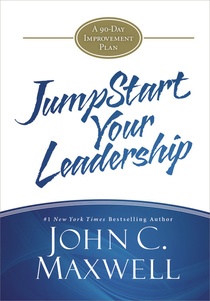
10 Quotes From John Maxwell In “JumpStart Your Leadership”

JumpStart Your LeadershipI always love John Maxwell’s insights into leadership. JumpStart Your Leadership is a great learning book for leaders at any level. You can read my book review by clicking here. Below are a few quotes from John Maxwell that I especially appreciated.

“Too often people associate leadership advancement with their career path. That’s the wrong paradigm. What you should be thinking about is your own leadership development! The sign of good leadership isn’t personal advancement. It’s the advancement of your team. When others succeed and your team gets better, it’s a sign that your leadership is improving.

“Good leadership begins with leaders knowing who they are. Successful leaders know their own strengths and weaknesses. They understand their temperament. They know what personal experiences serve them well. As a result, they have developed successful work habits and understand their daily, monthly, and seasonal rhythms. They have a sense of where they are going and how they want to get there. They don’t pretend to be something they’re not. Instead they admit their shortcomings and harness their strengths. As a result, they know what they’re capable of doing, and their leadership is strong.”

“Success demands more than most people are willing to offer, but not more than they are capable of giving. The thing that often makes the difference is good leadership.”

“Let a vision for making a difference in the lives of the people you lead lift you and your people above the confines of job descriptions and petty rules.”

“The path to leadership growth requires that one stops trying to impress others to maintain their position and starts developing trust to maintain their relationships.”

“Good leaders understand that the heart of leadership is dealing with people and working with the good, the bad, and the ugly in everyone. They are able to look at hard truths, see people’s flaws, face reality, and do it in a spirit of grace and truth. They don’t avoid problems; they solve them. Leaders who build relationships understand that conflict is a part of progress.”

“Knowing what to do isn’t enough to make someone a good leader. Just because something is right doesn’t necessarily mean that people will let you do it. Good leaders take that into account, then they think and plan accordingly. And to accomplish this, you must exhibit a consistent mood, maintain an optimistic attitude, possess a listening ear, and present to others your authentic self.”

“What makes a family great isn’t what makes a team great. Families value community over contribution. Businesses value contribution over community. The best teams strike a balance.”

“Care without candor creates dysfunctional relationships. Candor without care creates distant relationships. But care balanced with candor creates developing relationships.”

“People are any organization’s most appreciable asset. Good leaders invest their time, energy, money, and thinking into growing others as leaders. They look at every person and try to gauge his or her potential for growth and lead—regardless of the individual’s title, position, age, or experience.”

Links & Quotes

link quote

Some good reading and watching from this weekend…

“Malice needs nothing to live on; it can feed on itself. A contentious spirit will find something to quarrel about. A faultfinder will find occasion to accuse a Christian even if his life is as chaste as an icicle and pure as snow. A man of ill will does not hesitate to attack, even if the object of his hatred be a prophet or the very Son of God Himself. If John comes fasting, he says he has a devil; if Christ comes eating and drinking, he says He is a winebibber and a glutton. Good men are made to appear evil by the simple trick of dredging up from his own heart the evil that is there and attributing it to them.” —A.W. Tozer

“Let not thy peace depend on the tongues of men, for whether they judge well or ill, thou art not on that account other than thyself.” —Thomas á Kempis

[VIDEO] John Maxwell on the energy in synergy—

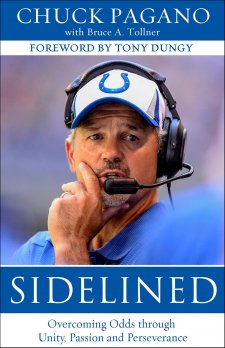
9 Quotes From “Sidelined”

SidelinedSidelined was a book I could hardly put down: such a compelling story of love, and family, and overcoming adversity! You can read my full book review by clicking here. Below are some quotes I highlighted in this book, unless otherwise noted all of the quotes are from Coach Pagano.

“We can! We will! We must! By any means necessary—we have no choice—we will win.”

“We were determined to create a culture where guys couldn’t wait to come to work. We wanted people who would be excited about getting up in the morning and being here. … We wanted a workplace where people are honest and forthright with each other. We wanted open communication to be practiced daily. We wanted every person in the building to be treated with the dignity that every human being deserves. Sure, we’re tough guys, and we like to joke and trash talk sometimes as part of our fun. But there has to be a limit to that kind of behavior, and we wanted everyone to respect each other more than anything else. A joke’s only funny if we all share in it together at no person’s expense. And when we make mistakes or do something wrong, we don’t deny it. We want a place that if we are going to eat crow, we are going to eat it while it’s hot!”

“…My condition will not determine my position. I understand the condition, but choose to focus on my position. That is to stay positive and serve….” (part of a letter to his team before the Green Bay Packers game)

“Endurance is not just the ability to bear a hard thing, but to turn it into glory.” —William Barclay

“You brought the spiritual plane. That’s why your leadership goes beyond coaching. You set an example as a spiritual leader, and that’s what inspires people.” —Kevin Elko

“Coaching is a profession of love. You can’t coach people unless you love them.” —Eddie Robinson

“People sometimes ask me what we look for in a player—how we know he’ll be a good fit for our program. It’s a hard question to answer because there are so many variables. … We also go beyond all the facts and stats and determine if these are what we like to call ‘horseshoe guys.’ The horseshoe emblem of the Colts shows seven nails or studs. Each one represents a quality we want in a player/leader for our team—smart, tough, dynamic, physical, character, integrity, and respect. … Players who want to be a part of something bigger. Something great.”

“Part of the reason I couldn’t remain disappointed after our lost to the Ravens [in the playoffs] was that I knew we had built our foundation on solid rock. We had established something that wasn’t going to dry up and blow away in a matter of weeks or months. Our team was committed to building a program for sustained success. We called it ‘building the monster.’ We wanted to take our building blocks of athleticism, talent, and skill and bring them to life with our commitment, character, and determination.”

“Cancer can take away a lot—your hair, your appetite, your energy, and, yes, sometimes your very life. But cancer cannot take away the love that passes between you and the special people in your life. It can’t take away the support and encouragement, the creativity and beauty, the connections and relationships to others who are fighting alongside you. No matter how hard it tries, cancer can never contain the human spirit or diminish the power of faith.”

23 Quotes From “The 5 Levels Of Leadership”

5 Levels of LeadershipThere is always so much rich content in a John Maxwell book, and The 5 Levels Of Leadership is no exception. You can read my full book review by clicking here. These are a few of the quotes that especially caught my attention. Unless otherwise noted, these quotes are from John Maxwell.

“At any level, a leader doesn’t automatically stay at that level. You must earn your level of leadership with each person, and that level can go up or down at any time.” 

“You have no control over how much talent you possess. You control only what you do with it.”

“Leadership is accepting people where they are, then taking them somewhere.” —C.W. Perry 

“Often to make themselves look better or to keep people from rising up and threatening them, positional leaders make other people feel small. How?

  • By not having a genuine belief in them.
  • By assuming people can’t instead of assuming they can.
  • By assuming people won’t rather than believing they will.
  • By seeing their problems more readily than their potential.
  • By viewing them as liabilities instead of assets.”

“Anytime you think you’ve arrived—whether your position is the lowest or the highest in the organization—you’ve lowered your expectations for yourself, sold your leadership short, and fallen into a no-growth mind-set.”  

“Above all else, good leaders are open. They go up, down, and around their organizations to reach people. They don’t stick to established channels. They’re informal. They’re straight with people. They make a religion out of being accessible.” —JackWelch

“You see, when there is danger, a good leader takes the front line. But when there is celebration, a good leader stays in the back room. If you want the cooperation of human beings around you, make them feel that they are important. And you do that by being humble.” —Nelson Mandela 

“People will not get ahead with others unless they are willing to work behind others.”

“[Good leaders] have more than an open-door policy—they know the door swings both ways. They go through it and get out among their people to connect.” 

“If you want to be successful on Level 2, you must think less in terms of systems and more in terms of people’s emotions. You must think more in terms of human capacity and less in terms of regulations. You must think more in terms of buy-in and less in terms of procedures. In other words, you must think of people before you try to achieve progress.”

“Care without candor creates dysfunctional relationships. Candor without care creates distant relationships. But care balanced with candor creates developing relationships. …Caring values the person while candor values the person’s potential. …Caring establishes the relationship while candor expands the relationship. … Caring defines the relationship while candor directs the relationship.” 

“Before having a candid conversation, make sure you can answer yes to the following questions:

  • Have I invested enough in the relationship to be candid with them?
  • Do I truly value them as people?
  • Am I sure this is their issue and not mine?
  • Am I sure I’m not speaking up because I feel threatened?
  • Is the issue more important than the relationships?
  • Does this conversation clearly serve their interests and not just mine?
  • Am I willing to invest time and energy to help them change?
  • Am I willing to show them how to do something, not just say what’s wrong?
  • Am I willing and able to set clear, specific expectations?”

“If achieving the vision is worth building the team, it is also worth risking the relationship. Building relationships and then risking them to advance the team creates tension for the leader. That tension will force you to make a choice: to shrink the vision or to stretch the people to reach it. If you want to do big things, you need to take people out of their comfort zones. They might fail. They might implode. They might relieve their own tension by fighting you or quitting. Risk always changes relationships. If you risk and win, then your people gain confidence. You have shared history that makes the relationship stronger. Trust increases. And the team is ready to take on even more difficult challenges. However, if you risk and fail, you lose relational credibility with your people and you will have to rebuild the relationships. Risk is always present in leadership. Anytime you try to move forward, there is risk. Even if you’re doing the right things, your risk isn’t reduced. But there is no progress without risk, so you need to get used to it.” 

“You can issue all the memos and give all the motivational speeches you want, but if the rest of the people in your organization don’t see you putting forth your very best effort every single day, they won’t either.” —Colin Powell

“The job of a leader is to build a complementary team, where every strength is made effective and each weakness is made irrelevant.” —Stephen Covey

“If you want to be an effective leader, you must move from perfectionist to pragmatist.”

“Since you can’t prevent mistakes, why not adopt and attitude in which you and your team learn from them?” 

“The individual leads in order that those who are led can develop their potential as human beings and thereby prosper.” —Socrates

“The highest goal of leadership is to develop leaders, not gain followers or do work.”

“Leadership is an opportunity to serve.” —J. Donald Walters

“No matter where you are in your leadership journey, never forget that what got you to where you are won’t get you to the next level.” 

“The reality is that no one is indispensable. Worse, allowing others to become dependent does little more that satisfy a leader’s ego. It is a very limiting leadership style that has a very short life span. The first step in developing leaders is to have a desire to develop people so that they can succeed without you. …If you want to develop people, you must help them discover and build upon their strengths. That’s where people have the most potential to grow. Helping to develop their strengths is the only way to help leaders become world-class.”

“What you do daily, over time, becomes your legacy.”

Visioneering (book review)

VisioneeringWhat a great word! Visioneering: A blueprint for developing and maintaing personal vision by Andy Stanley is how God want to use you to help engineer the vision He has birthed in you.

Andy Stanley is an author that I thoroughly enjoy reading. His wisdom is profoundly practical, which means he uncovers things I never would have seen, but does it in a way that I can immediately apply. Visioneering uses the story of Nehemiah in the Bible as the template to guide us through the steps necessary to see a God-breathed vision become a reality.

Andy uncovers in the life of Nehemiah the things that are universal to anyone who has a burning desire to see things around them taken to a higher level. Things like: second-guessing whether God actually spoke that particular vision, the first steps to take, how to handle criticism, pulling together a team to work together on fulfilling the vision, handling setbacks, keeping all of the team members aligned behind the vision, and what the ultimate purpose of a God-given vision really is.

Each chapter concludes with some thought-provoking questions, and a place to record your answers to those questions. These guides help put “feet” to the concepts shared in each chapter.

After reading Visioneering you will be more energized and equipped to do the great things God is calling you to do.

I am a Multnomah book reviewer.

Check out some quotes from this book here.

Smarter Work

I met this morning with my teaching team. These are some great leaders-in-training who are helping me both think through what we need to talk about with our students in our youth group, and they help teach some of these points as well. This morning we refined the next series that we want to deliver. I had a pretty good idea going in, but my teaching team made it so much better!

I love leadership teams. The New Testament frequently uses the phrase one another to show that “all of us” is a lot better than “one of us.”

  • My team helps me think of things I may have missed on my own
  • My team challenges me to clarify my words
  • My team gives me perspectives that I wouldn’t have caught
  • My team makes my good ideas better
  • My team gives me a chance to invest in and train up the next generation of leaders

Do you have a good team around you? Do you have people challenging you to think in new ways? Do you have people who can sharpen you? Do you have people around you that pour into your life, and allow you to invest in them too?

Two great team quotes from some coaches who knew what they were talking about:

“The freedom to do your own thing ends when you have obligations and responsibilities. If you want to fail yourself, you can, but you cannot do your own thing if you want to have responsibilities to your team members.” —Lou Holtz

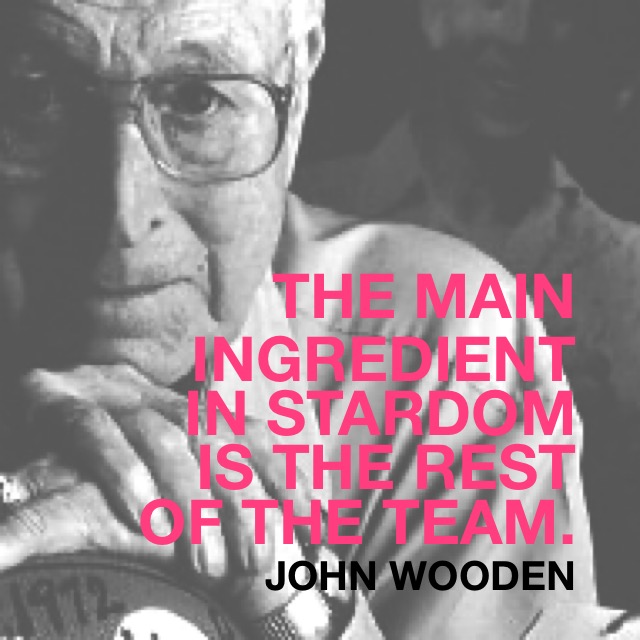
“The main ingredient in stardom is the rest of the team.” —John Wooden

I promise you “all of us” makes you look a whole lot smarter than just “one of us”! If you’re not already, start developing a team—you’ll be glad you did.