Renewed Passion For Prayer

If I were to ask you if we should we pray for our friends in need, I think I’d probably get a universal “yes.” Even non-Christians might say we should “send good thoughts” or “best wishes” to our friends.

But if I were to ask, “How long should we pray for them?” we might get a lot of different answers. 

What about if we’re praying for a friend to get a job (and he gets it), or a friend to be healed (and she is), or a marriage to be restored (and it is)—do we stop praying then? 

Psalm 20 and 21 appear to be companion psalms: with Psalm 20 being David’s prayer of petition, and Psalm 21 being his prayer of praise. But there is also something quite interesting in each of these psalms about the placement of the word Selah. 

Remembering that Selah means some sort of pause, I find it very interesting where David tells us to pause in both of these psalms. In Psalm 20 we see the prayer request “may” either 6 or 7 times in the first five verse, but the Selah pause is right in the middle of them. Why would David start making his requests to God, tell us to pause in the middle, and then continue making his requests? 

I believe this Selah means to “pause and consider” that… 

  1. God invites us to participate with Him in fulfilling His plans. 
  2. God loves us so much that He wants to hear from us. 
  3. God is powerful enough to grant what we ask of Him. 

It’s as if in the middle of all of his petitions, David says, “Hold on a second. Do you realize what we are in the midst of doing? We are actually communing with the All-Knowing, All-Loving, All-Power Creator and Sustainer of the Universe!!”

In Psalm 21 David is offering up a prayer of praise for God’s answers to his prayers (note the similar language in Psalm 20:4 and 21:2), and once again he tells us to Selah pause right in the middle of those prayers of gratitude. 

I asked earlier, “When do we stop praying for a friend or for ourselves?” Is it when we get the job, or experience the healing, or have the breakthrough or restoration? What if the job, the healing, the restoration was just the beginning of what God wanted to do? The Selah in Psalm 21 is an accentuation: an explosion into so much more!! 

David prayed for victory in battle, but God gave him an everlasting victory; David prayed for long life, but God gave him eternal life (21:4); David prayed for blessings on his battle, but God gave him His eternal blessings (21:6).

Jesus said our Heavenly Father has gifts for us beyond our asking (Matthew 7:11), and the Apostle Paul said the same thing in Ephesians—

Now glory be to God, who by His mighty power at work within us is able to do far more than we would ever dare to ask or even dream of—infinitely beyond our highest prayers, desires, thoughts, or hopes. (Ephesians 3:20 TLB)

These two Selahs tell me: 

Don’t quit praying when times are tough. 
Don’t quit praying when you’ve prayed a long time. 
Don’t quit praying when it seems like God has answered. 
Keep on praying. Always. About everything!


Please join me this coming Sunday as we continue to look at the Selahs in the Psalms. You can join me in person or via Facebook Live. 
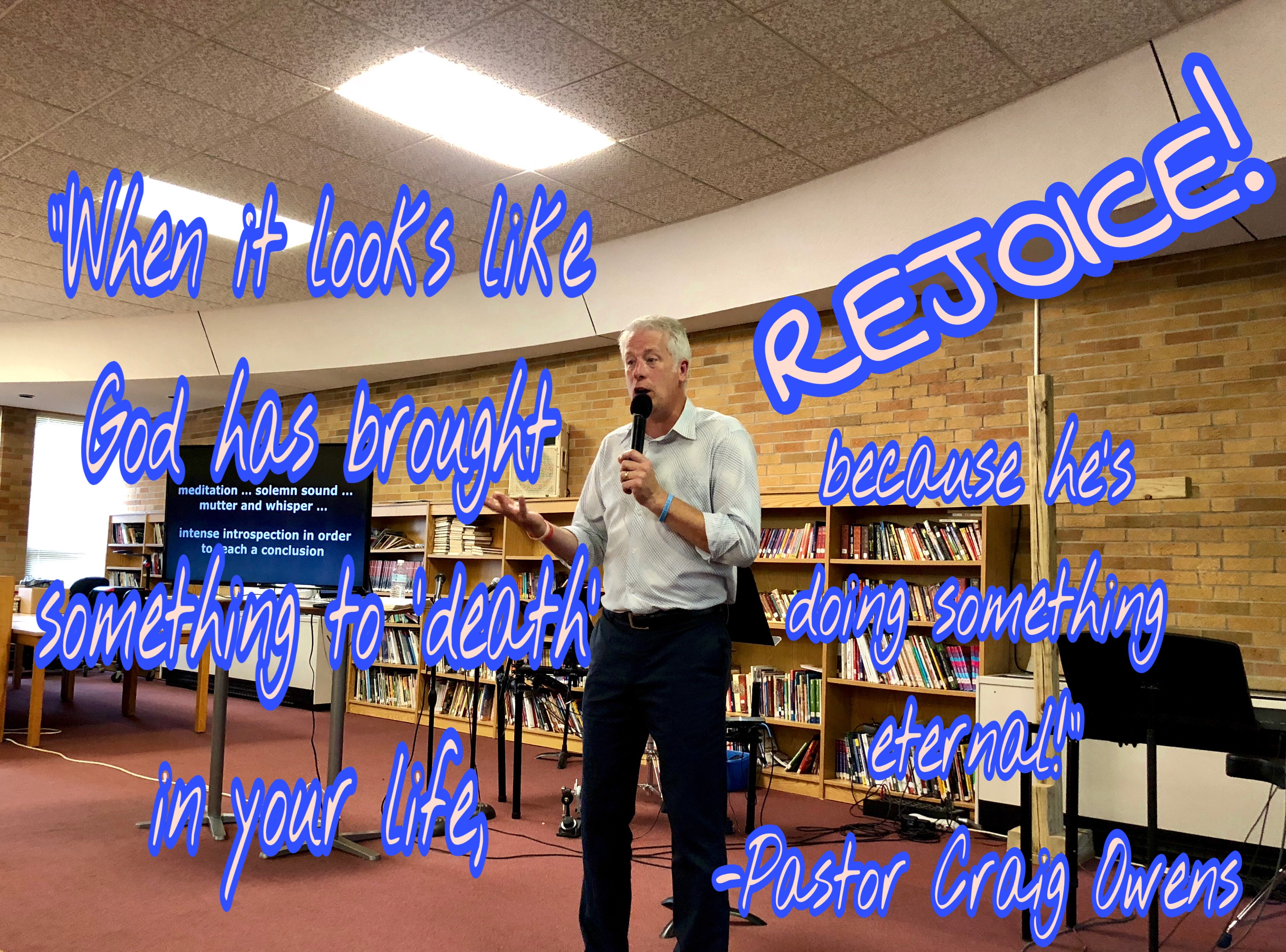
Unexpected Praise

Well, this isn’t what I expected! David says his song in Psalm 9 is supposed to be sung to the tune of “Death Of The Son,” so I’m expecting a prayer that is loaded with minor notes. But instead, David gives us … this! 

The opening verses show us David exploding in praise to God. Check out his vocabulary—

  • I will praise You—this literally means David is pumping his hands in the air
  • I will tell of all Your wonders—David is not doing this just one time but is ticking off a long list of God’s praiseworthy deeds and attributes
  • I will be glad—his face lights up with joy 
  • I will rejoice—this word means a roar of praise (see 1 Chronicles 16:32)
  • I will sing praise—there is a new melody with every praise David lifts to God

Why this loud, exuberant, unexpected praise? Because David has noticed that whatever has “died” on earth is only a temporary loss, but God is forever! 

There is an unusual word pairing at the end of verse 16: Haggaion and Selah. This is the only time these two words appear like this in all of Scripture, and it’s also the only time Haggaion is used without being translated. 

Haggaion appears just four times in the Bible—(a) in Psalm 19:14 where it is translated meditation; (b) in Psalm 92:3 where it is translated solemn sound; (c) in Lamentations 3:62 where it is translated whisper and mutter; and (d) here in Psalm 9 where it is untranslated. 

By combining Haggaion and Selah, David is wanting us to solemnly meditate on an important contrast: God’s way vs. man’s way. In verses 3-16, David uses huge and eternal terms for God like righteous Judge, reigns forever, refuge, stronghold, merciful, and prayer-answerer. 

Side-by-side with these eternal terms for God, David lists the temporary terms for man like stumble, perish, ruined, forgotten, and trapped. In fact, David ends this Psalm by reminding us evil men who do evil things are “mere men.” Other translations fill in the details: 

  • make them realize their frail nature (AMP)
  • show them how silly they look (MSG)
  • merely human (NLT) 
  • puny men (TLB)

Then David ends with a final Selah—one more call for us to allow this message to resonate with us, especially during the times others may call dark, depressing times. The message that should resonate in our hearts and cause us to throw our hands up in joyful celebration of God is…

these earthly things are temporary and God is eternal. He has never forsaken those who seek Him, and He has never forgotten those who call on Him for help. 

When a dark time—a “death of a son”—tries to rock your world, don’t do what puny mortals expect, but throw your hands up in the air, and sing and roar a praise to the Almighty God Who cares for you! 

Join me this coming Sunday as we continue our looks at the Selahs in the Book of Psalms. You can join me in person or on Facebook Live.

Grudges Can Block God’s Blessings

In Psalm 7, some guy named Cush is giving David trouble. How much trouble? David felt like Cush was a lion about to rip him apart! 

We would naturally expect David to cry out for God’s help from this tormentor (which he does in the opening verses), but then what David does next is quite unexpected—he asks to God to search his heart to see if he might be the cause for Cush’s attack: 

  • Have I done something wrong?
  • Is there guilt on my hands?
  • Have I done such an evil to cause him to attack? 
  • Have I somehow robbed Cush of something? 

This introspection in God’s presence was apparently a regular habit for David. He made this a regular habit when the heat was on, and also when he was at peace (see Psalm 139:23-24). 

Not only did David want to make sure his hands were clean, but he also wanted to make sure he wasn’t carrying a grudge against Cush. A grudge is a feeling of anger or resentment toward someone who has wronged us. But the most devastating thing about a grudge is that it takes our eyes off God and places them on our tormentor. 

In other words, as long as we hold a grudge, we continue to give our tormentor power over our lives. 

So after asking those introspective questions, David writes Selah. One definition of this word—which is probably quite appropriate here—is pause, and calmly think of that. 

After this Selah pause of introspection in God’s presence, David must have felt clear of any guilt (because we don’t see him repenting, as is his habit), but we also see him being very careful of not holding on to a grudge against Cush. 

David then begins to affirm in the remaining verses that God is more than capable of handling evil people and keeping the righteous protected. David determines that he will give thanks to the Lord because of His righteousness, and will sing praise to the name of the Most High (v. 17). 

Here’s an important thing for anyone who has been injured by someone else to remember—

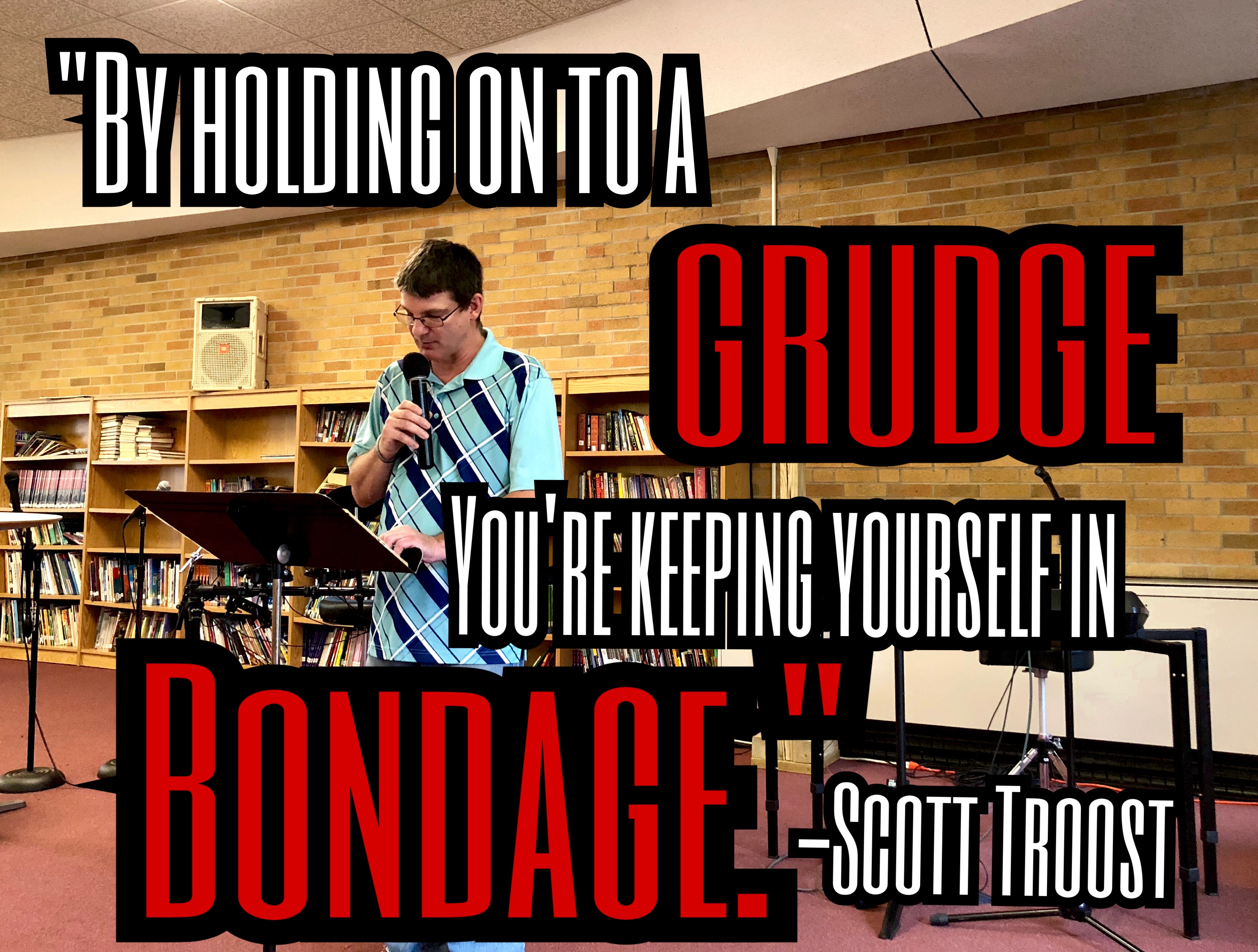
By holding on to a grudge, you’re holding yourself in bondage! 

How can your hands be free to receive God’s blessings if your hands are full of the grudges you are holding? 

Learn from David’s Selah these two lessons when someone torments you: 

  1. Ask God: am I to blame? If so, repent. If not, ask question 2.
  2. Ask God: am I holding on to a grudge? If so, let it go so your hands are free to receive God’s blessings! 

Join me next Sunday as we continue our look at the Selahs in the Psalms. 

The Selah That Keeps Us From Sinning

There is a very natural emotion that we humans have when someone has hurt us, but if we don’t pause (Selah), that natural emotion can lead us into sin. David has good counsel for angry people in Psalm 4. 

Many scholars think that Psalm 4 is a continuation—or a part 2—of Psalm 3. As you will notice in the preface of Psalm 3, David is on the run from his son Absalom, who is trying to steal the kingdom of Israel from him. 

Look at the swing of David’s emotions:

  • Troubled/sad (v. 1) 
  • Anger (v. 4)
  • Contentment (v. 7)
  • Peace (v. 8)

The first time David tells his readers to Selah pause is between verses 2 and 3. The change is almost an about-face: 

Look at this: look who got picked by God! He listens the split second I call to Him. Complain if you must, but don’t lash out. Keep your mouth shut, and let your heart do the talking. Build your case before God and wait for His verdict (vv. 3-5 in The Message). 

My friend Josh Schram shared these truths: 

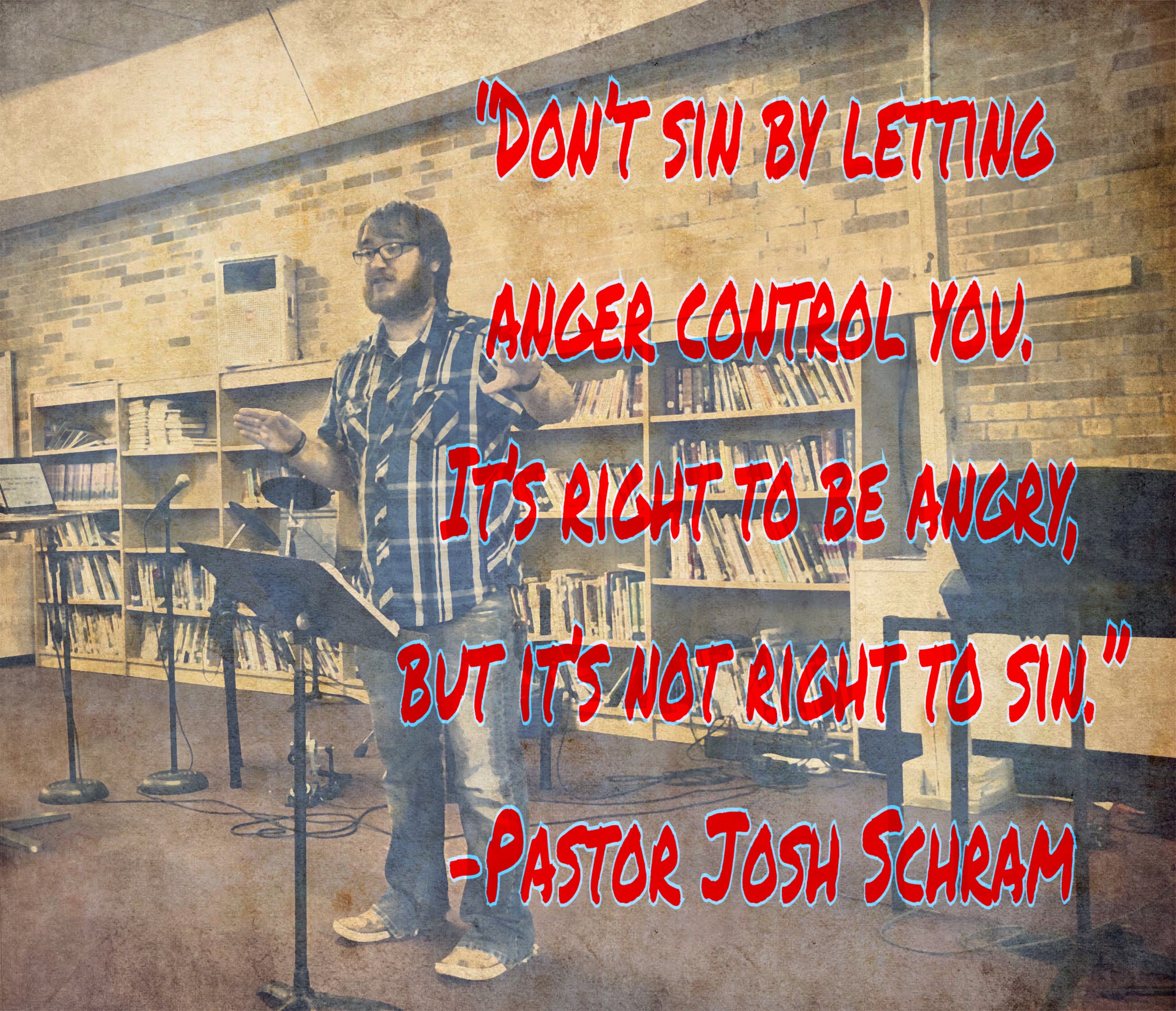
  1. Don’t sin by letting anger control you. 
  2. It’s right to be angry, but it’s not right to sin. 
  3. When someone hurts us, it’s tempting to break God’s law. We can almost justify it, but it is a sin to give in to anger. 

“Search your heart and be silent”Selah. This pause gives us hope that we can “build your case before God and wait for His verdict.” 

In Romans 12:17-21, Paul gives similar counsel when dealing with enemies:  As far as it depends on you…

  • Don’t repay evil for evil. 
  • Do repay evil with doing what’s right. 
  • Don’t take revenge. 
  • Do let God handle it. 
  • Don’t mistreat your enemies. 
  • Do bless your enemies. 
  • Don’t be overcome by evil. 
  • Do overcome evil by doing good. 

Since David let his anger go, that also means he didn’t sin! His clear conscience meant he could lie down and sleep in peace. 

You cannot hold a grudge and peace in the same heart. 

Please join me next week as we continue our look at the Selahs in the Book of Psalms. 

Argument Vs. Experience

There is a curious word that shows up about 70 times in the Bible (almost all of them in the Psalms)—Selah. The best scholars can figure is that this word has some sort of musical meaning: 

  1. Pause / Interlude—to rest in silence. This might even be where the singers stopped while the music continued. 
  1. Accentuation—to lift up or exalt; as in the renewed vigor of the singer or musician after pausing for a deep breath. 
  1. Consideration—the root word for Selah means to weigh on a balance, with the idea of despising the things that are light or trivial, and valuing the things that carry weight or substance. The Amplified Bible uses the phrase “pause and calmly think of that.” 

All three are valid definitions, and all three are used in the Psalms. I think the context of the Psalm makes it clear which one is meant. Sometimes more than one meaning is implied, and sometimes all three meanings are implied. 

Selah first shows up in Psalm 3. This is also one of the few psalms that uses Selah multiple times. We also get a clue to the context in the introduction: A psalm of David. When he fled from his son Absalom [see 2 Samuel 15]. 

David has a lot of enemies ganging up on him? The Message says, “enemies past counting!” And David laments that his enemies are whispering something very negative: “There is no God” or “God is too disinterested or weak to help you” or “You don’t deserve to have God’s help.” 

In the midst of this noise, David pens his first  SELAH—David needs a pause. The enemies past counting have got his thoughts swirling. He needs to pause and calmly think: “I KNOW God can and will help me because He has already helped me in the past. You may have your arguments and reasons, but I have my personal experience with God!” 

Notice the very next word: But (v. 3). You ARE [not were or will be] a shield around me…. To the Lord I CRY aloud [not I used to cry or I will cry], and He ANSWERS [not He answered or He will answer] me… (v. 4).

The second SELAH (v. 4) is the renewed vigor after the pause. The Message says, His answers thunder from the holy mountain. This corresponds with what David wrote when God delivered him previously (see Psalm 18:4-13). Then in the next four verses, David lists all the blessings that come when God answers: 

    • sleep 
    • sustaining power 
    • no fear of the tens of thousands on every side
    • deliverance
    • retribution for enemies 
    • God’s blessing—Real help comes from God. Your blessing clothes Your people! (v. 8 in MSG) 

David concludes this psalm with one final SELAH (v. 8)—to weigh on a balance. On one side: accusations and threats (only words). On the other side: personal experience of past deliverance and confident assurance of God’s present presence and rock-solid hope in God’s future grace. Pause and calmly consider those scales: which side are you on? Do you have only words, or do you have personal experience? 

The one with an experience with God is NEVER at the mercy of the one with only an argument against God. 

Join me next Sunday as we continue our look at the Selahs in the Book of Psalms. You can join me in person or on Facebook Live. 

Selah

The word Selah appears nearly 70 times in the Bible, almost exclusively in the Psalms. Although it is primarily a musical term, it applies beautifully to our new summer series. 

Selah can mean…

  • a pause from the noise to reflect;
  • a preparation for an exciting accent; or 
  • a reflective time of consideration

Throughout the Psalms, Selah appears at the end of a verse, at the end of the psalm, or sometimes even mid-sentence. But each one of them is perfectly placed by the Spirit-inspired authors to get us to take a breath and deeply contemplate what we just read or sang. 

Summertime is typically a time for us to pause from our regular routine. Perhaps it’s a vacation, time with friends and family, driving around with the windows down and the music blasting, or just a quiet walk through woods or along a beach. In any case, whether we realize it or not, we’re actually doing Selah in these break-from-the-routine activities. 

Join me beginning this Sunday for our summertime look at each of the Psalms that ask us to Selah. I think you will find that this Sunday summertime pause will be both refreshing and encouraging. You can join me either in person or on Facebook Live. 

If you missed any of the messages in this series, check them out here:

Anger That Crosses The Line

Last night in our Bible study we looked at some words that David penned when he was angry. He was on the run from his son Absalom, and it seemed like everywhere he turned people were after him, or slandering him, or just doing their best to make him miserable. Yet in two back-to-back Psalms David says, “I lay down every evening and get a great night of rest.”

His sweet sleep comes from a moment of reflection before dozing off. He says:

In your anger do not sin; when you are on your beds, search your hearts and be silent. Selah.

  • Did my anger today cross the line into sin?
  • Am I allowing the time for the Holy Spirit to search my heart?
  • When the Holy Spirit points out where my anger crossed the line, do I justify my anger, or am I silent?

How do we know if our anger has not crossed that line and become sin?

Aristotle wrote, “Anybody can become angry—that is easy; but to be angry with the right person, and to the right degree, and at the right time, and for the right purpose, and in the right way—that is not within everybody’s power and is not easy.”

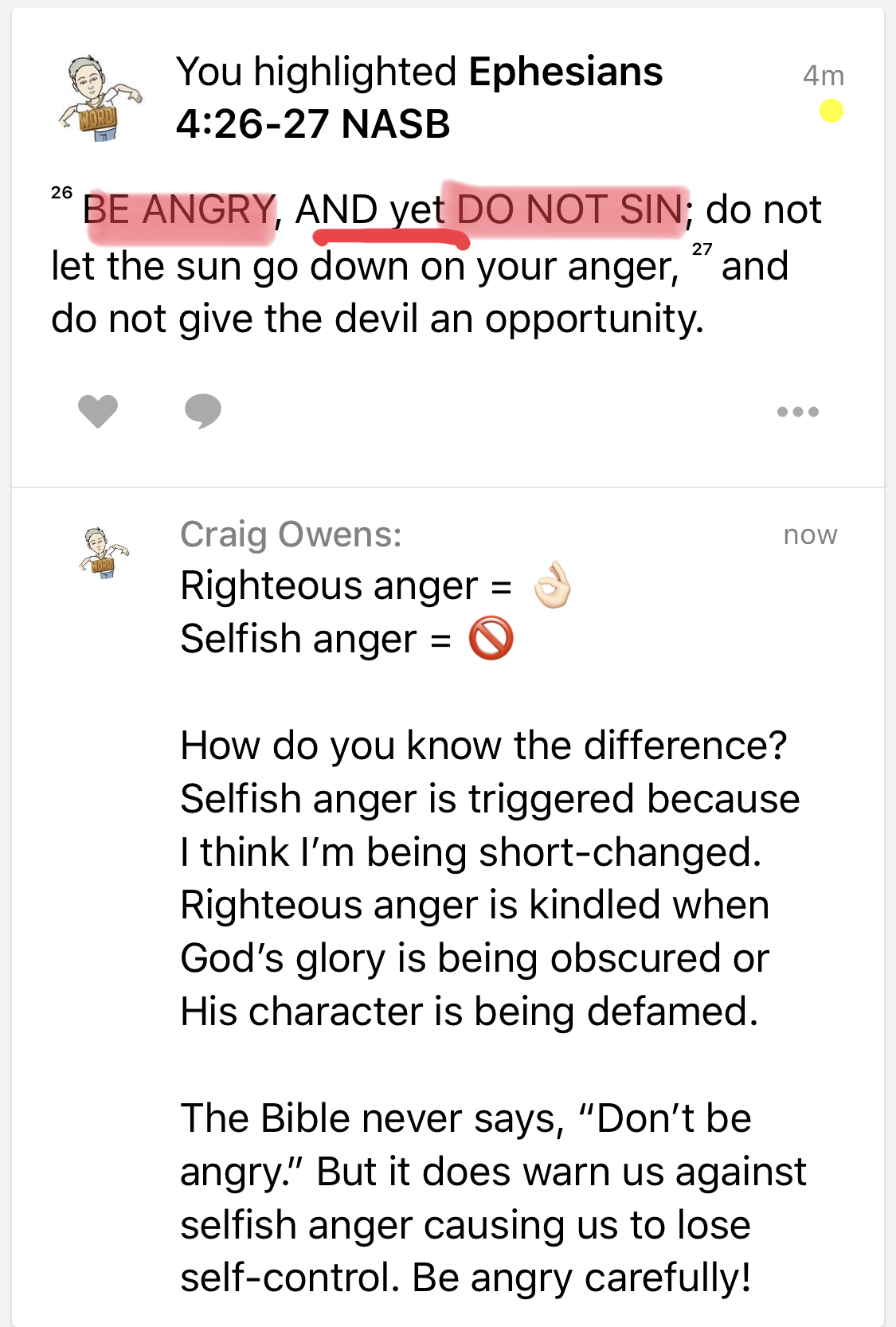
Being angry is not the issue. David said it (and Paul quoted it in Ephesians 4:26): “Be angry; just don’t sin.” God gets angry, but He does not sin. Jesus, in His public ministry, got angry, but He did not sin. We need to search our hearts to make sure our anger has not crossed the line to sin. We have to be angry in a godly way.

I see at least four ways to become angry without crossing the line into sin:

1.  Selfless Anger = anger at sin, but not angry at the sinner.

Love is not rude, it is not self-seeking, it is not easily angered, it keeps no record of wrongs. Love does not delight in evil but rejoices with the truth. (1 Corinthians 13:5, 6)

2.  Slow Anger = lengthen your fuse a bit.

Do not be quickly provoked in your spirit, for anger resides in the lap of fools. (Ecclesiastes 7:9)

My dear brothers, take note of this: Everyone should be quick to listen, slow to speak and slow to become angry, for man’s anger does not bring about the righteous life that God desires. (James 1:19, 20)

Good advice from Thomas Jefferson: “When angry, count to ten before you speak; if very angry, a hundred.”

3.  Protective Anger = when sinners entice others to join them in their sin. God is sad when people leave Him; He is angry at them when they take others with them.

But they put God to the test and rebelled against the Most High; they did not keep His statutes. Like their fathers they were disloyal and faithless, as unreliable as a faulty bow. They angered Him with their high places; they aroused His jealousy with their idols. When God heard them, He was very angry; He rejected Israel completely. (Psalm 78:56-59)

4.  Righteous Anger = against those who are keeping others from coming closer to God.

For I endure scorn for Your sake, and shame covers my face. I am a stranger to my brothers, an alien to my own mother’s sons; for zeal for Your house consumes me, and the insults of those who insult You fall on me. (Psalm 69:7-9)

This verse was recalled by Jesus’ disciples when they saw Him get angry and clear out the Temple in Jerusalem. Jesus was angry because of the religious clutter that was keeping God’s house from being a house of prayer for all nations.

I think everyone is familiar with the acrostic WWJD = What Would Jesus Do?

I’d like to propose something similar: WGGA = Would God Get Angry?

This is a great question to ask to make sure our anger does not cross that line into sin. Get angry—in a godly way—and do not sin.