



You Are My Lamp
October 8, 2013 — Craig T. Owens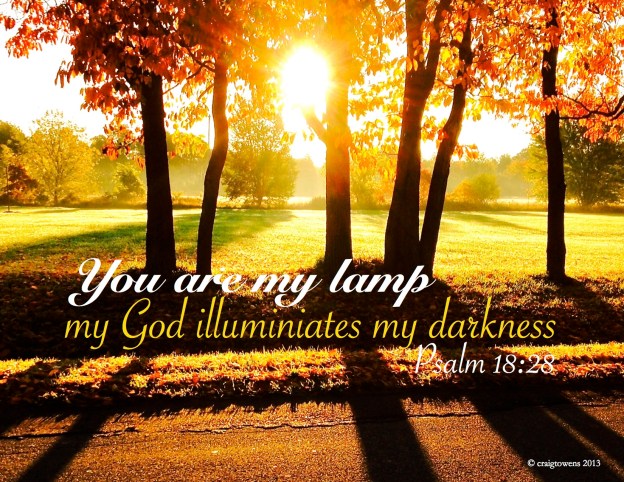 You are my lamp; my God illuminates my darkness. (Psalm 18:28)

Learning & Teaching
August 12, 2013 — Craig T. Owens I’ve been leading my congregation through a spiritual workout from the 119th Psalm. This psalm is unique for a couple of reasons: (1) It’s the longest chapter in the Bible; (2) It’s divided into twenty-two 8-verse segments, with each segment beginning with its own Hebrew letter; and (3) All but four of the 176 verses directly mention God’s Word (using words like command, precept, statues, commands, etc.).
Something else that makes this psalm interesting to study is the Hebrew alphabet itself. In our western world, a letter is just a letter: an L is just an L. But in the Hebrew language, the letters have a name, a meaning, and even a numeric value. So the Hebrew equivalent to our English L is the letter/word lamedh.
Lamedh is the tallest of all the Hebrew letters, so that means it stands out. The section called lamedh in Psalm 119 is one of big proportions. Words like eternal, boundless, established, enduring, and forever are prominent in these eight verses. The psalmist is inviting us to climb up into God’s Word and get a bigger view, a higher vantage point of who God is.
When we are in difficult places, we tend to focus more on our problems, and less on God’s awesomeness. So lamedh is a call to shift our gaze.
But this letter/word also has a definition, and lamedh is a double-edged definition. This word can mean to learn. Indeed, as we gaze upon God’s majesty, we learn so much more about Him! But lamedh also means to teach.
I have found that as I go through difficult times and choose to change my focus from my situation to my Savior, that I learn more about His faithfulness. But at the same time, others are learning from that decision to switch my gaze to God.
So I’ve got one word of advice for you if you feel like your problem is too big and you’re thinking about throwing in the towel: DON’T!!
By focusing on God’s bigness instead of your circumstance, you will learn to grow in faith. And at the same times you will be teaching others to place their faith in God too.
Those who wait on God will soar to new heights!
If you have missed any of the messages in our P119 series, you can access them all by clicking here.
The Highest Good (book review)
July 9, 2013 — Craig T. Owens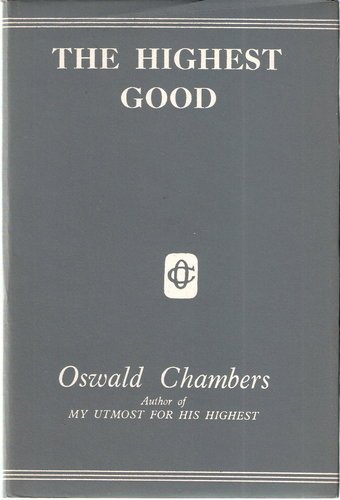 The Highest Good is a collection of three books by Oswald Chambers: The Highest Good, The Pilgrim’s Song Book, and Thy Great Redemption.
The Pilgrim’s Song Book is made up of Chambers’ commentary and insight on the ascension psalms (Psalms 120-128). This is an encouraging study that leads the reader higher and higher into God’s presence, just as the pilgrims climbed the roads to the heights of Jerusalem for the annual worship feasts.
In The Highest Good portion of this collection, I felt like having arrived in “Jerusalem,” I was now receiving a series of thoughtful teachings on Christian ethics which were preparing me for my descent back into my every-day life.
Finally in Thy Great Redemption I am getting ongoing refresher courses on the reality that the redemption of Jesus Christ should make in my life. As Chambers said, “Everything that has been touched by sin and the devil has been redeemed; we are to live in the world immovably banked on that faith.”
As always, the insight of Oswald Chambers is like a graduate level class in theology, philosophy, and ethics. Very few authors expand my biblical paradigm and challenge me to go deeper into God’s Word, so I always highly recommend any Chambers book on which you can get your hands.
Oxymoron
July 8, 2013 — Craig T. Owens No, an oxymoron is not the big oaf sitting next to you! An oxymoron is a literary term where two seemingly contradictory things are put together to make a new item. For instance, jumbo shrimp isn’t something that is big smallness, but a tasty seafood dish. A girl who is awfully pretty isn’t a beautiful jerk, but someone remarkably cute.
I love the oxymoron that appears in the section of Psalm 119 called Teth—good pain. In just eight verses the word good appears six times, right alongside the word afflicted, which appears twice.
How in the world can pain be good?!?
To be sure there is bad pain, but where does good pain come in? Bad pain is the pain that sends you to the doctor, perhaps the pain that means you need to have surgery. There is still pain after the surgery, but that’s a good pain because it reminds you that what was wrong has been fixed. But if what was wrong has now been fixed, wouldn’t we say that the initial pain was really good pain all along?
That’s what the writer of the 119th Psalm thought. He said, “It was good for me to be afflicted so that I might learn Your decrees” (v. 71). Do you see the good pain there? How about in verse 67: “Before I was afflicted I went astray, but now I obey Your Word.”
A 16th-century monk named John of the Cross described good pain this way—
“Thou hast wounded me, oh, hand Divine, in order to heal me, and Thou hast slain in me that which would have slain me but for the life of God wherein now I see that I live.” (emphasis added)
We’re really good at dulling physical pain with aspirin, Motrin and Tylenol. We try to chase away emotional pain with anti-depressants. And, to our own harm, we try to excuse or mask our spiritual pain too. But that spiritual pain is GOOD pain … if we will listen to it.
The psalmist knew good pain that came from the Holy Spirit’s illumination of God’s Word was something to pay attention to and obey quickly. The writer of Hebrews knew it too—
For the Word that God speaks is alive and full of power, making it active, operative, energizing, and effective; it is sharper than any two-edged sword, penetrating to the dividing line of the breath of life (soul) and the immortal spirit, and of joints and marrow of the deepest parts of our nature, exposing and sifting and analyzing and judging the very thoughts and purposes of the heart. (Hebrews 4:12, Amplified Bible)
Don’t ignore that spiritual pain. It’s good pain for those who will listen.
If you have missed any of the messages in our P119 series, you can access them all by clicking here.
Don’t Fake It
February 24, 2011 — Craig T. OwensListen to the podcast of this post by clicking on the player below, and you can also subscribe on Apple, Spotify, or Audible.
 Have you ever had someone tell you, “Fake it until you make it”? In other words, you may not feel happy, but just start smiling and soon you will feel happy. Sadly, I’ve heard this type of so-called wisdom given by Christians to other Christians. Phrases like…
- Don’t let anyone know that you feel scared, doubtful, or angry.
- Never let ‘em see you sweat.
- Even if you’re down, put on a happy face.
Turns out that this is not only bad advice, but harmful advice too. A study done by Michigan State University found:
“Pretending to smile when you’re feeling bad makes you feel worse and be less productive. … [You] can’t just fake a smile and expect to feel good about it or negative feelings intensify.”
If you’re a follower of Jesus Christ, you should never fake it. Take a quick glance through the Psalms and you’ll see raw, real emotions: anger … depression … anxiety … vengeance … sadness … envy … spite … and many others.
Here’s the deal: You may wear a {fake} smile on the outside, but God knows the {real} emotions in your heart. You’re not fooling Him. And, as it’s been revealed in this study, you’re not fooling anyone else either.
So go ahead and vent those negative emotions when you’re alone with God. Tell Him how you really feel (He already knows, but it’s good for you to hear you say it). And then let the Holy Spirit show you how to deal with those emotions in a healthy way.
Don’t bottle it up—don’t fake-it-until-you-make-it—be real and let God heal you.
UPDATE: I talk a lot about dealing with our strong, negative emotions in my book When Sheep Bite.
►► Would you please prayerfully consider supporting this ministry? My Patreon supporters get behind-the-scenes access to exclusive materials. ◀︎◀︎
No Commentary Needed
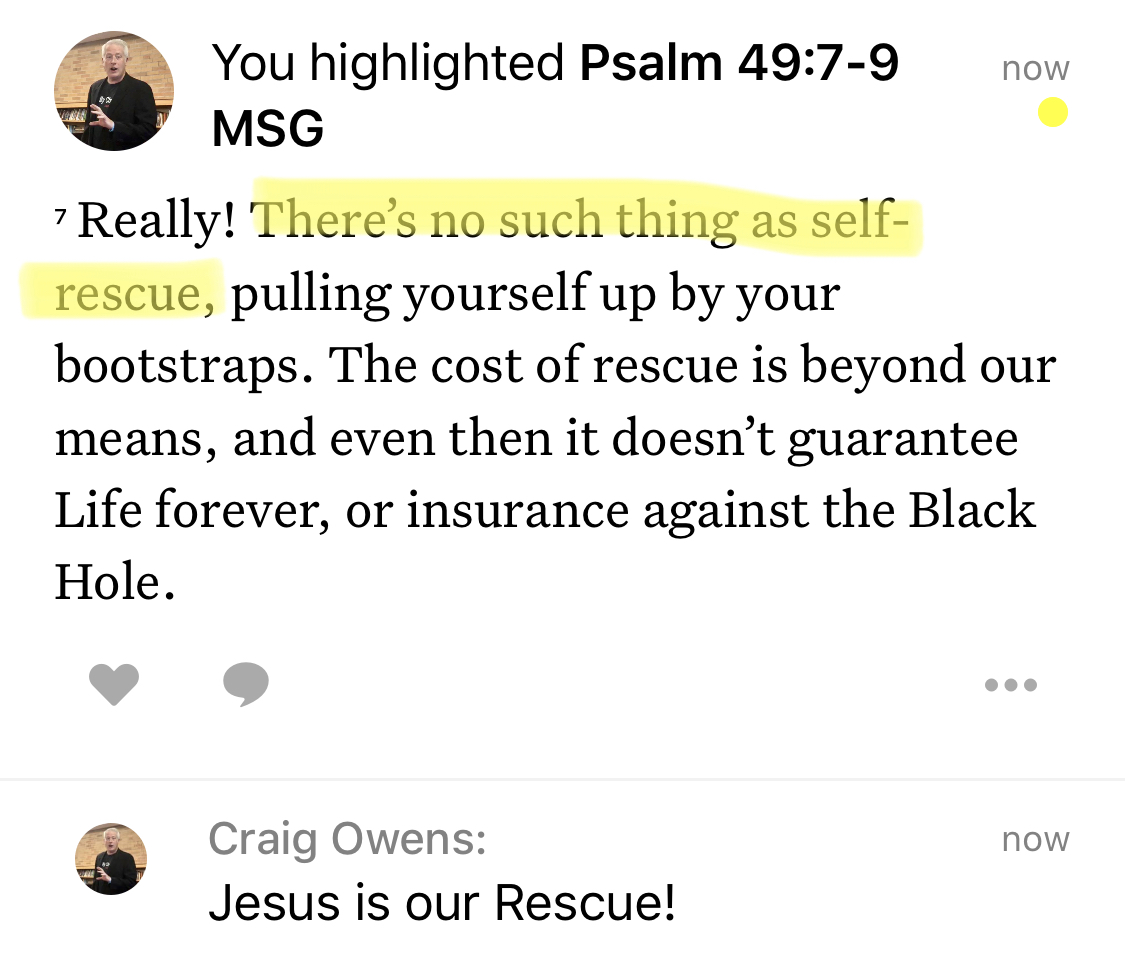
February 8, 2011 — Craig T. OwensSometimes it’s best to just let the Bible speak for itself, without any commentary. This is one of those passages. It comes from Psalm 49, using The Message paraphrase.
Really! There’s no such thing as self-rescue,
pulling yourself up by your bootstraps.
The cost of rescue is beyond our means,
and even then it doesn’t guarantee
Life forever, or insurance
against the Black Hole.Anyone can see that the brightest and best die,
wiped out right along with fools and dunces.
They leave all their prowess behind,
move into their new home, The Coffin,
The cemetery their permanent address.
And to think they named counties after themselves!We aren’t immortal. We don’t last long.
Like our dogs, we age and weaken. And die.This is what happens to those who live for the moment,
who only look out for themselves:
Death herds them like sheep straight to hell;
they disappear down the gullet of the grave;
They waste away to nothing—
nothing left but a marker in a cemetery.
But me? God snatches me from the clutch of death,
He reaches down and grabs me.
Getting Away With Evil?
March 23, 2009 — Craig T. Owens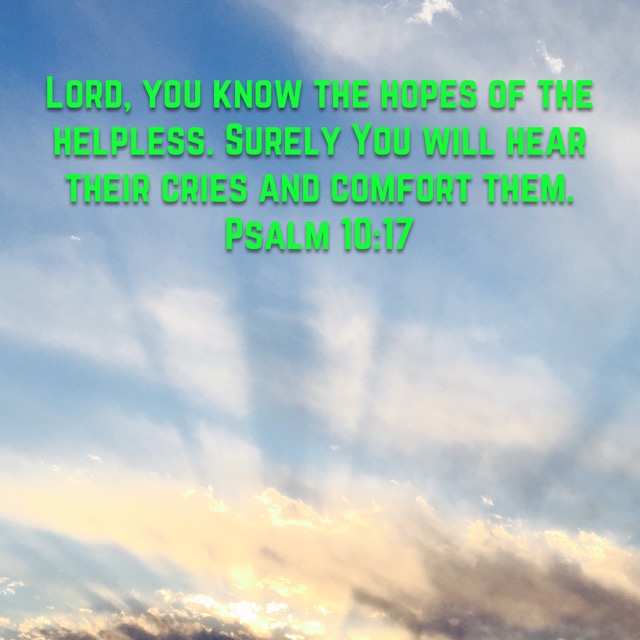 I’ve had some particularly mean and untrue words fired at me recently.
It hurts.
Especially because so many of these barbs have no redemptive quality to them—there is no attempt at even trying to bring about restoration. The statements are intended merely to harm me, not to help me.
During these times I’m especially drawn to the psalms; even more specifically to the psalms written by David.
Psalm 10 captures the emotion I sometimes struggle with when these unwarranted attacks come in. David asks, “Why do these people get away with evil? God, don’t You see what they’re doing? Don’t You hear what they’re saying? How can You let them spew such venom and not bring them to account for it?”
My feelings exactly!
Psalm 10 ends with, “God hears, He is aware, He will defend.”
But I find myself wanting more than that!
Then I noticed the footnote in my NIV Bible. It says that Psalm 9 and 10 form one psalm in the Septuagint (Greek) Bible; that they were originally written as a single poem.
Ah hah!
In Psalm 9, David tells us why he can praise God and rejoice in Him and sing praises to Him:
• God turns back David’s enemies
• God upholds David’s cause
• God judges righteously
• God completely uproots the wicked
• God is a refuge for the oppressed
• God never forsakes those who seek Him
• God avenges
• God does not ignore the cries of the afflicted
• God is known by His justice
• God makes sure the hope of the afflicted never perishes
• God lets men know He is God and they are just men
The wicked may seem to gain the upper hand, but it’s only for a moment. God’s righteousness will always prevail. What a comfort to know God is my Defender!
Why do I need to go through these tough times? Because when (not if!) God delivers me, I can praise Him with even greater zeal! He is exalted even more highly when people see His justice and righteousness.
My friend, if you are going through a battle right now, run to God. Don’t attack your enemies. Let God be God and let Him deal with men in His righteous justice. Praise Him for He will prevail mightily!
My most-viewed posts


 Craig T. Owens