


 Pastors, this is good counsel for all of us…
“Think yourself empty, read yourself full, write yourself clear, pray yourself keen—then enter the pulpit and let yourself go!” —W.H. Griffith Thomas
Pastors, this is good counsel for all of us…
“Think yourself empty, read yourself full, write yourself clear, pray yourself keen—then enter the pulpit and let yourself go!” —W.H. Griffith Thomas
This is a weekly series with things I’m reading and pondering from Oswald Chambers. You can read the original seed thought here, or type “Thursdays With Oswald” in the search box to read more entries.
 Exhausted For God
Jesus said to Peter, ‘Feed My sheep,’ but He gave him nothing to feed them with. The process of being made broken bread and poured out wine means that you have to be the nourishment for other souls until they learn to feed on God. They must drain you to the dregs. Be careful that you get your supply, or before long you will be utterly exhausted. Before other souls learn to draw on the life of the Lord Jesus direct, they have to draw on it through you; you have to be literally ‘sucked,’ until they learn to take their nourishment from God. We owe it to God to be our best for His lambs and His sheep as well as for Himself.
Has the way in which you have been serving God betrayed you into exhaustion? If so, then rally your affections. Where did you start the service from? From your own sympathy or from the basis of the Redemption of Jesus Christ? Continually go back to the foundation of your affections and recollect where the source of power is. You have no right to say, ‘O Lord, I am so exhausted.’ He saved and sanctified you in order to exhaust you. Be exhausted for God, but remember that your supply comes from Him. ‘All my fresh springs shall be in Thee.’
From My Utmost For His Highest
He saved and sanctified you in order to exhaust you. I want to be continually filled up and poured out for God. But in order to be of any good to others, I have to keep going back to the Source of life. If I’m not filled up with God’s presence, I will be exhausted, but not in the right way.
I have shared quite a bit about the correct way for godly leaders to be replenished through self-care. Check out these posts.
 Sometimes what needs to go on my To Do list seems logical. But logical to whom? If I’m not careful I can get so focused on doing the next logical thing, that I miss out on the Holy Spirit’s guidance.
Bruce Wilkinson said it this way—
“If we aren’t passionately and deliberately focused on carrying out God’s agenda with God’s heart, we’ll end up putting our own agenda first. We’ll increasingly look for the kind of missions we enjoy most. We’ll tend to ask God to bless our busyness for Him instead of asking Him to send us on the miracle mission of His choice.”
Ouch!
I don’t think the Bible is against To Do lists, but I need to make my lists the right way.
Instead, you ought to say, “If it is the Lord’s will, we will live and do this or that.” (James 4:15)
Your kingdom come, Your will be done on earth as it is in heaven. (Matthew 6:10)
With those verses in mind, this is what I’m praying:
I am trying to Live Dead to my agenda this week.
If you’ve missed any messages in our series called Live Dead, you can find them all by clicking here.
 Pastors, I wrote earlier about the idea that you have to preach your message to yourself before you preach it you’re your congregation. But I want to back up a step to the motivation for that.
These words from William Law are challenging—
“The first business of a clergyman awakened by God into a sensibility and love of the truths of the Gospel, and of making them equally felt and loved by others, is to thankfully, joyfully, and calmly adhere to and give way to the increase of this new-risen light, and by true introversion of his heart to God, as the sole Author of it, humbly beg of Him that all that he feels a desire of doing to those under his care may be first truly and fully done in himself.”
God, if You want to do something in my congregation, start it with me. Right here, right now, in the privacy of my study, begin with me. When I come before my congregation this weekend, may my life be the example of the work You want to do in us all.
 Have you ever heard someone that can pray really well? And then isn’t it a bit intimidating when you’re asked to pray right after that master pray-er?
Or maybe you hear about people that spend extended time praying. But you think, “I run out of things to say after just a few minutes,” or “I get so distracted when I’m trying to pray.”
Here’s a thought from Mark Batterson’s book The Circle Maker which may help you—
“Prayer was never meant to be a monologue; it was meant to be a dialogue. Think of Scripture as God’s part of the script; prayer is our part. Scripture is God’s way of initiating a conversation; prayer is our response. The paradigm shift happens when you realize that the Bible wasn’t meant to be read through; the Bible was meant to be prayed through. And if you pray through it, you’ll never run out of things to talk about.”
Think about it this way. If you are a parent, doesn’t it get your attention when your child says, “Dad, you said…”? I know that makes my ears perk up. It’s the same way when we use Scripture to pray. It’s like saying to God, “Dad, you said….”
Praying Scripture also helps you personalize the promises you come across. Whether you need courage, health, money, wisdom, protection, or anything else, there is a promise in the Bible that you can pray to God.
As Mark said, don’t just read through your Bible, pray through your Bible!
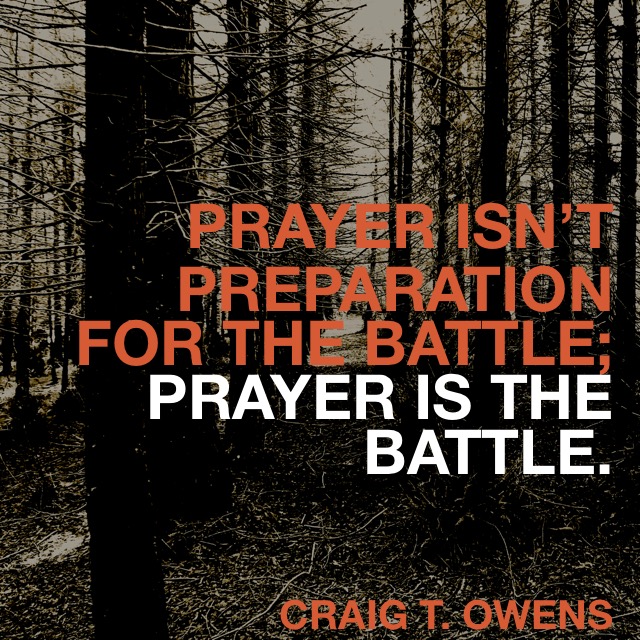 A challenging quote from Oswald Chambers—
“We have to treat the body as the servant of Jesus Christ: when the body says ‘Sit,’ and He says ‘Go,’ go! When the body says ‘Eat,’ and He says ‘Fast,’ fast! When the body says ‘Yawn,’ and He says ‘Pray,’ pray!”
I do not run like a man running aimlessly; I do not fight like a man beating the air. No, I beat my body and make it my slave so that after I have preached to others, I myself will not be disqualified for the prize. (1 Corinthians 9:26-27)
Wow! Time for me to redouble my efforts to Go, Fast, and Pray.
 We wrapped up our series on The Danger Of Prayerlessness by looking at a very innocent thing: just doing what seems the natural thing to do.
In Luke 18, Jesus told a story about a persistent widow who would not stop approaching a judge to get justice. She had been wronged, but she didn’t take matters into her own hands, nor did she get tired of asking the judge for help. Either of these responses would have been very natural responses. But that’s the point: they would be natural, and not spiritual; they would depend on us, and not on God.
Luke introduces this story like this: Jesus told His disciples a parable to show them that they should always pray and not give up (Luke 18:1).
The word for give up is one that means to slide back to the natural way of doing, feeling or acting. In other words, to handle things like we always have before. But Jesus said there was a better way: keep taking your request to our Heavenly Father.
Prayer overcomes the “gravitational pull” of my natural tendencies to do things on my own. Prayer is the rocket fuel to help me break free!
Do not fret or have any anxiety about anything, but in EVERY circumstance and in EVERYthing, by prayer and petition (definite requests), with thanksgiving, continue to make your wants known to God. (Philippians 4:6 AMP)
Don’t get pulled back down. Instead always pray and never, ever give up! Let your prayers take you higher and higher!
 It’s a lot of work preparing a sermon (and even that is a major understatement!). So if we pastors are going to put all of this effort in, isn’t it right to believe for a great return on that investment?
I’ve got good news and bad news for you—and they’re both the same. Pastor, after all of your hard work preparing your message, there is only one thing you can do: pray.
Sounds simple, right? But if it’s so simple, why are so many church attendees unmoved by the sermons they hear each Sunday (check out this Barna report)?
Here is some good counsel of how we should pray—
“Of what efficacy would be the exterior word of pastors, or even the Scriptures themselves, if we had not within the word of the Holy Spirit giving to the others all their vitality? The outward word, even of the Gospel, without the fecundating, vivifying, interior word would be but an empty sound. ‘It is the letter alone that kills (2 Corinthians 3:6), and the Spirit alone can give us life.’” —Francois Fenelon
“Does anyone of us desire to help the Church of Christ? Then let him pray for a great outpouring of the Spirit. Only the Holy Spirit can give edge to sermons, and point to advice, and power to rebukes, and can cast down the high walls of sinful hearts. It is not better preaching, and finer writing that is needed in this day—but more of the presence of the Holy Spirit.” —J.C. Ryle
If I can add my two cents’ worth to these eminent theologians:
And then watch what the Holy Spirit does with your sermon!
 Yesterday I posted the following on Facebook, which generated quite a few positive responses—
“God may not recall the soldier from the battle, but if He gives him a greater stomach for the fight, and increased strength for its toils, it may be better still for him” (Spurgeon). Think about it: If God has left you in the battle, He will give you the strength to be victorious. Either way, you come out stronger AND God is glorified!
Since several commented on Facebook or emailed or texted me with words like, “That’s just what I needed to hear right now,” I thought I would add a couple additional thoughts for you.
“Let’s be honest, 90% of our prayers revolve around personal comfort, not God’s glory. Too often we try to pray away every problem. But what if that is the very thing that God wants to leverage for His glory? Let’s not be too quick to pray away the pain, the suffering, the situation, the problem. Let’s not just pray ‘get me out’ prayers. We sometimes need to pray ‘get me through’ prayers.
“We need a paradigm-shift in our prayer lives. It’s not about us. It’s all about God. And when you begin to pray for God’s glory above and beyond everything else it’s a game changer! You no longer pray away every problem. You pray through the problem. You know that God might do a miracle, but that isn’t the goal. The goal is God’s glory. And if suffering with grace yields more glory to God then so be it.” —Mark Batterson, in The Circle Maker
And finally, this prayer thought—
“Do not pray for easy lives; pray to be stronger men. Do not pray for tasks equal to your powers; pray for powers equal to your tasks. Then the doing of your work shall be no miracle; but you shall be a miracle.” —Phillips Brooks
If you need someone to stand with you as you “pray through” your battle, let me know. I would be honored to join my prayers with yours.
 Jesus has some pointed words for us in Matthew 5—
Therefore, if you are offering your gift at the altar and there remember that your brother has something against you, leave your gift there in front of the altar. First go and be reconciled to your brother; then come and offer your gift. (vv. 23-24)
Notice that Jesus says that your brother has something against you. Since the first word of this verse is therefore, we have to back up a couple of verses to get the context. In the preceding two verses Jesus talks to us about our anger, our harsh words, and our rash judgments leveled at others. In other words, things we have done to others which has made them upset at us.
In our prayer time, the Holy Spirit will help us remember what we have done. Now what are you going to do about it? Excuse it? Justify it? Or will you rectify it? Will you be obedient to go and make it right?
Until we do, we’re keeping our offended brother or sister in bondage to us. But as soon as we ask forgiveness, we set them free.
I love what C.S. Lewis said about recognizing where we may have offended someone—
“When I come to my evening prayers and try to reckon up the sins of the day, nine times out of ten the most obvious one is some sin against charity; I have sulked or snapped or sneered or snubbed or stormed. And the excuse that immediately springs to mind is that the provocation was so sudden or unexpected. I was caught off my guard, I had not time to collect myself…. Surely what a man does when he is taken off guard is the best evidence of what sort of man he is. Surely what pops out before the man has time to put on a disguise is the truth. If there are rats in the cellar you are most likely to see them if you go in very suddenly. But the suddenness did not create the rats; it only prevents them from hiding. In the same way the suddenness of the provocation does not make me an ill-tempered man: it only shows what an ill-tempered man I am.”
When the Holy Spirit shows you the rats in your cellar—when He helps you remember how your ratty words or behavior hurt someone else—take care of it immediately! It’s the fastest way to freedom!
I will be speaking on The Danger Of Prayerlessness again next Sunday. I hope you can join me.


 Craig T. Owens