7 Quotes From “Discipleship In Crisis”

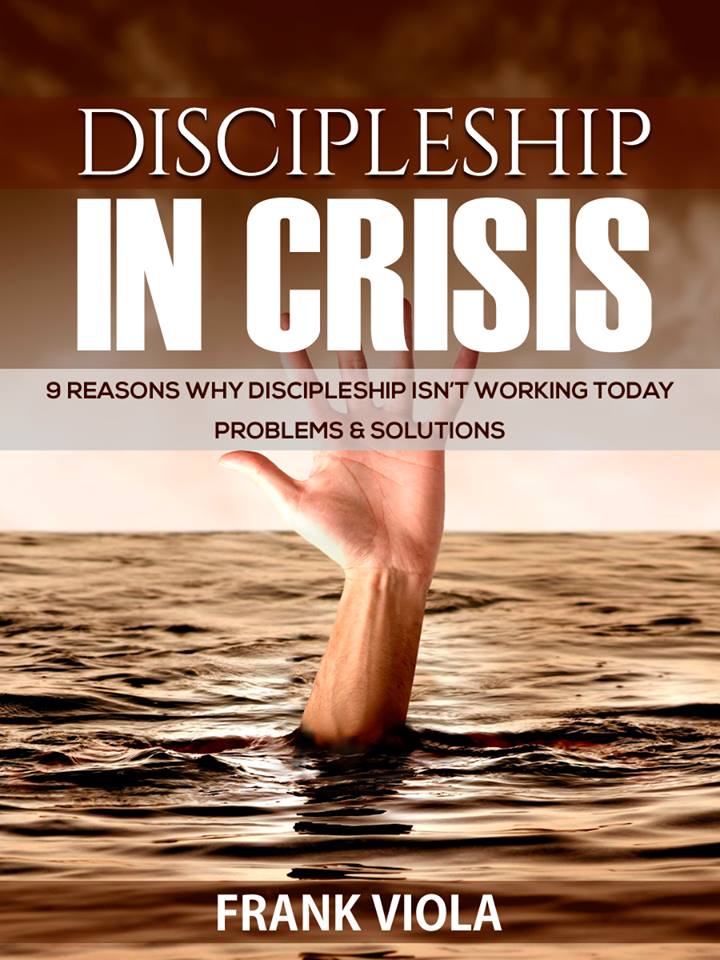
Discipleship In CrisisCheck out my review of Discipleship In Crisis by Frank Viola by clicking here. Below are a few quotes which I found especially highlighter worthy.

“The presupposition that sits underneath virtually every sermon heralded today and most of the Christian books that fill bookstores is that we can live the Christian life if we just try hard enough. If we study our Bible more, pray more, witness more, tithe more, hear more sermons… then we can be like Jesus. But that’s not the gospel. The gospel teaches that just as Jesus couldn’t do anything of Himself, we can’t do anything of ourselves. Listen to the Lord again: ‘Without Me you can do nothing.’ The Christian life is impossible. It’s only Him-possible.” 

“The goal of the gospel is not to get you out of hell and into Heaven, but to get God out of Heaven and into you.”

“A person who is living by the tree of life doesn’t sit back and say, ‘Let me try to do good and avoid evil.’ Instead, he allows the life of God to flow with in and through him. He yields to the instincts, promptings, and energy of that God-life. … You see, ‘good’ is a form of life. And only God is good. Here are the two choices before you today: (1) The choice to intellectually know good from evil and to try to do good = the tree of the knowledge of good and evil; (2) Living by the life of God, which is goodness itself = the tree of life.”

“The only way you and I can truly imitate Jesus’ external lifestyle is to imitate His internal relationship with His Father.”

“What history teaches us is that men have never learned anything from it.” —G.W.F. Hegel

“In a word, you cannot raise the bar on discipleship without raising the bar on the ekklesia—the living experience of the body of Christ—the native habitat in which true disciple-making and transformation take place.”

“The New Testament talks about spiritual seeing, spiritual touching, spiritual tasting, spiritual handling, and spiritual healing. These are the faculties of your Spirit-regenerated human spirit. Jesus was very much in touch with His spiritual instincts, and hence, He ‘perceived’ things ‘in His spirit’ that were outside natural means. He did this as a man anointed by the Holy Spirit, not because He was God.”


Joni On Suffering

Finding GodIf anyone understands suffering, it would be Joni Eareckson Tada. She is paralyzed from the chest down, due to a diving accident she suffered as a teenager. For the past 40+ years she has relied on her husband and others to help her with most of her daily tasks. Yet none of this has slowed down her world-wide ministry, nor has it dampened her trust in God.

I recently read her book Finding God In Hidden Places (you can read my book review by clicking here). These are some quotes about suffering that Joni has learned firsthand.

“Some refuse to believe it. Surely, if we hate suffering, God must hate it worse and could never have founded an institution as horrible as hell. But the same Jesus who gave heaven a five-star rating also described an otherworldly chamber of horrors. ‘[Hell] has long been prepared; it has been made ready… its fire pit has been made deep and wide… the breath of the Lord, like a stream of burning sulphur, sets it ablaze’ (Isaiah 30:33). Stop and listen. Do you feel the rattling? The down-deep rumbling of something gone haywire? Had the Bible not told us otherwise, we might think this life was the only life there is. We’d continue to arrange our days as though rearranging deck chairs on the Titanic. We’d clink our brandy glasses and toast our fate, as though we were only facing a soul-sleep—a dull, gray existence without God, who, as a matter of fact, was a bit of a bore on earth anyway. Don’t misunderstand. God didn’t make hell for people. Jesus said it was ‘prepared for the devil and his angels’ (Matthew 25:41). It’s unnatural for humans to be there—as unnatural as turning our backs on a Creator who loves us. As unseemly as shrugging off the Father’s kind arm while we caress Eden’s serpent, coiled around our hearts. No. God takes no joy in anyone heading for eternal misery. And His Son is the lifeboat—big enough and wide enough to rescue all of the perishing.”

“I was collapsing from a time of interior questioning. Suffering does this. It forces us to be utterly alone with ourselves. Once sequestered, suffering is what tests us most as persons. It examines us, sifting and asking, ‘Who are you, really?’ … Suffering, then, can be our friend. … Suffering goes below the surface, sandblasting us to the core. It brings us into a new relationship with ourselves. It also brings us into a new relationship with God. When pain and problems press us up against a holy God, guess what goes first? You’ve got it. The selfishness that pain unmasks. The pride and pettiness that problems reveal. … The beauty of being stripped down to the basics is that God can then fill us up with Himself. It’s not just that sin is removed; the saint is built up: ‘Christ in you, the hope of glory’ (Colossians 1:27). Think of the Father’s joy when He sees Christ in you. Nothing pleases Him more. When the soul empties itself of pride and pettiness, Christ fills it up. It’s just another way of saying, ‘You died, and your life is now hidden with Christ in God’ (Colossians 3:3). Suffering doesn’t teach me about myself from a textbook; it teaches me from my heart.”

If you would like to check out some other quotes from this book, please click here.

Thursdays With Oswald—Heaven & Hell

This is a weekly series with things I’m reading and pondering from Oswald Chambers. You can read the original seed thought here, or type “Thursdays With Oswald” in the search box to read more entries.

Heaven & Hell

     Hell is the place of angelic condemnation. It has nothing to do primarily with man. God’s Book never says that Hell was made for man, although it is true that it is the only place for the man who rejects God’s salvation. Hell was the result of a distinct condemnation passed by God on celestial beings, and is as eternal as those celestial anarchists. 

From Biblical Psychology

Jesus makes it quite clear that Heaven is my home— “…take your inheritance, the kingdom prepared for you since the creation of the world” (Matthew 25:34).

He makes it equally as clear that Hell was not made for mankind— “…the eternal fire prepared for the devil and his angels (Matthew 25:41).

Furthermore, Jesus is completely clear that He is the only way to Heaven, and that the rejection of the forgiveness that is possible by accepting His atonement on the Cross leaves only one destination for the unforgiven: Hell.

This is an important reminder. It reawakens me to be persistent in telling others this truth about Heaven and Hell.

Rescue those who are unjustly sentenced to die; save them as they stagger to their death. Don’t excuse yourself by saying, “Look, we didn’t know.” For God understands all hearts, and He sees you. He who guards your soul knows you knew. He will repay all people as their actions deserve. (Proverbs 24:11-12)

And you must show mercy to those whose faith is wavering. Rescue others by snatching them from the flames of judgment. Show mercy to still others, but do so with great caution, hating the sins that contaminate their lives. (Jude 22-23)

Revelation Or Speculation

In answering questions that have been submitted for The Q Series, I noticed a recurring trend: How much of our “conventional thought” in church circles is not revelation, but speculation.

Yesterday I had some tough questions on Heaven, Hell, suicide, our resurrected bodies, the after-life, and so on. In answering these questions, I used many passages from the Bible, but I also quoted from Charles Spurgeon, Charles Dickens, and C.S. Lewis. There’s nothing wrong, per se, with quoting from extra-biblical sources, but we have to be very careful what we do with those.

I once heard renowned evangelist C.M. Ward say something like this:

“The Word of God is completely good; you can devour all of it. But reading anything else is like eating chicken. There is some meat that’s good, and there are some bones, and gristle, and fat that you should spit out. Be very careful of what you take in, unless it is the pure Word of God.”

The Bible reveals so much for our lives, and we put ourselves in a place God can bless us when we are obedient to the revelation of His Word. But we put ourselves on shaky ground when we live by speculation of what we think may be truth.

The Apostle Peter said it this way:

For no prophecy ever originated because some man willed it [to do so — it never came by human impulse], but men spoke from God who were borne along (moved and impelled) by the Holy Spirit. (2 Peter 1:21 AMP)

So whether you are looking for an answer yourself—or you are asking someone for an answer—make sure you are getting revelation from God’s Word, and not the speculation of man’s opinion.

Check out other questions in our Q Series by clicking here.

My People

The prophet Jeremiah is often called “the weeping prophet.” Perhaps if we wept a bit more over the lost souls who are staggering toward Hell, we would be compelled to do more to rescue them.

What I love about Jeremiah is his identification with lost humanity. God called Jeremiah to be His prophet, so if anyone could have the opportunity to feel special or superior, it might be Jeremiah. But when the prophet heard about the approaching judgment, he called the residents of Jerusalem my people. Did you get that: MY people.

Not only did he call them my people, but his heart broke for them:

  • My heart is faint within me (Jeremiah 8:18)
  • I am crushed (8:21)
  • I mourn … horror grips me (8:21)
  • I weep day and night (9:1)
  • I weep and wail and take up a lament (9:10)

In Soul Work, Randy Harris has a passage that has been pounding on my heart—

Why don’t we cancel all those [church] meetings and make a field trip to the laundromat and the bars and the streets and listen to what makes sinners tick until we love them. I don’t mean try to convert anybody; I mean listen to them until we love them. Listen until we find ourselves in them. Listen to what they’re afraid of, listen to what they hope for, listen to what hurts, until we love them. And then we can try to be the church again. (emphasis added)

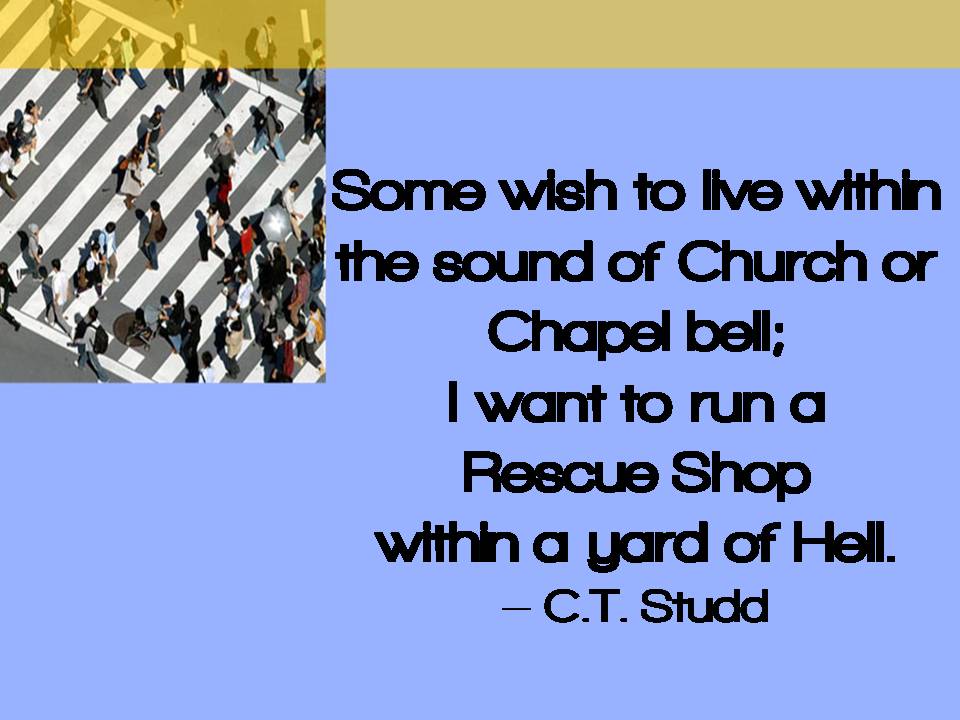
Or as C.T. Studd famously said:

“Some wish to live within the sound of Church or Chapel bell;

I want to run a Rescue Shop within a yard of Hell.”

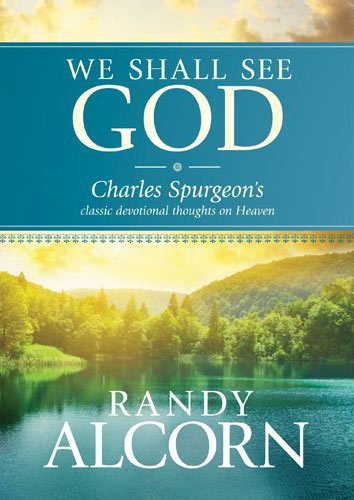
We Shall See God (book review)

It wasn’t for nothing that Charles Spurgeon was called “the prince of preachers.” In We Shall See God by Randy Alcorn, you can get a taste of Spurgeon’s eloquence, and of Heaven’s majesty.

We Shall See God is a collection of Spurgeon’s sermons about Heaven. Randy Alcorn has done a masterful job of culling through the prince’s sermons to pull out excerpts that talk about the beauty of Heaven and the horrors of Hell. Randy’s comments following each passage from Spurgeon are wonderfully presented. He doesn’t “talk over” Spurgeon, nor does he simply rehash what Spurgeon already said. He eloquently amplifies or briefly explains.

This book is designed to be used as a 50-day devotional reading. But I’ll be honest with you: I couldn’t put it down! I was so enthralled by Spurgeon’s description of Heaven, that I couldn’t wait to read more. And now I can’t wait to tell others more about Heaven.

Lately there have been so many authors and blogger hypothesizing about Heaven and Hell and the after-life. But Spurgeon doesn’t give us his opinion, he gives us biblical insight. And wouldn’t you much rather hear what the Creator of Heaven has to say about it, than what any mere mortal has to say?

I highly recommend this book to you. You will not only look forward to Heaven even more, but you will enjoy your brief journey on this Earth even more too.

I am a Tyndale book reviewer.