Thursdays With Oswald—A New Look At Some Old Bible Studies

This is a weekly series with things I’m reading and pondering from Oswald Chambers. You can read the original seed thought here, or type “Thursdays With Oswald” in the search box to read more entries.

A New Look At Some Old Bible Studies

     It is important to notice the difference between the Wisdom of the Hebrews and the Wisdom of the Greeks. The Wisdom of the Hebrews is based on an accepted belief in God; that is, it does not try to find out whether or not God exists, all its beliefs are based on God, and in the actual world of things as they are, all its mental energy is bent on practical living. The Wisdom of the Greeks, which is the wisdom of our day, is speculative; that is, it is concerned with the origin of things, with the riddle of the universe, etc., consequently the best of our wits is not given it to practical living.

     The value of the Book of Job is not in what it teaches, but that it expresses suffering, and the inscrutability of suffering. In the Book of Psalms, Wisdom is applied to things as they are and to prayer. The Book of Proverbs applies Wisdom to the practical relationships of life, and Ecclesiastes applies Wisdom to the enjoyment of things as they actually are; there is no phase of life missed out, and it is shown that enjoyment is only possible by being related to God. 

     The record of the whirl of things as they are is marvelously stated in these books of Wisdom: Job—how to suffer; Psalms—how to pray; Proverbs—how to act; Ecclesiastes—how to enjoy; Song of Solomon—how to love. … 

     Solomon sums up the whole thing as follows: If you try to find enjoyment in this order of things, you will end in vexation and disaster. If you try to find enjoyment in knowledge, you only increase your capacity for sorrow and agony and distress. The only way you can find relief and the right interpretation of things as they are it is by basing your faith in God, and by remembering that man’s chief end is to glorify God and enjoy Him forever. Jesus Christ is the One Who can transmute everything we come across.

From Shade Of His Hand

Sometimes the “wisdom” books of the Bible can be difficult to understand in our modern day, Western culture. But perhaps you may be able to read them differently with these insights that Oswald Chambers shares.

Why not try giving a new look at some old Bible studies, and then comment below on how it worked for you.
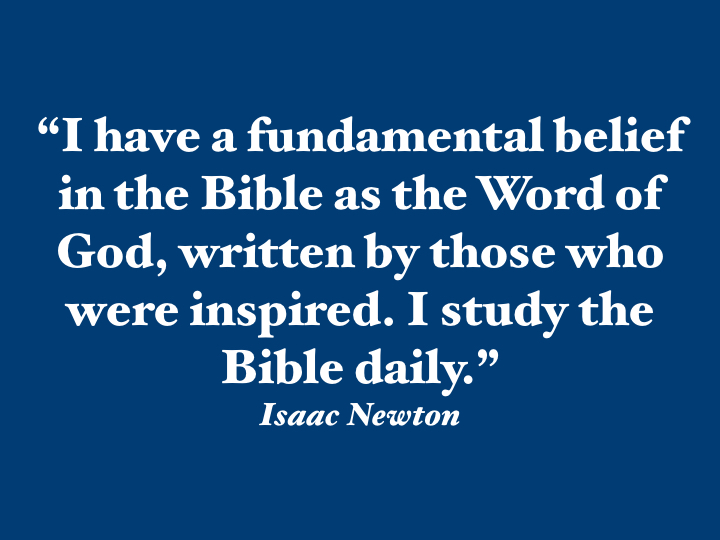
4 Terrible Ways & 4 Great Ways To Study Your Bible

Isaac Newton Bible study.001There are two Greek words in the New Testament that have to do with trying to figure things out. One of them leads to less knowledge, and one opens the way for greater learning. Not surprisingly, Jesus never used the first way, but He confronts people who try to.

The first Greek word is defined as learning through self-calculation. In other words, I try to get at the right answer by either teaching myself, or by talking with people who don’t know any more than I do. This way leaves me in the dark.

For example, notice the phrase “discussed among themselves” in Matthew 16:7 and Mark 11:31. These are people who wanted to try to get answers without going to someone who could teach them. So that leads to four terrible ways to study your Bible—

  1. Approach your Bible with a know-it-all attitude.
  2. Try to figure out what the Bible is saying all on your own.
  3. Try to be your own Bible teacher.
  4. Grade your own tests as to your answers being right or wrong.

These are not only terrible ways to learn, but they are the exact opposite of what God desires. God says things like, “Come, let us reason together” (Isaiah 1:18), and “Call to Me and I will tell you things you do not know” (Jeremiah 33:3).

There is another Greek word which means to learn by having a conversation with someone more knowledgable than myself. So that means four great ways to study your Bible are—

  1. Ask the Holy Spirit to illuminate Scripture to you (John 16:13).
  2. Study the Bible in a daily systematic way (Acts 19:9).
  3. Don’t take anyone else’s word for what the Word says (Acts 17:11).
  4. If you’re confused, ask God to make it clear to you (Jeremiah 33:3).

Luke records an important story for us that took place on the day Jesus was raised from the dead. Two men were walking along “discussing these things with each other,” but not consulting the Scriptures. The result: they were sad and confused. Jesus join them on their journey (although they didn’t recognize Him at first), and took them to the Scriptures that showed them the answers for which they were yearning. They even said, “When He talked to us from the Scriptures, that’s when our hearts burned within us!” (see Luke 24:13-32).

You can try to figure life out on your own, and you will probably end up stymied like the religious leaders in Mark 11, or downcast like the disciples in Luke 24. Or you can ask the Holy Spirit to show you truths from the Scriptures, and have your eyes opened, like the two disciples after Jesus met with them. I think the choice is obvious!

Join me next week as we continue our series How To Study Your Bible.

Links & Quotes

link quote

“The world has put a little letter before the word ‘musing,’ and these are the days, not for musing, but for a-musing. People will go anywhere for amusement; but to muse is a strange thing to them, and they think it dull and wearisome. … Now there is much virtue in musing, especially if we muse upon the best, the highest, and the noblest of subjects. If we muse upon the things of which we hear and read in sacred Scripture, we shall do wisely. It is well to muse upon the things of God, because we thus get the real nutriment out of them. A man who hears many sermons, is not necessarily well-instructed in the faith. We may read so many religious books, that we overload our brains, and they may be unable to work under the weight of the great mass of paper and printer’s ink. The man who reads but one book, and that book his Bible, and then muses much upon it, will be a better scholar in Christ’s school than he who merely reads hundreds of books, and muses not at all.” —Charles Spurgeon

“Patients do not serve their physicians. They trust them for good prescriptions. The Sermon on the Mount is our Doctor’s medical advice, not our Employer’s job description.” —John Piper

“Every time I open my Bible I will read it as the Word of ‘God, that cannot lie;’ and when I get a promise or a threatening, I will either rejoice or tremble because I know that these stand fast.” —Charles Spurgeon

I can use this: 25 habits to get a better night’s sleep.

Rev. Tim Dilena has an amazing reminder of God’s perfect timing in sending Jesus to earth—He Couldn’t Have Timed It Any Better.

“Given the Greek and Roman acceptance of homosexuality, it is difficult to overstate the courage and conviction required by the early Church to write and speak out on behalf of a biblical, sexual ethic.” Read more in the article When Christians Rejected Homosexuality.

Eric Metaxas shares some good news from Baltimore.

Quotes From “No Idols”

No idolsAs requested, here are the quotes I shared in my message this morning…

“In Greek the word idol has in it the sense of unreality. Plato used it for the illusions of this world as opposed to the unchangeable realities of eternity.” —William Barclay

“What we think and believe, we are; not what we say we think and believe, but what we really do think and believe, we are; there is no divorce at all.” —Oswald Chambers 

“Until the love of God that knows no boundary, limit, or breaking point is internalized through personal decision; until the furious longing of God seizes the imagination; until the heart is conjoined to the mind through sheer grace, nothing happens. The idolatry of ideas has left me puffed up, narrow-minded, and intolerant of any idea that does not coincide with mine.” —Brennan Manning

No Puffiness, Please

Here’s a quick fill-in-the-blank statement:

Now about ______________________: We know that we all possess knowledge. Knowledge puffs up, but love builds up. (1 Corinthians 8:1)

Fill in this blank with something you consider (as Dr. Charles Ryrie calls them) a “morally indifferent” practice. In other words, something that is not a black-in-white, do-it-and-you’re-sinning issue. What goes in your blank?

  • …skipping church?
  • …drinking alcohol?
  • …smoking a cigar?
  • …dancing?

We all have knowledge about such things, but where’s the love?

Love builds up. Knowledge only benefits me; love benefits all. The Amplified Bible says it this way, “love edifies and builds up and encourages one to grow to his full stature.

The Greek word for builds up means “to promote growth in Christian wisdom, affection, grace, virtue, holiness, blessedness; to grow in wisdom and piety.”

The question, “Does this fill-in-the-blank item hinder a weaker brother?” is too puffy. The better question is, “Does this help my weaker brother grow?”

That’s the question love asks.

Love avoids the negative-growth items and even the neutral-growth items. Love seeks only those things which promote positive growth.

It’s too puffy to ask, “Does this hurt someone.”

It’s too puffy to say, “This is no big deal!”

We need to ask, “Does this help everyone?” If we can’t answer “yes,” leave it alone!

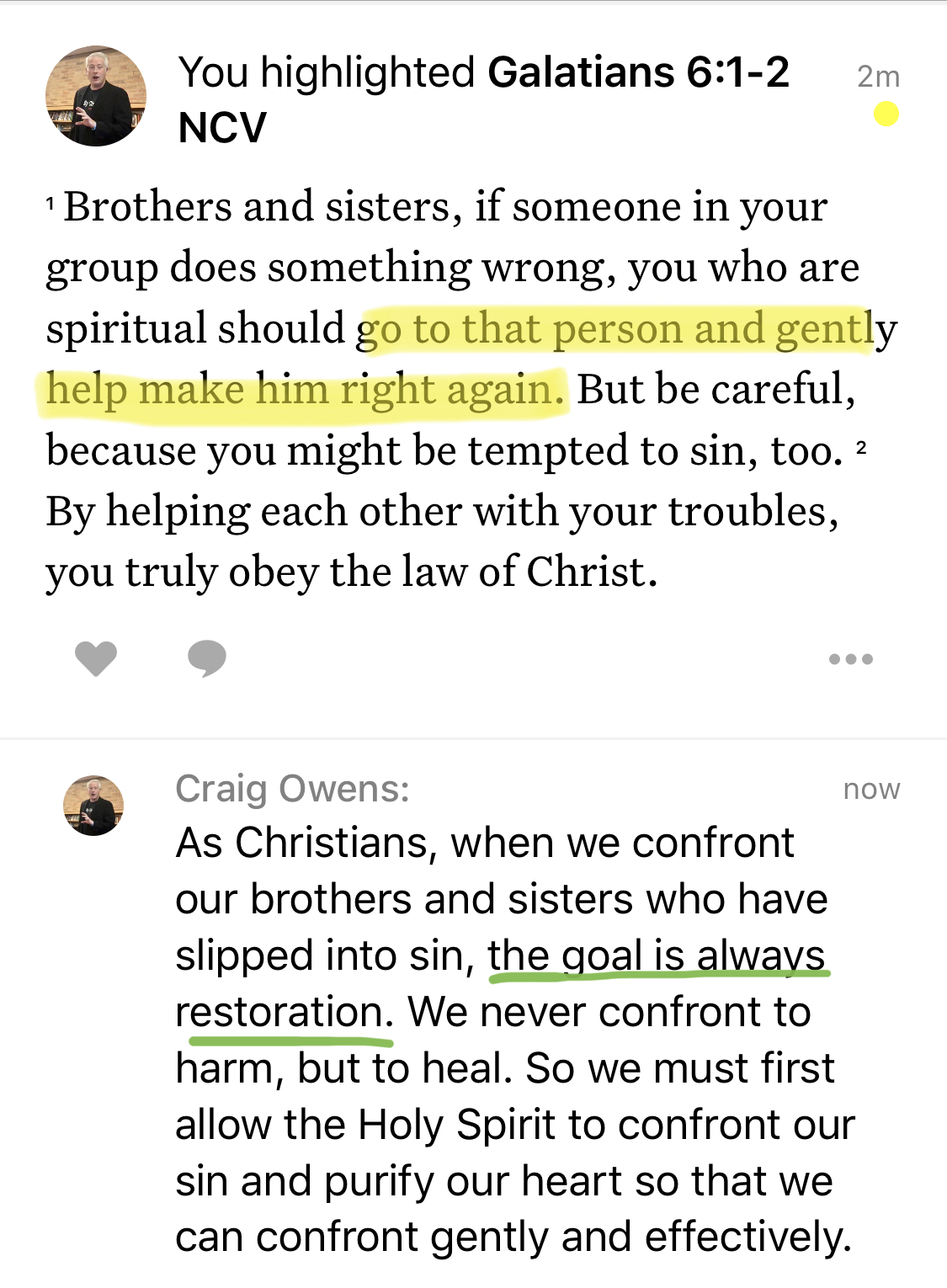
Gentle Restoration

I’m struggling with this one. I have a dear friend who is perplexed by an ongoing drug addiction. He appeared to have it under control until things in his life started spiraling out of his control, and he gave in to his old habit again.

So the Bible says that if one of my brothers slips up I’m supposed to restore him gently. How exactly does one do that? I bounced between so many emotions during the last 48 hours: anger at this addiction, sorrow for what my friend is going through, heaviness at what he’s doing to himself and his family, hatred at the devil for his evil tricks, and a passion to see him whole and healthy and free again. Then my own thoughts have baffled me: “How do I gently restore my brother? What does restoration look like?”

Restoration is an interesting Greek word. It can mean setting a broken bone; mending torn fishing nets; manning a fleet of ships; or supplying an army with its provisions.

Restoration is NOT canceling a debt or removing the consequence for someone’s actions. I like what Dave Anderson wrote, “One of the best lessons you can teach your people is that when they choose a behavior they choose the consequences for that behavior.”

Restoration is feeling the pain of what’s been broken or defeated, learning the lesson from that, and then repairing the break or deficiency in such a way that it won’t break or be defeated again. I have the responsibility and the privilege of doing some mending for my friend.

What about gentle? Over time this word has come to mean something like wishy-washy, no backbone, no guts. Gentle originates from the Latin word gentilis which means belonging to the same family or clan. To be gentle is to be strong enough to respond in a controlled manner to someone who is just like me. Gentleness is strength under control.

I hope I’m gentle enough to restore my friend, to mend what is broken in him so he never has to be defeated by this addiction again. He has some consequences to face. But I am committed to helping him carry this heavy load all the way to the finish line.

Check it out—

Brothers, if someone is caught in a sin, you who are spiritual should restore him gently. But watch yourself, or you also may be tempted. Carry each other’s burdens, and in this way you will fulfill the law of Christ. (Galatians 6:1-2)

Gentle restoration is hard work. But it’s so worth the effort!

If you have any thoughts on how to gently restore a friend, I’d love to have you share them with me in the comments section.