Though the army of the Syrians came with a small company of men, the Lord delivered a very great host into their hands, because Joash and Judah had forsaken the Lord, the God of their fathers. So the Syrians executed judgment against Joash. And when they had departed from Joash, leaving him very ill, his own servants conspired against him for the blood of the sons of Jehoiada the priest, and they slew him on his bed. So he died and they buried him in the City of David, but not in the tombs of the kings. (2 Chronicles 24:24-25 AMPC)
Joash started well when he listened to the godly counsel of Jehoiada. But he made a 180-degree turn when he listened to ungodly counselors. Joash, it seems, couldn’t commit to a godly or ungodly lifestyle on his own; instead, he lived as those around him did—always giving in to the loudest voice at that particular moment.
We are prone to follow the voices around us, too, which is why Paul urges us to make a commitment to follow God regardless of how others are living:
I appeal to you therefore, brethren, and beg of you in view of all the mercies of God, to make a decisive dedication of your bodies—presenting all your members and faculties—as a living sacrifice…. Do not be conformed to this world (this age)—fashioned after and adapted to its external, superficial customs—but be transformed (changed) by the entire renewal of your mind…. (Romans 12:1-2 AMPC).
A life fully committed to living God’s precepts is red hot in its passions—“Let your love be sincere (a real thing); hate what is evil—loathe all ungodliness, turn in horror from wickedness—but hold fast to that which is good” (Romans 12:9 AMPC).
The word “saints” is always plural in the New Testament. That means that each us needs all of us, and all of us need each of us. Check out this full message here. I have lots of new content every week, which you can check out on my YouTube channel.
“The words of the civil codes of God’s Law are neither salvific nor exhaustive; they are, rather, designed to illustrate applications of the Ten Commandments in various situations, so that local judges and authorities could reason based on the words of the Law concerning what the spirit of the Law required in any situation.” —T.M. Moore
“Sin grows when we think we deserve something from God, or life. Godliness grows when we remember we are debtors to God, throughout life.” —Tim Keller
“Pornography is not new. Archeological discoveries testify that fascination with sexual portrayals is nearly as old as humanity. Yet our times present new challenges. Technological advancements coupled with moral corrosion are increasing the accessibility and normality of pornography at a dizzying rate.” Check out this post that shares nine ways parents can talk about pornography with their children.
This is a weekly series with things I’m reading and pondering from Charles Spurgeon. You can read the original seed thought here, or type “Thursdays With Spurgeon” in the search box to read more entries.
Listen to the podcast of this post by clicking on the player below, and you can also subscribe on Apple, Spotify, or Audible.
Judging By First Appearances
A good horse cannot be a bad color, and a really good preacher can wear what he likes, and none will care much about it; but though you cannot know wine by the barrel, a good appearance is a letter of recommendation even to a plowman. Wise men neither fall in love or take a dislike at first sight, but still the first impression is always a great thing even with them; and as to those weaker brethren who are not wise, a good appearance is half the battle.
What is a good appearance? Well, it’s not being pompous and starchy and making oneself high and mighty among the people, for proud looks lose hearts, and gentle words win them. … When a man is as proud as a peacock, all strut and show, he needs converting himself before he sets up to preach to others. The preacher who measures himself by his mirror may please a few silly girls, but neither God nor man will long put up with him. The man who owes his greatness to his tailor will find that needle and thread cannot long hold a fool in a pulpit. …
At the same time, the preacher should endeavor, according to his means, to dress himself respectably; and, as to neatness, he should be without spot, for kings should not have dirty footmen to wait at their table, and they who teach godliness should practice cleanliness. … A worn coat is no discredit, but the poorest may be neat, and the men should be scholars rather than teachers till they are so.
From John Ploughman’s Talks of Plain Advice For Plain People
Like it or not, people do form first impressions on external appearances, and all leaders (and especially pastors) would do well to measure these words from Charles Spurgeon.
I think Spurgeon is talking about honesty here. I need to be honest with who I am, while at the same time being honest about the office that I hold. I’m not playing dress-up, but I also need to be aware that I am representing the King of kings so an appropriate dress and lifestyle are required.
I also need to be honest that people are forming first impressions the moment they see me, but also that I cannot try to dress or act in a way to please or attract people.
I remember meeting a group of “seasoned saints” who all showed up at our church one morning. When I engaged them in conversation, they told me that their new pastor appeared to be too young for their style. They formed an opinion about him before ever giving him a chance. I told them that I knew their pastor and that I liked him a lot. I directed them to return to their home church and give their best support to their pastor for at least six months before they made any decisions. Thankfully, during that time they got to know this pastor and remained in that church with him.
I am in the position I am in because God placed me there. I am working to hear Him say, “Well done, good and faithful servant.” I don’t want my appearance to get in the way of people hearing the message. I don’t want to try to be someone I’m not. I need to remain sensitive to the Holy Spirit’s direction in how I should dress, talk, and live. If my conscience is clear before God, then I won’t have to pay attention to the opinions of others.
This is a weekly series with things I’m reading and pondering from Charles Spurgeon. You can read the original seed thought here, or type “Thursdays With Spurgeon” in the search box to read more entries.
Listen to the podcast of this post by clicking on the player below, and you can also subscribe on Apple, Spotify, or Audible.
Be Careful
Having a form of godliness but denying its power…. (2 Timothy 3:5)
Time was when to be a Christian was to be reviled, if not to be imprisoned and perhaps burned at the stake. Hypocrites were fewer in those days, for a profession cost too much. …Today religion walks forth in her velvet slippers. And in certain classes and ranks, if men did not make some profession of religion, they would be looked upon with suspicion. Therefore men will take the name of Christian upon them and wear religion as a part of full dress. …
I do not doubt that a form of godliness has come to many because it brings them ease of conscience and they are able, like the Pharisee, to thank God that they are not as other men are. …
Many who have the form of godliness are strangers to its power and so are in religion worldly, in prayer mechanical, in public one thing, and in private another. True godliness lies in spiritual power, and they who are without this are dead while they live. …
In the depths of winter, can you warm yourself before a painted fire? Could you dine off the picture of a feast when you are hungry? There must be vitality and substantiality—or else the form is utterly worthless and worse than worthless, for it may flatter you into deadly self-conceit. Moreover, there is no comfort in it. The form without the power has nothing in it to warm the heart, to raise the spirits, or to strengthen the mind against the day of sickness or the hour of death. …
If you tremble at God’s Word, you have one of the surest marks of God’s elect. Those who fear that they are mistaken are seldom mistaken. If you search yourselves and allow the Word of God to search you, it is well with you. …
If the Spirit of God leads you to weep in secret for sin and to pray in secret for divine grace, if He leads you to seek after holiness, if He leads you to trust alone in Jesus, then you know the power of godliness, and you have never denied it.
From The Form Of Godliness Without The Power
Spurgeon mentioned the Pharisee that said, “God, I thank You that I am not like other people. Especially like that tax collector over there.” Jesus said that the tax collector who humbly said, “God, be merciful to me, a sinner” is the one who went home justified by God (see Luke 18:9-14).
That’s where the warning comes in. When we begin to compare ourselves to others, when we begin to say, “I’m better than him” or “At least I don’t mess up as bad as she does,” instead of judging ourselves by God’s standard, we are in real danger of having merely a form of godliness without any real power.
Paul said, “So, if you think you are standing firm, be careful that you don’t fall,” and challenged each of us to “test their own actions. Then they can take pride in themselves alone, without comparing themselves to someone else” (1 Corinthians 10:12; Galatians 6:4).
I would challenge everyone that calls themself a Christian to be careful! Don’t fool yourself by saying, “I do all of the things a Christian is supposed to do, so I must be standing firm.” But ask the Holy Spirit to reveal to you even your hidden sins, and then just as the tax collector who experienced God’s reassurance in his heart did, pray: “God, be merciful to me. Help me to correct what’s wrong. May my life be godly not just in outward performance, but in the power that can only come from a vibrant, growing relationship with You!”
Let’s all strive to not only have the form of godliness, but to have the real energizing power of godliness on full display in our daily lives.
How about saying “No” to temptations? Perhaps this thought will help.
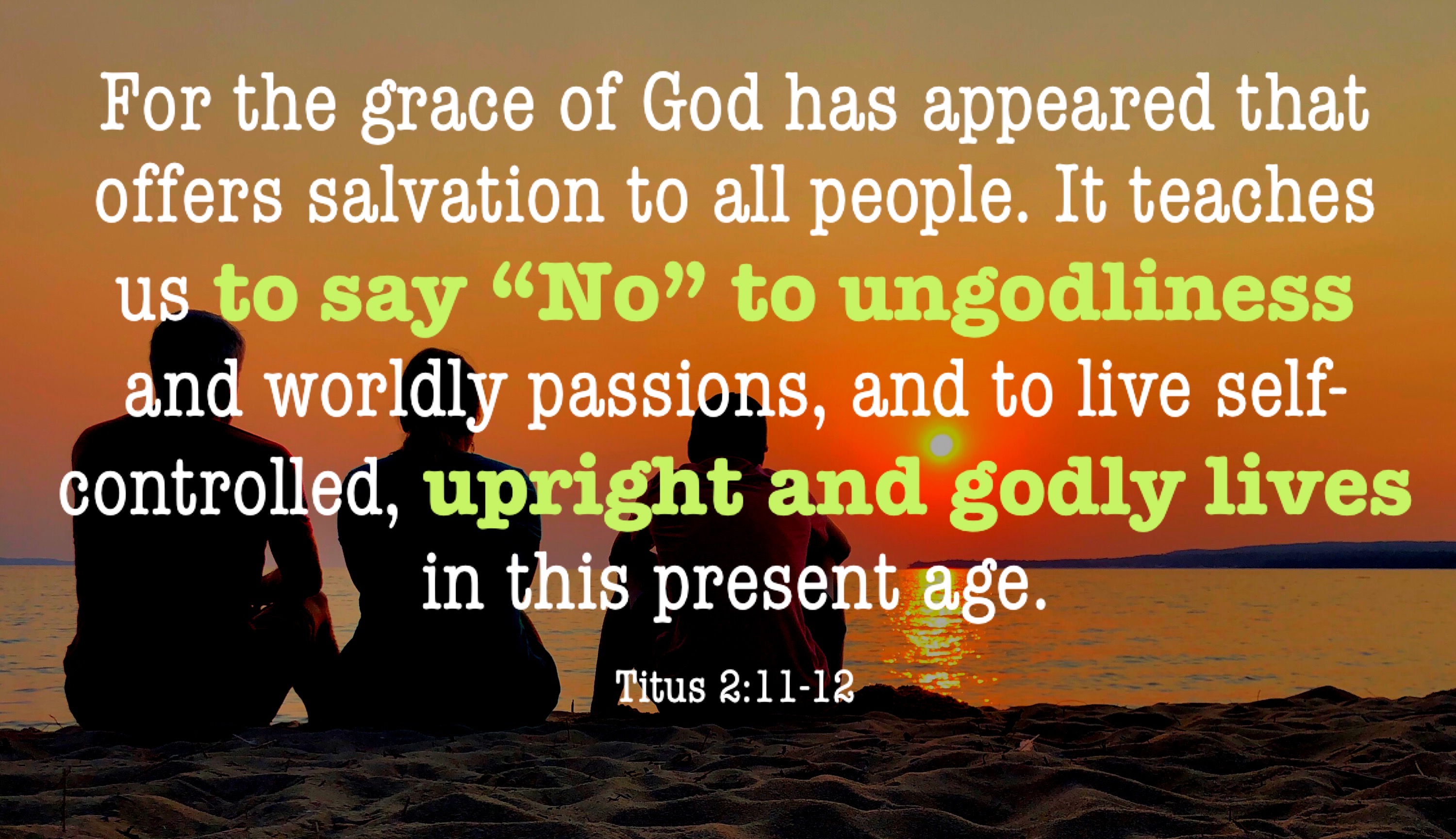
For the grace of God…teaches us to say “No” to ungodliness and worldly passions, and to live self-controlled, upright and godly lives in this present age. (Titus 2:11-12)
How does grace teach me to say, “No”?
The more I realize how much it cost Jesus to extend grace to me, the more I will realize what I can do to show gratitude for this amazing gift. I show my appreciation for this inestimable gift by saying “No” to ungodliness, AND saying “Yes” to godliness.
Saying “Yes” to my sinful passions is like a slap in the face of God. It’s saying that what I want to indulge in is somehow more valuable than Christ’s death on the Cross.
To live a self-controlled, upright, godly life is the bare minimum I can do to show my gratitude to my Savior! Grace is not a license to live as I want to live. Grace teaches me to say “No” to anything that would offend Jesus Christ.
George Whitefield said, “Think of the love of Jesus and let that love constrain you to keep near unto Him.” Which reminds me of a stanza of an old song—
Pastor, these are incredible words spoken by the great Charles Finney nearly 140 years ago! I encourage you to take the time to hear these words with an open heart.
I believe it is a fact generally admitted that there is much less conscience manifested, by men and women, in nearly all the walks of life, than there was forty years ago. There is justly much complaint of this, and there seems to be but little prospect of reformation. The rings and frauds and villainies in high and low places, among all ranks of men, are most alarming, and one is almost compelled to ask: “Can nobody be safely trusted?” Now, what is the cause of this degeneracy? Doubtless there are many causes that contribute more or less directly to it; but I am persuaded that the fault is more in the ministry and public press than in any and all things else. It has been fashionable now for many years to ridicule and decry Puritanism. Ministers have ceased, in a great measure, to probe the consciences of men with the spiritual law of God. So far as my knowledge extends, there has been a great letting down and ignoring the searching claims of God’s law, as revealed in his Word. This law is the only standard of true morality. “By the law is the knowledge of sin.” The law is the quickener of the human conscience. Just in proportion as the spirituality of the law of God is kept out of view will there be manifest a decay of conscience. …The proper guardians of the public conscience have, I fear, very much neglected to expound and insist upon obedience to the moral law.
… The true Gospel is not preached where obedience to the moral law as the only rule of life is not insisted upon. Wherever there is a failure to do this in the instructions of any pulpit it will inevitably be seen that the hearers of such a mutilated Gospel will have very little conscience. …The universal literature of the present day shows conclusively that the moral sense of the people needs toning up, and some of our most fascinating preachers have become the favorites of infidels, skeptics of every grade, Universalists, and the most abandoned characters.
… My beloved brethren in the ministry, is there not a great want in the public inculcations of the pulpit upon this subject? We are set for the defense of the blessed Gospel and for the vindication of God’s holy law. I pray you let us probe the consciences of our hearers, let us thunder forth the law and Gospel of God until our voices reach the capital of this nation, through our representatives in Congress. It is now very common for the secular papers even to publish extracts of sermons. Let us give the reporters of the press such work to do as will make their ears and the ears of their readers tingle. Let our railroad rings, our stock gamblers, our officials of every grade hear from its pulpit, if they come within the sound, such wholesome Puritanical preaching as will arouse them to better thoughts and a better life. Away with this milk-and-water preaching of a love of Christ that has no holiness or moral discrimination in it. Away with preaching a love of God that is not angry with sinners every day. Away with preaching a Christ not crucified for sin.
… Brethren, our preaching will bear its legitimate fruits. If immorality prevails in the land, the fault is ours in a great degree. If there is a decay of conscience, the pulpit is responsible for it. If the public press lacks moral discrimination, the pulpit is responsible for it. If the church is degenerate and worldly, the pulpit is responsible for it. If the world loses its interest in religion, the pulpit is responsible for it. If satan rules in our halls of legislation, the pulpit is responsible for it. If our politics become so corrupt that the very foundations of our government are ready to fall away, the pulpit is responsible for it. Let us not ignore this fact, my dear brethren; but let us lay it to heart, and be thoroughly awake to our responsibility in respect to the morals of this nation. —Charles Finney (December 4, 1873)
Satisfied with what one is or has; not wanting more or anything else.
Does that describe you? Sadly, it’s describing fewer and fewer of us today. But saddest of all: Very few Christians describe themselves as being content!
The Bible says, “But godliness with contentment is great gain. … If we have food and clothing, we will be content with that.” (1 Timothy 6:6, 8)
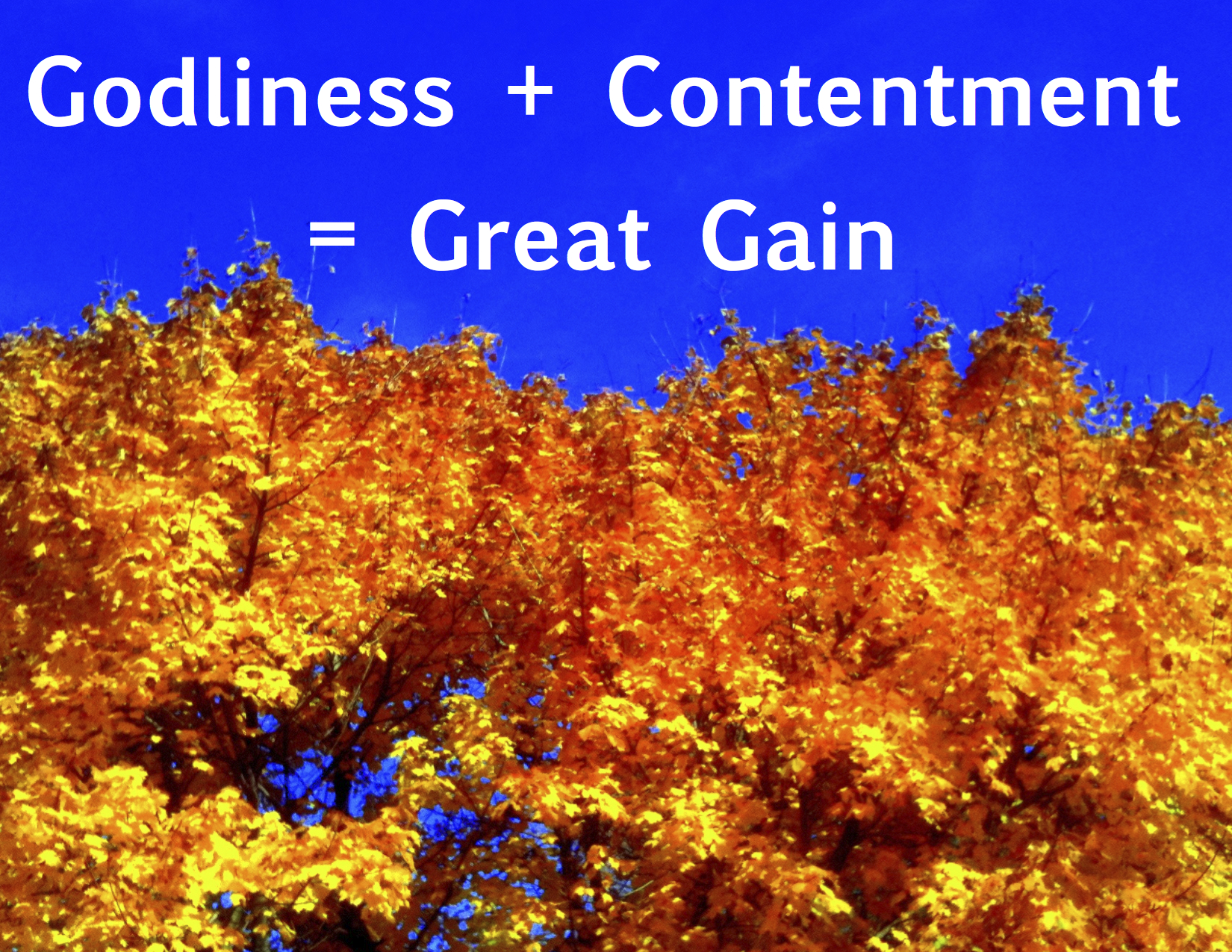
Godliness + Contentment = Great Gain
Both godliness and contentment are choices we must make.
I choose to be godly, and I choose to be content.
The default—the natural course for us—is selfishness. The pull toward my gain and my pleasure is strong. So I must exert great energy to pursue godliness; I must make the conscious decision to be content.
Give us this day our daily bread should be the prayer request in the morning (Matthew 6:11).
Thank You, God, for providing food and clothing for today should be the prayer of thanks in the evening.
Today if you have more than food and clothing, how much more blessed you are!
Choose godliness. Choose contentment. And watch and see how God provides great gain for you!



 Though the army of the Syrians came with a small company of men, the Lord delivered a very great host into their hands, because Joash and Judah had forsaken the Lord, the God of their fathers. So the Syrians executed judgment against Joash. And when they had departed from Joash, leaving him very ill, his own servants conspired against him for the blood of the sons of Jehoiada the priest, and they slew him on his bed. So he died and they buried him in the City of David, but not in the tombs of the kings. (2 Chronicles 24:24-25 AMPC)





 Craig T. Owens