Good And Angry

When was the last time you got good and angry? Be careful how you answer because I want you to notice that important conjunction AND. So maybe I should ask the question this way: when was the last time you got angry and were still good?

Aristotle correctly pointed out, “Anybody can become angry—that is easy; but to be angry with the right person, and to the right degree, and at the right time, and for the right purpose, and in the right way—that is not within everybody’s power and is not easy.”

Over the past week, I’ve been studying the life and leadership of Nehemiah, an incredible leader who rebuilt the walls of Jerusalem. But when I got to the final chapter of his account, I noticed quite a bit of anger coming from Nehemiah. As a kid, I used to have to really battle against my temper, so this aspect of Nehemiah’s life intrigued me. Can someone be good AND angry?

I think that the deeper I love someone or something, the greater my anger will be towards anyone or anything that violates what I love.

Nehemiah loved God and he was passionate to see God’s holiness magnified. All of his anger is directed at those people or things that violated or detracted from God’s holiness. Look how he got good AND angry

  • Towards Tobiah, who moved his personal belongings into God’s temple, a place reserved exclusively for the worship of God. “I was angry, really angry, and threw everything in the room out into the street, all of Tobiah’s stuff” (v. 8).
  • Towards the people who stopped financially supporting the priests, forcing the priests to leave the temple and work as farmers. “I immediately confronted the leaders and demanded, ‘Why has the Temple of God been neglected?’” (v. 11).
  • Towards those who violated the regulations of the Sabbath Day. “I got angry and said to the leaders of Judah, ‘This evil you are doing is an insult to the Sabbath!’” (v. 17).
  • Towards those tried to get around Nehemiah’s new Sabbath Day regulations. “I spoke sharply to them and said, ‘What are you doing out here, camping around the wall? If you do this again, I will arrest you!’” (v. 21).
  • Towards those who had intermarried with false-god-worshipping people. “I rebuked them and called curses down on them. I beat some of the men and pulled out their hair” (v. 25).
  • Towards Joiada, a priest who married a non-God-fearing woman. “I banished him from my presence” (v. 28).

After each of these incidents, you might expect Nehemiah to regret what he had done and think to himself, “Perhaps I overdid it. Maybe I was too zealous, or maybe I went a little overboard.” But instead, each time Nehemiah was righteously angry he prayed this to God, “Remember me for this, O my God. Remember me with favor because of what I have done” (vv. 14, 22, 29, 31). He was unashamed that he got good AND angry.

The Bible says, “Go ahead and be angry. You do well to be angrybut don’t use your anger as fuel for revenge. And don’t stay angry.”

Can you be good AND angry? Yes! In fact, I think being good helps us be angry with the right person or thing, in the right way, for the right purpose, and for the right length of time. 

Beat Up

Some snippets from a few conversations I have had the past week—

  • “What’s the point?”
  • “My life doesn’t make sense.”
  • “I probably deserve this.”
  • “I don’t know how I got here … I don’t know how to get out of here.”
  • “Why me?”
  • “I feel beat up.”

C.S. Lewis got it exactly right when he wrote, “If satan’s arsenal of weapons were restricted to a single one, it would be discouragement.”

Have you ever worked with someone whose attitude changed after giving his 2-week notice? His job performance slips … his attitude stinks … he does things against company policy … and he justifies it all by saying, “What are they going to do, fire me?” He’s got nothing to lose by acting like a complete jerk!

satan has already been “fired”—he knows he’s got a terrible end coming. And all he wants to do is make other people feel rotten … beat up … discouraged … defeated. He wants to take you down. He’s a jerk!

Did you know that the word devil means slanderer? By his very nature, he only tells lies. Everything he says is intended to harm you. He slings mud at your character, tries to get you thinking you’re no good, turns your attention to anything that’s dark, picks on your faults, jumps on your weaknesses. Like a jerk, he beats you up and beats you down until you start believing his lies.

He is a LIAR!

You are invaluable.

You are a masterpiece.

You are desperately loved by God.

You are integral to God’s plan.

I know you may want to ignore satan’s slandering, to tune out his lies, but can I suggest something else? Listen to them. Listen very carefully. If you are listening closely, you will be able to identify the lies and then demolish them. satan is hoping you will simply accept what he’s saying without analyzing it.

Here’s the next step. After you’ve identified the lies, you have to speak the truth OUT LOUD that contradicts those lies. The Bible says that we defeat satan’s slander by the power of Jesus AND the true words from our mouth. If you’re not sure what biblical truth counteracts the lies that are discouraging you, email me and I’d be happy to help you.

You are so very valuable! There’s a bully who wants to intimidate you, but your Big Brother Jesus is ready to take care of him!

Are You Out Of Your Mind?

I love this thinking thought from James William Fulbright—

“We must dare to think ‘unthinkable’ thoughts. We must learn to explore all the options and possibilities that confront us in a complex and rapidly changing world. We must learn to welcome and not to fear the voices of dissent. We must dare to think about ‘unthinkable things’ because when things become unthinkable, thinking stops and action becomes mindless.”

After you have identified the negative thoughts and you have started thinking creatively, you have to be able to take it further. You have to be able to think unthinkable things.

Too many times we don’t let our minds begin to go into “unknown” places, so we look at everything through the lens of what we’ve experienced in the past. Our thoughts are “in our minds.” When Albert Einstein began to propose that there were more dimensions to our universe than scientists had previously thought, people had a hard time following his reasoning. Even those in the scientific community thought he was “out of his mind.”

One of Einstein’s favorite books was called Flatland. In this book, Square lives in the two-dimensional world that Sphere came to visit. Because Square’s world only has length and width (no height), he can only see the part of Sphere that was on his level. As Sphere moves through Flatland, Square can see different parts of him, but he can never see all of him at the same time. If Sphere moves above Flatland, Square can still hear his voice but cannot see his shape.

So, too, with us. Many times we only perceive what moves through the “line of sight” we have previously experienced. We are—so to speak—in our minds.

But look what God has in store for you—

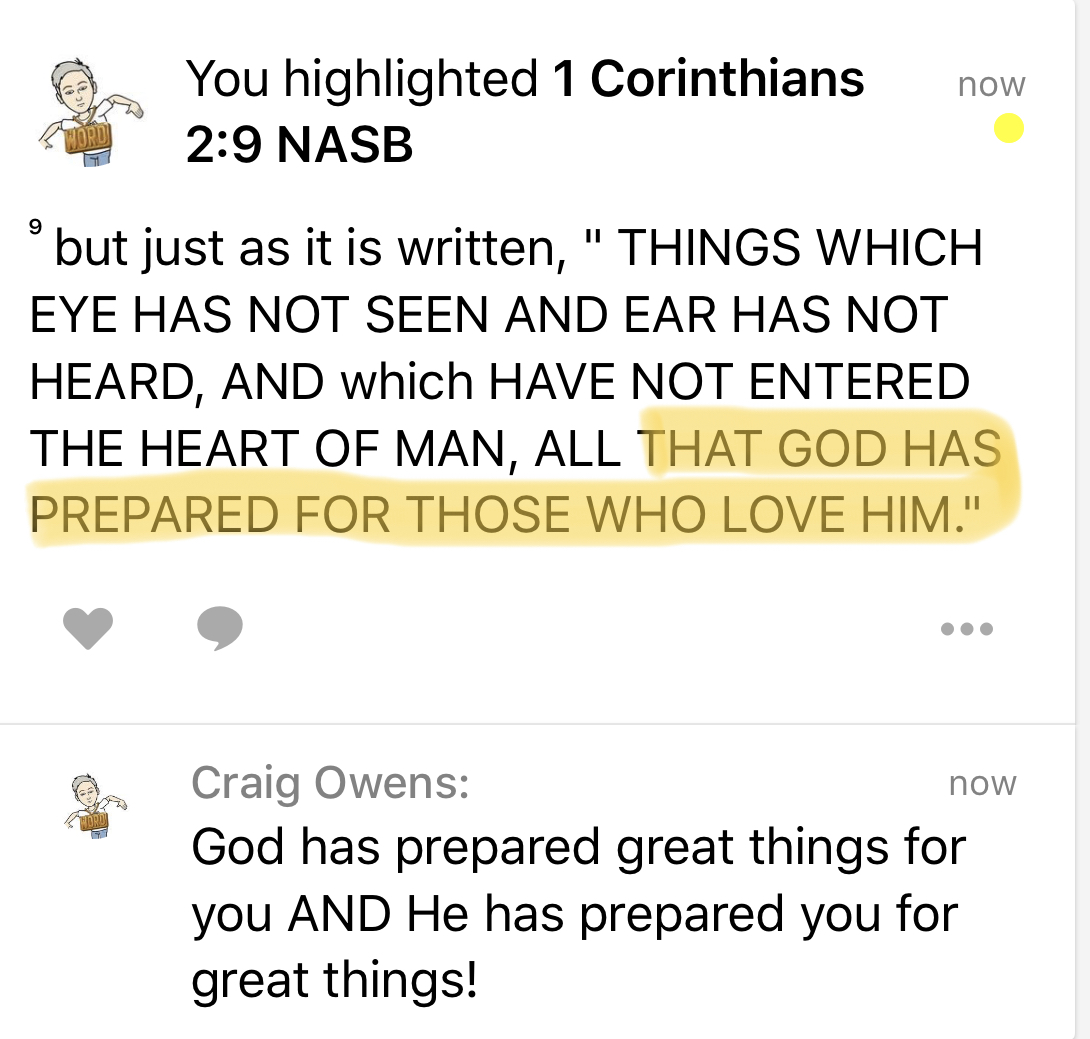
No eye has seen, no ear has heard, and no mind has imagined what God has prepared for those who love Him. (1 Corinthians 2:9 NLT)

So here’s how Scripture teaches us to pray—

I pray that from His glorious, unlimited resources He will empower you with inner strength through His Spirit. Then Christ will make His home in your hearts as you trust in Him. Your roots will grow down into God’s love and keep you strong. And may you have the power to understand, as all God’s people should, how wide, how long, how high, and how deep His love is. May you experience the love of Christ, though it is too great to understand fully. Then you will be made complete with all the fullness of life and power that comes from God. Now all glory to God, who is able, through His mighty power at work within us, to accomplish infinitely more than we might ask or think.(Ephesians 3:16-20 NLT)

God wants to do infinitely more than you can ask or think. He wants to show you new dimensions of His greatness and His love—notice that Paul goes out of his way to list four dimensions (wide, long, high, deep) even though we live in a three-dimensional world.

Here’s the question: are you OUT of your mind or IN your mind? In other words, are you only looking for things that you know can happen, or are you believing God for things that are completely OUT OF YOUR MIND?

More Than Okay

Most mornings when I wake up there is a song echoing in my mind. This morning it was Switchfoot’s song “More Than Fine” (lyrics here).

Lately, I’ve been noticing some clichés in our culture that are survival-oriented—

  • “I’m just trying to make a living.”
  • “Another day, another dollar.”
  • “Ugh, another Monday!”
  • “I just need to make it until the weekend.”
  • “If we can just survive today.”
  • “How are you?” “I’m fine… okay, I guess.”

I suppose for some, this is how they view life. But this should never be the mindset for followers of Jesus Christ.

Jesus didn’t die on a Cross for us, conquer death and rise again so we could have an okay life. He came to give us overflowing life. Of all people, those who are in a personal relationship with Jesus should be the most more-than-okay people of anyone!

You prepare a feast for me in the presence of my enemies. You honor me by anointing my head with oil. My cup overflows with blessings. (Psalm 23:5 NLT)

The thief comes only in order to steal and kill and destroy. I came that they may have and enjoy life, and have it in abundance (to the full, till it overflows). (John 10:10 AMP)

Because of the sacrifice of the Messiah, His blood poured out on the altar of the Cross, we’re a free people—free of penalties and punishments chalked up by all our misdeeds. And not just barely free, either. Abundantly free! (Ephesians 1:7-8 MSG)

Now to Him who is able to do immeasurably more than all we ask or imagine, according to His power that is at work within us, to Him be glory in the church and in Christ Jesus throughout all generations, for ever and ever! Amen. (Ephesians 3:20-21 NIV)

Today is the only today you will ever get. You don’t have to just survive today, you don’t have to just make it through this day, you don’t have to settle for just okay. You can live for more than okay today, you can experience God’s abundance, and you can revel in the overflowing life Jesus’ resurrection purchased for you!

Choice Four-Letter Words

Listen to the podcast of this post by clicking on the player below, and you can also subscribe on AppleSpotify, or Audible.

Have you ever been “cursed out” by someone? I mean had a stream of four-letter obscenities hurled at you? What happens inside you? Isn’t your natural reaction to strike back? To begin to a counter-attack with a few choice four-letter words of your own?

It’s natural to feel this way; it’s a very human response.

On the other hand, have you ever been “blessed out” by someone? Had someone shower you with niceties and accolades and compliments? What happens inside you this time? Isn’t your natural reaction the complete opposite? Don’t you want to say, “Well, I think you’re pretty special, too”?

It’s natural to feel this way; it’s a very human response.

But Jesus commanded us to do something counter-cultural, something which requires a spiritual response: “Bless those who curse you” (Luke 6:28). Paul amplified this thought: “Bless those who persecute you; bless and do not curse” (Romans 12:14).

These words curse and bless are challenging for me. Curse means to hope for someone’s downfall; bless means to say good words to or about someone. Cursing can be done internally or verbally; blessing has to be done verbally. Eugene Peterson captures the essence of this in his paraphrase of Romans 12:14: “Bless your enemies; no cursing under your breath.”

If my natural response is to match curse for curse, obscenity for obscenity, then to respond in a Christ-like fashion is going to take a change of character. To respond with the right four-letter words, I have to do the opposite of my natural response.

In the Old Testament, the Hebrew word for bless carried the understanding that it all hinged on God—He is the focal point. All of the definitions of this word involve a close relationship with God: (a) bless God; (b) bless men in the name of God; (c) ask for divine favor for persons or things created by God; or (d) salute someone because we know God has saluted us.

In the New Testament, the Greek word for bless makes it clear that this has to be done verbally, out loud. It is impossible to bless under your breath. In the Greek, bless is the compound word eulogeo = eu- (good) + –logos (words): saying good words out loud.

Only God is good, so only a closer relationship with our good God will help us say good words to others. Especially to those who curse us.

The right four-letter words to use—the un-natural words to use—are: Good words.

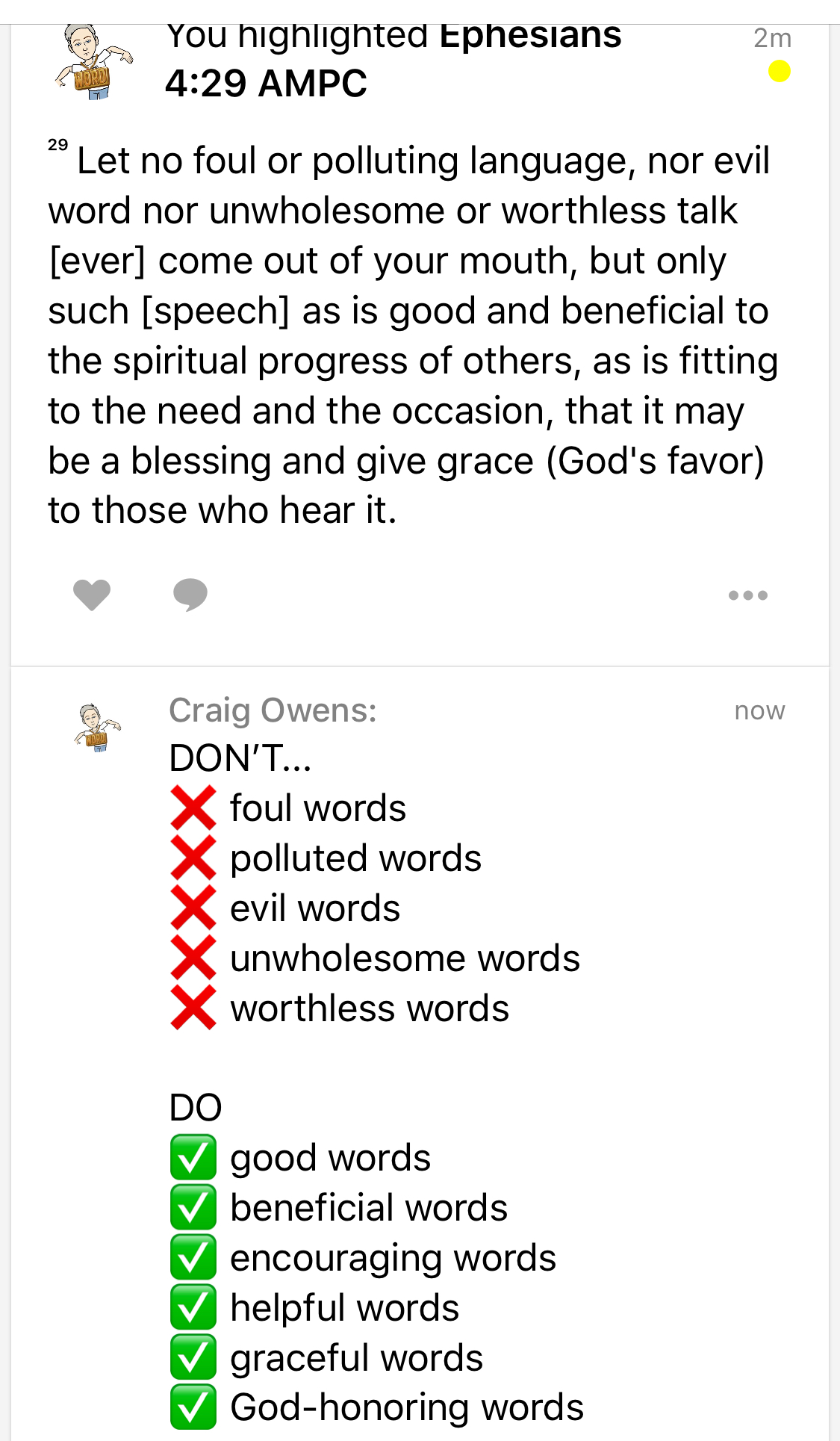
I’m challenging myself today to bless others, especially those who curse me. I only want to say good to and about others today. I’m attempting to live out Ephesians 4:29—

  • Do not let any unwholesome talk come out of your mouths, but only what is helpful for building others up (New International Version)
  • Let no foul or polluting language, nor evil word nor unwholesome or worthless talk ever come out of your mouth, but only such speech as is good and beneficial to the spiritual progress of others (Amplified Bible)
  • Watch the way you talk. Let nothing foul or dirty come out of your mouth. Say only what helps, each word a gift (The Message)
  • When you talk, do not say harmful things, but say what people need—words that will help others become stronger (New Century Version).

So let me ask you: How will you say the right four-letter words to others today?

►► Would you please prayerfully consider supporting this ministry? My Patreon supporters get behind-the-scenes access to exclusive materials. ◀︎◀︎