Thursdays With Spurgeon—Bragging About God

This is a weekly series with things I’m reading and pondering from Charles Spurgeon. You can read the original seed thought here, or type “Thursdays With Spurgeon” in the search box to read more entries.

Listen to the podcast of this post by clicking on the player below, and you can also subscribe on AppleSpotify, or Audible. 

Bragging About God

I will extol the Lord at all times; His praise will always be on my lips. I will glory in the Lord; let the afflicted hear and rejoice. Glorify the Lord with me; let us exalt His name together. (Psalm 34:1-3)

     Boasting is a very natural propensity, and if it were used as in this case, the more it were indulged the better. The exultation of this verse is no mere tongue bragging; the soul is in it, and the boasting is meant and felt before it is expressed. 

     What scope there is for holy boasting in Jehovah! His Person, attributes, covenant, promises, works, and a thousand things besides are all incomparable, unparalleled, matchless; we may cry them up as we please, but we shall never be convicted of vain and empty speech in so doing.

From Spurgeon And The Psalms

What is even more remarkable about the praise David offers up in this psalm is the setting. The introduction to the psalm tells us it is while David is running from Saul and trapped in a Philistine stronghold. 

And yet David still chooses to praise God.

It is a choice of his will. David didn’t wait until he felt like praising God, or until his circumstances were improved. We are more likely to act ourselves into feeling than we are to feel ourselves into action. So David says, “I will extol the Lord … His praise will be on my lips.” 

This bragging about God—when from a human standpoint there appears to be nothing to brag about—becomes a testimony. David’s personal pronouns “I” and “my” quickly turn into the plural pronoun “us” as David invites others to ponder the beauty of Jehovah! “Glorify the Lord with me; let us exalt His name together. 

Our bragging about God, especially in the face of difficult circumstances, is a powerful testimony that will draw others to Him. You may start out praising Him on your own, but it won’t be long until others join your worship chorus. 

Friends, your praising and bragging about God is more powerful than you may realize. When God is worshipped, He is lifted up for all to see, so keep on bragging about Him!

►► Would you please prayerfully consider supporting this ministry? My Patreon supporters get behind-the-scenes access to exclusive materials. ◀︎◀︎

Thursdays With Spurgeon—New Songs Everyday

This is a weekly series with things I’m reading and pondering from Charles Spurgeon. You can read the original seed thought here, or type “Thursdays With Spurgeon” in the search box to read more entries.

Listen to the podcast of this post by clicking on the player below, and you can also subscribe on AppleSpotify, or Audible. 

New Songs Everyday

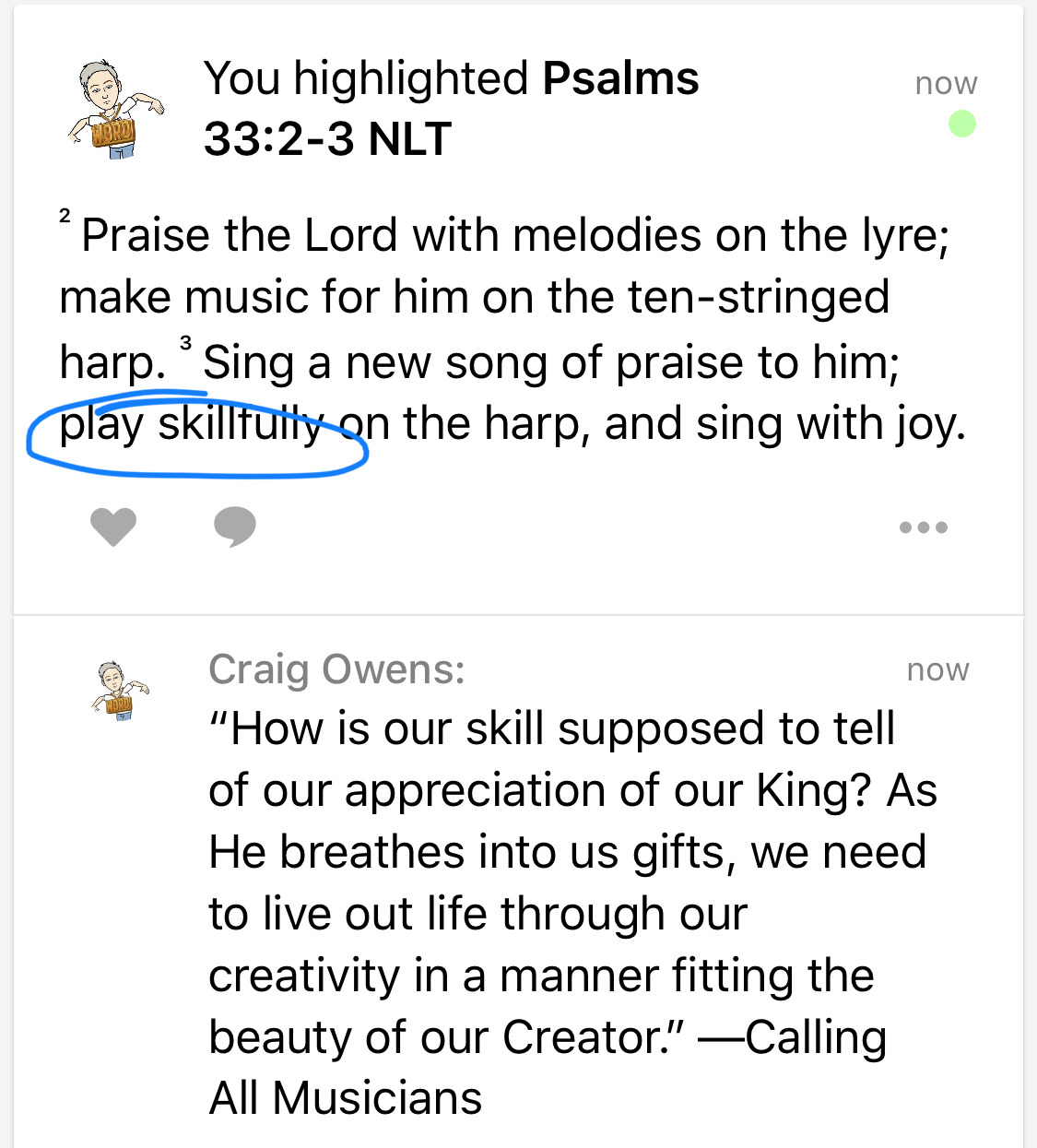
Sing joyfully to the Lord, you righteous; it is fitting for the upright to praise Him. Praise the Lord with the harp; make music to Him on the ten-stringed lyre. Sing to Him a new song; play skillfully, and shout for joy. (Psalm 33:1-3)

     To keep up the freshness of worship is a great thing, and in private, it is indispensable. Let us not present old, worn-out praise but put life and soul and heart into every song, since we have new mercies everyday and see new beauties in the work and Word of our Lord. 

     It is wretched to hear God praised in a slovenly manner. He deserves the best we have. All Christians should endeavor to sing according to the rules of the art so that they may keep time in tune with the congregation. The sweetest tunes, and the sweetest voices, with the sweetest words, are all too little for the Lord our God; let us not offer Him limping rhymes, set to harsh tunes, and growled out by discordant voices.

From Spurgeon And The Psalms

Imagine if I told my wife something like this—

Every Thursday night is going to be our date night. I’m going to plan something special, dress up in some nice clothes, and be totally tuned in to your needs. I’m going to listen to everything you have to say to me, express my unending love to you, ask forgiveness for areas I may have messed up that week, and then endeavor to put into practice everything you tell me that you would like. 

I promise I’ll be there every Thursday. 

The other days of the week, I’ll think about you every once in a while—especially if I need something—but other than that I’ll be doing my own thing. 

How rich and meaningful would you expect that relationship to be? 

Sadly, this is how many people who call themselves Christians view their relationship with Jesus. They put on nice clothes every Sunday, show up at church, sing some songs, listen to a sermon, repent of sins, and promise to live a better life in this new week. But after they leave their church service, they seldom give their Savior another thought—unless they get themselves into trouble where they really need a Savior’s immediate help. 

In Psalm 33, the psalmist is calling us to—as Spurgeon puts it—“freshness in worship” not just in a public worship service, but in private worship at every moment of every day. Our God is continually revealing Himself to us in new and fresh ways, so our worship should be equally as fresh, vibrant, and passionate—both planned times of worship and spontaneous songs of praise. 

Both our relationship with God and with our loved ones will go to new levels of intimacy when we seek to know the other one more deeply. Our God is worthy of the very best praise we can give Him, which means we will always be finding new ways to sing our worship to Him every single day.

►► Would you please prayerfully consider supporting this ministry? My Patreon supporters get behind-the-scenes access to exclusive materials. ◀︎◀︎

Thursdays With Spurgeon—The Proof In The Longing

This is a weekly series with things I’m reading and pondering from Charles Spurgeon. You can read the original seed thought here, or type “Thursdays With Spurgeon” in the search box to read more entries.

Listen to the podcast of this post by clicking on the player below, and you can also subscribe on AppleSpotify, or Audible. 

The Proof In The Longing

My soul is consumed with longing for Your laws at all times. (Psalm 119:20) 

     Can you say that your heart pines for God as the watcher through the midnight sighs for the dawn, or as the traveler over burning sand longs for the shadow of a great rock? Oh, then, though I would not have you rest in longings; indeed, I know you never can. Yet they are a proof that you are spiritually alive! Heart longings are far better tests than attendance at sacraments, for men who are dead in sin have dared to come both to baptism and the Lord’s Supper. Eager desires prove spiritual life much better than supposed attainments, for these supposed attainments may all be imaginary. But a heart breaking for the longing that it has for God’s Word is no fancy. It is a fact too painful to be denied! … 

     We have not reached perfection, but do not let us, therefore, be discouraged, for the apostle of the Gentiles said, ‘Not as though I had already attained, either were already perfect’ (Philippians 3:12). … When a man thinks himself so good that he cannot be better, he is probably so bad that he could not be worse. … 

     The fuller a man is of grace, the more he hungers for grace! Strange it is to say so, but the paradox is true—the more he drinks and the more he is satisfied and ceases to thirst in one sense, the more he is devoured with thirst after the living God! … This it is to be a true child of God: To always have a yearning soul toward God’s Word, to be eager after His commandments at all times. May the Holy Spirit keep us ever hungering and thirsting after God and His truth.

From Holy Longings

In a recent interview that I did, I was asked how someone should deal with the fact that they are struggling to be balanced in their leadership. My reply was, “The very fact that they are feeling the struggle should be a great encouragement to them. People who don’t feel the tension of wanting to get better are blinded to their deficiencies and never seek help.” 

The proof of our growing maturity is in our longing for growing maturity. 

The psalmist in this great chapter is thrilled with what God’s Word has already accomplished in his life, and yet he is still longing for the Holy Spirit to do an even greater work in his heart. This is the tension in which every maturing Christian should live. The devil would love to whisper to your heart, “Your longing for more proves that you are still immature.” This is an utter lie! As Spurgeon reminds us, the more of God we have, the more of God we will crave.

My friend, never be satisfied with what you have already attained. Be delighted with what God has done, but crave that He will continue to do more and more and more! These longings not only delight God but bring Him great glory.

►► Would you please prayerfully consider supporting this ministry? My Patreon supporters get behind-the-scenes access to exclusive materials. ◀︎◀︎

Thursdays With Spurgeon—Cutting The Root Of The Weed Of Sin

This is a weekly series with things I’m reading and pondering from Charles Spurgeon. You can read the original seed thought here, or type “Thursdays With Spurgeon” in the search box to read more entries.

Listen to the podcast of this post by clicking on the player below, and you can also subscribe on AppleSpotify, or Audible. 

Cutting The Root Of The Weed Of Sin

I acknowledged my sin to You, and my iniquity I have not hidden. I said, “I will confess my transgressions to the Lord,” and You forgave the iniquity of my sin. Selah. (Psalm 32:5) 

     We must confess the guilt as well as the fact of sin. It is useless to conceal it, for it is well known to God; it is beneficial to us to own it, for a full confession softens and humbles the heart. I will confess my transgressions to the Lord. Not to my fellow human beings or to the high priest, but to Jehovah. … 

     When the soul determines to lay low and plead guilty, absolution is near at hand; hence we read, “And You forgave the iniquity of my sin.” Not only was the sin itself pardoned, but so was the iniquity of it; the virus of its guilt was put away at once, as soon as the acknowledgment was made. God’s pardons are deep and thorough: the knife of mercy cuts at the roots of the ill weed of sin.

From Spurgeon And The Psalms

I notice again the Selah at the end of this verse. That word means to pause and deeply consider the previous words. I shared a sermon about the weight that is lifted and the freedom that is restored if we will just confess our sin to God! 

But the devil loves to condemn us, to whisper the lie that we’ve sinned one too many times for God to forgive us again. This is truly a lie because a forgiven sin is a forgotten sin. So in essence when we ask God to forgive us for our most recent sin, He views it as our only sin! 

In my book Shepherd Leadership, I challenged pastor-shepherds to make good use of confession: 

     When your reactions aren’t Christlike, admit it. Someone might want to push back, “But if I say I was wrong, then I may lose some leadership credibility.” I would agree that you will lose credibility if you believe you are a self-made leader and if you are climbing up a career ladder that you designed. But if you are truly living and leading as a servant that God has equipped and placed among this flock, admission of an un-Christlike action or reaction triggers something extraordinary: God’s help. Peter said it this way: “All of you, clothe yourselves with humility toward one another, because, ‘God opposes the proud but shows favor to the humble’” (1 Peter 5:5). 

     Did you catch that? God stands back from the proud person who will not admit his error nor ask for help, let alone ask for forgiveness. On the other hand, God lavishes His grace on the humble one who admits both his error and his need for help. Admission of an inappropriate action or reaction brings God’s help! 

     Friends, the mark of a maturing shepherd is not one who never misspeaks or never makes a mistake. No, the mark of a maturing shepherd is the one who is closing the gap between his mess up and his confession, and one who is experiencing fewer mess ups over time because the Holy Spirit is helping him get healthier and more mature. —an excerpt from chapter 12 of Shepherd Leadership

Don’t listen to the devil’s lies, but hear the loving voice of the Holy Spirit calling you to confess your sin and receive immediate absolution from it. As Spurgeon said, “God’s pardons are deep and thorough: the knife of mercy cuts at the roots of the ill weed of sin.” 

If you would like to know more about Shepherd Leadership, please click here.

►► Would you please prayerfully consider supporting this ministry? My Patreon supporters get behind-the-scenes access to exclusive materials. ◀︎◀︎

Thursdays With Spurgeon—Delightful Judgments

This is a weekly series with things I’m reading and pondering from Charles Spurgeon. You can read the original seed thought here, or type “Thursdays With Spurgeon” in the search box to read more entries.

Listen to the podcast of this post by clicking on the player below, and you can also subscribe on AppleSpotify, or Audible. 

Delightful Judgments

My soul is consumed with longing for Your laws at all times. (Psalm 119:20) 

     Search God’s Word and you will have before your eyes the ultimate judgment of unerring truth, the last decree from the supreme authority from which there is no appeal! The Bible contains the verdict of the Judge of all the earth, the judgments of God who cannot lie and cannot err.

     Thus, God’s Word is rightly called His ‘judgments.’ It is a Book not to be judged by us, but to be our judge—not a word of it may be altered or questioned. But to it we may constantly refer as to a court of appeal whose sentence is decisive. … 

     Our judgments must be daily more and more conformed to the judgments of God that are laid down in Scripture. And there must be in our spirit a longing after holiness until we delight in the Law of the Lord and meditate therein both day and night. We will grow to the likeness of that which we feed upon, heavenly food will make us heavenly minded! The Word of God received into the heart changes us into its own nature and, by rejoicing in the decisions of the Lord, we learn to judge after His judgment and to delight ourselves in that which pleases Him. 

From Holy Longings

The 119th Psalm is an amazing chapter—176 verses arranged as a love letter to both God’s Word and the God who gave us His Word. Every one of these verses extol the value and beauty of God’s commands, decrees, precepts, statues, law, and judgments. 

As Spurgeon pointed out, “judgment” does not mean a sentence of guilt pronounced against us, but a standard for determining the rightness or lawlessness of something. God’s Word is the final judgment on sin and righteousness. 

The psalmist who penned this beautiful prose more than likely had only the first five books of our Bible—Genesis, Exodus, Leviticus, Numbers, and Deuteronomy—and yet he finds such delight in these words because of the awesome God they reveal. Look at his delight…

  • I delight in Your decrees (v. 16) 
  • Your statues are my delight (v. 24) 
  • I delight in Your commands (v. 47) 
  • I delight in Your law (v. 70)
  • Your commands give me delight (v. 143) 

As Spurgeon said, the more we delight in God’s Word, the more we will meditate on it; the more we meditate on it, the more it will change our hearts to make lifestyle judgments that are pleasing to God. 

No matter whether you’ve never really studied the Bible, or you are an “old pro” with a well-worn Bible close at hand, may we all continue to grow in our delight of God’s Word and our reverence of the God revealed to us in the Word. 

If you would like some Bible studies to help get you started, check out:

And you can also check out a previous post were I shared three steps to better Bible studies.

►► Would you please prayerfully consider supporting this ministry? My Patreon supporters get behind-the-scenes access to exclusive materials. ◀︎◀︎

Thursdays With Spurgeon—Aids Of Self-Judgment

This is a weekly series with things I’m reading and pondering from Charles Spurgeon. You can read the original seed thought here, or type “Thursdays With Spurgeon” in the search box to read more entries.

Listen to the podcast of this post by clicking on the player below, and you can also subscribe on AppleSpotify, or Audible. 

Aids Of Self-Judgment

My soul is consumed with longing for Your laws at all times. (Psalm 119:20) 

     Spiritual desires are the shadows of coming blessings. What God intends to give us, He first sets us longing for. Therefore, prayer is wonderfully effective because it is the embodiment of a longing that is inspired by God because He intends to bestow the blessing prayed for! What are your longings, then, my hearer? Do you long to be holy? The Lord will make you holy! Do you long to conquer sin? You will overcome it by faith in Jesus! Are you pining after fellowship with Christ? He will come and make His abode with you! Does your soul thirst, yes, even pant after God as the hart for the water brooks? Then you will be filled with all His fulness…. 

     I say not that it is so with all human wishes, for ‘the sluggard desires and has nothing’ [Proverbs 13:4] and many a man has such evil cravings within his heart that it were contrary to the purity of God for Him to grant them. But where there are intense, heartbreaking earnings of a holy order, depend upon it, they are tokens of good things to come! 

     Where the grace of God reigns in the soul, it makes a man become a stranger among his fellows…. Worldly men care nothing for the judgments of God. No, they care nothing for God Himself! But when a man becomes born anew, a citizen of heaven, there grows up within his spirit a spiritual appetite of which he had felt nothing before—and he longs after God and His Holy Word. See to it, brothers and sisters, whether your souls cry out for God, for the living God, for again I say, by your longings you may test yourselves—by your heart’s desires you may forecast the future—and by your hungering and thirsting you may judge whether you are men of this world or citizens of the world to come. With such aids to self-judgment, no man ought to remain in doubt as to his spiritual condition and eternal prospects.

From Holy Longings

I am currently teaching a series of lessons called Craving. We are learning in these sermons that God created our souls to long intensely, to have cravings. But we go astray when what we crave are things that will merely last during this world. 

John told us, “This world is fading away, along with everything that people crave. But anyone who does what pleases God will live forever” (1 John 2:17 NLT). So by its very definition, worldly things will never satisfy our cravings because the world is temporary. Only an eternal God can give us eternal satisfaction. 

As Spurgeon teaches us here, examining our longings is the best aid of self-judgment and will help us determine our future. Craving God’s presence will bring God’s blessing and His eternal fulfillment of our cravings. Craving anything else will lead to frustration and eternal disappointment. 

God longs to bless us (Isaiah 30:18) as long as we are craving Him!

►► Would you please prayerfully consider supporting this ministry? My Patreon supporters get behind-the-scenes access to exclusive materials. ◀︎◀︎

Thursdays With Spurgeon—Guided For God’s Sake

This is a weekly series with things I’m reading and pondering from Charles Spurgeon. You can read the original seed thought here, or type “Thursdays With Spurgeon” in the search box to read more entries.

Listen to the podcast of this post by clicking on the player below, and you can also subscribe on AppleSpotify, or Audible. 

Guided For God’s Sake 

In You, Lord, I have taken refuge; let me never be put to shame; deliver me in Your righteousness. Turn Your ear to me, come quickly to my rescue; be my rock of refuge, a strong fortress to save me. Since You are my rock and my fortress, for the sake of Your name lead and guide me. Keep me free from the trap that is set for me, for You are my refuge. Into Your hands I commit my spirit; deliver me, Lord, my faithful God. (Psalm 31:1-5) 

     To lead and to guide are two different things very like each other, but patient thought will detect different shades of meaning, especially as the last may mean ‘provide for me.’ The double word indicates an urgent need—we require double direction, for we are fools and the way is rough. 

     Lead me as a soldier, guide me as a traveler! Lead me as a babe, guide me as an adult; lead me when You are with me, but guide me even if You are absent; lead me by Your hand, guide me by Your Word. The argument used is one fetched from the armory of free grace: not for my sake, but ‘for the sake of Your name’ guide me. 

From Spurgeon And The Psalms

When we let God lead us and guide us, we are never “put to shame.” It’s my own attempts at guiding myself that end up in shame and failure. This is why Jesus taught us to pray for God’s name to be glorified as His will is done. Part of that leading and guiding provides our daily bread and an escape from falling in the face of temptation. 

Interestingly, Jesus prayed the same thing for Himself in the Garden of Gethsemane: “Not My will, but Yours be done.” And then Jesus could confidently use the same words from this Psalm as He hung on the Cross: “Father, into Your hands I commit My spirit.” We can pray with the same assurance when we are allowing the Holy Spirit to both lead and guide us every single day.

►► Would you please prayerfully consider supporting this ministry? My Patreon supporters get behind-the-scenes access to exclusive materials. ◀︎◀︎
Thursdays With Spurgeon—Holy Longings

This is a weekly series with things I’m reading and pondering from Charles Spurgeon. You can read the original seed thought here, or type “Thursdays With Spurgeon” in the search box to read more entries.

Listen to the podcast of this post by clicking on the player below, and you can also subscribe on AppleSpotify, or Audible. 

Holy Longings

My soul is consumed with longing for Your laws at all times. (Psalm 119:20) 

     One of the best tests of a man’s character will be found in his deepest and heartiest longings. You cannot always judge a man by what he is doing at any one time, he may be under constraints that compel him to act contrary to his true self, or he may be under an impulse from which he will soon be free. He may, for a while, back off from that which is evil, yet he may be radically bad. … A man’s longings are more inward and more nearer to his real self than his outward acts—they are more natural in that they are entirely free and beyond compulsion or restraint. 

     As a man longs in his heart, so is he. I mean not every idle wish, as I now speak, but strong desires of the heart. These are the true life of a man’s nature. You will know whether you yourself are evil by answering this question: To what have you the greatest desire? … So then, dear hearers, your heart longings may furnish you with helps for self-examination, and I beg you to apply them, as things of the heart touch the root of the matter.

From Holy Longings

Jesus was constantly taking us back to the examination of our heart. He knew that “out of the heart come evil thoughts—murder, adultery, sexual immorality, theft, false testimony, slander” (Matthew 15:19). He further demonstrated this when He made anger in the heart the same as murder, and lust in the heart the same as adultery (Matthew 5:21-30). 

We can try to change our behaviors all day long, but if we don’t address the heart longings that are prompting those behaviors, we are fighting a losing battle. 

Sigmund Freud called them “Freudian slips” when we said or did something that seemed out of character. I think we should call them eye-opening insights—we just had an opportunity to glimpse what heart longing is at the root of that inappropriate word or action. Thankfully, the same Holy Spirit that reveals these carnal longings to us will also lead us to repentance and a heart change that brings about God-honoring heart longings. 

Don’t try to excuse or cover up what may have slipped out, but use that as a merciful warning of heart longings that need the sanctification of the Holy Spirit. We are all a work-in-progress, which is why I like to remember the word sanctification by saying it “saint-ification.” Let’s yield to the Holy Spirit to bring out greater saintliness by saint-ifying our heart longings.

►► Would you please prayerfully consider supporting this ministry? My Patreon supporters get behind-the-scenes access to exclusive materials. ◀︎◀︎

Thursdays With Spurgeon—God Our Healer

This is a weekly series with things I’m reading and pondering from Charles Spurgeon. You can read the original seed thought here, or type “Thursdays With Spurgeon” in the search box to read more entries.

Listen to the podcast of this post by clicking on the player below, and you can also subscribe on AppleSpotify, or Audible. 

God Our Healer

O Lord my God, I cried out to You, and You healed me. O Lord, You brought my soul up from the grave; You have kept me alive, that I should not go down to the pit. (Psalm 30:2-3) 

     God is the best Physician, even for our bodily infirmities. We do very wickedly and foolishly when we forget God. It was a sin in Asa that he trusted physicians and not God (2 Chronicles 16:12). If we must have a physician, let it be so, but still let us go to our God first of all. And above all remember that there can be no power to heal in medicine of itself; the healing energy must flow from the divine hand. …

     If our watch is out of order, we take it to the watchmaker; if our bodies or souls are in an evil plight, let us resort to Him who created them, who has unfailing skill to put them in right condition. As for our spiritual diseases, nothing can heal these evils but the touch of the Lord Christ: if we do but touch the hem of His garment, we shall be made whole….

From Spurgeon And The Psalms

God has created us as a soul with a body. I believe that physical ailments can be attended to by a medical doctor, emotional distress should be addressed by a counselor, and spiritual issues should have the wisdom of a pastor. 

But let’s always remember that since God created our body, soul, and spirit, He is the Ultimate Source of wisdom for any areas that are out of alignment. So as Spurgeon says, seek out a doctor, counselor, or pastor, but go to God first. 

God may bring divine healing that requires no other intervention, or He may heal through medicine or counseling, but ultimately He is THE Healer.

►► Would you please prayerfully consider supporting this ministry? My Patreon supporters get behind-the-scenes access to exclusive materials. ◀︎◀︎

Thursdays With Spurgeon—Blessed Discipline

This is a weekly series with things I’m reading and pondering from Charles Spurgeon. You can read the original seed thought here, or type “Thursdays With Spurgeon” in the search box to read more entries.

Listen to the podcast of this post by clicking on the player below, and you can also subscribe on AppleSpotify, or Audible. 

Blessed Discipline

Blessed is the man whom You instruct, O Lord, and teach out of Your law, that You may give him rest from the days of adversity, until the pit is dug for the wicked. For the Lord will not cast off His people, nor will He forsake His inheritance. But judgment will return to righteousness, and all the upright in heart will follow it. (Psalm 94:12-15) 

     First, I will ask you to notice that God’s children are under instruction. Other children may run about and take holiday. They may wander into the woods, gather the flowers, and do very much what they like, but God’s own children have to go to school. This is a great privilege for them, although they do not always think so. Children are not often good judges of what is best for themselves. … 

     Some of us have learned much from the Lord’s chastening rod! For instance, we have learned the evil of sin. ‘Before I was afflicted I went astray, but now I keep Your Word’ (Psalm 119:67). … Do we not also learn by affliction our own frailty and our own impatience? We are wonderfully patient when we have nothing to suffer, and we are all great heroes and very courageous when there is no fighting to be done. … 

     Do we not, then, learn also the value of prayer? … Do we ever pray in such dead earnest as when everything seems to be sinking from under our feet and our sweetest cups are full of bitterness? … And then how precious the promises become! As we only see the stars when the shadows gather at night, so the promises shine out like newly kindled stars when we get into the night of affliction! …  

     And, oh, dear friends, how should we ever know the faithfulness of God if it were not for affliction? We might talk about it and theoretically understand it, but to try to prove the greatness of Jehovah’s love and the absolute certainty of His eternal faithfulness—this comes not except by the way of affliction and trial! … 

     O Lord, still use the rod if You see that it is necessary. But go on teaching us out of Your Word! We are slow to learn and poor scholars at best, but You may yet make something of us.

From Blessed Discipline

I have learned that there are many lessons that I can learn in no other way than to go through the furnace of affliction. During those dark times, I’ve learned the closeness and the sweetness of God—His presence and His promises became even more precious to me. 

In one of my darkest times of affliction, I stumbled upon this poem from Robert Browning Hamilton:

I walked a mile with Pleasure—
She chattered all the way
But left me none the wiser
For all she had to say.
I walked a mile with Sorrow
And ne’er a word said she,
But, oh, the things I learned from her
When Sorrow walked with me.

If you’re going through a difficult time, don’t try to get out of it, but get closer into God’s presence. He is teaching you invaluable lessons during this trial.

►► Would you please prayerfully consider supporting this ministry? My Patreon supporters get behind-the-scenes access to exclusive materials. ◀︎◀︎