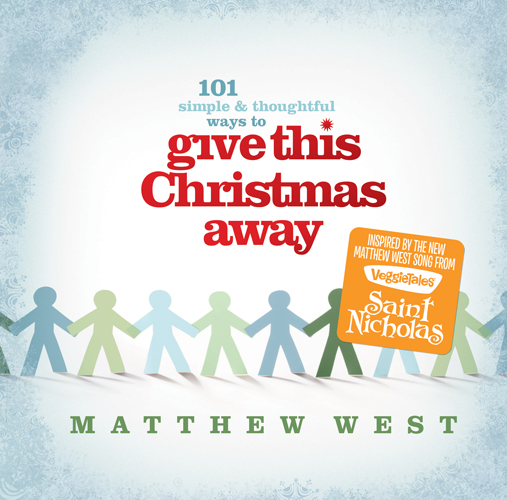
Matthew West wrote Give This Christmas Away based on two simple questions: What if December looked different this year? What if we all just give this Christmas away?
If you are becoming as frustrated as I am with the over-commercialization of Christmas, this book is like a breath of crisp, clean winter air. Matthew West gives us “101 simple and thoughtful ways” to truly focus on the reason for the Christmas season. This is a great book for your family to read together. It will help you begin a meaningful discussion of what Christmas truly means.
I anticipate that this book will become a seasonal classic: with families pulling it out each year as they begin to decorate for Christmas. The ideas in here are simple and easy to put into practice. Just reading this book will open your eyes to numerous possibilities. And if you happen to think of idea number 102 and beyond, log onto the Give This Christmas Away website to share your idea.
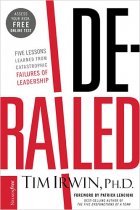
As I read Dr. Tim Irwin’s latest book, Derailed, I thought about a quote from John Maxwell: “A wise man learns from his mistakes. A wiser man learns from others’ mistakes. The wisest man learns from others’ successes.”
The subtitle of this book is “Five lessons learned from catastrophic failures of leadership.” In this, we learn from others’ mistakes. But then Dr. Irwin goes on to show us successes that we can learn from as well. Combining the insight from successful—or should I say “non-derailed” leaders—with his own discernment, Dr. Irwin shows us how to stay on the rails.
When I first noticed that the examples in the book were all high-profile CEOs, I thought, “What could I learn from them? After all, I’m not the CEO of a Fortune 500 company.” But Dr. Irwin does an excellent job of bringing the four qualities of character—authenticity, self-management, humility, and courage—down to a pedestrian level where even we non-CEO-types can benefit from his wisdom.
Although the principles in Derailed can benefit anyone in leadership, or aspiring to a leadership position, this book still might not be for everyone. The six case studies in the book are all derailed CEOs, and unless you have a penchant for the business world, you might not find them very enjoyable reading. However, for those of you who enjoy business history, there is much to gain from a careful reading of Derailed.
In my role as a book reviewer, I am presently reading Derailed. This book has really jolted me wide awake!
Dr. Tim Irwin is walking through the profiles of six high-profile business leaders who got derailed on their path to success. These CEOs seemed to have everything: talent, opportunity, great ideas, a proven track record of success. In short, everything they would need to be successful.
Yet they got derailed.
Here’s the wake-up call for me: The same thing can happen to me. The Apostle Paul wrote his own “derailed” story about the Israelite leaders:
These are all warning markers—danger!—in our history books, written down so that we don’t repeat their mistakes. Our positions in the story are parallel—they at the beginning, we at the end—and we are just as capable of messing it up as they were. Don’t be so naive and self-confident. You’re not exempt. You could fall flat on your face as easily as anyone else. Forget about self-confidence; it’s useless. Cultivate God-confidence.
I don’t want to get derailed, so I’m focusing on God-confidence today.
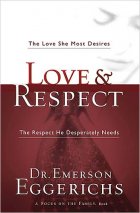
My Grandma used to say this poem, “Good, better, best, never let it rest until your good is better and your better is best.” I thought of this again while reading Emerson Eggerichs’ book Love & Respect. If your marriage is bad, this book can help it get good; if your marriage is already good, this book can help it getter even better; if your marriage is already better, you can use this book to “best it.”
Many of the principles in this book generated an initial push-back from me. I found myself thinking, “I’m not so sure that would work.” But as I read on, I found almost all of those initial hesitancies dissolving.
The book is divided into three overarching sections that cover the three cycles in which your marriage could be: the Crazy Cycle (a bad marriage), the Energizing Cycle (a good marriage), and the Rewarded Cycle (the best marriage). Throughout all of the sections, there is sound, biblically-based counsel for husbands and wives. The title of the book—and most of the underlying principles—come from Ephesians 5:33 where the Apostle Paul tells women to respect their husbands, while husbands are to love their wives.
Be forewarned: the first part of this book felt a little like a commercial for Dr. Eggerichs’ Love & Respect seminar. And oftentimes I felt he was “plugging” his seminar throughout the book. But if you don’t mind the occasional sales-pitch feel, you will uncover some great truths to help your marriage go from bad to better to best.
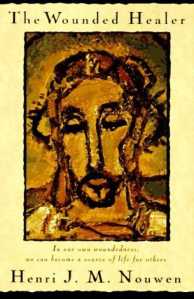
“For the minister is called to recognize the sufferings of his time in his own heart and make that recognition the starting point of his service. Whether he tries to enter into a dislocated world, relate to a convulsive generation, or speak to a dying man, his service will not be perceived as authentic unless it comes from a heart wounded by the suffering about which he speaks” (from the introduction).
Henri Nouwen was a man ahead of his time. Although this book was written in the early 1970s, it sounds so applicable for today. The Wounded Healer challenged me as a Christian leader to step into the pain-filled lives as others in a more authentic way. Nouwen argues that healers must first be personally acquainted with the same type of pain that other wounded people are experiencing.
Isaiah 53 says that Christ “was wounded for our transgressions, He was bruised for our guilt and iniquities; the chastisement [needful to obtain] peace and well-being for us was upon Him, and with the stripes [that wounded] Him we are healed and made whole.” Because Jesus was wounded in the same way we are wounded, He knows how to help (see Hebrews 2:18).
One closing quote from Nouwen: “If there is any posture that disturbs a suffering man or woman, it is aloofness. … No one can help anyone without becoming involved, without entering with his whole person into the painful situations, without taking the risk of become hurt, wounded or even destroyed in the process. The beginning and the end of Christian leadership is to give your life for others.”
This book reconfirmed my desire to—like Jesus—be a wounded healer for others.
You might be thinking, “Why is he reviewing this book?” After all, the subtitle of Marcus Buckingham’s latest book is “What the happiest and most successful women do differently.” Well, guess what? I absolutely loved this book! I’m excited for my wife to be able to read Find Your Strongest Life, but in the meantime, I got so much out of it.
One of the things I love about Marcus Buckingham’s books is that they read just like he sounds: a silky smooth British accent. But it’s not just about style; his books have plenty of substance too. I especially love Marcus’ focus on building on strengths, as opposed to trying to fix weaknesses.
The other thing I appreciate is how affirming Marcus is. His comfortable style feels highly personalized—sort of like he’s sitting on the other side of the coffee table from me.
Find Your Strongest Life opens with some background information on the important timing for this book. Then after taking a simple online assessment to learn your leading and supporting Life Roles, you’ll learn more about how to capture and cradle your strongest moments. Then you’ll learn how to use these strong moments to purposely imbalance your life in favor of those strong moments.
So many of Marcus’ ideas sound counter-intuitive, and yet they ring so true at the same time. From my personal experience from reading and applying the principles in his other books, I can attest that this man knows what he’s talking about. I know I found several takeaways from this book, and I’m especially excited to see how my wife and the other key women in my life are going to be able to use this book to make a stronger life for themselves.
Max Lucado has always had a unique way of turning a phrase, of capturing a moment in Scripture that makes biblical truths pop off the page. I’ve always appreciated the way he can bring first-century truths into twenty-first-century applications. Fearlessis no exception to this.
Fearless is also exceptionally well-timed in its release. Lucado quotes Frank Furedi’s findings that the appearance of the term “at risk” was printed in US newspapers more than 18,000 times in the year 2000. A ninefold increase over the previous six years. A ninefold increase! We are a fear dominated society:
“Fear loves a good stampede. Fear’s payday is blind panic, unfounded disquiet, and sleepless nights. Fear’s been making a good living lately.” —Max Lucado
In his unique style, Lucado unmasks thirteen fears that have been “making a good living.” He unmasks these fears by countering each of them with Christ’s admonishment to us to “Fear not!” This is not a fear-denying book, nor is it a run-for-the-hills-because-the-sky-is-falling book.
Lucado presents a straightforward look into our most besetting fears and shows the fears for what they really are: monsters in the dark. And once these “monsters” are exposed to the light of Jesus Christ, they become toothless, harmless shadows.
A great read for anyone! I also loved the discussion questions at the back of the book. These helped me confront some fears head-on. They would also be an excellent springboard for a Bible study group.
I’m giving this book five unreserved stars! Imagine your life without fear— you can do it—this book will help.
I’m a HUGE John Maxwell fan. He has been a mentor-from-afar for me for a number of years. So I know whenever I pick up a Maxwell book I’m going to be challenged and stretched in my thinking. Put Your Dream To The Test lived up to my expectations.
What’s your dream? Everyone has a dream, so what’s yours? I have always loved this quote from T.E. Lawrence:
“All men dream, but not equally. Those who dream by night in the dusty recesses of their minds, wake in the day to find that it was vanity: but the dreamers of the day are dangerous men, for they may act on their dreams with open eyes, to make them possible.”
If you are a “dreamer of the day” you will find great value in reading this. In this book, Dr. Maxwell guides you through ten questions to help you refine the pursuit of your dream—
Is my dream really my dream?
Do I clearly see my dream?
Am I depending on factors within my control to achieve my dream?
Does my dream compel me to follow it?
Do I have a strategy to reach my dream?
Have I included the people I need to realize my dream?
Am I willing to pay the price for my dream?
Am I moving closer to my dream?
Does working toward my dream bring satisfaction?
Does my dream benefit others?
In typical Maxwell fashion, I was challenged to think differently, I was encouraged to renew what I have already learned, and I realized some things I needed to give up. One of the aspects of Maxwell’s books that I especially appreciate is how energized I feel after reading them. I feel like the counsel he gives me has prepared me to live my life more fully.
If you have a dream that is bigger than you, good! If you have a dream that size, I would strongly recommend that you read this excellent book to help you see your dream and seize your dream.
I have read almost everything that Stephen Covey has written, so when I saw this newest title—Everyday Greatness—with his name on it, I was really looking forward to it. I know the classic rule is “Never judge a book by its cover,” but I admit I broke this rule!
When I saw “Stephen Covey” on the cover I was prepared for his typical thought-provoking insights. Instead what I got in Everyday Greatness was anecdotal support of Covey’s profound teachings from other authors. I was actually pleasantly surprised by this.
The premise of this book is similar to Covey’s other books; namely, you have the power to make the choices that will make your life more effective, more fulfilling, and more beneficial to those around you. Everyday Greatness reinforces this message by letting you hear Covey’s thoughts through the stories of “everyday people.”
The book is divided up into seven categories that everyday people live each day—
Searching for meaning
Taking charge
Starting within
Creating the dream
Teaming with others
Overcoming adversity
Blending the pieces
Each of these seven categories is supported by three principles, and each of these principles are illustrated by three short stories and a few pages of noteworthy quotes. So in essence Everyday Greatness presents Covey’s thoughts in 63 short stories and several pages memorable quotes.
Stories are so much more effective at driving a point home than is a lecture, and these stories are the perfect length for anyone. This is a book I’ll keep handy on my shelf so I can return to these stories time and time again. An excellent read!
The other day a friend of mine wrote on Facebook that he was shopping with his daughter. He half-jokingly added, “I think that is her love language!” I say half-jokingly because I think the time with Daddy was speaking volumes to his daughter.
Spending time shopping with Dad was filling her love tank!
Have you ever felt like one of your relationships was in a rut? Or maybe even in a rut with ends in it (also known as a grave!)? Do you ever feel like the other person just doesn’t get you? Have you ever been frustrated that the other person doesn’t understand all that you are doing for him/her?
My guess is that you are speaking different love languages.
Dr. Gary Chapman wrote an amazing book called The Five Love Languages. In his book, he lays out five “languages” that we use to communicate our love to one another:
Words of affirmation
Quality time
Gifts
Acts of service
Physical touch
When you and I communicate, we naturally communicate in a way that is most comfortable to us. We communicate in our primary love language. But if the other person in the relationship has a different love language, no matter how much you love them, you are simply not getting through effectively. You are leaving the other person with a near-empty love tank.
I would suggest you start by taking a brief love language assessment (download the free PDF here → 5 Love Languages assessment) to determine YOUR OWN love language first. This is the language you will feel most comfortable using. Second, you need to learn the love languages of OTHERS CLOSE TO YOU so you can change your love dialect.
In the great love chapter in the Bible, the apostle Paul says this, “When I was a child, I spoke and thought and reasoned as a child. But when I grew up, I put away childish things” (v. 11, New Living Translation). Our love—and the way we express it to others—should always be growing up. If you are trying to communicate your love to someone special in the same ways (the same “languages”) you’ve always used, there’s a good chance your love is being viewed as childish.
As you mature in your expressions of love — as you speak the other person’s love language — you will begin to fill their love tank. Guess what happens next? Out of a full love tank, the other person is motivated to begin to speak your love language, to fill your tank. It can become so much fun to love with a full tank! Because when the other person’s love tank is full, almost any love language will work for them—wow, what a blast!
UPDATE… my friend Greg Heeres and I host a leadership podcast on YouTube. Recently, we discussed the value of leaders learning and speaking the love languages of their teammates.



 I’m a HUGE


 Craig T. Owens