According to Romans 12, all Christians have been given a unique gift package by God. We are to use these motivational gifts to make God’s Kingdom more visible and more desirable.
This week we discuss the gifts of teaching and exhortation. You may download the participant’s notes and the gifts assessment I use in this lesson:
According to Romans 12, all Christians have been given a unique gift package by God. We are to use these motivational gifts to make God’s Kingdom more visible and more desirable.
This week we discuss the gifts of teaching and exhortation. You may download the participant’s notes and the gifts assessment I use in this lesson:
According to Romans 12, all Christians have been given a unique gift package by God. We are to use these motivational gifts to make God’s Kingdom more visible and more desirable.
This week we discuss the gifts of prophecy and serving. You may download the participant’s notes and the gifts assessment I use in this lesson:
This is a weekly series with things I’m reading and pondering from Charles Spurgeon. You can read the original seed thought here, or type “Thursdays With Spurgeon” in the search box to read more entries.
Listen to the podcast of this post by clicking on the player below, and you can also subscribe on Apple, Spotify, or Audible.
Accepting It For What It Is
…For the mouth of the Lord has spoken (Isaiah 1:20).
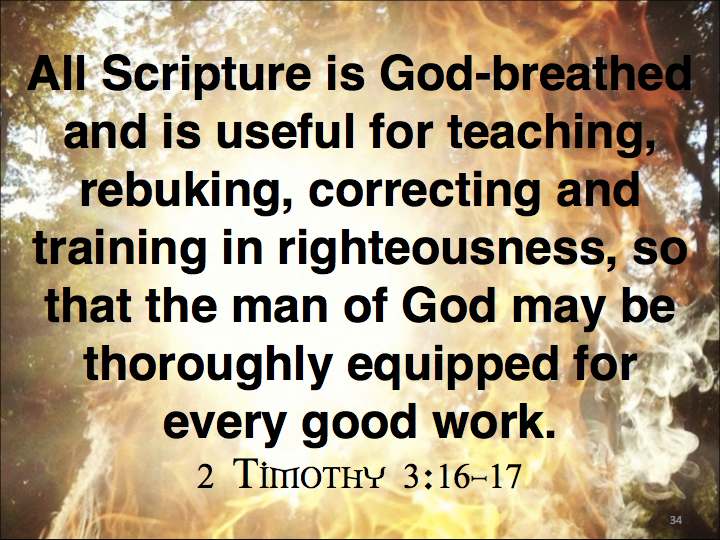
In the Word of God the teaching has unique dignity. This Book is inspired as no other book is inspired, and it is time that all Christians avowed this conviction. …
Where are we if our Bibles are gone? Where are we if we are taught to distrust them? If we are left in doubt as to which part is inspired and what is not, we are as badly off as if we had no Bible at all. I hold no theory of inspiration. I accept the inspiration of the Scriptures as a fact.
During the summer months, I like to lead my congregation through a study of the Book of Psalms. Currently, we are looking at the psalms that contain the word Selah.
It is distressing to me to see how many “modern” translations of the Bible either relegate the word Selah to a footnote (like the NIV which says, “The Hebrew has Selah [a word of uncertain meaning] here”), or completely disregard this word (e.g. The Message, The Contemporary English Version, and The Living Bible, to name a few).
Why? Do we think we are so much smarter now that we know which words the Holy Spirit truly inspired, and which ones we can leave out?
Once we start down this path, what is to stop us from modifying any word in the Bible? Many liberal-minded people want to tell us “what God really meant” in some passages, or to water down the inspiration so much to try to make it “culturally relevant” that they end up destroying its very meaning. This is not only a slippery slope, but it is something that God has already warned us against doing:
I warn everyone who hears the words of the prophecy of this scroll: If anyone adds anything to them, God will add to that person the plagues described in this scroll. And if anyone takes words away from this scroll of prophecy, God will take away from that person any share in the tree of life and in the Holy City, which are described in this scroll. (Revelation 22:18-19)
Let us accept the Word of God for what it is: Words that the mouth of Almighty God has spoken, not words that we think can be modified, improved, or eliminated.
According to Romans 12, all Christians have been given a unique gift package by God. We are to use these motivational gifts to make God’s Kingdom more visible and more desirable.
This is the introductory lesson in this series. You may download the participant’s notes and the gifts assessment I use in this lesson:
If you would like to join us in person for this class, here is where you can find us. If you have missed any of the classes in this series, check them out here:
The word Selah appears nearly 70 times in the Bible, almost exclusively in the Psalms. Although it is primarily a musical term, it applies beautifully to our summer series.
Selah can mean…
a pause from the noise to reflect;
a preparation for an exciting accent; or
a reflective time of consideration
Throughout the Psalms, Selah appears at the end of a verse, at the end of the psalm, or sometimes even mid-sentence. But each one of them is perfectly placed by the Spirit-inspired authors to get us to take a breath and deeply contemplate what we just read or sang.
Summertime is typically a time for us to pause from our regular routine. Perhaps it’s a vacation, time with friends and family, driving around with the windows down and the music blasting, or just a quiet walk through woods or along a beach. In any case, whether we realize it or not, we’re actually doing Selah in these break-from-the-routine activities.
Join me this Sunday as we continue our summertime look at each of the Psalms that ask us to Selah. I think you will find that this Sunday summertime pause will be both refreshing and encouraging. You can join me either in person or on Facebook or YouTube.
Since this is a continuation of our summer series, you can check out the Selahs we discussed by clicking here for the 2018 messages, here for the 2019 messages, here for the 2020 messages, and here for the 2021 messages.
Listen to the podcast of this post by clicking on the player below, and you can also subscribe on Apple, Spotify, or Audible.
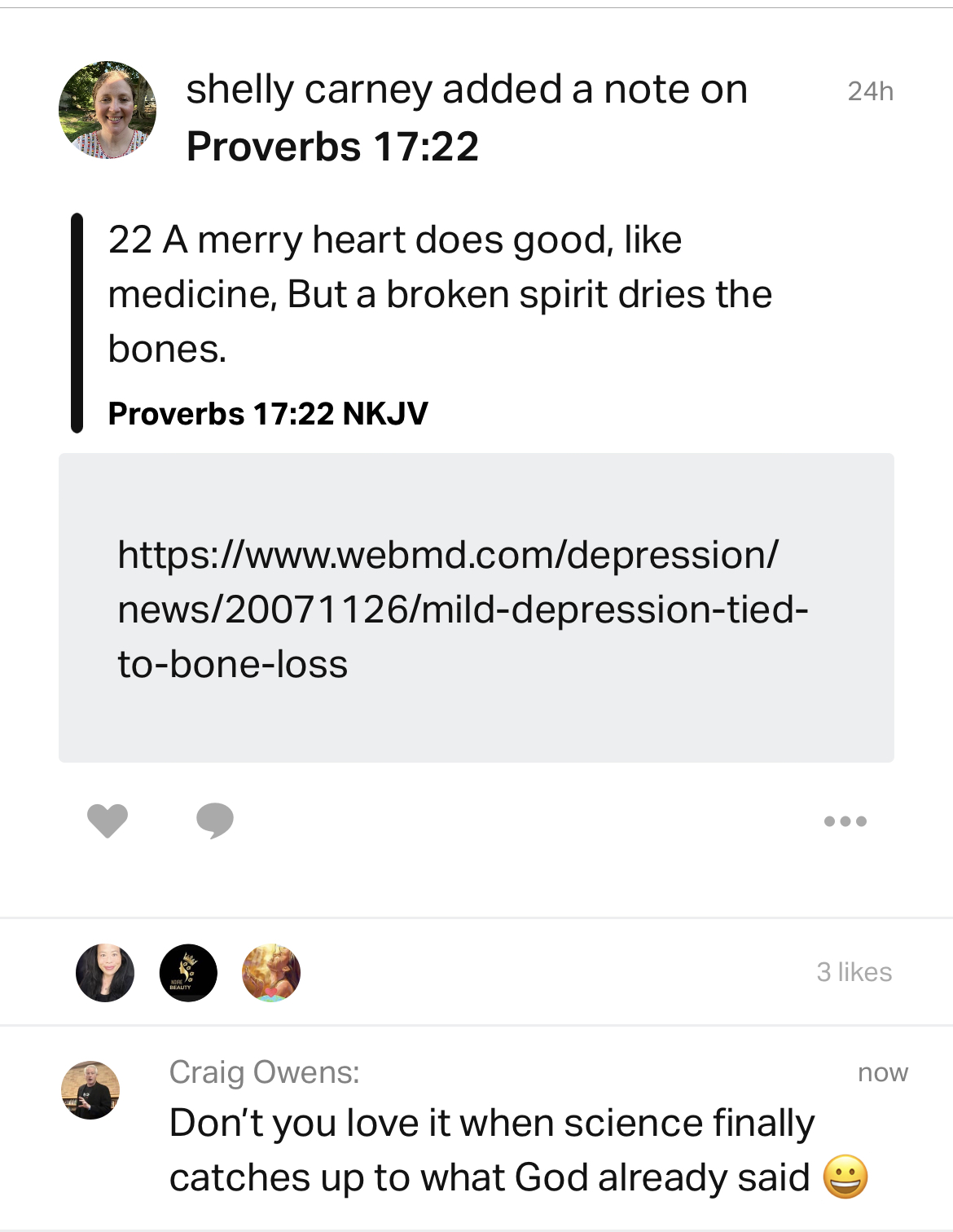
I just love it when science catches up with what God has already pronounced in the Bible!
I’ve blogged previously about psychology, archeology, and astronomy uncovering truths that have already been stated in the Bible, but there are also numerous recent medical discoveries that confirm what Scripture has already been telling us.
Like the fact that there is a healthy way to relieve stress, and that retaining the stress hormone cortisol in our bodies for too long has serious implications. The apostle Paul tells us to not “be anxious about anything” but to enjoy “the peace of God which transcends all understanding” (Philippians 4:4-7).
And then there is this finding that my YouVersion friend Shelly pointed out. “A happy heart is good medicine and a cheerful mind works healing, but a broken spirit dries up the bones” (Proverbs 17:22 AMP).
In a WebMD article, medical science confirms this truth of dried-up bones resulting from depression. They wrote, “Even mild depression may significantly increase a woman’s risk for developing osteoporosis. … The level of bone density loss attributed to depression in the study was similar to that previously associated with other well-known osteoporosis risk factors, including smoking cigarettes and getting little or no exercise. … Bone mineral density testing revealed that 17% of the depressed women showed evidence of bone thinning at a particularly vulnerable area of the thigh bone, compared to 2% of women who were not depressed.”
The Bible is God’s inspired Word to humankind, which means it is never out of date. The principles God has shared with us stand the test of time and are continually verified by the brightest scientific minds.
So here is my challenge to you: Take God at His Word, and apply the principles He has given you. I think you will find how much better your life will go when you live God’s way.
This is a weekly series with things I’m reading and pondering from Charles Spurgeon. You can read the original seed thought here, or type “Thursdays With Spurgeon” in the search box to read more entries.
Listen to the podcast of this post by clicking on the player below, and you can also subscribe on Apple, Spotify, or Audible.
Top Priority
…For the mouth of the Lord has spoken (Isaiah 1:20).
Every word that God has given us in the Bible claims our attention because of the infinite majesty of Him who spoke it. … See that you refuse not Him who speaks. O my hearer, let it not be said of you that you went through this life, God speaking to you in His book, and you refusing to hear! It matters very little whether you listen to me or not. But it matters a very great deal whether you listen to God or not. It is He who made you. In His hands is your breath. And if He speaks, I implore you, open your ears and be not rebellious. There is an infinite majesty about every line of Scripture, but especially about that part of Scripture in which the Lord reveals Himself and His glorious plan of saving grace in the Person of His dear Son Jesus Christ. …
For what He has spoken He still speaks to us, as freshly as if He spoke it for the first time. …
God’s Word has a claim, then, upon your attention because of its majesty and its condescension. But, further, it should win your ear because of its intrinsic importance. ‘The mouth of the Lord has spoken,’ so it is no trifle. God never speaks vanity. No line of His writing treats of the frivolous themes of the day. That which may be forgotten in an hour is for mortal man and not for the eternal God. When the Lord speaks, His speech is Godlike, and its themes are worthy of one who is dwelling in infinity and eternity. …
He speaks to you of great things that have to do with your soul and its destiny. It is not a vain thing for you, because it is your life. Your eternal existence, your happiness or your misery, hang on your treatment of that which the mouth of the Lord has spoken. … Treat not the Word of the Lord as a secondary thing that might wait your leisure and receive attention when no other work is before you. Put all else aside and hearken to your God.
From The Infallibility Of Scripture
Charles Spurgeon is so on-target with these words. Believe it or not, this sermon was actually delivered to his fellow pastors. But the words are true for all of us—we must make listening to God’s Word our first priority.
Every single word of Scripture is inspired by the Holy Spirit. And I do mean every single word. Even the order in which the words are listed is inspired. So when you read your Bible, ask the Holy Spirit—the Author of the text—to illuminate the words to you. Ask questions like:
What did that mean then?
What does it mean now?
What does it mean for me?
Does something in my life need to change?
If you make your time with God a priority, He will reveal more of Himself to you each time you open your Bible.
We will be meeting at 6:00 on Wednesdays to discuss how to apply to our daily lives the lessons from the most recent Sunday sermon. Even if you missed the Sunday message, there will be so much for you to learn at our mid-week Bible studies.
This is a weekly series with things I’m reading and pondering from Charles Spurgeon. You can read the original seed thought here, or type “Thursdays With Spurgeon” in the search box to read more entries.
Listen to the podcast of this post by clicking on the player below, and you can also subscribe on Apple, Spotify, or Audible.
Encouragement For Preachers
…For the mouth of the Lord has spoken (Isaiah 1:20).
We preach because ‘the mouth of the Lord has spoken.’ It would not be worth our while to speak what Isaiah had spoken if in it there was nothing more than Isaiah’s thought—neither should we care to meditate hour after hour upon the writings of Paul, if there was nothing more than Paul in them. … The true preacher, the man whom God has commissioned, delivers his message with awe and trembling because ‘the mouth of the Lord has spoken.’ …
Woe unto us if we dare to speak the Word of the Lord with less than our whole heart and soul and strength! Woe unto us if we handle the Word as if it were an occasion for display! If it were our own word, we might be studious of the graces of oratory. But if it is God’s Word, we cannot afford to think of ourselves. … Because the mouth of the Lord has spoken the truth of God, we therefore endeavor to preach it with absolute fidelity. …
Believing that ‘the mouth of the Lord has spoken,’ it is my duty to repeat God’s Word to you as correctly as I can after having heard it and felt it in my own soul. It is not mine to amend or adapt the gospel. …Again, dear friends, as ‘the mouth of the Lord has spoken,’ we speak the divine truth with courage and full assurance. Modesty is a virtue, but hesitancy when we are speaking for the Lord is a great fault. …
We preach not the gospel by your leave. We do not ask tolerance nor court applause. We preach Christ crucified, and we preach boldly as we ought to speak because it is God’s Word not our own. … We cannot use ‘ifs’ and ‘buts,’ for we are dealing with God’s ‘shalls’ and ‘wills.’ If He says it is so, it is so. And there is the end of it. Controversy ceases when Jehovah speaks [Jeremiah 1:17-19].
From The Infallibility Of Scripture
Preaching God’s Word is not for the faint of heart. It takes one who is confidently humbled—confident that God has spoken and humbled that He would choose someone like me to speak His Word to His people.
Check this out: “Now Moses was a very humble man, more humble than anyone else on the face of the earth” (Numbers 12:3). Who wrote the book of Numbers? If you answered “Moses,” you are correct. Doesn’t that sound a bit brash to declare that you are more humble than anyone else on the earth? Yet, God allowed Moses to pen those words, making that a Holy Spirit-inspired statement of fact. Humility is a double-edged sword: it can serve a leader well when it is balanced with appropriate confidence, but it is a detriment to an organization’s health if it is self-de-basing humility that undercuts a leader’s credibility.
The God-honoring preacher gets his message from the mouth of the Lord, and then confidently endeavors “to preach it with absolute fidelity.” Whether others praise of criticize, the humble leader says, “I am only God’s servant speaking God’s Word.”
Preachers, let’s make sure that everything we confidently and humbly share from our pulpits is the whole counsel of what has been spoken by the mouth of the Lord.



 According to Romans 12, all Christians have been given a unique gift package by God. We are to use these motivational gifts to make God’s Kingdom more visible and more desirable.




 Craig T. Owens