Thursdays With Spurgeon—God Our Healer

This is a weekly series with things I’m reading and pondering from Charles Spurgeon. You can read the original seed thought here, or type “Thursdays With Spurgeon” in the search box to read more entries.

Listen to the podcast of this post by clicking on the player below, and you can also subscribe on AppleSpotify, or Audible. 

God Our Healer

O Lord my God, I cried out to You, and You healed me. O Lord, You brought my soul up from the grave; You have kept me alive, that I should not go down to the pit. (Psalm 30:2-3) 

     God is the best Physician, even for our bodily infirmities. We do very wickedly and foolishly when we forget God. It was a sin in Asa that he trusted physicians and not God (2 Chronicles 16:12). If we must have a physician, let it be so, but still let us go to our God first of all. And above all remember that there can be no power to heal in medicine of itself; the healing energy must flow from the divine hand. …

     If our watch is out of order, we take it to the watchmaker; if our bodies or souls are in an evil plight, let us resort to Him who created them, who has unfailing skill to put them in right condition. As for our spiritual diseases, nothing can heal these evils but the touch of the Lord Christ: if we do but touch the hem of His garment, we shall be made whole….

From Spurgeon And The Psalms

God has created us as a soul with a body. I believe that physical ailments can be attended to by a medical doctor, emotional distress should be addressed by a counselor, and spiritual issues should have the wisdom of a pastor. 

But let’s always remember that since God created our body, soul, and spirit, He is the Ultimate Source of wisdom for any areas that are out of alignment. So as Spurgeon says, seek out a doctor, counselor, or pastor, but go to God first. 

God may bring divine healing that requires no other intervention, or He may heal through medicine or counseling, but ultimately He is THE Healer.

►► Would you please prayerfully consider supporting this ministry? My Patreon supporters get behind-the-scenes access to exclusive materials. ◀︎◀︎

Creating A Peaceful Environment

Listen to the podcast of this post by clicking on the player below, and you can also subscribe on AppleSpotify, or Audible. 

The Israelites fought constantly with the Philistines throughout Saul’s lifetime… (1 Samuel 14:52). 

Have you ever worked in a hostile environment? I was involved with one organization where all of the staff members called the weekly meeting the “staff beating” instead of the staff meeting. This was largely because the senior leader started off every meeting by asking for problems that needed to be addressed, but then he “addressed” the problem by attacking the person who shared the problem. 

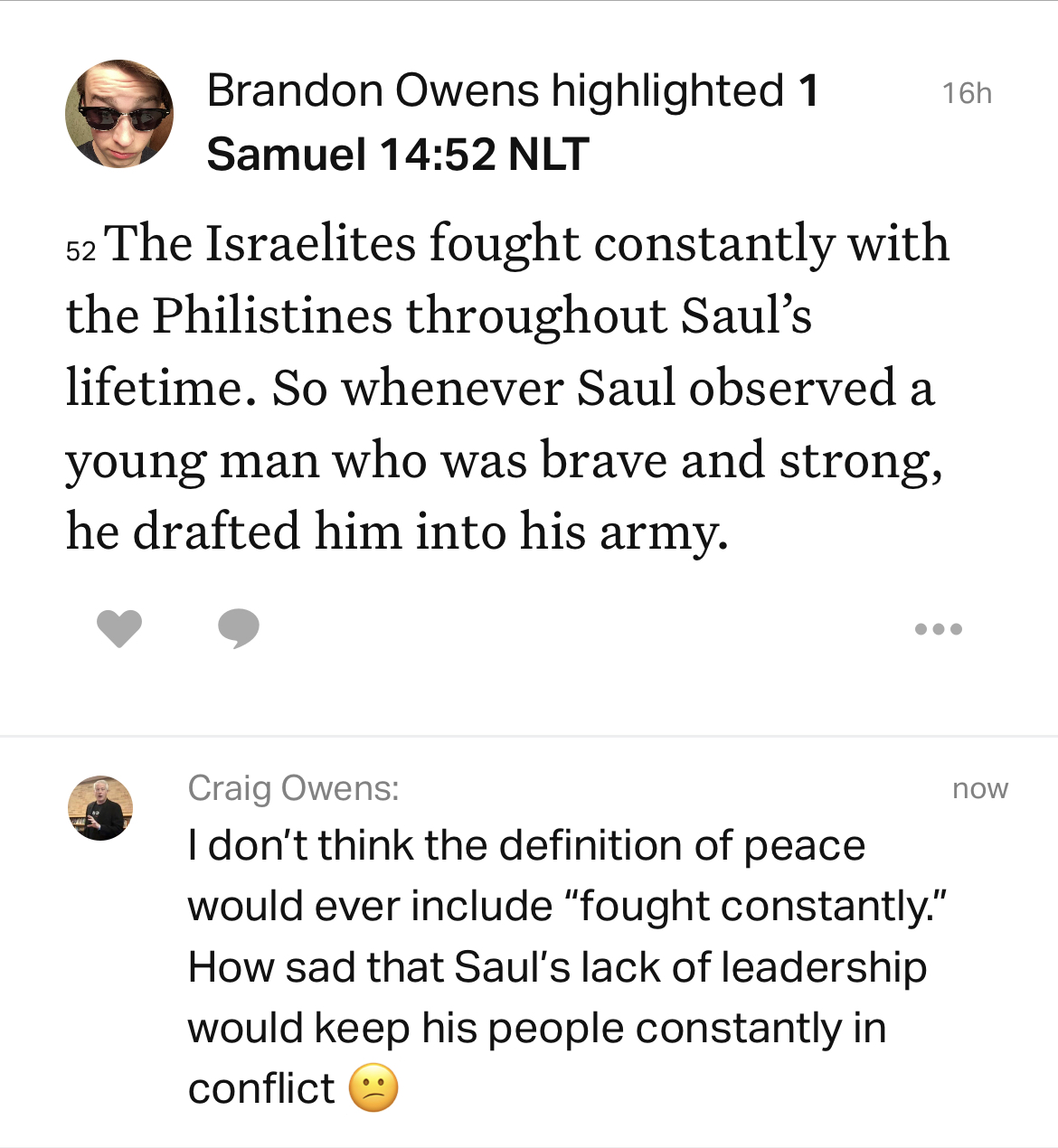
I was reminded of this recently when I was scrolling through YouVersion and saw that my son had highlighted 1 Samuel 14:52 that said that Saul’s reign as king was noted for the constant fighting. I added the comment, “I don’t think the definition of peace would ever include ‘fought constantly.’ How sad that Saul’s lack of leadership would keep his people constantly in conflict.” 

Make no mistake about it: It was his poor leadership that created this environment. We often read of his jealousy of anyone else who was successful, and we see that although he had a loyal army, he kept them bottled up. 

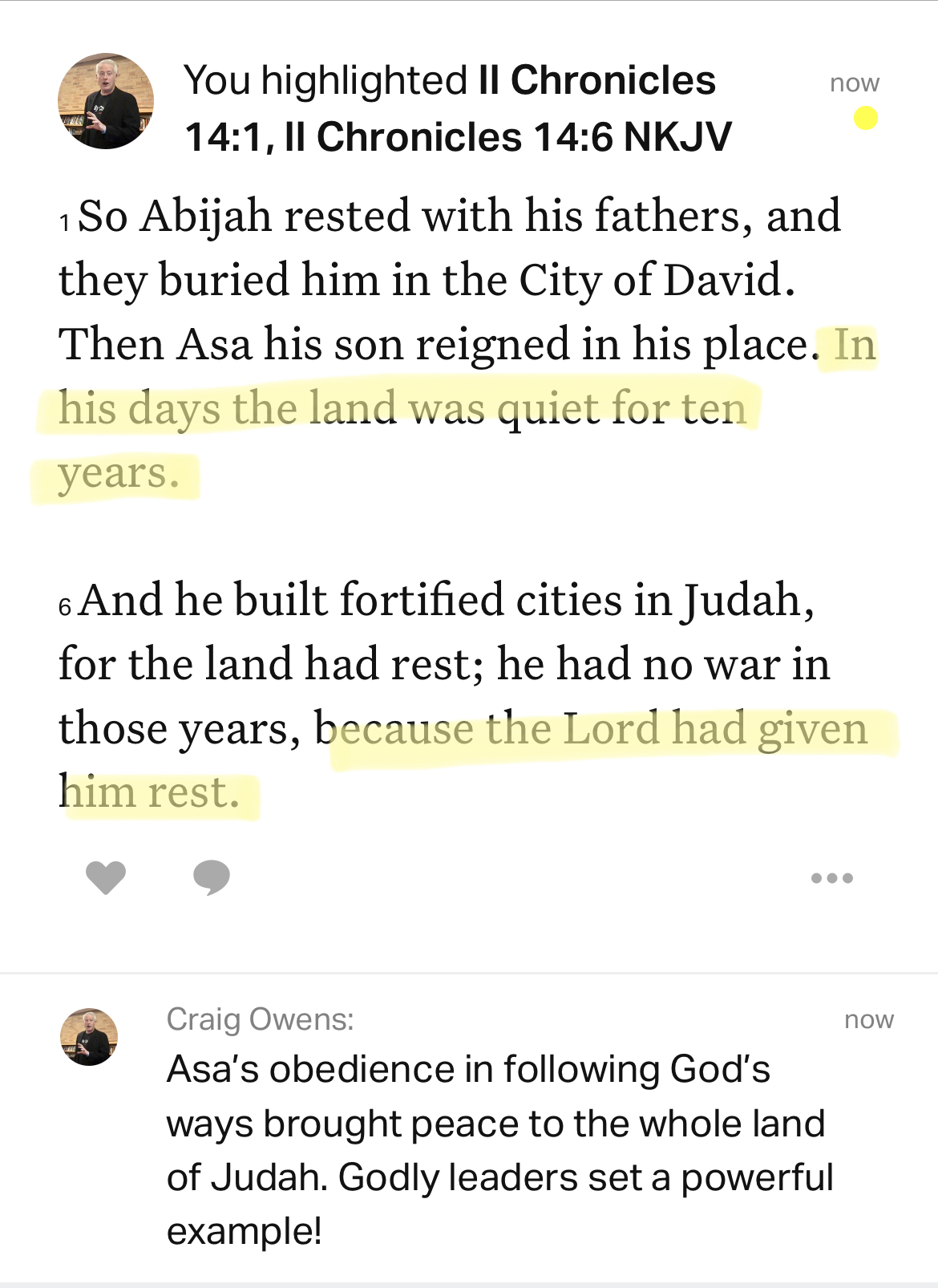
On the other hand, consider this statement about the reign of king Asa: “In his days the land was quiet for ten years. … He had no war in those years, because the Lord had given him rest” (2 Chronicles 14:1, 6). This peace and quiet and rest is directly tied to Asa’s obedience to God’s laws. 

A mark of a godly leader is one whose obedience to God fosters an environment of peace for his people. 

This is part 62 in my series on godly leadership. You can check out all of my posts in this series by clicking here. And I would also encourage you to check out my book Shepherd Leadership: The Metrics That Really Matter, where I outline in more detail the characteristics of godly leadership. 

►► Would you please prayerfully consider supporting this ministry? My Patreon supporters get behind-the-scenes access to exclusive materials. ◀︎◀︎
Finishing Well Is Better

Listen to the podcast of this post by clicking on the player below, and you can also subscribe on iTunes or Spotify.

The land was at peace… (2 Chronicles 14:6).

King Asa started out so well. The beginning of his reign could best be described by the word “peace”:

  • The land was at peace 
  • No one was at war with him 
  • The Lord gave him rest 
  • “[God] has given us rest on every side”  
  • The Lord his God was with him

When Cush attempted to attack the nation of Judah, Asa called on God: “Lord, there is no one like You to help the powerless against the mighty. … Do not let mere mortals prevail against You” (14:11). God gave Asa a great victory over Cush, and other God-fearing people from Israel began flocking to Judah “when they saw that the Lord his God was with [Asa]” (15:9). 

This peace lasted for 35 years!

And then came one poor decision from which Asa never recovered. 

The king of Israel began to make preparations for war against Judah. Instead of calling on God as he did when Cush was preparing to attack, Asa reverted to political maneuvering. He sent a bribe to a rival nation, enticing them to attack Israel. 

The prophet Hanani told Asa, “The eyes of the Lord range throughout the earth to strengthen those whose hearts are fully committed to Him. You have done a foolish thing, and from now on you will be at war” (16:9). 

From “the land was at peace” to “from now on you will be at war” came about because Asa…

  • …trusted his own ingenuity instead of relying on God 
  • …calculated his odds instead of calling on his God 
  • …forgot about God’s past provision 
  • …refused to confess his sin and repent from it, even when the prophet called him out
  • …utterly abandoned his God (16:2-12) 

Starting well is good, but finishing well is far better! 

A mark of a godless leader is one who refuses to confess and repent from his sin. 

Asa’s refusal to admit his sin resulted in the end of his life being spent afflicted with disease and his country being surrounded and oppressed by enemies. 

This is part 54 in my series on godly leadership. You can check out all of my posts in this series by clicking here.

Links & Quotes

link quote

“To fulfill God’s destiny for your life, you likely don’t have to do more; you have to do less. … Enjoy the Christmas season. Wrap the presents. Prepare your home in a festive way. Make memories with your family. But don’t let this Christmas pass without spending some time at Jesus’ feet. Long after everything else fades from this Christmas, worshiping Jesus is all that will truly last.” —Rick Warren

“Holidays in America have come to be regarded as entitlements. They’re all about us, seasons of diversion, distraction, self-indulgence, and time off work. Even the great religious celebrations of the national calendar—Thanksgiving, Christmas, and Easter—are regarded by most Americans as opportunities to get some good bargains and enjoy a little time for relaxation, not for spiritual reflection and renewal, but just for doing whatever we want. Sort of like the way most Christians observe the Lord’s Day.” —T.M. Moore

As we are celebrating the First Advent, J. Warner Wallace asks a great question: Why didn’t the Apostle Paul mention the virgin conception?

“I am convinced many Christians today are troubled for the same reason Asa was [2 Chronicles 16:1-9]. They have war in their souls because they have traded faith for self-reliance. But the fact is, there is no way a follower of Jesus can have faith in any other source and not be troubled.” —David Wilkerson

“People who are exercised and preoccupied with such things as how the star worked and how the Red Sea split and how the manna fell and how Jonah survived the fish and how the moon turns to blood are generally people who have what I call a mentality for the marginal. You do not see in them a deep cherishing of the great central things of the gospel—the holiness of God, the ugliness of sin, the helplessness of man, the death of Christ, justification by faith alone, the sanctifying work of the Spirit, the glory of Christ’s return and the final judgment. They always seem to be taking you down a sidetrack with a new article or book. There is little centered rejoicing.” —John Piper

“Whether one makes the observation light-heartedly or in all seriousness, one must observe that, when the male body unites for procreation with the female, the pleasure that goes along with it is understood to be in accordance with nature, but that when male joins with male, or female with female, it is outside the bounds of nature. This outrage was first done by people whose desire for pleasure was without self-control.” —Plato. This agrees with what the Bible says in Romans 1:26-27.

Lenny Esposito has some good advice for students to defend their Christian faith in the classroom.

Seth Godin has some insight on whining—“Before starting, a question: Will it help? Like holding a grudge, or like panicking, whining rarely helps. If anything, any of the three make it far less likely that you’ll make progress solving the problem that has presented itself. And, like knuckle cracking, it’s best enjoyed alone.”

[VIDEO] Bobby Conway asks Lenny Esposito how to handle the claim “The Bible has contradictions in it”—

Finishing Well

Asa started so well, accomplished so many things, was known for his greatness, won an unbelievable victory, made the tough choices that the people loved, and then faded into disrepute.

Starting well is important; finishing well is so much more important. After we’re gone, people usually remember us for how we went out.

Asa was a great king of Judah (see 2 Chronicles 14-16). He began to clean out all of the false gods and pull down the places where these idols were worshipped. The people were so unified behind Asa that none of their enemies even dared to attack them. And Asa recognized this. He said, “The land is ours and is at peace because we have sought God; we’ve sought Him and He’s given us peace everywhere.”

An army from Cush (modern-day Sudan and Libya) marched up to challenge Asa in battle. The Cushites came with an army too large to even count, while Asa had about 500,000 fighting men. Asa and his men called on God, and God helped them win an incredible victory. In fact, they inflicted such heavy casualties on the Cushites that they never returned to their former strength.

Then something happened.

Baasha, the king of Israel, began fortifying the city of Ramah. This wasn’t hostile in itself, but it did look to Asa like the build-up to war. Israel’s army wasn’t nearly the size of the army of Cush that Asa had just seen God help him defeat. But instead of calling on God, Asa bribed Ben-Hadad, king of Aram, to break his treaty with Israel. This political turnabout caused Baasha to quit building up Ramah to move his forces to protect himself from Aram.

At first glance, it looks like Asa won. He was the clever one. He did it himself. And there’s the problem: he did it himself—he didn’t rely on God.

Why did Asa do this? Why did he abandon God? Why didn’t he seek God as he did before?

The prophet Hanani came to ask Asa these very questions. Hanani told Asa it was foolish of him to turn his back on God. Instead of this prompting Asa to recognize he had slipped away from God, he got angry and threw Hanani in prison. Then in his guilt-provoked rage, Asa began to oppress his own people.

A short time later Asa contracted some sort of disease in his feet. The Bible says, “Though his disease was severe, even in his illness he did not seek help from the Lord, but only from the physicians.”

Asa started out so well, yet finished so poorly. Starting well is important; finishing well is so much more important.

The Lord is with you when you are with Him. If you seek Him, He will be found by you, but if you forsake Him, He will forsake you (2 Chronicles 15:2).

What are you doing today to make sure you finish well? The best thing you can do is seek God with all your heart. Do that and you will finish well. People usually remember us for how we go out.

Finish well.