Manufactured Success

Listen to the podcast of this post by clicking on the player below, and you can also subscribe on AppleSpotify, or Audible.

Does success come from hard work, or does it have another origin? We can certainly manufacture success by doing some public relations, some spin, some creative promotion. And from the outside, it can look very successful. Someone may even do such a good job manufacturing their success that they begin to believe their own press releases.

But humanly manufactured success rarely lasts.

Consider the case of a man named Adonijah. He was the heir-apparent in Israel. As the oldest living son of the famed King David, Adonijah was the odds-on favorite to be the next king. And so Adonijah began to manufacture a successful transfer of power for himself. He invited all the right people and ignored those who he knew wouldn’t go along with his plan. He set up everything just the way a prince ascending the throne should have it. His followers joined him for a party and began to raise their glasses in a toast: Long live King Adonijah!

Except God—and King David—had other plans. Just as God directed, David had his son Solomon anointed king. When the few followers that were toasting Adonijah heard this, they all bailed on him and ran away. Even Adonijah recognized that something else can trump manufactured success. Here’s what he said:

“As you know,  the kingdom was mine. All Israel looked to me as their king. But things changed, and the kingdom has gone to my brother; for it has come to him from the LORD.” (1 Kings 2:15)

Success has come to him from the Lord.God’s success always trumps humanly manufactured success.

Manufactured success leads to pride (the kingdom was mine). And pride over-exaggerates our self-worth and obscures reality (all Israel looked to me as their king). God’s success comes to the humble who recognize His lordship and their place in His Kingdom. God’s success lasts.

Although Adonijah eventually recognized this, he didn’t learn from it. In the next scene, he is again trying to manufacture a way to ascend to the throne. And this time he not only loses his position but his life as well.

Here’s what Jesus says: For whoever exalts himself will be humbled [manufactured success], and whoever humbles himself will be exalted [God’s success].

►► Would you please prayerfully consider supporting this ministry? My Patreon supporters get behind-the-scenes access to exclusive materials, like this recent Bible study tip from the Book of Ecclesiastes. ◀︎◀︎

Happy New (School) Year

This is a new year for many people, especially students heading to college, or families with school-aged children. We’re all coming out of the fun-and-sun times of the summer, and it’s time to get back to a more normal routine.

With this return to routine, many people make New (School) Year’s resolutions. If you’re going to make them, you should do your best to keep them, don’t you think? So here are a few quick bullet points from my message on Sunday.

  • Check your motivation—be motivated by something which will last into eternity.
  • Set realistic goals—we often overestimate what we can get done in a day, and underestimate what we can get done in a year.
  • Don’t quit when you slip—there’s always slip-ups with new things, so be prepared for it, and don’t throw in the towel when it happens.
  • Start now—the Bible uses the word today twice as often as tomorrow, and uses now 1000 times more than later. Get the point? Don’t wait!

And two more tips that may help:

Guys—studies show you are more likely to follow through on your resolutions if you set specific goals (like: read one chapter a day, or exercise for 30 minutes three times a week).

Ladies—studies also show you are more like to stick with your resolutions if you tell a friend what you have resolved to do differently, and then ask that friend to follow up with you.

Happy new (school) year!

Pray Now

Listen to the podcast of this post by clicking on the player below, and you can also subscribe on AppleSpotify, or Audible.

The Gibeonites had a great strategy. They had heard about the advancing Israelite army, they knew how God had given them victory at every step of the way, and they knew that the Israelites weren’t going to make a peace treaty with anyone living even remotely close to them. So the Bible says the Gibeonites resorted to a ruse (v. 4).

They put on worn-out shoes and clothes and packed moldy bread. That way they would have all of the appearances of a delegation that traveled a long, long distance. And it worked. The Israelites examined their clothing and food and said, “Yep, it sure looks like you made a long journey to get here. We’re convinced.”

The Bible records an important footnote—

The men of Israel sampled their provisions but did not inquire of the Lord (v. 14).

How many times do I do this…

  • …I use my five senses, but not the wisdom of the Holy Spirit?
  • …I use my logical brain, but not the supernatural resources of God?
  • …I use my experiences, but not the insight of an All-Knowing God?

I have to make it a habit to pray about EVERY decision. It might only be a 5-second prayer, but I must inquire of the Lord.

►► Would you please prayerfully consider supporting this ministry? My Patreon supporters get behind-the-scenes access to exclusive materials. ◀︎◀︎

Too Good To Be True

You know the old cliché: If something sounds too good to be true, it probably is. Yet time after time we buy into the hype…

  • “I get all of this for free!”
  • “I’ll be able to make this big score and it’s gonna cost me next to nothing.”
  • “He agreed to help me out with this just because he likes me. He’s not charging me a dime.”
  • “I think they really want to be my friend.”

It never works out that way, does it? Because if it sounds too good to be true, it probably is.

Do you know when those with these great offers show up? Right after you’ve done something well. Like Abraham in the Bible when he had just won a dramatic victory.

Here’s what happened. The bad guys swept in, defeated the good guys, and in carrying off the loot from their victory, they took Abraham’s nephew Lot with them. Abraham called out his special forces team and conducted a surprise night raid on the bad guys’ lair. He not only rescued Lot but all of the other captives too.

Abraham comes back loaded with everything he’s just recovered, and the King of Sodom comes out to meet him. This king is a big shot. It would be a career-advancing move to get in good with him. The King of Sodom says to Abraham, “Great work! Just let me have all the hostages, but you can keep all of the other loot. Even the stuff that was mine that the bad guys stole, I’m going to let you keep it.”

But Abraham knew that if it sounded too good to be true, it probably was.

Abraham wisely answered, “I’m God’s man. I’ve given Him my word: I will accept nothing that belongs to you, not even a thread or the thong of a sandal so that you will never be able to say, ‘I made Abram rich.’”

Smart move. Those things that seem to be free always come with strings attached. How much better to simply trust God for everything. So when God makes you successful, no one else gets the credit but Him.

Here’s the simple decision: Trust God or rely on “freebies” from men. Who are you going to trust?

Sharper

Yesterday was one of those days that I was in “receive” mode. As a pastor, I usually spend more days in the “dispense” mode: teaching, counseling, advising. But yesterday I was blessed to sit back and soak in some great counsel. And I’m sharper for it.

It’s too bad that many people never take the time to allow others to advise them. Or, if they do go through the motions of “listening” to advice, they never put that counsel into action.

I met with a seasoned pastor yesterday morning. He asked me several questions to assess where I was personally and professionally, and then he gave me some invaluable insight. He’s one of those “been-there-done-that” guys who has learned the lessons of history well, and he was gracious to share with me.

Last night I invited my Impact teaching team over to my house. After sharing dinner together I listened as they weighed in on our upcoming series in our youth services. Since they are closer in age to our students, their insight into the teenage mind was so keen. They were able to help me better understand the challenges and culture of middle and high school students. And I’m sharper for it.

A few thoughts from some other wise counselors:

“A wise man will hear, and will increase learning; and a man of understanding shall attain unto wise counsels.” —Proverbs 1:5 (KJV)

“Those who will not be counseled, cannot be helped. More souls are ruined by pride than by any other sin whatever.” —Matthew Henry

“Without good direction, people lose their way; the more wise counsel you follow, the better your chances.” —Proverbs 11:14 (The Message)

“Plans fail for lack of counsel, but with many advisers they succeed.” —Proverbs 15:22 (NIV)

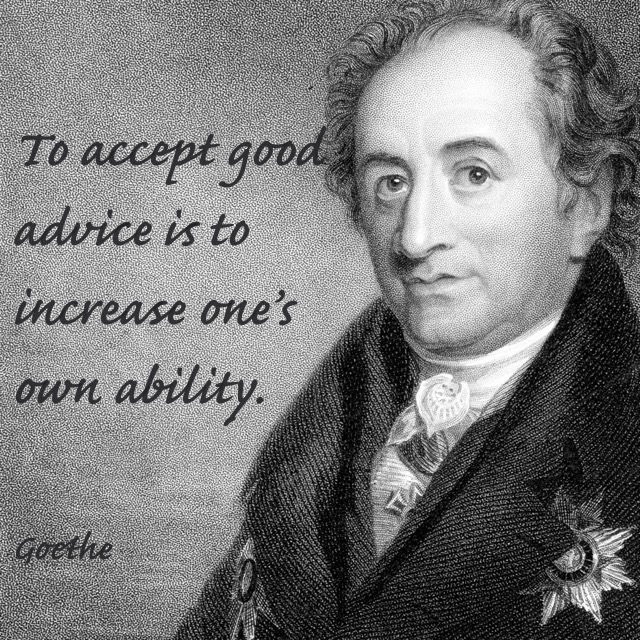
“To accept good advice is to increase one’s own ability.” —Goethe

Are you getting sharper? Are you listening to good advice?

Derailed (book review)

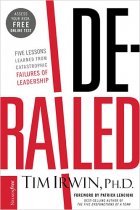
Derailed

As I read Dr. Tim Irwin’s latest book, Derailed, I thought about a quote from John Maxwell: “A wise man learns from his mistakes. A wiser man learns from others’ mistakes. The wisest man learns from others’ successes.”

The subtitle of this book is “Five lessons learned from catastrophic failures of leadership.” In this, we learn from others’ mistakes. But then Dr. Irwin goes on to show us successes that we can learn from as well. Combining the insight from successful—or should I say “non-derailed” leaders—with his own discernment, Dr. Irwin shows us how to stay on the rails.

When I first noticed that the examples in the book were all high-profile CEOs, I thought, “What could I learn from them? After all, I’m not the CEO of a Fortune 500 company.” But Dr. Irwin does an excellent job of bringing the four qualities of character—authenticity, self-management, humility, and courage—down to a pedestrian level where even we non-CEO-types can benefit from his wisdom.

Although the principles in Derailed can benefit anyone in leadership, or aspiring to a leadership position, this book still might not be for everyone. The six case studies in the book are all derailed CEOs, and unless you have a penchant for the business world, you might not find them very enjoyable reading. However, for those of you who enjoy business history, there is much to gain from a careful reading of Derailed.

I am a Thomas Nelson book reviewer.

Is It Selfish To Pray For Success At Work?

Listen to the podcast of this post by clicking on the player below, and you can also subscribe on AppleSpotify, or Audible. 

“Dear Lord, I pray that You will help me be successful on my job today. Help me to make that sale [close that deal, get the promotion, earn the raise]. Bless me today. Amen.” All over the world today people at work are praying something similar to this. Does God notice? Is this a prayer God wants to answer?

I’ve been thinking about this a lot lately. I’ve been wondering if asking God to bless my efforts is praying a selfish prayer.

That well-known prayer by Jabez sounds very similar, doesn’t it? “Oh, that You would bless me and enlarge my territory!” This prayer must have pleased God because the verse ends with, “And God granted his request” (1 Chronicles 4:9-10).

In the life of Joseph, the phrase about his on-the-job success is repeated again and again. First in Potiphar’s house, and then in prison, and then in the royal court we see the phrase “Joseph prospered” (for those of you keeping track at home, that means Joseph was a success at the office). We don’t see Joseph praying for this success, but we see him walking in it nonetheless.

But here’s the key component: it’s all about your heart attitude. In other words, it’s all about how you intend to become successful and what you plan to do with your success.

Jabez wanted to be successful so he wouldn’t be a burden to anyone else. He asked God to give him success in a way that benefitted others. So, too, with Joseph: at every mention of Joseph’s success there is a corresponding phrase like, “The Lord was with him” or “The Lord gave him success in everything he did.”

When Jabez and Joseph were successful on the job, everyone around them knew it was because they did things God’s way. And everyone around them got to share in the blessings of their successes.

Do you want success on the job? Go ahead and pray for God to “enlarge your territory” or help you to “prosper.” Then do things God’s way, and be sure to give Him the credit for your success. I believe that God wants to give you more and more on-the-job success so that He is glorified, and so that others around you recognize God’s provision.

Keep praying for success. I’m praying that for myself and for you too.

►► Would you please prayerfully consider supporting this ministry? My Patreon supporters get behind-the-scenes access to exclusive materials. ◀︎◀︎

Fall Down Attitude

Fall

This Sunday at Calvary Assembly of God we start a brand new series called Fall: We all fall, but falling doesn’t have to be fatal. If we have the right attitude about it, the times that we fall can be some of the most instructional times of our lives.

A man with a great fall down attitude was Thomas Alva Edison. Check out these snippets from this inventor’s life:

“If I find 10,000 ways something won’t work, I haven’t failed.” —Edison’s answer to a newspaper reporter’s question about how he felt about his 10,000 failed attempts to perfect the incandescent light bulb

“Son, there’s great value in disaster. All our mistakes are burnt up. Thank God we can start all over again.” —Edison, at age 67, speaking to his son Charles while they were watching his laboratory being destroyed by fire

“I’ve had a lot of success with failure.”

Falling down doesn’t have to be fatal. With the right attitude, falling down can be one of the most instructional times of our lives. Come join me on Sunday morning at 10:30am to hear more about the attitude that makes success out of failure.

Burn, Baby, Burn

It’s been a debate around golfing circles for years as to which PGA pro gets credit for responding to a fan who quipped, “That was a lucky shot!” The famous reply (variously attributed to either Gary Player, Arnold Palmer or Lee Trevino) is, “You know, the more I practice, the luckier I seem to get.”

Regardless of who said it, there’s so much truth in that statement. Here’s what I’ve learned about success:

NO ONE is an over-night success. “The heights of great men reached and kept // Were not attained by sudden flight // But they, while their companions slept // Were toiling upwards in the night.” —Henry Wadsworth Longfellow

NO ONE is a half-hearted success. “Success is the maximum utilization of the ability that you have.” —Zig Ziglar

NO ONE is successful on their own. “Leaders will not experience long-term success unless a lot of people want them to.” —John Maxwell

SUCCESS requires a high price. “Achievers choose what losers won’t and pay the price that others don’t.” —Anonymous

SUCCESS takes dedicated time. Malcolm Gladwell in his book Outliers quotes the 10,000 Hour Rule. He writes, “The biggest misconception about success is that we do it solely on our smarts, ambition, hustle and hard work.” Instead, he says that highly successful people have put in a minimum of 10,000 hours in a single area (think the Beatles with their music or Bill Gates with his computer programming).

SUCCESS starts with personal initiative. “Success isn’t a result of spontaneous combustion. You must set yourself on fire.” —Arnold H. Glasow

John Wesley explained how he drew such large crowds in the First Great Awakening by stating, I set myself on fire, and the people come to see me burn.” If you want to be successful, you must set yourself on fire, pay the price, and do the time.

Are you ready? If so, then burn, baby, burn!

Doing Thinking Doing

To think or to act? That is the question. Or maybe the question should be, which comes first: the thinking or the acting? Do I think about something and then go do it? Or do I do something first and then think about what I’ve done and how I could do it better next time?

The answer, I believe, is yes.

You could be the most creative thinker in the world, your thoughts could be off on another plane, but if you do nothing with what you’re thinking, all of those great insights are wasted.

On the other hand, many people hold to the axiom that experience is the best teacher, so they just do and do and do. But experience is not the teacher; we only learn when we stop to think about what we’ve done.

William Wilberforce was already a rising star in British politics when he experienced a deeper understanding of his relationship to God. Suddenly this man of word and action wanted to do nothing more than meditate on the greatness of God. Wilberforce believed that he could best serve God by withdrawing from society and simply thinking about God.

His good friend and future prime minister William Pitt disagreed. Pitt wrote to Wilberforce, “Why then this preparation of solitude which can hardly avoid tincturing the mind either with melancholy or superstition? … Surely the principles as well as the practice of Christianity are simple and lead not to meditation but to action.” Or as the line from Amazing Grace has it, “We humbly suggest you can do both.”

I love Oswald Chambers’ counsel—

“God will never allow us to divide our lives into sacred and secular, into study and activity. We generally think of a student as one who shuts himself up and studies in a reflective way, but that is never revealed in God’s book. A Christian’s thinking ought to be done in activities, not in reflection, because we only come to right discernment in activities.”

Whether it starts with thinking or starts with action, successful thinking-doing must include both. Think about it → act on it → think about your results → do it again better than last time.

Paul wrote to the Romans how thinking and action work together when he said, “for their own conscience and thoughts either accuse them or tell them they are doing right” (Romans 2:5 NLT). The Amplified Bible renders this phrase, “their consciences (sense of right and wrong) also bear witness; and their decisions (their arguments of reason, their condemning or approving thoughts) will accuse or perhaps defend and excuse them.”

Think about it → do it → think about it → do it = the pattern for success.