Loyalty

Listen to the podcast of this post by clicking on the player below, and you can also subscribe on AppleSpotify, or Audible.

How would you define loyalty? All of the dictionary definitions have to do with faithfulness. It’s almost implied that there is a blindness (at worst), or a dogged persistence (at best), to remain loyal to a person or to an idea. The thinking goes, “If I’m loyal to someone, like it or not, I become their Yes-man.”

But I think…

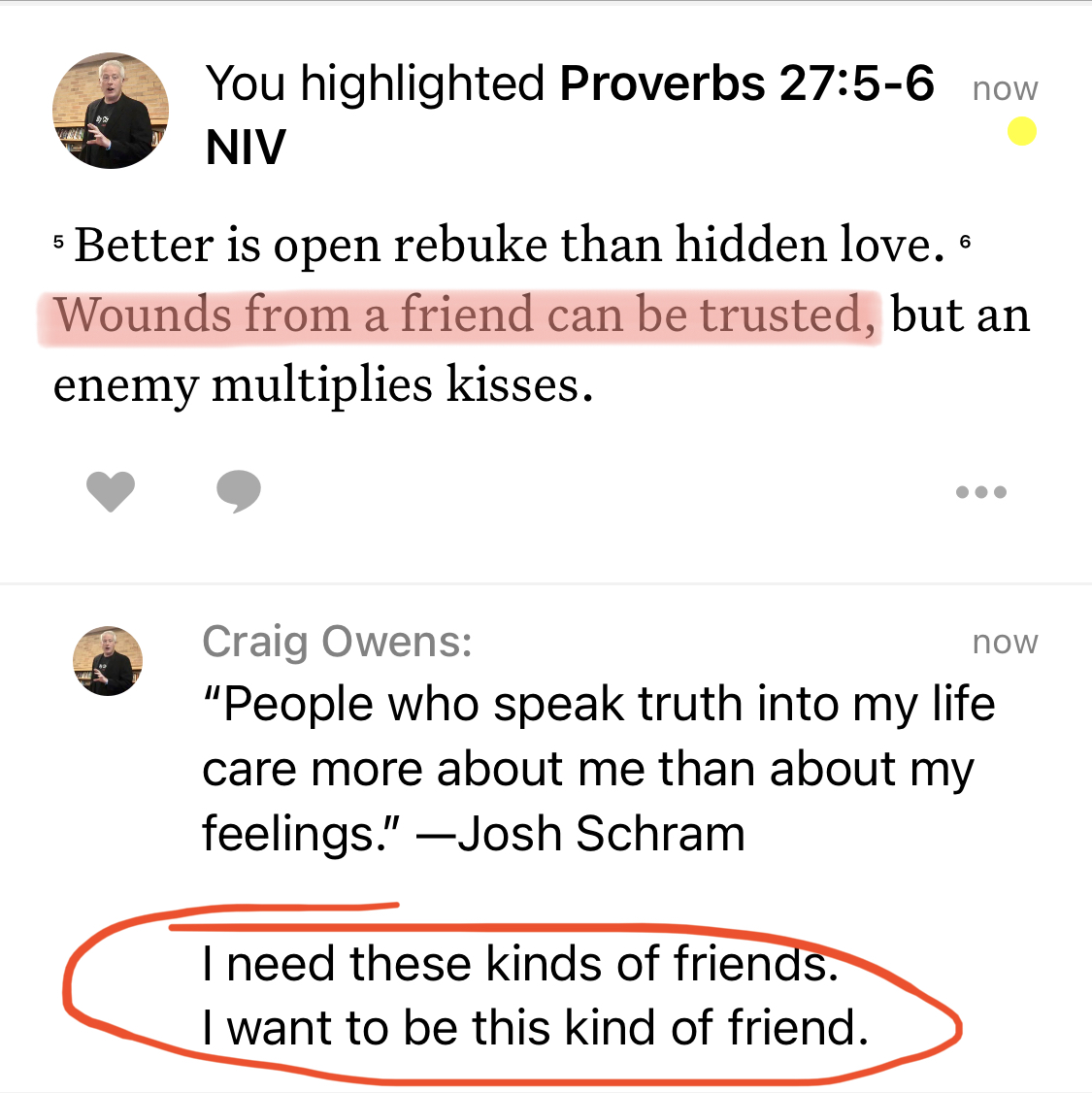
Loyalty is not telling people what they want to hear, but what they need to hear.

For an example, take the prophet Nathan in the Bible. We don’t know how old he is when he steps on the scene, or even where he came from. There isn’t a clue as to his tribal ancestry or even his father’s name.

King David wanted to build a temple for the ark of the covenant of the Lord, and he asked Nathan about this. Nathan immediately said, “Yes!” (kinda reinforces that idea of loyalty = Yes-man, doesn’t it?) But wait! That night, God speaks to Nathan and says, “Tell David he’s not the one to build the temple for Me.” So Nathan returns to David and loyally tells him no.

Later on, David steals another man’s wife and contrives a plan to have that man murdered on the battlefield. David thinks he’s gotten away with it until Nathan, the loyal friend, shows up to confront David with his sin. Nathan didn’t want to see David fail, but he wanted to give him a chance to confess and repent.

Near the end of David’s life, one of David’s sons, Adonijah, wanted to take the throne for himself. Many of the officials in David’s palace jumped on the bandwagon, but loyal Nathan did not. In fact, Nathan even got word to the King about Adonijah’s plans. As a result, David asked Nathan to anoint his son Solomon as king.

During David’s life, Nathan wrote David’s biography. If Nathan was just a mindless Yes-man, he could have easily left out the messy parts of David’s life. But the loyal friend wanted to show future readers that we all mess up, but God forgives and restores us when we repent.

Nathan’s name means the gift God gave or a giver. Both meanings fit this loyal man.

David was so blessed by Nathan’s loyalty that he named one of his own sons after the prophet.

Loyal friends give their friends the gift of life. They don’t let friends go down a destructive path. They don’t join with others when they attack. They remain constant, always-there, friends.

What a blessing to be called a loyal friend! And what an even greater blessing to have “Nathans” in our own lives!

►► Would you please prayerfully consider supporting this ministry? My Patreon supporters get behind-the-scenes access to exclusive materials. ◀︎◀︎

Don’t Be That Guy

I love studying leadership books and learning from the lives of great men and women of history. The leadership section of my library is only slightly larger than the biography section. One of the saddest things to see is a leader who self-destructs. I was just reviewing some of my notes about leadership failures when Tim Elmore’s latest e-newsletter arrived entitled Self-Destructive Leaders.

Check out a couple of blurbs from this excellent article:

Projecting their self-worth.
There are few things more unappetizing than a leader who has to constantly talk about how important they are. They name drop, they remind others of their busyness, accomplishments, authority, past positions, degrees, or pedigree. It’s like they’re lobbying for attention and affirmation. It’s a sad commentary when so much of a leader’s energy is spent doing this instead of helping their team reach their goals.

Possessing a controlling spirit.
Often, insecure leaders react to their inward desperation with control. They feel if they can control people, they’ll maintain absolute authority. … They resort to more regulations and policies to enforce compliance among staff instead of trusting them and earning their loyalty….

Comparing themselves to others obsessively.
When a leader has a low EQ [emotional intelligence quotient], they naturally tend to look around them; they look outward rather than inward (at their own natural strengths and style) or upward (to their Creator for their sense of identity).  They become consumed with comparing their own traits or achievements to those of other leaders. Soon, their team ceases to operate in a healthy way. They’re driven by comparing and competing with others instead of capitalizing on their own core competencies.

Possessing self-imposed blindness.
This one is huge. All leaders have blind spots. Like in a car, blind spots happen not so much because of stupidity but position. The driver can’t see certain things. Sadly, self-destructive leaders refuse help. They repel any input from colleagues and insist on living in a bubble that makes them feel good. All is well, or so they think. Their insecurity won’t let them face the facts. They prefer a perspective that’s limited, but comfortable. Their narrow view will eventually lead to an accident.

Here’s what wise King Solomon said about the self-destructive leader:

Arrogant know-it-alls stir up discord, but wise men and women listen to each other’s counsel. (Proverbs 13:10)

If you ignore criticism, you will end in poverty and disgrace; if you accept correction, you will be honored. (Proverbs 13:18)

The saddest part is this – the self-destructive leader will read this and then say to himself, “Nope, that’s not me. This is describing someone else.”

Don’t be that guy (or gal)!

  • Look in the mirror of Scripture.
  • Listen to the counsel of others.
  • Listen to the criticism of your teammates. (Hint: if your teammates aren’t telling you anything that you need to improve on, it’s not because you’re perfect. Either you have intimidated them into silence, or you’re deaf to what they’re telling you.)
  • Learn from the lives of great leaders from the past. Read their biographies and autobiographies.

Flight Is Your Best Fight

Listen to the podcast of this post by clicking on the player below, and you can also subscribe on AppleSpotify, or Audible. 

He was ripped and he was handsome. She was lonely and she was hungry. He followed God and she gave lip-service to the numerous gods of Egypt. He was Joseph and she was Potiphar’s wife. He was in charge of all of Potiphar’s household and she was attracted to that power.

A pretty heady place for Joseph to be. Think about it, guys, how would you feel? You’re good looking, successful, and the object of some babe’s desire. What are you going to do with all of that?

Do you know what Joseph did? He ignored her to the point of almost being rude:

And though she spoke to Joseph day after day, he refused to go to bed with her or even be with her.

Or even be with her is a rude phrase. It means she was doing everything she could think of to bring him to her, and he was thwarting her at every turn:

  • She walked into a room; he walked out.
  • She planned her path to run into him; he went out of his way to change his route.
  • She smiled; he kept a straight-faced.
  • She flirted; he ignored.
  • She was persistent; he was consistent.

There are many temptations the Bible tells us to fight. But there are two that we’re advised to flee: idolatry and sexual immorality.

Joseph chose fleeing over fighting.

Solomon said, “When you know what that sort of woman is up to, don’t even walk down her street.”

Talk to Wisdom as to a sister. Treat Insight as your companion. They’ll be with you to fend off the Temptress—that smooth-talking, honey-tongued Seductress.

Jesus said, “Don’t even entertain any thoughts about that kind of woman.”

From this type of temptation, your best fight is flight.

Guys, be like Joseph: stay away, take a different path, don’t smile at the flirty jokes, don’t hang out at her desk, don’t treat her politely. RUN AWAY.

Flight is your best fight against sexual temptation.

►► Would you please prayerfully consider supporting this ministry? My Patreon supporters get behind-the-scenes access to exclusive materials. ◀︎◀︎

Do You Really Want To Be Accountable?

I have a great friend. He is the brother I never had, but he is more than any brother I could have ever hoped for. We are brothers like David and Jonathan were brothers in the Bible. We are covenant brothers (we’ve coined the shorthand CovBro).

What is accountability? The dictionary simply says it means “to give an account or to give an answer.” It doesn’t say “to give an excuse or to give the rationale.”

Accountability means there is only black and white. No gray. Either I did what I was supposed to do. Or I didn’t. King Solomon said it this way:

Young people, it’s wonderful to be young! Enjoy every minute of it. Do everything you want to do; take it all in. But remember that you must give an account to God for everything you do.

Before it’s time to give an account to God, wouldn’t you like someone else to hold you accountable? I would!

In this everything’s-relevant, I’m-not-responsible-for-my-own-actions world, finding someone who will actually hold you to a rigid “Yes, I did it” or “No, I didn’t do it” standard is rare. But my CovBro is one who holds me accountable.

When we meet each month, he asks me the hard questions:

  • How are your business dealings?
  • Are you spending enough time with God?
  • Are you doing what God has called you to do?
  • What’s happening in your marriage? Your relationship with your kids? Your church?

He gets my internet usage report from X3 Watch. He is the iron that sharpens my iron. He accepts no wishy-washy answers nor any flimsy excuses. I do the same for him. And we’re both better off for it.

Do you really want to be accountable? Then find someone that loves you too much to let you get away with anything less than your very best. Someone who will hold you to God’s standards. Someone who will sharpen your iron. It can be painful. But the results are so worth it!

Lots Of Stairs

Sometimes it’s hard to find a block of time to set aside exclusively for exercise, so I try to build some exercise opportunities into my day. My during-the-day exercise usually is trying to find more ways to walk. Like…

  • Parking at the back of the parking lot
  • Walking down the hall to someone’s office instead of sending an email
  • Taking the stairs

Lately, I’ve been in lots of places with stairs, and yesterday my legs were really feeling it. I learned something from climbing all those stairs: It’s a lot easier going down than it is going up.

Up gets my heart pumping more. Up works up a sweat. Up makes me breathe deeper. Up builds my leg muscles. Up is painful (but it’s a good pain).

The soreness in my legs is a reminder that I’ve exercised, that I’ve done something that’s giving me long-term benefits, that I’ve prepared myself for a healthier future.

Solomon wrote, “The path of life leads upward for the wise to keep him from going down to the grave.”

Spiritually, I can say up brings life.

Up makes me wiser. Up keeps me from going down. Up is painful (but it’s a good pain).

If you haven’t been spiritually sore lately, perhaps you’re shying away from a healthy workout.

Let God take you up today. You might be a little sore tomorrow, but the soreness will remind you that you’ve exercised, that you’ve done something that’s giving you long-term benefits, that you’ve prepared yourself for a heavenly future.

Opposites

For everything there is a season,
a time for every activity under heaven.
A time to be born and a time to die.
A time to plant and a time to harvest.
A time to kill and a time to heal.
A time to tear down and a time to build up.
A time to cry and a time to laugh.
A time to grieve and a time to dance.
A time to scatter stones and a time to gather stones.
A time to embrace and a time to turn away.
A time to search and a time to quit searching.
A time to keep and a time to throw away.
A time to tear and a time to mend.
A time to be quiet and a time to speak.
A time to love and a time to hate.
A time for war and a time for peace. (Solomon)

Everything in life has an opposite.

For every hello, there’s a goodbye.

Every time you say yes to something, you’re saying no to something else.

Sweet has its bitter, and bitter has its sweet.

Your day may be gloomy, but the sun will shine.

You may have sorrow, but there will be joy.

You may be in the dark night of your soul, but a bright dawn will appear.

Just remember: God has made everything beautiful in its time.

Objective Beauty

Do you ever doubt Scripture? I don’t mean doubting its inerrancy, but its application to real life. You know what I mean: “Okay, that sounds interesting, but I’m not sure that’s for now or for me. C’mon, that can’t mean me!”

Here’s the verse that got me thinking: “He has made everything beautiful in its time….”

Everything?! Really? Everything?!

My viewpoint is subjective. That’s a fancy way of saying, “Things should be the way I want them to be.” I see some things as beautiful, but about other things I say, “This is a pain, or this is ugly.” But if I believe God’s Word, in God’s timing everything is beautiful.

I think the second part of the verse illuminates the problem of my subjectivity. “…He has also set eternity in the hearts of men; yet they cannot fathom what God has done from beginning to end.”

Eternity—my soul’s longing for God—is in me, yet I cannot grasp it. Not naturally, at least. God knows how everything will end beautifully because He made everything beautifully.

Even me.

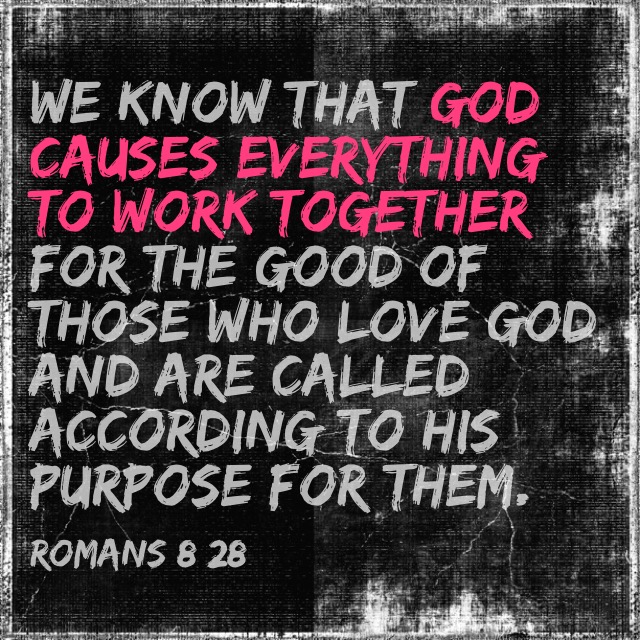
My life might seem like a mess at times: ugly, scared, scarred, even worthless. But God sees beauty. And we know that in all things [even the ugly stuff] God works for the good [the beautiful] of those who love Him, who have been called according to His purpose. (Romans 8:28). God gives His beauty to replace my ashes.

With subjective thinking, this doesn’t seem very likely. It’s hard to subjectively see how God could turn my ugliness and my pain into anything beautiful.

That’s why Scripture also contains this prayer: A prayer that will change my subjectivity (seeing only my ugliness) to objectivity (now seeing God’s beauty). If you struggle to see everything as beautiful, pray this prayer right now:

When I think of all this, I fall to my knees and pray to the Father, the Creator of everything in heaven and on earth. I pray that from His glorious, unlimited resources He will empower you with inner strength through His Spirit. Then Christ will make His home in your hearts as you trust in Him. Your roots will grow down into God’s love and keep you strong. And may you have the power to understand, as all God’s people should, how wide, how long, how high, and how deep His love is. May you experience the love of Christ, though it is too great to understand fully. Then you will be made complete with all the fullness of life and power that comes from God.

Amen!

Sharper Thoughts

John Maxwell said, “Some of my best thinking has been done by others.” I believe that what Dr. Maxwell was saying is that our creative thoughts can become even better when someone else helps sharpen them.

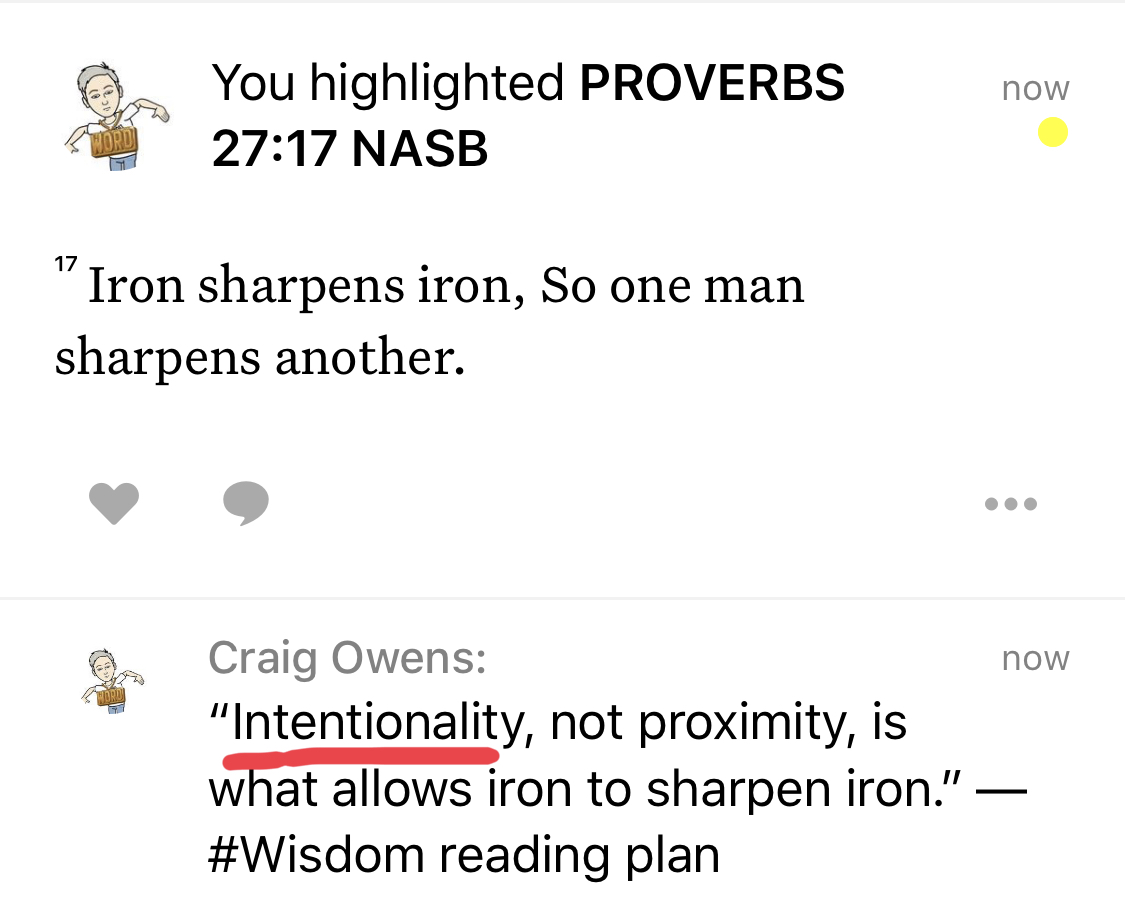
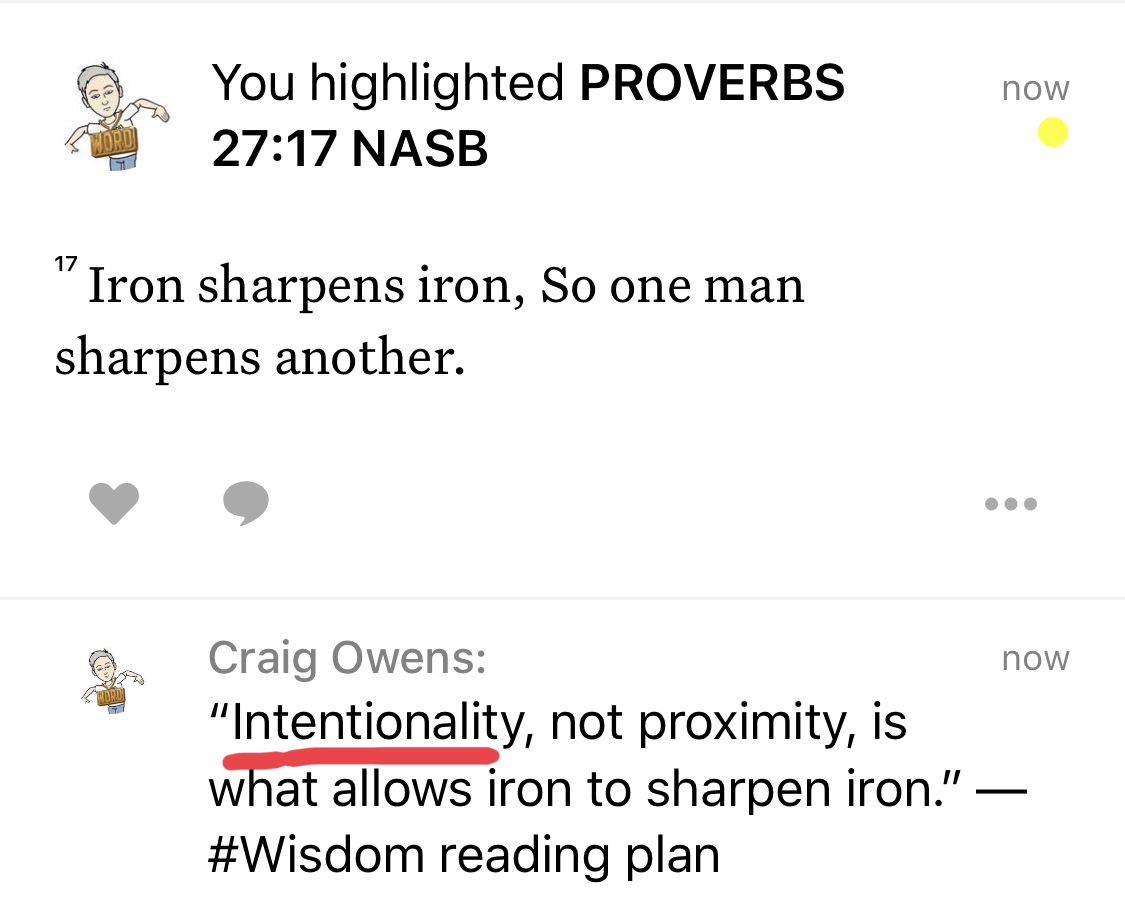
King Solomon, a pretty fair thinker himself, said the same thing when he wrote, “As iron sharpens iron, so one man sharpens another” (Proverbs 27:17). In other words, you need some pretty sharp people to help you think better thoughts, sharper thoughts.

Check out what John Stuart Mill wrote in On Liberty

“Nor is it enough that he should hear the arguments of adversaries from his own teachers, presented as they state them, and accompanied by what they offer as refutations. That is not the way to do justice to the arguments, or bring them into real contact with his own mind. He must be able to hear them from persons who actually believe them; who defend them in earnest, and do their very utmost for them. He must know them in their most plausible and persuasive form; he must feel the whole force of the difficulty which the true view of the subject has to encounter and dispose of; else he will never really possess himself of the portion of truth which meets and removes that difficulty. Ninety-nine in a hundred of what are called educated men are in this condition; even of those who can argue fluently for their opinions. Their conclusion may be true, but it might be false for anything they know: they have never thrown themselves into the mental position of those who think differently from them, and considered what such persons may have to say; and consequently they do not, in any proper sense of the word, know the doctrine which they themselves profess.”

General George C. Marshall, chief of staff of the Army during World War II, created the largest army the world had ever seen (13 million soldiers) in the shortest time possible. General Omar Bradley tells of being called into Marshall’s office in 1939, a week after the outbreak of war in Europe. Marshall was disappointed in Bradley, “You haven’t disagreed with a single thing I have done all week!” Marshall wanted to make sure he was doing his very best so he was calling on another sharp comrade to challenge his thinking.

Do you have some sharp people around you? Do you listen to those who disagree with you? If you do, your creative thoughts can become even sharper.

I’ll Make You An Offer You Can’t Refuse (Book Review)

I'll Make You An Offer You Can't RefuseOkay, I’ll be honest with you, the title of Michael Franzese’s latest book sounds like a cliché—I’ll Make You An Offer You Can’t Refuse. Sounds like a line right out of “The Godfather” or “Goodfellas,” right? But if you’re involved in the world of business, Mr. Franzese’s book is exactly that: an offer (book) you can’t refuse. From how to craft a business plan, to picking the right people, to learning how to negotiate the best deals, Mr. Franzese uses his years of wiseguy street-smarts to give you an advantage.
From the very first page, this book engaged me because I felt like I was having a conversation with the author. His style is very relaxed, and his stories about his business successes and failures are compelling. It’s not often that a business book reads like a novel, but I’ll Make You An Offer does just that.

Throughout all of his lessons, Mr. Franzese makes the contrast between the principles spelled out in the mobster’s bible (The Prince by Machiavelli) and principles articulated in the Holy Bible (specifically the writings of Solomon). Although he learned his strategies from his years in La Cosa Nostra (“this thing of ours” or the mob life), he makes a strong case his strategies will work in the legit life. The difference is the motivation that drives the strategies: Machiavellian or biblical.

“A dictionary definition of success says it’s ‘the favorable or prosperous termination of attempts or endeavors.’ … But dictionary definitions are like sausage casings. It all depends on what you stuff inside” (quote from page 144).

Whether you are just getting started in a new business venture, or whether you are not satisfied with the results of your current business venture, you will find invaluable strategies here to help you. This former mob boss truly does make you an offer you can’t refuse.

Sharper Thinking

Yesterday I was challenged to do a lot of thinking. To think about things I’ve not considered before, and to think about things I have considered before but from a different perspective.

Yesterday a fellow pastor convened a Pastor’s Leadership Thinking Lab. The purpose was to use Warren Bullock’s book When The Spirit Speaks as a springboard to talk about the vocal gifts of the Holy Spirit in operation in our church services (see 1 Corinthians 12-14). At the outset, we all reaffirmed our unwavering commitment to our fellowship’s fundamental truths—those were non-negotiable. The challenge was to think about and discuss the practicalities of the how’s in our church services.

It was a bit intimidating being in the room with such smart people. These are guys with way more education and experience than me—guys who have had the privilege of studying and discussing this topic with some of the greatest Pentecostal thinkers of our generation. I felt a little out of place. In fact, during the lunch break, one of my friends commented, “Have you ever felt like that in a roomful of tuxedos you’re the one brown shoe?” My feelings exactly.

But King Solomon wrote, “As iron sharpens iron, so one man sharpens another” (Proverbs 27:17). The iron of my colleagues definitely sharpened me yesterday.

I also like what John Maxwell said, “Some of my best thinking has been done by others.” In other words, these really smart guys have thought about some things in ways I haven’t; they’ve been exposed to some great thinkers that I haven’t; they’ve experienced some things that I haven’t. But spending the day with them was like getting that education they received, having those conversations with great thinkers they had, and experiencing those things they experienced.

Did I agree with everything that was shared? No.

Was I challenged to think differently? Yes.

F. Scott Fitzgerald wrote, “The truest test of a first-rate mind is the ability to hold two contradictory ideas at the same time, and still retain the ability to function.”

If you really want to sharpen your thinking, get around some people smarter than you. Spend time with people who see things differently than you. But most of all, make sure these folks are one in purpose with you. All of the guys in this Lab shared the same passion to see God glorified and people drawn into a deeper relationship with Jesus. That’s what made yesterday so rewarding for me.

Do you have some “iron” friends in your life that are sharpening your thinking?