David subdued Israel’s enemies. His son, Solomon, brought Israel incredible wealth and prestige. And his son, Rehoboam, brought it all crashing down.
How? “…the king did not listen to the people” when they asked him for relief (2 Chronicles 10:15).
It’s hard to lead people you don’t listen to! In fact, not only did Rehoboam not lead them, he destroyed a strong, rich, peaceful, united kingdom.
Actually Rehoboam’s problem goes back even earlier. He couldn’t hear his people because he didn’t hear his God—“He did evil BECAUSEhe had not set his heart on seeking the Lord” (2 Chronicles 12:14, emphasis added).
If I set my heart fully on God, I can hear His voice.
If I can hear His voice, I can accurately hear others’ voices.
If I can accurately hear other people, I can serve them (see 1 Kings 12:7).
This is the only way to have God-enabled success with people!
I’ve been pondering these quotes for the past few days. They describe a view of Christianity that is biblical, but highly countercultural. What do you think?
“If we obey the Lord, He will compel our adversaries to see that His blessing rests upon us. … It is for saints to lead the way among men by holy influence: they are not to be the tail, to be dragged hither and thither by others. We must not yield to the spirit of the age, but compel the age to do homage to Christ.” —Charles Spurgeon
“I am Thy servant to do Thy will, and that will is sweeter to me than position or riches or fame and I choose it above all things on earth or in heaven.” —A.W. Tozer
“The symbols under which Heaven is presented to us are (a) a dinner party, (b) a wedding, (c) a city, and (d) a concert. It would be grotesque to suppose that the guests or citizens or members of the choir didn’t know one another. And how can love of one another be commanded in this life if it is to be cut short at death?” —C.S. Lewis
Listen to the podcast of this post by clicking on the player below, and you can also subscribe on Apple, Spotify, or Audible.
Yesterday morning I showed my congregation this verse: As every man hath received the gift, even so minister the same one to another… (1 Peter 4:10 KJV). I then asked them, “What do you think of when you see the word minister in this verse?” The first answer given was “pastor.” Others said things like “encourager” and “helper.”
Then I shared that the Greek word for minister is the word from which we get deacon. I then asked them what deacon made them think of. They answered “administrator” and “leader.”
But the closest definition to what we have today for that Greek word is waiter or waitress. The NIV tries to capture this thought when it translates the same verse: Each of you should use whatever gift you have received to serve others….
Serving is not something that comes naturally to most people, as typically we prefer to be served.
In biblical times, a disciple was always very devoted to his rabbi. The disciple would serve almost in the role of a servant to his rabbi.
Almost.
Even the rabbis didn’t requite their disciples to remove their sandals, because it was considered so menial and demeaning to the disciple. So foot washing was reserved for the lowliest of servants.
Then along comes Jesus who knows that God has placed all authority under Him (John 13:3), who uses His authority to take on the lowest of lowliest positions: a foot-washer. As He finishes washing, He says, “Now that you’ve seen Me do this, you need to do the same thing: Be the humblest of servants.”
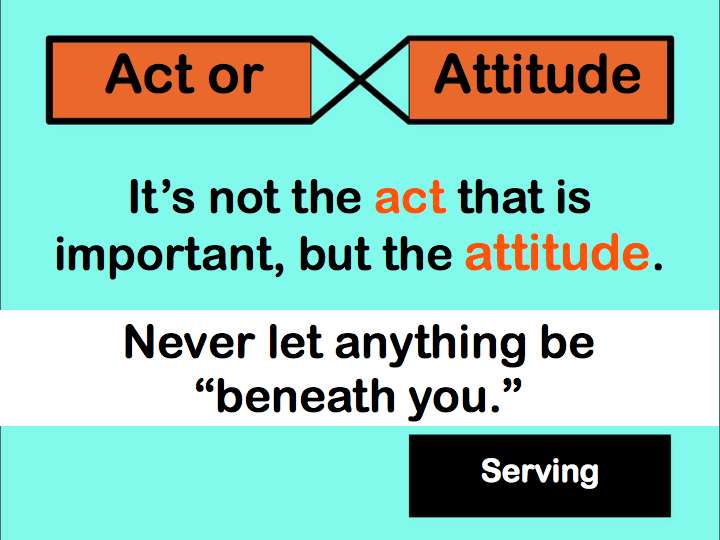
In our culture, most people don’t need to have their feet washed when they come into your home or a restaurant, like they did in first century Israel. It is not the act that is important, but the attitude. Jesus stooped to wash His disciples’ feet. He made Himself lower than anyone else in the room. Jesus showed us that there was nothing beneath Him.
I’ve heard this before: “How do you know you have a servant’s attitude? When you don’t mind that someone treats you like a servant.”
But I think a better question might be: “Do I think anything (or anyone) is beneath me?” If I do, my attitude is not Christ-like (Philippians 2:5-7), nor is it Christ-blessable (John 13:17).
Jesus calls us to be servants—to be waiters and waitresses to others. This will show the love of Jesus like nothing else can.
Check out all of the other messages in our series Live Togetherby clicking here.
Someone said to me, “Great job!” and then not too much later I heard someone else say, “Umm, not so much!” What’s a guy to do?
Here’s what I refocus on: I’m living for the approval of only One.
The only comment that matters to me is God saying, “Well done, good and faithful servant.”
Well done = done with excellence.
Well done = finished well, not just well begun.
Good = pleasantly done.
Faithful = trustworthy, reliable.
Servant = not my will, but Yours be done.
And when it comes to praise and criticism from men, I like this:
“Every man needs a blind eye and a deaf ear, so when people applaud, you’ll only hear half of it, and when people salute, you’ll only see part of it. Believe only half the praise and half the criticism.” —C.H. Spurgeon



 David subdued Israel’s enemies. His son, Solomon, brought Israel incredible wealth and prestige. And his son, Rehoboam, brought it all crashing down.





 Craig T. Owens