Just One Question

Grace's trophyPaul makes it quite clear in Ephesians 2 what we are apart from Jesus Christ:

  • Dead in our transgressions and sins (v. 1)
  • Following the ways of the world and selling out to satan’s dominion (v. 2a)
  • In obstinate opposition to God (v. 2b)
  • Living only for our own wicked cravings (v. 3a)
  • The objects of God’s righteous wrath (v. 3b)

The penalty is a death sentence. Yet God made Jesus—the perfect, sinless One—to be sin in our place so that God’s judgment would fall on Jesus Christ instead of us. That is what Paul describes as God’s great love and rich mercy (v. 4).

Mercy means not getting the punishment we should have received.

It would have been enough if God stopped there by showing mercy, but He didn’t! God brought us back to life, saved us from eternal damnation, and raised us up with Christ to a position of honor (vv. 5, 8-9). What did this? God’s amazing grace! 

Grace means getting blessings that we never should have received. 

God did this in order that we might be trophies of the incomparable riches of His grace and His kindness… (v. 7).

Gordon MacDonald said, “The world can do almost anything as well as or better than the church. You need not be a Christian to build houses, feed the hungry, or heal the sick. There is only one thing the world cannot do. It cannot offer grace.

So just one question…

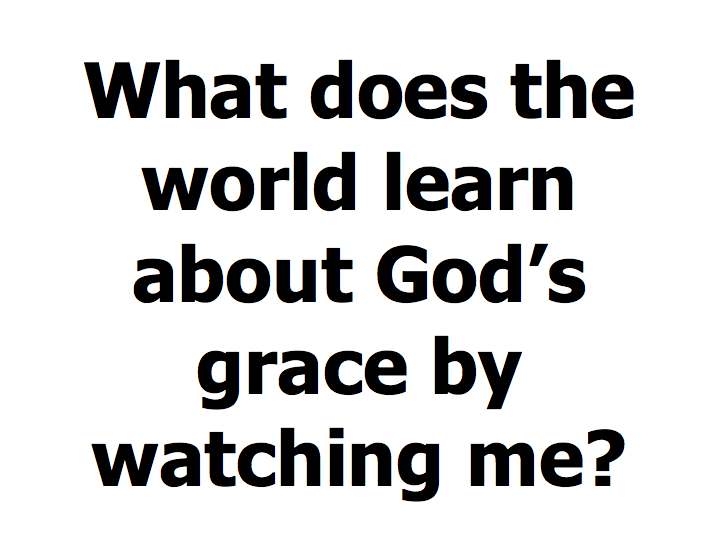
What does the world learn about God’s grace by watching you and me?

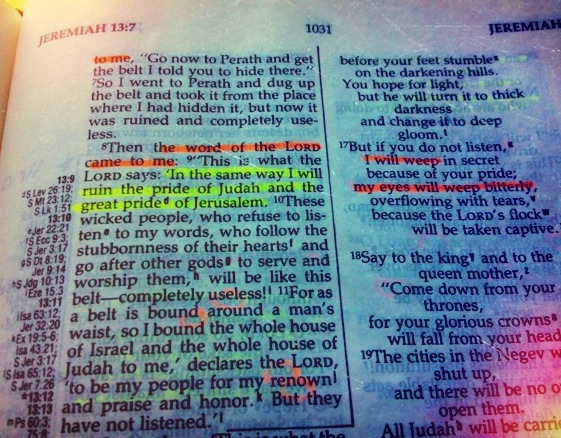
Word Of The Lord

BibleTwice in one chapter of the life of Abraham this phrase appears: The word of the Lord came to him (Genesis 15:1, 4). As awe-inspiring as it is to think about God speaking, what’s even more astounding to me is Abraham’s response.

Obedience.

God spoke. Abraham obeyed.

His first obedience was believing. So the Bible tells us, “Abraham believed God, and He credited to him as righteousness” (verse 6). By definition, righteousness means “right doing.” But doing comes directly out of believing, so Abraham had to first believe that what God said was the real deal.

God spoke. Abraham believed. God said, “You are righteous.” Then Abraham followed through on the word of God which he believed.

Why can’t it be the same with me? Or with you?

God speaks, I believe, God sees me as righteous, I act. It should be just that simple—there’s absolutely no need for me to add, subtract, modify, clarify, or delay.

The word of the Lord should be all I need.

Making The Hard Easy

Can you relate to this?

     I know the right things I’m supposed to do, and I also know the wrong things I’m not supposed to do. I try my very best to do the right and avoid the wrong, but far too many times I find myself not doing the right things, and (even worse) discover I’m doing the wrong thing.

     I say, “Enough of this!” and I vow (again!) to stop doing the wrong things, and I redouble my efforts (again!) to begin doing the right things. It seems like this is working, but only for a little while. Then I’m right back into the same old habit of doing those wrong things again.

     It shouldn’t be this hard! After all, it’s so easy to tell right from wrong. So why do I keep on doing the wrong things?! Why can’t I keep on doing the right things?!

     Is there any hope for me? (my paraphrase of Romans 8:17-24

If you’ve ever felt like that, you’re in good company because that’s just how the Apostle Paul said he struggled with right and wrong. But keep on reading, because he also shared how he overcame this struggle. He said, “Those who are controlled by the Holy Spirit think about things that please the Spirit. So letting your sinful nature control your mind leads to death. But letting the Spirit control your mind leads to life and peace.”

The Holy Spirit can help you do right, and avoid wrong. But you have to yield to Him.

I love what A.J. Gordon wrote—

“It costs much to obtain the power of the Spirit: It costs self-surrender and humiliation and a yielding up of our most precious things to God; it costs the perseverance of long waiting, and the faith of strong trust. But when we are really in that power, we shall find this difference, that whereas before, it was hard for us to do the easiest things, now it is easy for us to do the hard things.”

How would you rather live: finding it hard to do the easiest things … or finding it easy to do the hardest things?

Thursdays With Oswald—Hate Properly

This is a weekly series with things I’m reading and pondering from Oswald Chambers. You can read the original seed thought here, or type “Thursdays With Oswald” in the search box to read more entries.

Hate Properly

     A Quaker friend of mine referring to a certain man said he did not like him because he did not hate properly. … The Christian standpoint should be one of positive anger when anyone is made to stumble. To remain indifferent when there is injustice abroad is to come under the curse of Meroz, who “came not to the help of the Lord…against the mighty” (Judges 5:23).

From Baffled To Fight Better

There are six things the Lord hates, seven that are detestable to Him: haughty eyes, a lying tongue, hands that shed innocent blood, a heart that devises wicked schemes, feet that are quick to rush into evil, a false witness who pours out lies and a man who stirs up dissension among brothers. (Proverbs 6:16-19)

But if anyone causes one of these little ones who believe in Me to sin, it would be better for him to have a large millstone hung around his neck and to be drowned in the depths of the sea. (Matthew 18:6; Mark 9:42; Luke 17:2)

And the word of the Lord came again to Zechariah: “This is what the Lord Almighty says: ‘Administer true justice; show mercy and compassion to one another. Do not oppress the widow or the fatherless, the alien or the poor. In your hearts do not think evil of each other.’ But they refused to pay attention; stubbornly they turned their backs and stopped up their ears. They made their hearts as hard as flint and would not listen to the law or to the words that the LORD Almighty had sent by his Spirit through the earlier prophets. So the Lord Almighty was very angry.” (Zechariah 7:8-12)

It’s time for us to get positively angry and hate the things that God hates.

Insert Your Name Here

I don’t think anyone would mind having his or her name inserted in any of the following compliments:

  • ___________ is a righteous person.
  • ___________ is blameless before God.
  • God looks favorably on ___________.
  • ___________ walks with God.

Pretty nice pedigree, huh?

This is the description of Noah in the Bible. I especially love the phrase “walks with God.” It’s only used of two people in the Bible: Noah and Enoch. But it’s even more encouraging to me when I read it about Noah’s life.

Noah is the first in Adam’s family line to be born after Adam died. That’s significant because all of his ancestors (including Enoch) would have been able to get a first-hand account from Adam himself about what it was like to be in the Garden of Eden. All of Noah’s ancestors could have heard right from Adam’s mouth what it was like to visit with God personally each evening, to talk to Him face-to-face. And they could have heard firsthand how devastatingly painful it was to lose that intimate fellowship because of sin.

Since Noah was the first person in this family tree to hear about this secondhand, he’s the first person to walk with God by faith. Which is the exact same way we walk with God today:

Faith is being sure of what we hope for and certain of what we do not see (Hebrews 11:1).

You too can insert your name in this blank: “___________ walks with God.”

How do you do this? Pray this:

“God, I want to walk with You. I know it’s impossible to please You except by faith. I want to get closer to You. So I believe that You exist and that You care enough to respond to me when I seek You and love You with all of my heart, soul, mind, and strength.”

Let’s enourage one another to walk in this way every single day.