Fizzle

Jehu, the king of Israel, said, “Come with me and see my zeal for the Lord!” Wow, this guy was so fired up about doing great things for God! He got rid of all of King Ahab’s idol-worshipping family, he removed all of the court officials who supported Ahab, and he even cleared all of the priests of Baal out of Israel.

God was so pleased with Jehu and his zeal for holiness that God said, “Well done! Because of what you have done, your descendants will sit on the throne of Israel for the next four generations.”

What a God-fearing man Jehu was! How on fire for God!

Unfortunately, Jehu’s passion fizzled.

Aristotle famously said, “Well begun is only half done.” Jehu started well, but his zeal for God fizzled in the end.

In fact, the very next verse after God says, “Well done!” begins with a very telling word: Yet.

Jehu didn’t continue his walk with God. He began to fall away, and so the Bible adds this sad note: In those days the Lord began to reduce the size of Israel. Yes, Jehu and his descendants still sat on the throne, but Israel became smaller and smaller.

I want to start well and finish strong.

I don’t want to hear God say, “Well begun.” I want to hear Him say, “Well done, good and faithful servant.”

I don’t want to be “king” of a smaller and smaller sphere of influence.

I don’t want to fizzle—I want to keep on burning bright for God!

The Refinement Of Pain

I was recently invited to join a bunch of guys—mostly staff in the Cedar Springs schools—for some early morning basketball. I love playing basketball, I’m a morning guy, and getting to know new people in Cedar Springs made this an invitation I couldn’t refuse. So I started hoopin’ this week. It was nice to get back on the hardwood floor!

Yesterday morning, I jumped in my car to come home to shower. It’s a mile from the school to my house, but by the time I got home, my back muscles had seized up and I was barely able to stand up to get out of the car. I’ve had this happen to me once before, and it’s a whole lot of no fun!

So all day yesterday my schedule had to be modified, as it hurt to move, it hurt to stand for too long, and it hurt to sit for too long. I couldn’t get in the car. In fact, I couldn’t even bend over far enough to put my own socks on! All my plans for the day were shot.

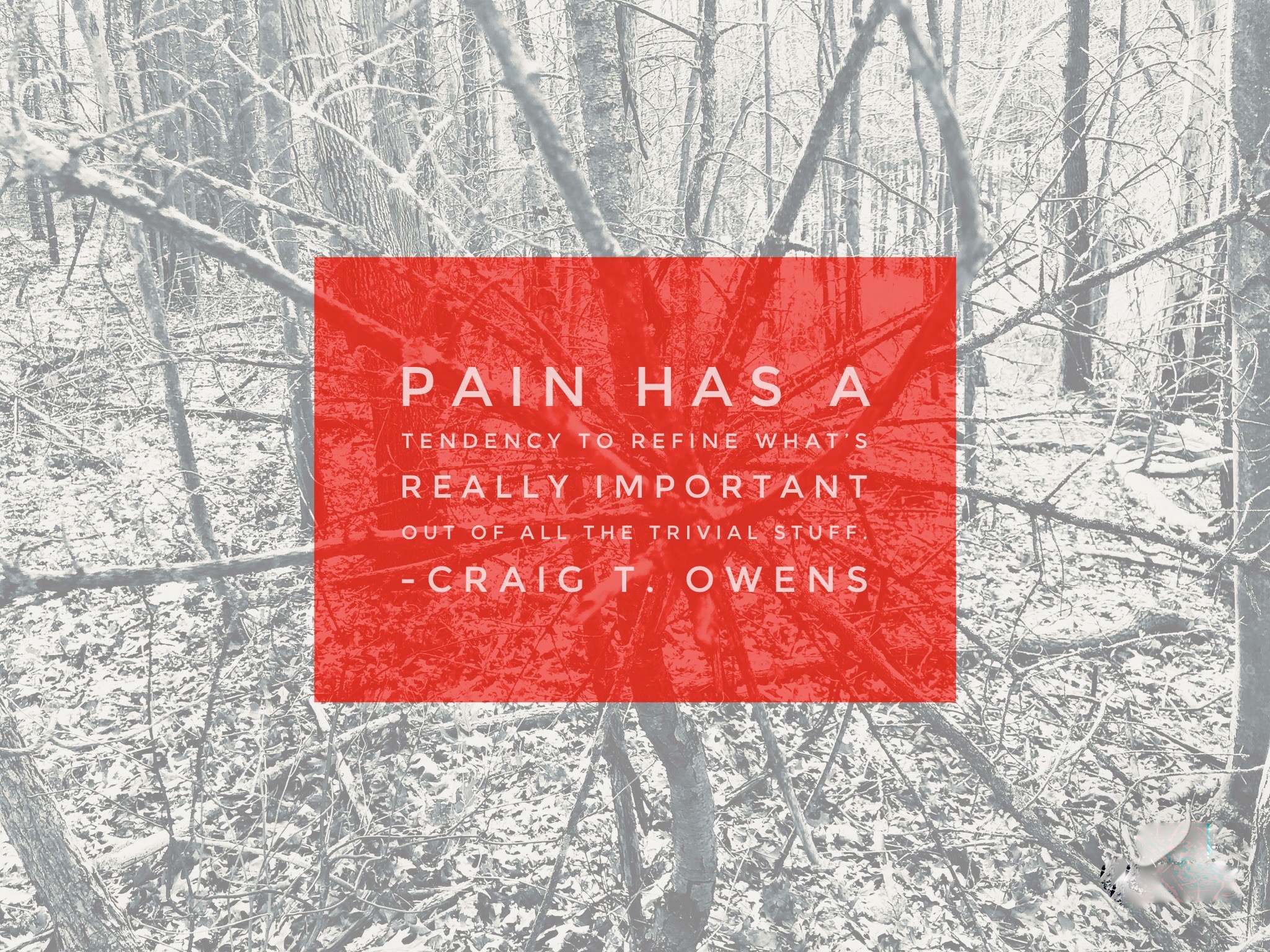
But here’s what I learned: my day wasn’t shot. My plans may not have worked out, but it was still a good day. Pain has a tendency to refine what’s really important out of all the trivial stuff.

  • A day in pain and immobility reminded me of just how blessed I am to normally have good health.
  • It prompted me to pray for others who are confined to a wheelchair or their beds.
  • It gave me greater empathy for those who live in chronic pain.
  • It made me more thankful that I have access to medicines and caregivers, things that some people have access to only rarely.
  • It let me see more clearly the love my family and friends have for me.
  • It gave me more time to pray.

Now here’s the tricky part: to live with these things on my mind even when I’m not in pain.

Here’s what C.S. Lewis wrote in The Problem Of Pain:

I am progressing along the path of life in my ordinary contentedly fallen and godless condition, absorbed in a merry meeting with my friends for the morrow or a bit of work that tickles my vanity today, a holiday or a new book, when suddenly a stab of abdominal [or back] pain that threatens serious disease, or a headline in the newspapers that threatens us all with destruction, send this whole pack of cards tumbling down. At first I am overwhelmed, and all my little happinesses look like broken toys. Then, slowly and reluctantly, bit by bit, I try to bring myself into the frame of mind that I should be in at all times. I remind myself that these toys were never intended to possess my heart, that my true good is in another world and my own real treasure is in Christ. And perhaps, by God’s grace, I succeed, and for a day or two become a creature consciously dependent on God and drawing strength from the right sources. But the moment the threat is withdrawn, my whole nature leaps back to the toys: I am even anxious, God forgive me, to banish from my mind the only thing that supported me under the threat because it is now associated with the misery of those few days. Thus the terrible necessity of tribulation is only too clear. God has had me for but forty-eight hours and then only by dint of taking everything else away from me. Let Him but sheathe that sword for a moment and I behave like a puppy when the hated bath is over—I shake myself as dry as I can and race off to reacquire my comfortable dirtiness, if not in the nearest manure heap, at least in the nearest flower bed. And that is why tribulations cannot cease until God either sees us remade or sees that our remaking is now hopeless.

With God’s help, I’m going to avoid running back to my “toys” today. I’m trying to keep the most important thing in the forefront of my thoughts today.

What lessons have you learned from pain?

Gettin’ Messy

In any culture where it exists, leprosy makes its victim an outcast. People might feel bad for the afflicted, but they quickly look away. No one invites the leper to dinner, few even go to visit the leper. Shunned, closeted away, quickly forgotten.

In every culture where it exists today, pain and suffering are treated almost like leprosy. We’ll talk about the problem, pray for the victims, form organizations to address the problem, and even give money to address the issue. But few people do more.

We feel safe at a distance.

We feel sanitized if we don’t have to touch the hurting.

We feel we’ve done our part if we throw a few dollars at it.

But not Jesus. He handled the hurting … literally.

A man with leprosy came and knelt in front of Jesus. He said, “Lord, You have the power to make me well, if only You wanted to.” Jesus put His hand on the man and said, “I want to! Now you are well.” At once the man’s leprosy disappeared.

Jesus put His hand on the man. He didn’t just pray. He didn’t give money. He didn’t organize a rally to address the problem of leprosy. He touched a hurting man.

He got messy.

He conveyed love to a hurting man like nothing else could have.

Robert Shuller wisely noted, “Being a Christian is offering yourself to Him. Your mind for Christ to think through; your heart for Christ to love through; your lips for Christ to speak through; your hands for Christ to touch through.”

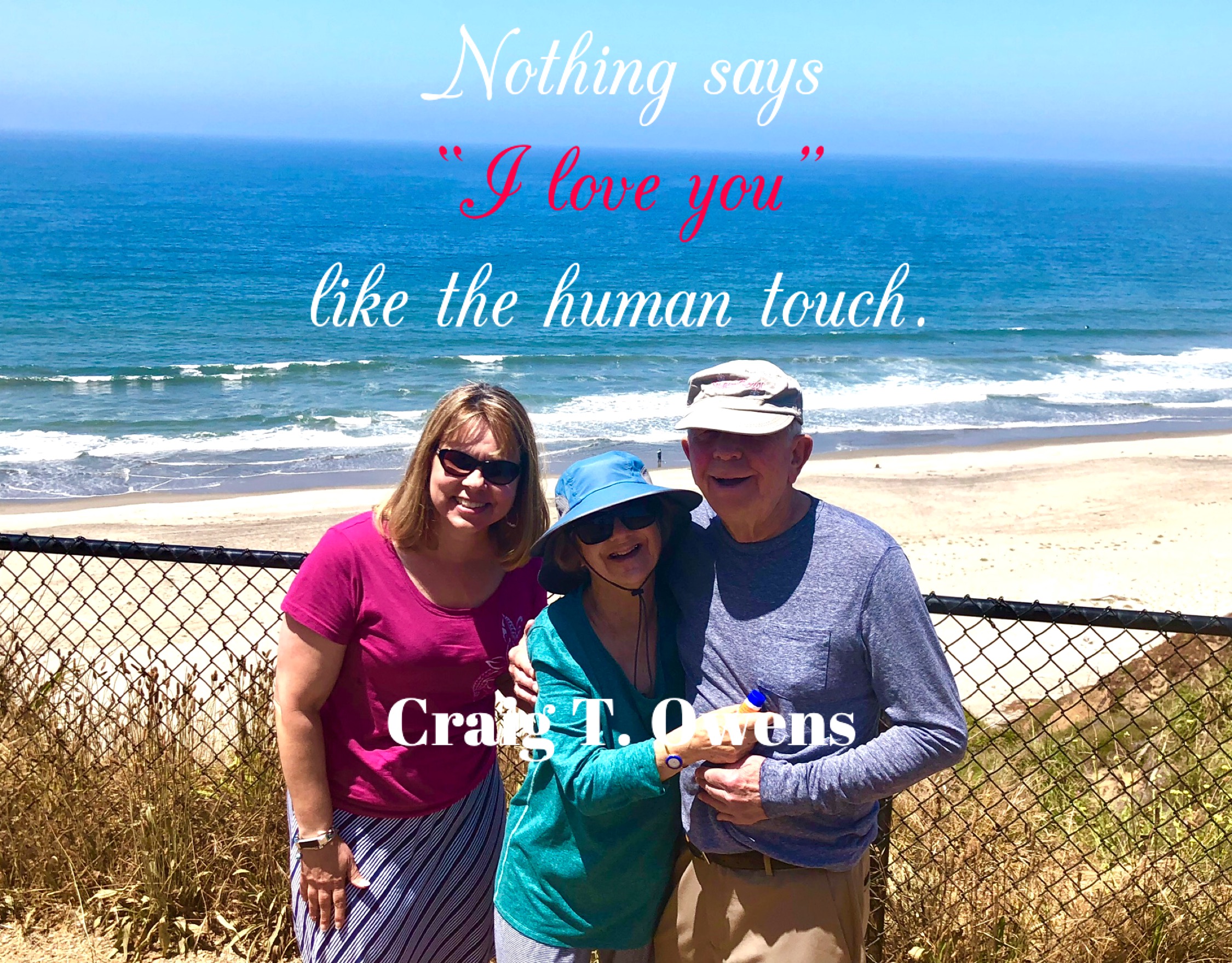
What about it? Are you ready to convey the love of Christ by touching—literally—people’s problems? Nothing says “I love you” like the human touch.

Goals & Strategies

I’m in the midst of a fascinating biography about General George S. Patton. As I wrote yesterday, I love borrowing the brains of other great men and women and adding some of their finer attributes to my life.

Years after Patton had died, his son donated his father’s books to the West Point Military Academy. It was then that a notation in Patton’s own hand was discovered on the last page of his Elements Of Strategy textbook. He wrote: “End of last lesson in Engineering. Last lesson as a Cadet, thank God.” But then on the back cover, he had also written—

Qualities of a Great General

1.  Tactically aggressive (loves a fight)

2.  Strength of character

3.  Steadiness of purpose

4.  Acceptance of responsibility

5.  Energy

6.  Good health and strength

George Patton

Cadet

April 29, 1909

Here’s what I love: he wrote these down years before he was ever given the command of anything! He put his goals and strategies in writing and dedicated himself wholeheartedly to achieving them. And achieve he did!

Years ago I took some time to write down a similar challenge for myself. Reading this about Patton reminded me that I haven’t reviewed my list in a while, and it was high time for me to reacquaint myself with those goals and strategies.

What about you?

Do you know where you want to go?

Do you know what it will take to get there?

Have you written down those goals and strategies?

Borrowed Brains

“We should not only use all the brains we have, but all that we can borrow.” —Woodrow Wilson

It’s so important to learn from others—to borrow their brains. I try to take something from other people’s brains every day.

  • Every morning I begin my day by studying the timeless truths found in the Bible.
  • Then I pray to ask God to give me the mind of Christ for my day.
  • Throughout my day I learn from the brains of other business and ministry leaders. People who have been-there-done-that and are willing to share are an invaluable source of wisdom.
  • I also consume a regular diet of biographies and autobiographies of past and present leaders. I try to put myself in their shoes to see why they made the decisions they made.
  • And I have some close friends that can give me their honest insight and critique.

One of the saddest things is to hear someone say, “I’m a self-made man” or “I’m a self-made woman.” Really?! That’s rather limited, isn’t it?

So whose brains are you borrowing? 

We Were Robbed!

Yesterday morning I walked into the church and noticed the office door was open. “Hmm,” I thought to myself, “I am sure that I closed that door before I left yesterday.”

Then I walked around the corner and noticed my office door standing open. “I know I closed that door,” I said. The hair on the back of my neck stood up, and I could feel all my muscles starting to tense. I walked into my office and saw the mess. I looked more closely at my office door and saw it had been jimmied open. So too had the office door.

Someone broke into the church. We had been robbed!

I made an inventory through the church, called the sheriff, and called our Board members. What else was there to do? I returned to my office, sat down in my chair, and looked around my office. Two thoughts overwhelmed me:

1.  All of the things that were taken were replaceable. I am grateful that the things that have sentimental value to me were left untouched.

2.  The words from Matthew Henry’s journal on the day he was robbed immediately came to mind:

“Let me be thankful first, because I was never robbed before; second, because, although they took my purse, they did not take my life; third, because, although they took my all, it was not much; and fourth, because it was I who was robbed, not I that robbed.”

So sitting in my office waiting for the sheriff deputy to arrive I prayed. I thanked God for His protection, and I prayed for the desperate individual who broke in. Clearly, this is someone who is at their wit’s end. Our thief is someone who needs my prayers, not my scorn.

I still feel violated. I still had a sick feeling in my stomach all day (and even now as I recall the events of yesterday). But I also remain grateful to God for His protection, and I’m continuing to pray for our thief that in His desperation He will meet this same loving God.

More Than Worship, It’s Worthship

Church has often been called a “house of worship.” But I struggle with what that means exactly. Sometimes it’s a house of singing, or a house of preaching, or a house of socializing, but not too often is the primary focus of the gathering people worship.

It seems most of the time worship is something we do at some point during the singing.

Now I will be the first to admit that the atmosphere most conducive to worship is usually created when meaningful—“worshipful”—songs are being played sung. But is that it? Shouldn’t there be something more?

The definition of worship includes:

…a condition of being worthy of honor or renown.

In fact, the Old English spelling was worthship. In other words, the greater the worth something had, the greater the honor or renown that something should be given.

In my case, the Something should have a capital “S.” The Person worthy of greatest honor and highest renown is my God and Savior Jesus Christ.

So why do I have to wait to go to a certain building to express His worth?

Why do I have to wait until the atmosphere is right?

Shouldn’t I be expressing my adoration and honor to Him always?

What does it mean to always be in a place of expressing my worthship?

I’ve been mulling over this quote from Brother Lawrence:

I know that for the right practice of it, the heart must be empty of all other things; because God will possess the heart alone; and as He cannot possess it alone, without emptying it of all besides, so neither can He act there, and do in it what He pleases, unless it be left vacant to Him.

As the Apostle Paul wrote I’m trying to capture every thought during the day and ask myself, “Is this thought taking up space in my heart that should be God’s space? Does this thought draw me closer to my Savior, or further away.” I’m trying to express His worth to me in the way I think about Him throughout the day.

Knowing God

I read a line in Craig Groeschel’s book—The Christian Atheist—this morning, and several thoughts have been swirling in my heart and mind. He wrote, “Get to know God. When you do, you will never be the same.” Maybe this resonates with you too.

To know God.

To really know Him.

Not just to know facts, or recite a history, or to know what He said. But to know HIM.

To know Him better. Better today than yesterday. To know His mind, His heart, His thoughts. Not knew (past tense) but know right now—this very moment.

What pleases Him? What does He long for? What breaks His heart? What are His plans for me?

Am I knowing Him?

Am I pleasing Him?

Am I living for Him today?

Am I walking in the path He wants me to?

Do I really know God?

I’m thankful for the Holy Spirit who helps me know God more. He helps me develop a more intimate knowledge. I’m so grateful that the Holy Spirit helps me to know that I am knowing God—intimately, personally, increasingly.

I will not stop my pursuit of God. I cannot stop. I don’t want to stop. I must know Him more today.

No Crutches

In preparing for the continuation of our Ignite series, I’ve been reviewing some of my notes about the Holy Spirit. This quote from R. Hollis Gause has really been working on me:

“[Jesus] was not a crutch for [the disciples’] immaturity. … Jesus did not encourage a mindless dependency on His physical presence; instead, He expected them to be interpretive of His instructions about their mission.”

Jesus said He wasn’t leaving us orphans, but He would send us the Holy Spirit to be a constant Counselor. When I submit to the Holy Spirit’s counsel, it’s not a mindless giving in, but a mind-full acknowledgment of His role. The Holy Spirit didn’t come to be my crutch, but to be my Liberator.

The Holy Spirit prepares me to be a conduit for God’s blessings.

I cannot touch in love…

I cannot speak with power…

I cannot truly represent Christ…

if I’m operating in my own strength.

The Holy Spirit comes alongside me to

Develop agape love in my heart…

stimulate my mind with the right words…

help me behave more like Jesus…

and live mind-full of His empowerment.

To do things on my own is to live with a crutch—to live a limited life.

To live in the flow of the Holy Spirit is to live a life that is fully engaged.

That’s how I want to live every day.

You See What You’re Looking For

It’s a pretty simple concept: you only see what you want to see. For example, if you are looking for your car keys, you won’t really see anything else that you are picking up or looking behind to find your keys. Your brain is locked in on keys, so that’s all you will see.

In a well-known Bible story, Moses sends twelve men into the Promised Land to check things out. He tells them to explore the land and bring back a report. The men went to several locations, and there is no mention of who or what they saw except…

  • …in the valley of Eschol, they found grapes of extraordinary size.
  • …in Hebron, they found people of extraordinary size.

They went in looking for big things, and that’s all they saw.

With the exception of Caleb and Joshua who said, “So what? Our God is bigger than those giants,” all the other men saw defeat. In the end, all the other men saw death in the desert; only Caleb and Joshua saw God’s victory in the Promised Land.

You see what you want to see—

What do you see?

What are you looking for?

Are you looking for giants? If so, you’ll find them. And they will seem even bigger in your eyes than they really are.

Are you looking for God’s victory? If so, you’ll find Him. And His deliverance will seem even more incredible than you could have imagined!

Prayer trains your eyes to see differently. Prayer trains your brain to look for victory. Prayer keeps you alert to what God is doing.

If all you see are giants, if all you hear is bad news, if all you feel is fear, perhaps you’re looking for giants and bad news and the fearful things.

Friend, God wants you to see Him on the move. Pray!

  • Prayer changes giants to dwarfs.
  • Prayer changes defeat to victory.
  • Prayer changes gloom to sunshine.
  • Prayer changes the way you see the world.
  • Prayer changes you.

“The prayer of the morning will determine the day.” —Dietrich Bonhoeffer