Your Autobiography

This quote from Oswald Chambers is right on target—

“Faith must have an autobiography.” 

You cannot live the stories of Abraham, Isaac, Jacob, Joseph or Moses.

You cannot live the stories of Peter, John or Paul.

You cannot live the stories of your grandparents or parents.

You can only live your story.

Your faith in Jesus must have an autobiography.

When Jesus tells us to let your light shine, and to go into all the world and preach, and to be My witnesses, He’s calling us to live our own story. He’s calling us to write an autobiography of faith.

How brightly will you live your faith autobiography in this new year?

What Does It Mean To Fear God?

Fear GodWhat does it mean to fear God? Does it mean we cower before Him? That He is utterly unapproachable? Or maybe it means we’re always looking over our shoulder wondering if God is coming after us in anger?

Let me ask the question another way:

  • Are you afraid that you won’t buy the right Christmas gift for someone?
  • Are you afraid that you’ll forget someone?
  • Are you afraid that your response won’t be right when you open a gift?
  • Are you afraid you’ll offend a family member by something you say or do?
  • Do other people’s opinion of you factor into your decisions?

If you answered “Yes” to the above questions, you have a fear problem. That is: you fear letting other people down.

I think this was the issue for Joseph in the Bible (Matthew 1:18-25). When he found out that Mary was pregnant before their marriage, Joseph carefully deliberated his response. Based on the meaning of the words had in mind and considered, and examining the way the angel told Joseph to “Fear not,” it appears that Joseph, too, lived in this same fear of letting others down.

But here’s the issue: Joseph placed greater value on people’s opinions than he did on God’s opinion. And what makes it even worse is that Joseph simply assumed what people would say about him, as he never actually asked anyone.

The angel challenged Joseph to re-evaluate his value system. To give greater weight to God’s opinion than to man’s opinion. In short, to change his fear of man to fear of God.

That’s really what it means to fear God: To give greater weight to His Word and His opinion than to anyone or anything else.

The wise king Solomon explored everything he could to find the meaning of life. He tried money, education, art, travel, women, food, power, and the like. At the end of his exploration, he came to this conclusion—

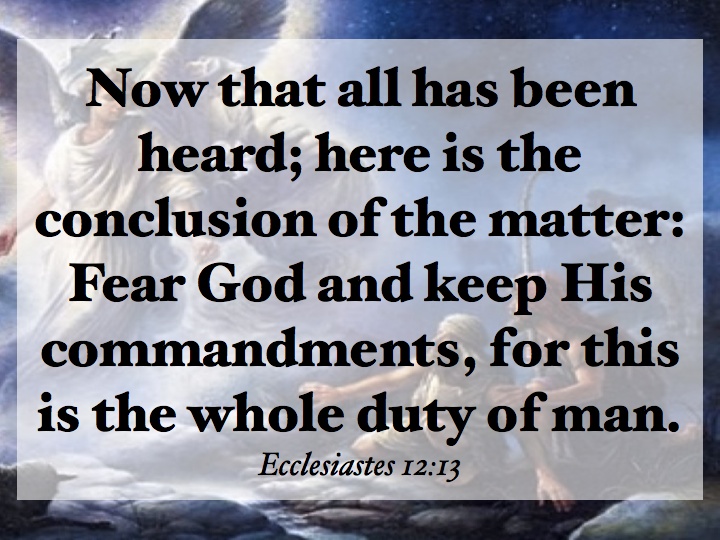
Now all has been heard; here is the conclusion of the matter: Fear God and keep His commandments, for this is the whole duty of man. (Ecclesiastes 12:13).

We should be living for the approval of an Audience of One. 

We should be longing to hear, “Well done, good and faithful servant” from our Creator. 

We should be listening only for the applause from nail-scarred Hands. 

“The remarkable thing about fearing God is that when you fear God you fear nothing else, whereas if you do not fear God you fear everything else.” —Oswald Chambers

If you have missed any of the messages in our Fear Not! series, you can find them all by clicking here.

Learning To Stop Complaining

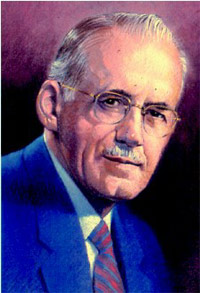
A.W. Tozer“The heart’s fierce effort to protect itself from every slight, to shield its touchy honor from the bad opinion of friend and enemy, will never let the mind have rest. Remember that always the greatest Christians have come out of hard times and tough situations. Tribulations actually worked for their spiritual perfection in that they taught them to trust not in themselves but in the Lord who raised the dead. They learned that the enemy could not block their progress unless they surrendered to the urgings of the flesh and began to complain. And slowly, they learned to stop complaining and start praising. It is that simple—and it works.” —A.W. Tozer

No!

Do you have a hard time saying “No”?

How about saying “No” to temptations? Perhaps this thought will help.

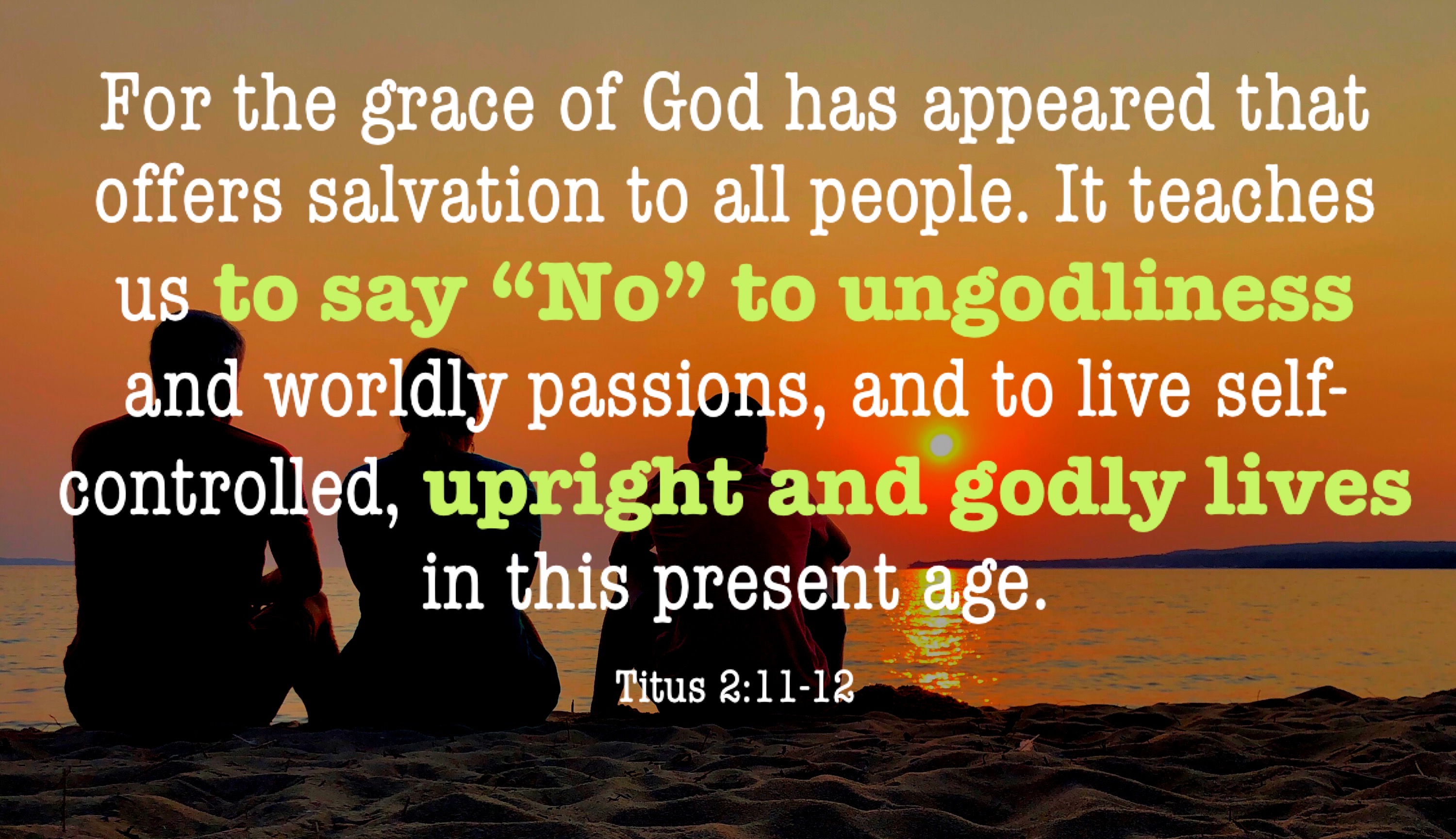
For the grace of God…teaches us to say “No” to ungodliness and worldly passions, and to live self-controlled, upright and godly lives in this present age. (Titus 2:11-12)

How does grace teach me to say, “No”?

The more I realize how much it cost Jesus to extend grace to me, the more I will realize what I can do to show gratitude for this amazing gift. I show my appreciation for this inestimable gift by saying “No” to ungodliness, AND saying “Yes” to godliness.

Saying “Yes” to my sinful passions is like a slap in the face of God. It’s saying that what I want to indulge in is somehow more valuable than Christ’s death on the Cross.

To live a self-controlled, upright, godly life is the bare minimum I can do to show my gratitude to my Savior! Grace is not a license to live as I want to live. Grace teaches me to say “No” to anything that would offend Jesus Christ.

George Whitefield said, “Think of the love of Jesus and let that love constrain you to keep near unto Him.” Which reminds me of a stanza of an old song—

Turn your thoughts upon Jesus
Think deep of His wonderful love
And the thoughts of sin
And of self and strife
Will be lost in that rapture above

I’m Not In Control

I am reminded again that my stressful feelings come because things are not going according to my plans. This can only mean one thing: Somehow I have let myself believe that I am in control of all my circumstances!

But I am not in control.

God alone is in control. He tells me not to be anxious, not to worry about tomorrow, but to come to Him to find rest.

Why, oh why, don’t I do this?!?

Enough! It’s time to once and for all give my concerns to the only One who can handle them.

“‘Come unto Me,’ says Jesus, ‘and I will give you rest.’ Do Jesus Christ’s words apply to me? Does He really know my circumstances? Fretting is sinful if you are a child of God. Get back to God and tell Him with shame that you have been bolstering up that stupid soul of yours with the idea that your circumstances are too much for Him. Ask Him to forgive you and say, ‘Lord, I take Thee into my calculation as the biggest factor now!’” —Oswald Chambers

“Brethren, The Fault Is Ours…”

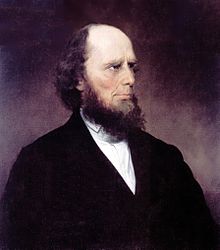
Pastor, these are incredible words spoken by the great Charles Finney nearly 140 years ago! I encourage you to take the time to hear these words with an open heart.

I believe it is a fact generally admitted that there is much less conscience manifested, by men and women, in nearly all the walks of life, than there was forty years ago. There is justly much complaint of this, and there seems to be but little prospect of reformation. The rings and frauds and villainies in high and low places, among all ranks of men, are most alarming, and one is almost compelled to ask: “Can nobody be safely trusted?” Now, what is the cause of this degeneracy? Doubtless there are many causes that contribute more or less directly to it; but I am persuaded that the fault is more in the ministry and public press than in any and all things else. It has been fashionable now for many years to ridicule and decry Puritanism. Ministers have ceased, in a great measure, to probe the consciences of men with the spiritual law of God. So far as my knowledge extends, there has been a great letting down and ignoring the searching claims of God’s law, as revealed in his Word. This law is the only standard of true morality. “By the law is the knowledge of sin.” The law is the quickener of the human conscience. Just in proportion as the spirituality of the law of God is kept out of view will there be manifest a decay of conscience. …The proper guardians of the public conscience have, I fear, very much neglected to expound and insist upon obedience to the moral law.

… The true Gospel is not preached where obedience to the moral law as the only rule of life is not insisted upon. Wherever there is a failure to do this in the instructions of any pulpit it will inevitably be seen that the hearers of such a mutilated Gospel will have very little conscience. …The universal literature of the present day shows conclusively that the moral sense of the people needs toning up, and some of our most fascinating preachers have become the favorites of infidels, skeptics of every grade, Universalists, and the most abandoned characters.

… My beloved brethren in the ministry, is there not a great want in the public inculcations of the pulpit upon this subject? We are set for the defense of the blessed Gospel and for the vindication of God’s holy law. I pray you let us probe the consciences of our hearers, let us thunder forth the law and Gospel of God until our voices reach the capital of this nation, through our representatives in Congress. It is now very common for the secular papers even to publish extracts of sermons. Let us give the reporters of the press such work to do as will make their ears and the ears of their readers tingle. Let our railroad rings, our stock gamblers, our officials of every grade hear from its pulpit, if they come within the sound, such wholesome Puritanical preaching as will arouse them to better thoughts and a better life. Away with this milk-and-water preaching of a love of Christ that has no holiness or moral discrimination in it. Away with preaching a love of God that is not angry with sinners every day. Away with preaching a Christ not crucified for sin.

… Brethren, our preaching will bear its legitimate fruits. If immorality prevails in the land, the fault is ours in a great degree. If there is a decay of conscience, the pulpit is responsible for it. If the public press lacks moral discrimination, the pulpit is responsible for it. If the church is degenerate and worldly, the pulpit is responsible for it. If the world loses its interest in religion, the pulpit is responsible for it. If satan rules in our halls of legislation, the pulpit is responsible for it. If our politics become so corrupt that the very foundations of our government are ready to fall away, the pulpit is responsible for it. Let us not ignore this fact, my dear brethren; but let us lay it to heart, and be thoroughly awake to our responsibility in respect to the morals of this nation. —Charles Finney (December 4, 1873)

Sola Deo Gloria

God wants to be glorified in your church service! That’s probably a “Duh!” statement, right? After all, who would disagree with that one?

But did you know God also wants to be glorified when you’re eating your dinner? And when you’re out with your friends? And when you’re on your job? And in your marriage? And in your private thought life?

Sola Deo gloria means that everything we do is only for the glory of God.

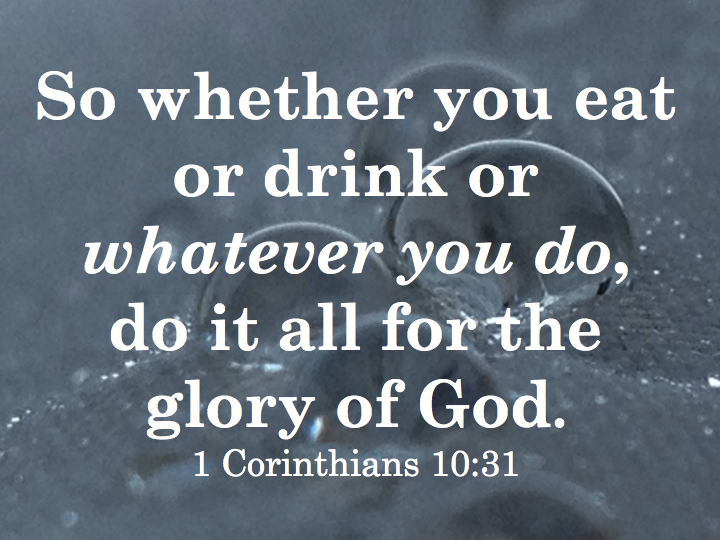
So whether you eat or drink or whatever you do, do it all for the glory of God. (1 Corinthians 10:31)

Sola Deo gloria means that there are no sacred/secular compartments in your life. You don’t have some activities that are for God and other activities that are not for God. All of life is for Him and for His glory.

“The shop, the barn, the scullery, and the smithy become temples when men and women do all to the glory of God! Then divine service is not a thing of a few hours and a few places, but all life becomes holiness unto the Lord, and every place and thing, as consecrated as the tabernacle and its golden candlestick.” —Charles Spurgeon

It borders on arrogance for me to say, “God, this is what I’m going to do and I want You to bless it.”

A better way to say it is like this: “God, what will bring You the most glory as I go to work? Or have a conversation with a friend? Or enjoy an evening out with my spouse? Or spend some time watching TV?”

What will bring You the most glory? If you ask this question, the Holy Spirit will answer it. Instead of you asking God to bless what you are going to do, He will show you what He’s already blessing—the ways in which He will be most glorified—and then you can go do that.

Try it this week: Ask the Holy Spirit to show you how you can bring glory to God in all that you do. Sola Deo gloria!

If you have missed any of the messages in this series, you can find them all here.

UPDATE: After posting this, I ran across a video from John Piper about God’s glory and I wanted to share it with you…

The Height Of Arrogance

Warning: this post may step on your toes.

Oswald Chambers wrote, “We have to find out God’s methods, not try to get God to approve our methods.”

Pastor, are you telling God what your church is going to do, and then asking God to bless your efforts?

Sadly, many churches innocently slide into this mode. But watch out: this is the height of arrogance!

Don’t fall into the trap of thinking you know how to reach your community, or organize your church, or even accurately select your next sermon. You can’t do it!

But God can!

He knows your community and your church better than you do. So try a better approach by starting with humility.

Don’t tell God what you’re going to do and then ask Him to bless your plans. Instead, ask God what He is already blessing, and then go do that.

No Competition In Church

What great words from A.W. Tozer!

“It is too bad that anything so obvious should need to be said at this late date, but from all appearances, we Christians have about forgotten the lesson so carefully taught by Paul: God’s servants are not to be competitors, but co-workers. … A local church, as long as it is indwelt by the Holy Spirit, cannot entertain the psychology of competition. When it begins to compete with another church, it is a true church of God no longer; it has voided its character and gone down onto a lower level. The Spirit that indwells it is no longer divine; it is human merely, and its activities are pitched on the plane of the natural. … The Holy Spirit always cooperates with Himself in His members. The Spirit-directed body does not tear itself apart by competition. The ambitions of the various members are submerged in the glory of the Head, and whatever brings honor to the Head meets with the most eager approval of the members. We should cultivate the idea that we are co-workers rather than competitors. We should ask God to give us the psychology of cooperation. We should learn to think of ourselves as being members in particular of one and the same body, and we should reject with indignation every suggestion of the enemy designed to divide our efforts.”

As Tozer said, it is too bad that we have to be reminded of the fact that the church should never be in competition with itself. It makes me appreciate all the more the relationship the churches in Cedar Springs have with each other!

Hope For The Despairing

“There are two things that kill the soul: despair and false hope.” —Augustine

Have you ever been around those who are despairing? They only see darkness; they only feel heaviness; they cannot perceive a way out.

How about those with false hope? They may see a light, but they’re not sure it’s real; the relief they feel is only temporary; nothing seems lasting or sure.

Despair and false hope crush the soul to death.

The word encourage means to inspire with courage … to give someone reason to hope … to breathe true life into their soul.

Political unrest doesn’t disturb the one grounded in real Hope. Economic turmoil doesn’t shake the one who knows the Provider. Social instability doesn’t cause anxiety for the one who knows the Prince of Peace. Death doesn’t crush the one who knows the Resurrected Lord.

Brothers, we do not want you to be ignorant about those who fall asleep, or to grieve like the rest of men, who have no hope. We believe that Jesus died and rose again and so we believe that God will bring with Jesus those who have fallen asleep in Him. … Therefore encourage each other with these words.

…But since we belong to the day, let us be self-controlled, putting on faith and love as a breastplate, and the hope of salvation as a helmet. … Christ died for us so that, whether we are dead or alive when He returns, we can live with Him forever. So encourage each other and build each other up, just as you are already doing. (1 Thessalonians 4:13-14, 18; 5:8, 10-11)

The good news—the hope-filled news—is Jesus is alive!

A relationship with Him is life!

A life full of hope!

A life full of promise!

A life full of Him that’s unending throughout eternity!

Do you know this hope? Are you sharing this hope with others?