Listen to the podcast of this post by clicking on the player below, and you can also subscribe on Apple, Spotify, or Audible.
God foretells that He will make governor Zerubbabel “like My signet ring.” This means that Zerubbabel would have God’s supreme authority—he could speak for God.
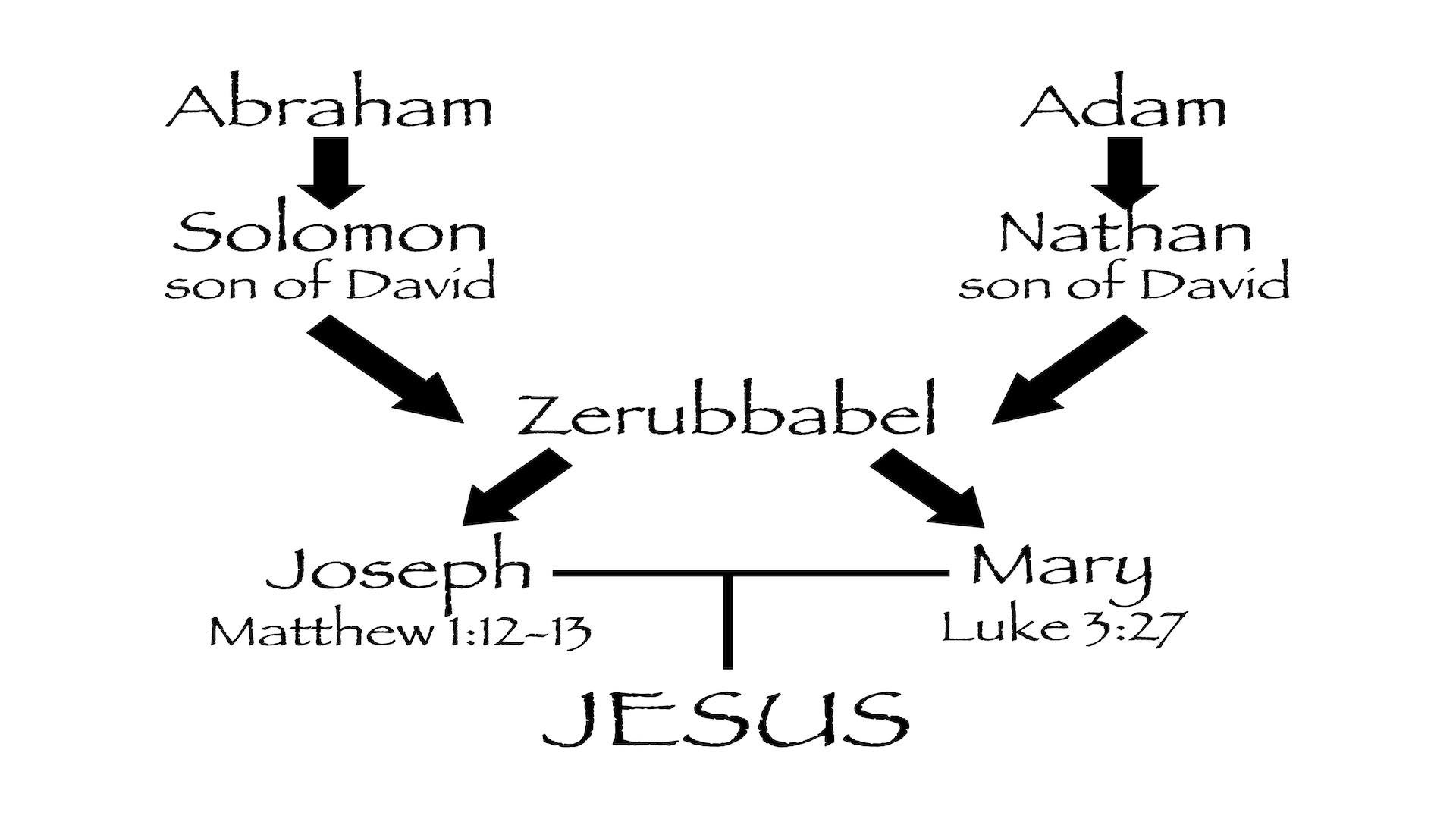
How could this happen? Zerubbabel couldn’t do it himself, but God sovereignly placed him in the family lines of both Joseph and Mary. This family lineage of Jesus Christ carried BOTH the covenant-fulfilling, kingly authority that traced back to Abraham AND the satan-crushing promise given to Adam’s human line.
Jesus joined these two promises through Zerubbabel the signet ring. Jesus became God’s Ultimate Signet Ring so that now every promise is “Yes” in Him. This mens every time we pray and claim promises in God’s Word, Jesus adds His stamp of authority—His “Amen!”—to our prayers (see 2 Corionthians 1:20).
Listen to the podcast of this post by clicking on the player below, and you can also subscribe on Apple, Spotify, or Audible.
Zechariah is the longest book of the minor prophets. His ministry overlaps Haggai the prophet, Ezra the priest, Zerubbabel the governor, and Joshua the high priest. I point all of this out because we need to always keep in mind that the Bible isn’t a collection of stories. It’s a verifiable (or falsifiable) record of real people at real moments in history. Many of the stories in the Bible confirm and even amplify each other.
Stand assured, encouraged, and unmovable on God’s Word
Aren’t you more assured of a message that has a confirmation? Like if one person gives you a compliment that you hadn’t considered before, and then later on someone else notices the same attribute. I think we are more ready to receive the word when it has a confirmation like that.
Haggai delivered a word directed to Zerubbabel the governor, which we saw was a prophecy pointing to and ultimately fulfilled in Jesus. God called Zerubbabel “Mysignet ring”—a mark of God’s supreme authority.
That might have been a difficult thing for Zerubbabel to accept, so Zechariah is given a confirming word two months after Haggai’s prophecy (Zechariah 4:1-9). This prophecy affirms the message given through Haggai, and also points to its ultimate fulfillment in Jesus.
But then Zechariah is also given an amplifying word, as he speaks a word from God to Joshua, the other “olive tree” in his God-given vision (Zechariah 3:1-9; 6:9-13).
Zechariah confirmed and amplified Haggai’s message. And then Jesus fulfilled both of their prophecies! We have the benefit of seeing the prophecy and fulfillment, which should build our faith in ALL of the promises in God’s Word.
The Word of God then become the (s)word of God in our mouths and hearts!
Because of these specific prophecies that have been fulfilled in Jesus Christ, we can now stand assured, encouraged, unmovable, and well-armed with the same sword of God.
There isn’t a more effective sword or shield than God’s (s)word!
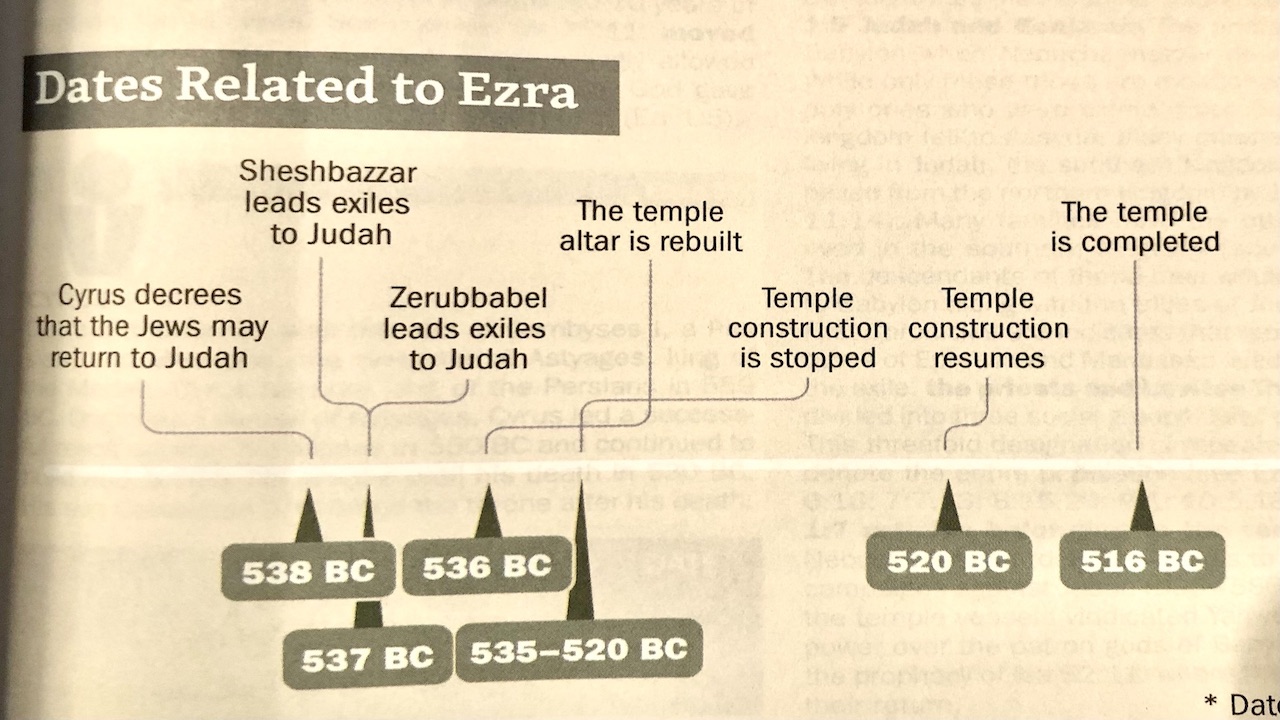
The reason these dates are so important is that they precisely align with the prophecy spoken by Jeremiah BEFORE the Israelites were even taken into exile. God said that they would return to worship in Jerusalem 70 years after their exile (Jeremiah 29:10-14; Daniel 9:1-2). Which is exactly what happened: They were taken into captivity in 586 BC, and the temple was completed in 516 BC!
Haggai’s final prophecy (Haggai 2:20-23) has an unusual ending. It’s unusual in that it doesn’t sound like “The End” that usually ends a book of the Bible. That is precisely because it’s not the end.
God tells Zerubbabel that he is God’s “signet ring,” a mark of God’s supreme authority. Zerubbabel was not the signet ring, but he was a forerunner—a type—of Jesus.
So when we trace the genealogies of Jesus in the New Testament, we see that Zerubbabel appears in the family line of both Joseph and Mary—both the family line from Abraham who received God’s covenant, and the family line of Adam who heard God promise that a human offspring would crush satan’s head.
These genealogies are as precise and exacting as the dates for the return of the exiles. God does everything exactly according to plan. He speaks His promises to us, and we can stand on those promises. Jesus is THE Signet Ring that stamps His “Amen” to every promise of God on which we stand.
Listen to the podcast of this post by clicking on the player below, and you can also subscribe on Apple or Spotify.
Jesus has just broken a 3-hour silence with His megaphone-voice cry: “My God, My God, why have You forsaken Me?” Now His final three statements will follow in rather short order, beginning with, “I am thirsty.”
It might seem trivial that Jesus expressed His desire for a drink, especially since He also knew that there was no thirst-quenching water nearby. Far from being trivial, however, this was eternally important because it completed His mission.
Before saying, “I am thirsty,” John tells us that Jesus knew “that all was now completed.” The Greek word for know is sometimes translated as “see” and sometimes “know.” When it’s “see” it’s always in the past tense—“saw” or “have seen.” Perhaps in His 3-hour silence, Jesus was reviewing His earthly life, looking back to see what He had accomplished. Make no mistake about it, Jesus was on-mission for all 30+ years of His life in Israel.
But now that He has seen His life, He “knows.” This word is in the perfect tense. He’s seen it all and He knows He has accomplished all He set out to complete. As He had told His audience earlier in His life, “For assuredly, I say to you, till heaven and earth pass away, one jot or one tittle will by no means pass from the law till ALL is fulfilled” (Matthew 5:18).
In looking back on His life, Jesus saw one final thing: He needed to be given vinegar to drink just as David prophesied (Psalm 69:13-21). With that sour sip, ALL the Ts are crossed and ALL the Is are dotted!
When John writes, “Knowing all was now completed, and so the Scripture would be fulfilled,” he uses the Greek word which means mission accomplished!
Why did Jesus need to fulfill ALL the prophecies and complete ALL the law? Check out His earlier statement from the Amplified Bible: “For truly I tell you, until the sky and earth pass away and perish, not one smallest letter nor one little hook identifying certain Hebrew letters will pass from the Law until all things it FORESHADOWS are accomplished.”
The law was just our temporary guardian and the temple practices were just a shadow of the realities of Heaven (see Galatians 3:23-25; Hebrews 10:1-10). ALL of them were merely pointing to Jesus, so Jesus made sure ALL of them were completed.
His “I am thirsty” statement was really His “Amen” to His completed mission.
Jesus fulfilled every Scripture so that we could stand on every promise!
Check this out: “For no matter how many promises God has made, they are ‘Yes’ in Christ. And so through Him the ‘Amen’ is spoken by us to God” (2 Corinthians 1:20).
The shadows of the law were turned into the substance on which we can come boldly before the throne of God’s grace! In just three words—“I am thirsty”—Jesus completed His mission for God’s glory and for our eternal help!
Listen to the podcast of this post by clicking on the player below, and you can also subscribe on Apple or Spotify.
Dying declarations are powerful statements!
As Jesus was nailed to the Cross, His first dying declaration prompted such a change of heart in a hardened criminal that the criminal’s own dying declaration caused Jesus to say, “Amen!” The story is found in Luke 23:32-43.
But first, we need to ask, why were criminals crucified alongside Jesus? An obvious answer is that it fulfilled a First Testament prophecy—He poured out His life unto death, and He let Himself be regarded as a criminal and be numbered with the transgressors (Isaiah 53:12).
How did this come about? Maybe…
Pilate was trying to justify his actions?
the Sanhedrin had used these criminals as “evidence” that Jesus was stirring up a rebellion against the crown?
a Roman centurion suggested, “Let’s kill three birds with one stone”?
Whatever the case, they couldn’t have been very happy about this, especially since Barabbas (a fellow criminal) had just been released. They probably blamed Jesus for their awful predicament, so they naturally joined in the mockery.
And what cruel mockery it was!
the people stood watching these crucifixions and, since Luke uses the word for a sports spectator, it appears they were cheering the bloodshed they were observing
the Pharisees and Sadducees derided Jesus
the Roman soldiers continued the inhuman mockery and abuse that they had begun hours before
the criminals crucified on either side of Jesus blasphemed Him
Luke kindly records that only one criminal was hurling insults at Jesus, but Matthew and Mark make it clear that both criminals were blaspheming Jesus (Matthew 27:44; Mark 15:32).
It appears that one criminal, although at first a blasphemer, had a change of heart.
Perhaps it was because He heard this Jesus, who was being so horribly mistreated, ask His Father to forgive His tormentors instead of asking for retribution. The apostle Peter says that when we follow Christ’s example in this it can actually make people become ashamed of their slander against us (1 Peter 2:23; 3:14, 16).
Or perhaps this criminal had been in the crowd earlier that week on Monday when Jesus taught about the Kingdom of God all day. If he was, he would have heard Jesus talk about the rewards for the righteous and the punishment for the wicked, and he would have heard Jesus talk about how even criminals like himself could be allowed into God’s Kingdom (Matthew 21:28-32).
All of this was working on him until his own slander against Jesus stuck in his throat and he rebuked his companion for his blasphemy. He said, “We are guilty and deserve this death sentence. But this Man is totally innocent!”
Then turning to Jesus, he delivers his faith-filled declaration, “LORD Jesus, remember me when You come into Your kingdom.” He called Him Lord, asked for a reward, and acknowledged that Christ’s Kingdom was not of this earth. This dying declaration was more faith-filled than even the disciples of Jesus could make, since all but one of them had fled in fear!
Jesus is so moved by this man’s declaration that His first word to him is Amen: “I tell you the truth [literally: Amen!], today you will be with Me in paradise.”
King David taught us that the sacrifice that God accepts is a broken heart, and the apostle Paul agrees by saying that it is the heart change and the confession of our mouth that brings our salvation (Psalm 51:16-17; Romans 10:4-11).
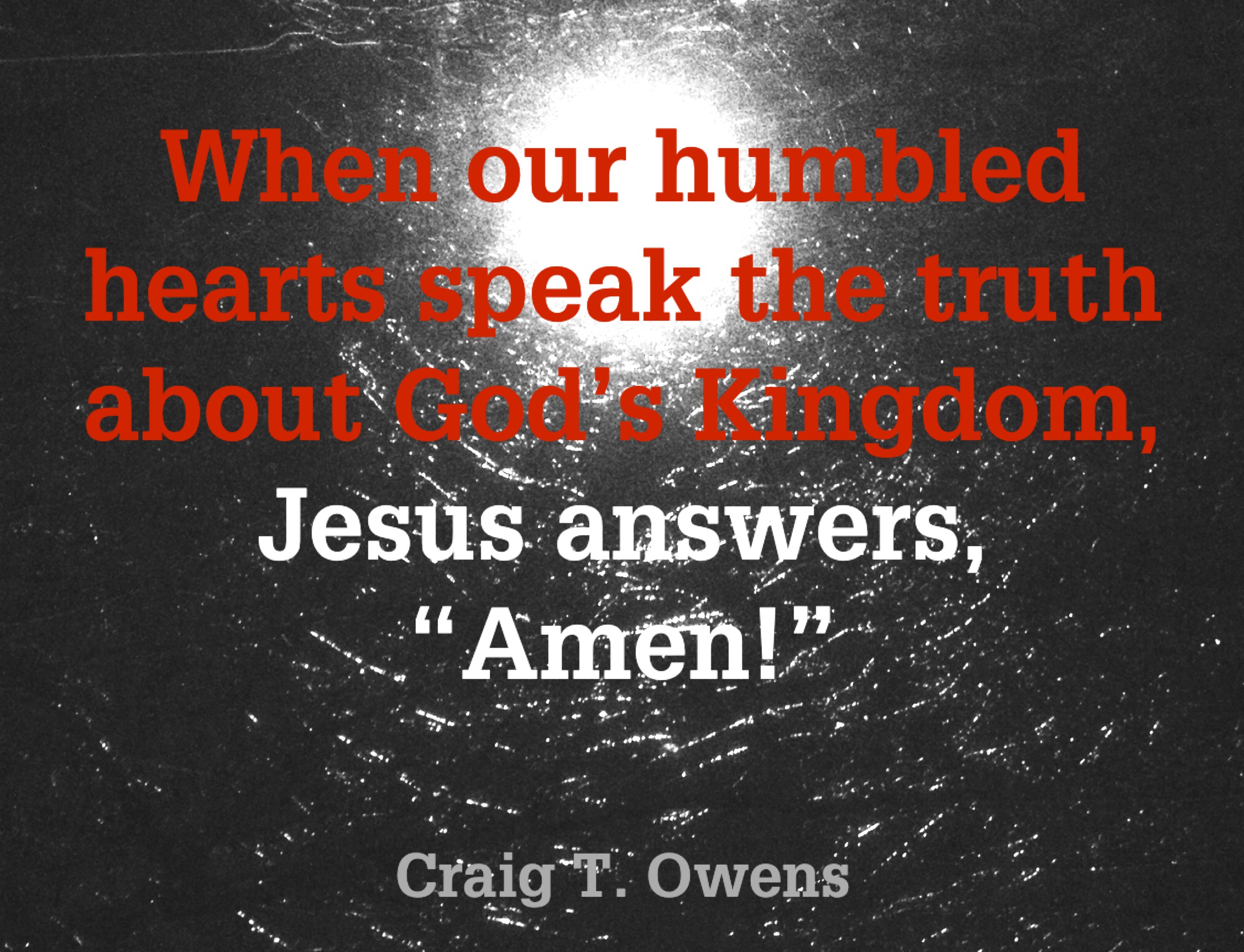
My friend, Jesus has opened the way to Paradise for you by His death on the Cross. When our humbled hearts speak the truth about God’s Kingdom, Jesus says, “Amen!” and God welcomes us into His presence for ever and ever! Don’t wait another day, but cry out to Jesus today: tell Him that you are guilty, but you believe He has paid for your sins. He will then say the same word to your heart: “Amen! You will spend eternity in Paradise with Me!”
If you would like to follow along as we look at all seven of the dying declarations Jesus made from the Cross, please click here.



 God foretells that He will make governor Zerubbabel “like My signet ring.” This means that Zerubbabel would have God’s supreme authority—he could speak for God.