Eternal Fruit

I love John Wesley’s commentary on this verse in the Gospel of John:

You have not chosen Me, but I have chosen you and I have appointed you [I have planted you], that you might go and bear fruit and keep on bearing, and that your fruit may be lasting [that it may remain, abide], so that whatever you ask the Father in My Name [as presenting all that I AM], He may give it to you. (John 15:16 AMP)

From John Wesley’s Notes On The Bible:

  • I have chosen and appointed you—for this end, that ye may go and convert sinners.
  • That your fruit may be lasting—that the fruit of your labors may remain to the end of the world; yea, to eternity.
  • That whatsoever you ask—the consequence of your going and bearing fruit will be, that all your prayers will be heard.

Leading others to an eternity with Jesus, bearing fruit that lasts forever, and having complete union with Christ in prayer. Wow! What amazing privileges followers of Jesus can have!

Battling Depression

Have you ever been depressed? I have. I know all too well how depression robbed me of sleep, sapped joy from my day, kept me from smiling and on the verge of tears all the time, made sunny days seem cloudy, caused me to sigh all the time and lose interest in the things that used to bring me pleasure, and brought such a sense of loneliness and isolation.

Did you know that Jesus felt the crushing load of depression too? As He was praying in the Garden of Gethsemane just before His arrest, listen to these words—

  • He began to be sorrowful and troubled
  • He became anguished and distressed
  • He began to show grief and distress of mind and was deeply depressed
  • He said to them, “My soul is overwhelmed with sorrow to the point of death”
  • He prayed more fervently, and He was in such agony of spirit that His sweat fell to the ground like great drops of blood
  • “Abba, Father,” He cried out, “everything is possible for You. Please take this cup of suffering away from Me. Yet I want Your will to be done, not Mine.” (see Matthew 26:37-38; Mark 14:36; Luke 22:44)

The writer of Hebrews wrote this about Jesus—

While Jesus was here on earth, He offered prayers and pleadings, with a loud cry and tears, to the One who could rescue Him from death. And God heard His prayers because of His deep reverence for God. Even though Jesus was God’s Son, He learned obedience from the things He suffered. In this way, God qualified Him as a perfect High Priest, and He became the source of eternal salvation for all those who obey Him. (Hebrews 5:7-9)

We learn something in suffering that we can’t learn any other way. Jesus learned how to experience all of the grief, anxiety, and depression that you and I will ever feel. And that is what qualifies Him to be a perfect High Priest for us.

Our part is to pray. Time and time and time again, not only did Jesus pray, but He encouraged His disciples to pray as well. As you continue to pray, Jesus is your High Priest praying for you. Only He truly knows how to translate the cry of your heart into a language Abba Father can understand.

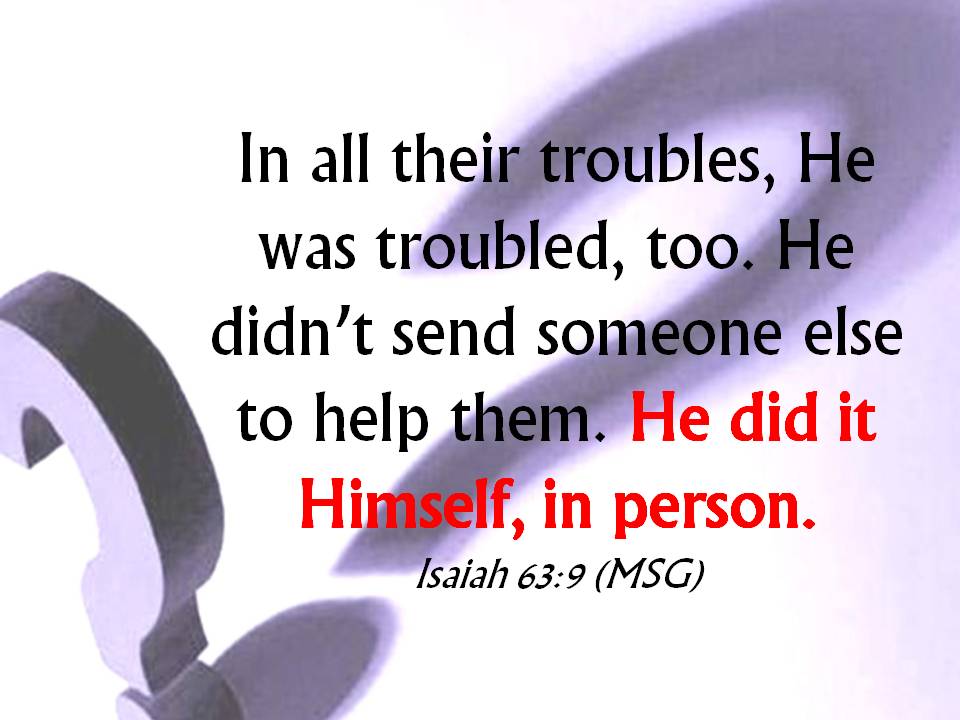
In all their troubles, He was troubled, too. He didn’t send someone else to help them. He did it Himself, in person. (Isaiah 63:9)

If you’ve missed any of the messages in this series called Where’s God, please check them all out by clicking here.

Thursdays With Oswald—Why Do I Go To God?

This is a weekly series with things I’m reading and pondering from Oswald Chambers. You can read the original seed thought here, or type “Thursdays With Oswald” in the search box to read more entries.

Why Do I Go To God?

     We have become so self-centered that we go to God only for something from Him, and not for God Himself. It is like saying, ‘No, Lord, I don’t want You; I want myself. But I do want You to clean me and fill me with Your Holy Spirit. I want to be on display in Your showcase so I can say, “This is what God has done for me.”’ Gaining heaven, being delivered from sin, and being made useful to God are things that should never even be a consideration in real surrender. Genuine total surrender is a personal sovereign preference for Jesus Christ Himself.

From My Utmost For His Highest

This quote smacked me right between the eyes: “We have become so self-centered that we go to God only for something from Him, and not for God Himself.”

This is one of those statements that caused me to put down my book, and take a hard look in my spiritual mirror. Why do I turn to God? Is it just so I can get something? When do I seek Him? Only when I’m in trouble?

The prayer that Jesus taught us to pray should be an everyday, heartfelt surrender: I surrender completely to You. Even Jesus Himself prayed: Not My will be done, but Yours.

My attitude as a disciple must be a daily decision to take my cross and follow Him.

How arrogant and self-centered of me to say, “God this is how I’m going to live today, and I want You to bless it. If things don’t go well, I will call on You for what I need.”

Instead I must pray: “Lord, I am totally surrendered to You today. Let me do only Your will. Let me walk more closely with You today. This is the only way I can be useful for You today.”

Why do I go to God: For His glory? Or for my comfort?

Thursdays With Oswald—The Intimacy Of God

This is a weekly series with things I’m reading and pondering from Oswald Chambers. You can read the original seed thought here, or type “Thursdays With Oswald” in the search box to read more entries.

The Intimacy Of God

     The 139th Psalm ought to be the personal experience of every Christian. My own introspection, or exploration of myself, will lead me astray, but when I realize not only that God knows me, but that He is the only One who does, I see the vital importance of intercessory introspection. Every man is too big for himself, thank God for everyone who realizes it and, like the Psalmist, hands himself over to be searched out by God. We only know ourselves as God searches us. ‘God knows me’ is different from ‘God is omniscient’; the latter is a mere theological statement; the former is a child of God’s most precious possession—‘O Lord, Thou hast searched me, and known me.’

From Biblical Ethics

I love the line, “We only know ourselves as God searches us.”

He knows me better than I know myself. If I ever hope to mature, I can only do so as I make this my daily prayer:

Search me, O God, and know my heart; test me and know my anxious thoughts. Point out anything in me that offends You, and lead me along the path of everlasting life. (Psalm 139:23,24)

We Must Pray

I don’t want to make my plans, and then ask God to bless them.

Instead, I want to ask God what He will bless, and then go do that.

There’s a huge difference. In order to know the difference, we must pray!

Charles Spurgeon wrote:

“Let it be a standing ordinance in the church that at certain times and occasions many shall meet together to pray, and supplication shall be their sole object. The private Christian will read, and hear, and meditate, but none of these can be a substitute for prayer: the same truth holds good upon the larger scale, the church should listen to her teachers, and receive edification from gospel ordinances, but she must also pray; nothing can compensate for the neglect of devotion.”

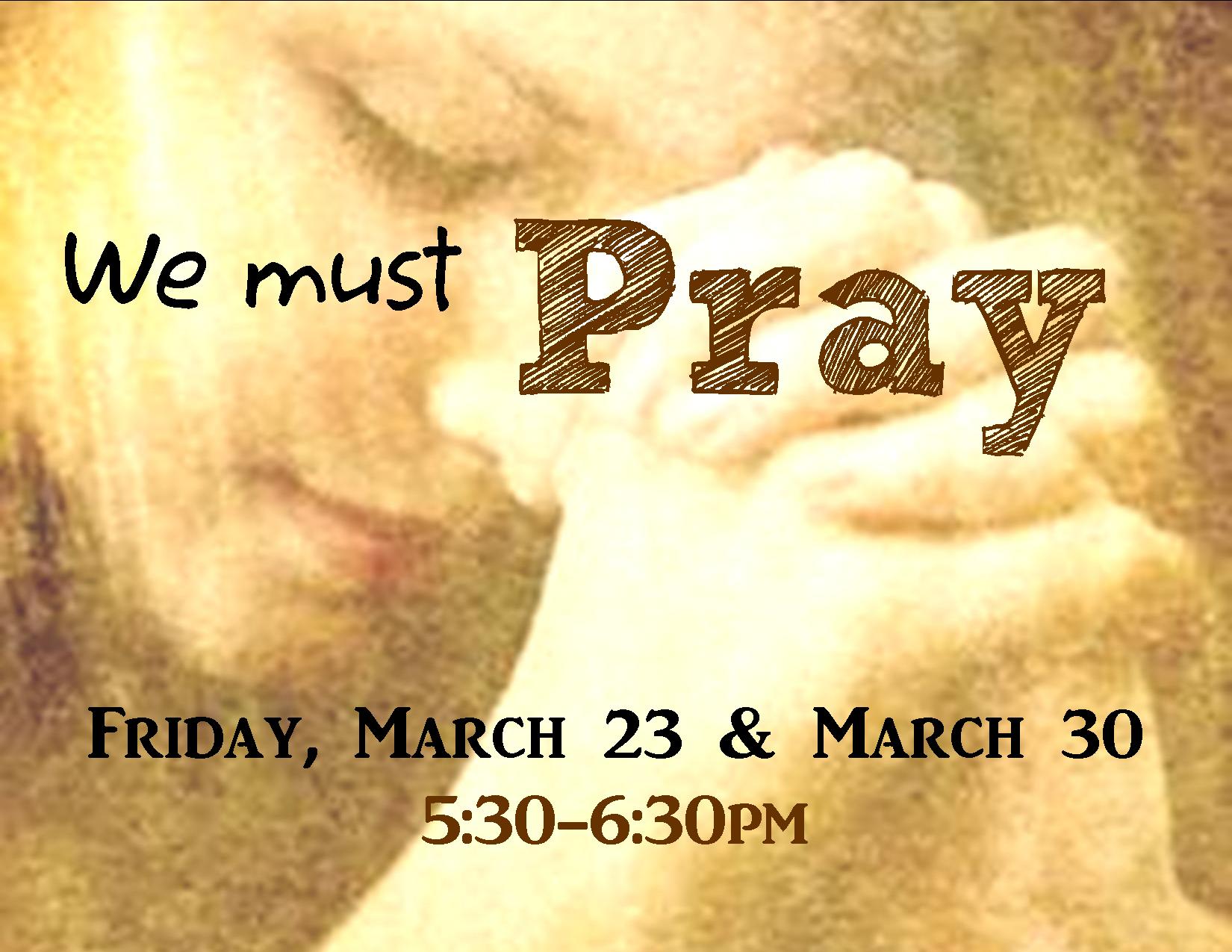
I have called for our church to have times that prayer will be our sole object. On Friday, March 23, and Friday, March 30, we will be meeting to pray. No singing, no devotional thoughts; just prayer for an hour starting at 5:30pm. If you are in the area, I welcome you to join us. If you’re not in the area, you can still join us in prayer.

Specifically, we’ll be praying for God to move on people’s hearts as we approach the Passion Week. We don’t want to just make a bunch of plans. We want to know what God would have us do during that week that will glorify His Name.

We must pray!

Thursdays With Oswald—Seeing Sin As Sin

This is a weekly series with things I’m reading and pondering from Oswald Chambers. You can read the original seed thought here, or type “Thursdays With Oswald” in the search box to read more entries.

Seeing Sin As Sin

     Knowledge of what sin is is in inverse ratio to its presence; only as sin goes do you realize what it is; when it is present you do not realize what it is because the nature of sin is that it destroys the capacity to know you sin. …

     To ‘crucify’ means to put to death, not counteract, not sit on, not whitewash, but kill. If I do not put to death the things in me which are not of God, they will put to death the things that are of God.

From Biblical Ethics

Romans 7 tells me that there are two forces at work in my life: God and sin. This is a battle to the death! So, if I think I am standing firm, that’s the exact time to watch out (see 1 Corinthians 10:12).

God never turns away the one who prays to Him, “Be merciful to me, a sinner.” But He turns a deaf ear to the one that claims, “I’m alright.”

May I always be VERY sensitive to even the hint of sin in my heart.

Praying, Praying, And Praying Some More

I start each new year teaching a series on prayer at my church. This year I also began by reading Mark Batterson’s excellent new book on prayer called The Circle Maker.

So 2012 has been a more prayerful year for me so far. As a result, I am hearing about and seeing miracles take place in my life, and throughout our church. You know what this is doing in me? Increasing my desire to pray more!

Charles Spurgeon wrote,

“We may be certain that whatever God has made prominent in His Word, He intended to be conspicuous in our lives. If He has said much about prayer, it is because He knows we have much need of it. The motto for this year must be, Continue in prayer.”

But some of the things I am praying for have been on my prayer list for a long time. It appears that an answer hasn’t come… yet. You know what this is doing in me? Increasing my desire to pray more!

Here’s what Mark Batterson said,

“Some prayers go unanswered because they aren’t what’s best for us. Some prayers go unanswered because they don’t glorify God. Some prayers go unanswered because they aren’t part of God’s will. But while God doesn’t always ANSWER our prayers the way we want, we can be confident that He HEARS our prayers! And our Father knows best.”

Have you seen answers to your prayers? Keep on praying!

Are you waiting for answers to your prayers? Keep on praying!

And then pray some more!!

Not Playing It Safe

Listen to the podcast of this post by clicking on the player below, and you can also subscribe on AppleSpotify, or Audible.

Sometimes I like to think about counterfactual history. That means thinking about the “What ifs” of historical events. What if George Washington had been killed in battle? What if a congressman had voted a different way? And so on.

Here’s one I was thinking about as I read the Book of Acts: What if Paul had prayed, “God, keep me safe”?

Over the last few chapters of Acts, Paul has the opportunity to share the gospel with…

  • the Jewish Sanhedrin
  • Claudius Lysias, a Roman garrison commander
  • two Roman governors (Felix and Festus)
  • Ananias, the high priest in Israel
  • Tertullus, a noted attorney
  • King Agrippa and his wife Bernice
  • a Roman centurion named Julius
  • Publius, the chief Roman official on Malta
  • the leading Jews in Rome
  • and the Roman Caesar

That’s quite an impressive list! But here’s the deal: Paul only got to speak to these high-ranking and influential people because he was a prisoner.

Paul could have prayed for a “safe life.” He could have run away. He could have disobeyed. Instead, he was willing to let God use him anytime, anyplace, anyway.

Isn’t that really the opening line of the Lord’s Prayer? Your Kingdom come, Your will be done.

Is that what I really want?

Or do I want to play it safe?

Phillips Brooks had another thought about how we should pray:

“Do not pray for easy lives; pray to be stronger men. Do not pray for tasks equal to your powers; pray for powers equal to your tasks. Then the doing of your work shall be no miracle; but you shall be a miracle.”

I don’t want to play it safe. I want to be strong enough, obedient enough, and willing enough to let God use me anytime, anyplace, anyway. I hope you will join me in that prayer.

►► Would you please prayerfully consider supporting this ministry? My Patreon supporters get behind-the-scenes access to exclusive materials. ◀︎◀︎

I-Have-To-Have-It Attitude

In our Live Dead series, we have been talking about different areas we need to allow to die, so that we might truly live for Christ as His disciples.

One of the things that often gets in the way of our pursuit of Christ is our cravings. This word—which the dictionary defines as a longing or an eager desire—has an interesting origin. The root word in both Latin and Old English means to lay claim to or to demand by right.

In other words, a craving is when something that was originally a want has now become a need in my mind. So I lay claim to it, saying that it’s something that is owed to me.

The Apostle Paul talks about cravings that we all had before we came to know Christ as Savior when he wrote, “All of us also lived among them at one time, gratifying the cravings of our sinful nature and following its desires and thoughts” (Ephesians 2:3).

This same Greek word shows up in Christ’s parable of the sower when He talks about the seed that falls among the weeds. These people, He explains, allow the worries of this life, the deceitfulness of wealth and the desires for other things come in and choke the Word (Mark 4:19).

Gratifying my cravings = Choking out the life of Christ in me

The problem is that this craving or desire for things other than Christ is often an unconscious habit. We have allowed them to become cravings—laying our claim to them as needs—without even realizing it.

The antidote: fasting. When we give up something, the Holy Spirit can show us if that thing has created an I-Have-To-Have-It attitude in our hearts. This spiritual discipline is hard because our bodies will rebel against having to give up “a right.” But when we press through with this discipline of fasting, God describes the results:

Then your light will break forth like the dawn, and your healing will quickly appear; then your righteousness will go before you, and the glory of the LORD will be your rear guard. Then you will call, and the LORD will answer; you will cry for help, and He will say: Here am I. (Isaiah 58:8-9)

That’s how I want to live! So I must live dead to my cravings. I can only do this when I allow a time of fasting to open my heart to hear the Holy Spirit point out all my I-Have-To-Have-It attitudes.

To check out all of the messages in our Live Dead series, please click here.

Prayer… Is The Act Of Dying

“We want to move closer to God, the source and goal of our existence, but at the same time we realize that the closer we come to God the stronger will be His demand to let go of the many ‘safe’ structures we have built around ourselves. Prayer is such a radical act because it requires us to criticize our world’s way of being in the world, to lay down our old selves and accept our new self, which is Christ. … Prayer therefore is the act of dying to all that we consider to be our own and of being born to a new existence which is not of this world.” —Henri Nouwen