Thursdays With Oswald—The Word & The Words

This is a weekly series with things I’m reading and pondering from Oswald Chambers. You can read the original seed thought here, or type “Thursdays With Oswald” in the search box to read more entries.

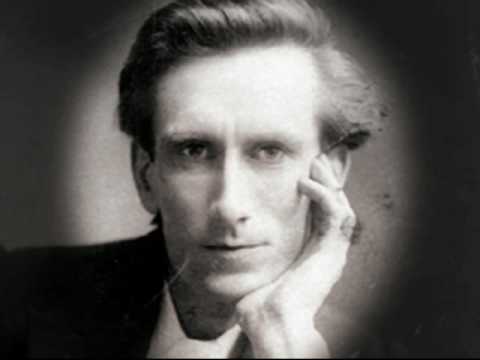
Oswald Chambers

The Word & The Words

     The Bible is the Word of God only to those who are born from above and who walk in the light. Our Lord Jesus Christ, the Word of God, and the Bible, the words of God, stand or fall together, they can never be separated without fatal results. A man’s attitude to our Lord determines his attitude to the Bible. 

     The “sayings” of God to a man not born from above are of no moment; to him the Bible is simply a remarkable compilation of literature—“that it is, and nothing more.” All the confusion arises from not recognizing this. 

     But to the soul born from above, the Bible is the universe of God’s revealed will. The Word of God to me is ever according to my spiritual character; it makes clear my responsibility to God as well as my individuality apart from Him. 

From Christian Disciplines (emphasis mine)

Do you agree with Chambers on this viewpoint?

In light of this, how will you view Scripture differently?

22 Quotes From “The Ragamuffin Gospel”

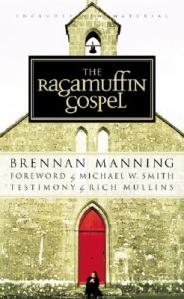
Ragamuffin GospelThe Ragamuffin Gospel by Brennan Manning really resonated with me. You can read my full book review by clicking here, but below are some of the quotes I especially appreciated.

“The institutional church has become a wounder of the healer rather than a healer of the wounded.” 

“Personal responsibility has replaced personal response. We talk about acquiring virtue as if it were a skill that can be attained, like good handwriting or a well-grooved golf swing. In the penitential seasons we focus on overcoming our weaknesses, getting rid of our hang-ups, and reaching Christian maturity. We sweat through various spiritual exercises as if they were designed to produce a Christian Charles Atlas. Though lip service is paid to the gospel of grace, many Christians live as if only personal disciplines and self-denial will mold the perfect me. The emphasis is on what I do rather on what God is doing. In this curious process God is a benign old spectator in the bleachers who cheers when I show up for morning quiet time.”

“God has a single relentless stance toward us: He loves us. He is the only God man has ever heard of who loves sinners. False gods—the gods of human manufacturing—despise sinners, but the Father of Jesus loves all, no matter what they do.” 

“Jesus comes not for the super-spiritual but for the wobbly and the weak-kneed who know they don’t have it all together, and who are not too proud to accept the handout of amazing grace.”

“The Word we study has to be the Word we pray.”

“We must never allow the authority of books, institutions, or leaders to replace the authority of knowing Jesus Christ personally and directly. When the religious views of others interpose between us and the primary experience of Jesus as the Christ, we become unconvicted and unpersuasive travel agents handing out brochures to places we have never visited.”

“Whatever past achievements might bring us honor, whatever past disgraces might make us blush, all have been crucified with Christ and exist no more except in the deep recess of eternity.” 

“It is unimaginable to picture a wooden-faced, stoic, joyless, and judgmental Jesus as He reclined with ragamuffins.”

“We miss Jesus’ point entirely when we use His words as weapons against others. They are to be taken personally by each of us.” 

“The saved sinner is prostrate in adoration, lost in wonder and praise. He knows repentance is not what we do in order to earn forgiveness; it is what we do because we have been forgiven. It serves as an expression of gratitude rather than an effort to earn forgiveness. Thus the sequence of forgiveness and then repentance, rather than repentance and then forgiveness, is crucial for understanding the gospel of grace.”

“Maybe this is the heart of our hang-up, the root of our dilemma. We fluctuate between castigating ourselves and congratulating ourselves because we are deluded into thinking we save ourselves. We develop a false sense of security from our good works and scrupulous observance of the law. Our halo gets too tight and a carefully disguised attitude of moral superiority results. Or we are appalled by our inconsistency, devastated that we haven’t lived up to our lofty expectations of ourselves. The roller coaster ride of elation and depression continues. Why? Because we never lay hold of our nothingness before God, and consequently, we never enter into the deepest reality of our relationship with Him. But when we accept ownership of our powerlessness and helplessness, when we acknowledge that we are paupers at the door of God’s mercy, then God can make something beautiful out of us.” 

“Honesty is such a precious commodity that it is seldom found in the world or the church. Honesty requires the truthfulness to admit the attachment and addictions that control our attention, dominate our consciousness, and function as false gods. I can be addicted to vodka or to being nice, to marijuana or being loved, to cocaine or being right, to gambling or relationships, to golf or gossiping. Perhaps my addiction is food, performance, money, popularity, power, revenge, reading, television, tobacco, weight, or winning. When we give anything more priority than we give to God, we commit idolatry. Thus we all commit idolatry countless times every day.”

“To be alive is to be broken. And to be broken is to stand in need of grace. Honesty keeps us in touch with our neediness and the truth that we are saved sinners. There is a beautiful transparency to honest disciples who never wear a false face and do not pretend to be anything but who they are. … Getting honest with ourselves does not make us unacceptable to God. It does not distance us from God, but draws us to Him—as nothing else can—and opens us anew to the flow of grace.” 

“When we wallow in guilt, remorse, and shame over real or imagined sins of the past, we are disdaining God’s gift of grace. Preoccupation with self is always a major component of unhealthy guilt and recrimination. … Yes, we feel guilt over sins, but healthy guilt is one which acknowledges the wrong done and feels remorse, but then is free to embrace the forgiveness that has been offered.”

“The evil one is the great illusionist. He varnishes the truth and encourages dishonesty. ‘If we say, “We have no sin,” we are deceiving ourselves, and the truth has no place in us’ (1 John 1:8). satan prompts us to give importance to what has no importance. He clothes trivia with glitter and seduces us away from what is real. He causes us to live in a world of delusion, unreality, and shadows.” 

“At Sunday worship, as in every dimension of our existence, many of us pretend to believe we are sinners. Consequently, all we can do is pretend to believe we have been forgiven. As a result, our whole spiritual life is pseudo-repentance and pseudo-bliss.”

“The way we are with each other is the truest test of our faith. How I treat a brother or sister from day to day, how I react to the sin-scarred wino on the street, how I respond to interruptions from people I dislike, how I deal with normal people in their normal confusion on a normal day may be a better indication of my reverence for life than the antiabortion sticker on the bumper of my car.” 

“A little child cannot do a bad coloring; nor can a child of God do bad in prayer.”

“The call asks, Do you really accept the message that God is head over heels in love with you? I believe that this question is at the core of our ability to mature and grow spiritually. If in our hearts we really don’t believe that God loves us as we are, if we are still tainted by the lie that we can do something to make God love us more, we are rejecting the message of the Cross.” 

“There are some real problems with projecting the perfect image. First of all, it’s simply not true—we are not always happy, optimistic, in command. Second, projecting the flawless image keeps us from reaching people who feel we just wouldn’t understand them. And third, even if we could live a life with no conflict, suffering, or mistakes, it would be a shallow existence. The Christian with depth is the person who has failed and who has learned to live with it.”

“We project into the Lord our own measured standard of acceptance. Our whole understanding of Him is based in a quid pro quo of bartered love. He will love us if we are good, moral, and diligent. But we have turned the tables; we try to live so that He will love us, rather than living because He has already loved us.” 

“No greater sinners exist than those so-called Christians who disfigure the face of God, mutilate the gospel of grace, and intimidate others through fear. They corrupt the essential nature of Christianity.”

20 Quotes From “The Highest Good”

The Highest GoodSome of my most highlighted books are Oswald Chambers’ books, so The Highest Good was no exception. It was difficult to narrow down, but here are 20 of my favorite quotes from this book. (If you would like to read my book review of The Highest Good, click here).

“If I am a child of God, distress will lead me to Him for direction. The distress comes not because I have done wrong, it is part of the inevitable results of not being at home in the world, of being in contact with those who reason and live from a different standpoint.” 

“Spiritual insight is not for the purpose of making us realize we are better than other people, but in order that our responsibility might be added to.”

“God expects us to be intercessors, not dogmatic fault-finders, but vicarious intercessors, until other lives come up to the same standard.” 

“In times of prosperity we are apt to forget God, we imagine it does not matter whether we recognize Him or not. As long as we are comfortably clothed and fed and looked after, our civilization becomes an elaborate means of ignoring God. … But remember God’s blessing may mean God’s blasting. If God is going to bless me, He must condemn and blast out of my being what He cannot bless. ‘Our God is a consuming fire.’ When we ask God to bless, we sometimes pray terrible havoc upon the things that are not of God. God will shake all that can be shaken, and He is doing it just now.”

“God intends our attention to be arrested, He does not arrest it for us. … We are apt to pay more attention to our newspaper than to God’s Book, and spiritual leakage begins because we do not make the effort to lift up our eyes to God.” 

“The majority of us do not enthrone God, we enthrone common-sense. We make our decisions and then ask the real God to bless our god’s decision.”

“When I wish I was somewhere else I am not doing my duty to God where I am.” 

“Let us not be so careful as to how we offend or please human ears, but let us never offend God’s ears.”

“We have not only lost Jesus Christ’s idea of righteousness, but we laugh at the Bible idea of righteousness; our god is the conventional righteousness of the society to which we belong.” 

“It is so absurd to put our Lord as Teacher first, He is not first a Teacher, He is a Savior first. He did not come to give us a new code of morals: He came to enable us to keep a moral code we had not been able to fulfill. … If He is a Teacher only, then He is a most cruel Teacher, for He puts ideals before us that blanch us white to the lips and lead us to a hell of despair. But if He came to do something else as well as teach—if He came to re-make us on the inside and put within us His own disposition of unsullied holiness, then we can understand why He taught like He did.”

“The only way to get out of our smiling complacency about salvation and sanctification is to look at Jesus Christ for two minutes and then read Matthew 5:43-48 and see Who He tells us we are to be like, God Almighty, and every piece of smiling spiritual conceit will be knocked out of us for ever, and the one dominant note of the life will be Jesus Christ first, Jesus Christ second, and Jesus Christ third, and our own whiteness nowhere. Never look to your own whiteness; look to Jesus and get power to live as He wants; look away for one second and all goes wrong.”

“For the past three hundred years men have been pointing out how similar Jesus Christ’s teachings are to other good teachings. We have to remember that Christianity, if it is not a  supernatural miracle, is a sham.”

“The point is that Jesus saw life from God’s standpoint, and we don’t. We won’t accept the responsibility of life as God gives it to us, we only accept responsibility as we wish to take it, and the responsibility we wish to take is to save our own skins, make comfortable positions for ourselves and those we are related to, exert ourselves a little to keep ourselves clean and vigorous and upright; but when it comes to following out what Jesus says, His sayings are nothing but jargon. We name the Name of Christ but we are not based on His one issue of life, and Jesus says, ‘What shall it profit a man, if he shall gain the whole world’—and he can easily do it—‘and lose his own soul.’” 

“It is remarkable how little Jesus directed His speech against carnal and public sins, though He showed plenty of prophetic indignation against the sins of a wholly different class, He preached His grandest sermon to a bad, ignorant woman (John 4:10-14), and one of His most prominent disciples was a publican named Matthew. The one man He ever said He wanted to stay with was another publican called Zaccheus, and some of the most fathomless things He said were in connection with a notoriously bad woman (Luke 7:36-50). … Jesus aroused the conscience of the very worst of them by presenting the highest good.”

“Ask yourself, then, what is it that awakens indignation in your heart? Is it the same kind of thing that awakened indignation in Jesus Christ? The thing that awakens indignation in us is the thing that upsets our present state of comfort and society. The thing that made Jesus Christ blaze was pride that defied God and prevented Him from having His right with human hearts.” 

“If we know that we have received the unmerited favor of God and we do not give unmerited favor to other people, we are damned in that degree.”

“‘If ye then, being evil…’ (Luke 11:13). Jesus Christ is made to teach the opposite of this by modern teachers; they make out that He taught the goodness of human nature. Jesus Christ revealed that men were evil, and that He came that He might plant in them the very nature that was in Himself. He cannot, however, begin to do this until a man recognizes himself as Jesus sees him.” 

“The holiest person is not the one who is not conscious of sin, but the one is more conscious of what sin is. … The purer we are through God’s sovereign grace, the more terribly poignant is our sense of sin. … Sin destroys the capacity of knowing what sin is. … We shall find over and over again that God will send us shuddering to our knees every time we realize what sin is, and instead of increasing hardness in us towards the men and women who are living in sin, the Spirit of God will use it as a means of bringing us to the dust before Him in vicarious intercession that God will save them as He has saved us.”

“‘God is able to make all grace abound toward you.’ Have you been saying, ‘I cannot expect God to do that for me’? Why cannot you? Is God Almighty impoverished by your circumstances? Is His hand shortened that it cannot save? Are your particular circumstances so peculiar, so remote from the circumstances of every son and daughter of Adam, that the Atonement and the grace of God are not sufficient for you? Immediately we ask ourselves these things, we get shaken out of our sulks into a simple trust in God. When we have the simple, childlike trust in God that Jesus exhibited, the overflowing grace of God will have no limits, and we must set no limits to is.” 

“The love of God rakes the very bottom of hell, and from the depths of sin and suffering brings sons and daughters to God.”

The Ragamuffin Gospel (book review)

Ragamuffin GospelThe Ragamuffin Gospel by Brennan Manning was originally published 15 years ago, but its message to us is just as needed—maybe even more needed—today! The subtitle nails the essence of this book: Good news for the bedraggled, beat-up and burnt-out. Indeed it is.

Without realizing it, Manning’s ragamuffin message has impacted much of my thinking for the past decade. Ever since I started working in a church, I have been more acutely aware of how many people feel like their beat-up, burnt-out status somehow disqualifies them for God’s grace. The message they’ve heard is, “Get your act together, and then get yourself to God for help.” As a result our societies are filled with the de-churched, and our churches are only left with those who think they have their acts together.

Manning’s message is such a refreshing wake-up call! He speaks to those bedraggled de-churched people to assure them Jesus wants them just as they are. He came to meet with the messed-up and burnt-out, to show them Abba God’s love. Manning also confronts the pharisaical view of far too many Christians who truly think God only helps those who help themselves, and who want people to make themselves worthy of God’s grace.

This book was like a breath of fresh air. It clarified my frustrations with churchy people, and it renewed my passion for all the bedraggled, beat-up, and burnt-out to know the amazing, unconditional, unmerited, awe-inspiring grace of a All-Loving God!

I am a Random House book reviewer.

Small Beginnings

Small beginnings“Hey, Pete,” I asked, “How’s the new workout routine going?”

“Well,” said Pete a little sheepishly, “It’s not.”

“What do you mean?”

“I wanted to be able to run that 5k charity run next spring, but I can hardly make it around the block. How in the world am I ever going to run 5 kilometers?! So I just threw in the towel.”

If Pete has never run before, it’s a bit unrealistic for him to complete a 5k on his first day lacing up his running shoes, don’t you think? But far too often we throw in the towel before we even get started! 

How about someone’s pursuit of God? God is so vast, so majestic, so awesome. And then we hear words from Jesus telling us, “Be perfect just as your heavenly Father is perfect” (Matthew 5:48). Just like Pete we think, “How am I ever going to do that?!” and we throw in the towel before we even start.

But God already started something when He created you. What God creates, He completes; and what He completes, He completes perfectly.

The prophet Zechariah said, “Do not despise small beginnings, for the Lord rejoices to see the work begin” (Zechariah 4:10).

The psalmist wrote, “Your hands formed me and made me; give me understanding to learn Your commands” (Psalm 119:73). There is just one Hebrew word for “Your hands” and it also happens to be the name of that section in Psalm 119: Yodh.

Yodh has a corresponding Greek word: Iota. This word shows up in Matthew 5:18 when Jesus says, “Not one iota of God’s Word will ever be wasted.”

God created you perfectly and on purpose. What He created, He wants to see completed perfectly too. He will do this through His Word working in you. The question is: Will you get started? The Hebrew letter yodh is the smallest of the Hebrew letters, but don’t despise its small beginning. Don’t despise the work God started in you either. So what if you can’t run a spiritual 5k yet … you can grow into that maturity by letting God’s Word work on you right now, right where you are.

Will you let God get started today?

If you have missed any of the messages in our P119 series, you can access them all by clicking here.

Give An Account

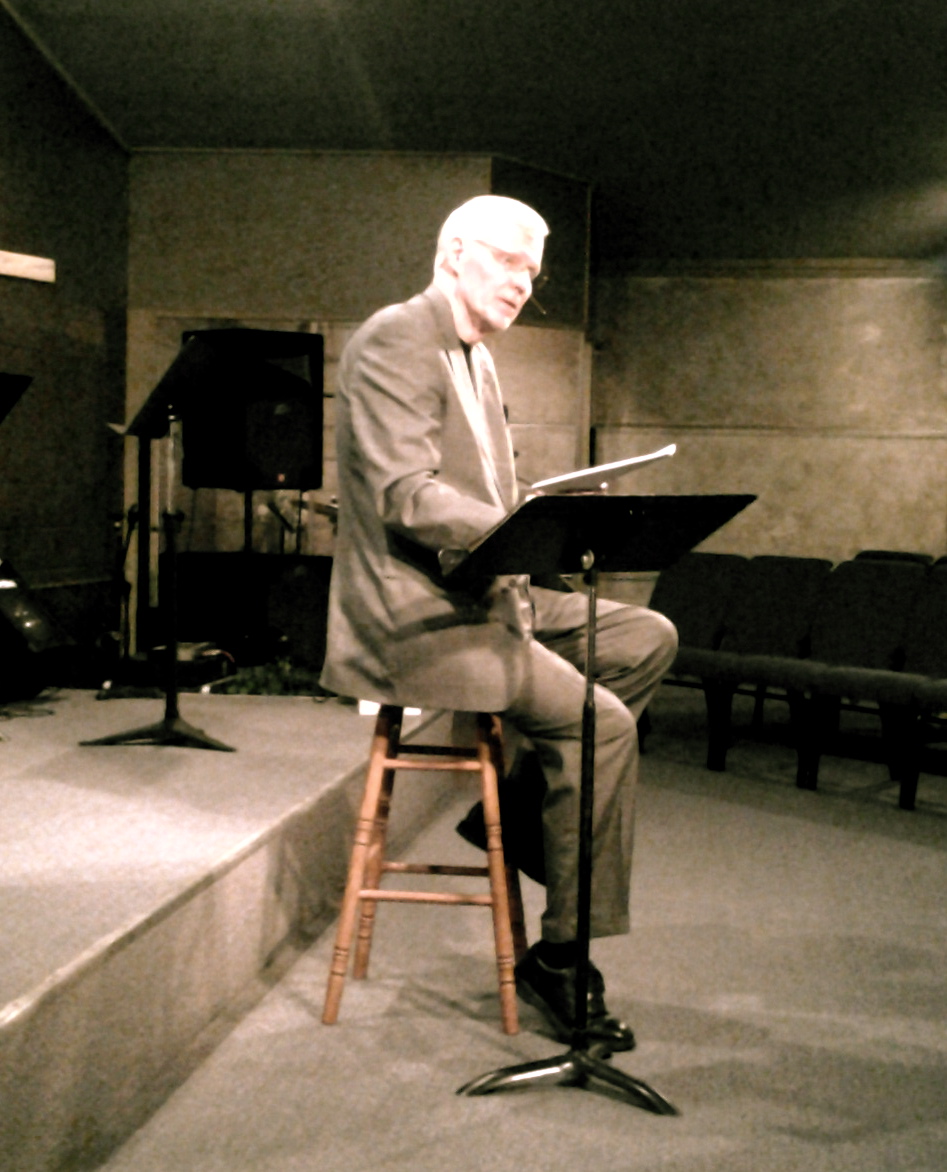
Bob Klingenberg

Bob Klingenberg

Pastor, let this sink in…

“Someday I will stand before The Word to give an account for every word I’ve preached.” —Rev. Bob Klingenberg

How does that make you feel?

It makes me realize how much more I need the Holy Spirit’s help in my study time! And I pray this prayer from Oswald Chambers almost weekly before I deliver the message God has laid on my heart—

In my preaching, cause Thy glorious voice to be heard, Thy lovely face to be seen, Thy pervasive Spirit felt. 


Keep It Closed!

Keep it closedJesus told us that the Holy Spirit would help us reply the right way when someone questioned us about our faith in God. But Jesus showed us, that sometimes no reply is the best reply.

After Jesus was arrested, He was first sent to Pilate:

So again Pilate asked Jesus, “Aren’t You going to answer? See how many things they are accusing You of.” But Jesus still made no reply… (Mark 15:4-5).

Then Pilate sent Jesus to King Herod:

When Herod saw Jesus, he was greatly pleased, because for a long time he had been wanting to see Him. From what he had heard about Him, he hoped to see Him perform a sign of some sort. He plied Him with many questions, but Jesus gave him no answer (Luke 23:8-9).

So Herod sent Jesus back to Pilate. And what was the bottom line? Mark 15:5 adds this important phrase about the Roman governor: “…and Pilate was amazed.”

Our ability to remain silent when the Holy Spirit bids us to be silent speaks volumes to those who witness our silence. Be careful. Be sensitive to the Holy Spirit. Sometimes keeping your mouth closed may be the best testimony for God that you can give.

The Hour Of Darkness

The hour of darknessSometimes when things look bleak—when it appears evil is winning—even the most upbeat of Christians can experience discouragement. Here are some encouraging thoughts for dark times…

But this is your hour—when darkness reigns (Luke 22:53).

Darkness is limited to an hour—God’s light is unquenchable forever!

When Jesus said, “I am He,” they drew back and fell to the ground (John 18:6).

Even in the hour of darkness, Christ’s power causes the forces of darkness to drop in fear! 

Jesus answered, “You would have no power over Me if it were not given you from above” (John 19:11).

The power of darkness is limited; it is kept in check by God’s limitless authority! 

Where, O death, is your victory? Where, O death, is your sting? (1 Corinthians 15:55).

Even a supposed “victory” for darkness is ultimately an overwhelming victory for Light!

What have I to fear when I am held in God’s power? I am shielded by the Almighty, and for that I can sing out loud praise even in the hour of darkness!

Thursdays With Oswald—The Right Context For Scripture

This is a weekly series with things I’m reading and pondering from Oswald Chambers. You can read the original seed thought here, or type “Thursdays With Oswald” in the search box to read more entries.

Oswald Chambers

The Right Context For Scripture 

     You study the Scriptures diligently because you think that in them you have eternal life. … Yet you refuse to come to Me to have life. (John 5:39-40) 

     These verses reveal how a knowledge of the Scriptures may distort the mind away from Jesus Christ. Unless we know the Living Word personally first, the literal words may lead us astray. The only way we can understand the Bible is by personal contact with the Living Word, then the Holy Spirit expounds the literal words to us along the line of personal experience. 

     … There is a context to the Bible, and Jesus Christ is that Context. The right order is personal relationship to Him first, then the interpretation of the Scriptures according to His Spirit. 

From Bringing Sons Until Glory 

Amen! Chambers is precisely on target with this.

Remain

↓
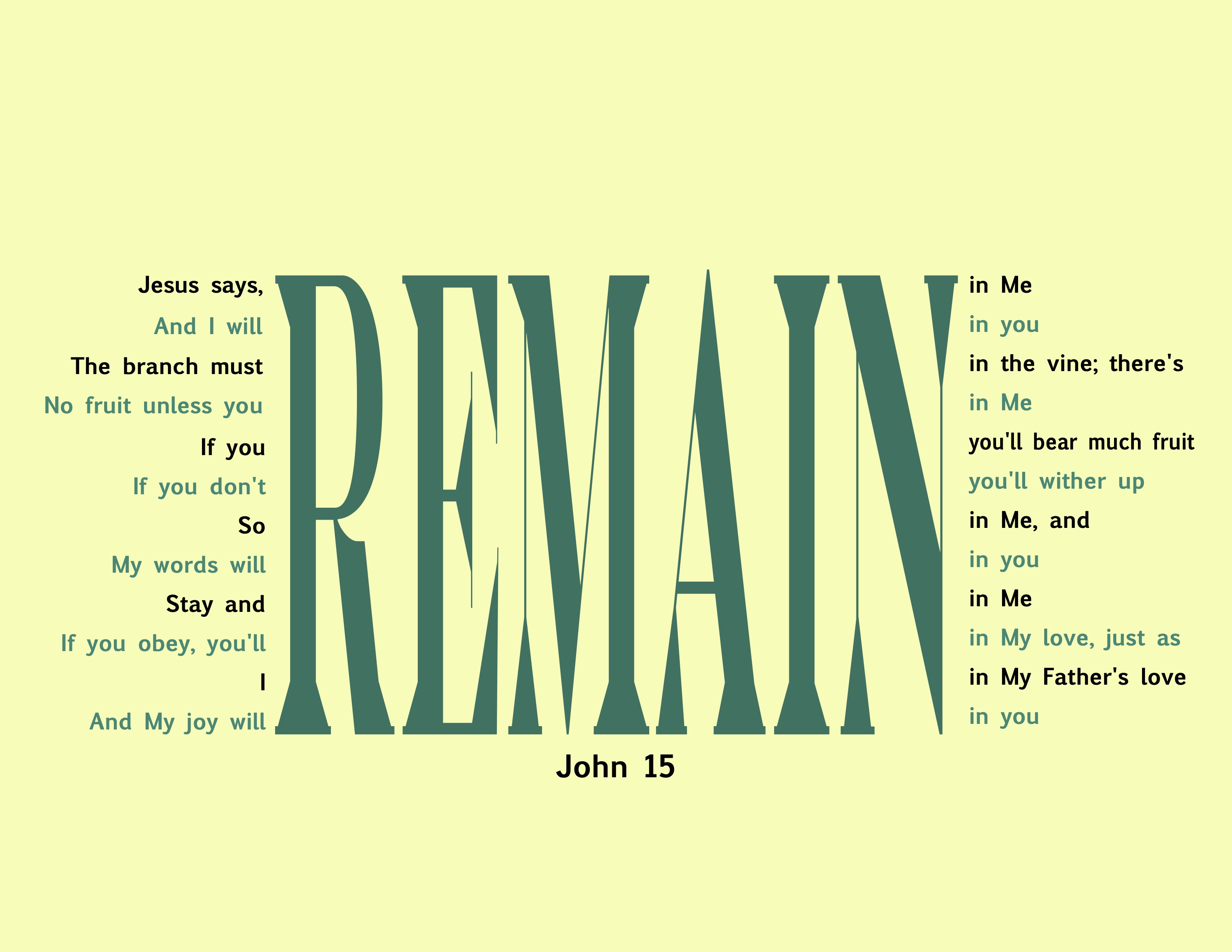
Jesus says, REMAIN in Me,
And I will REMAIN in you.
The branch must REMAIN in the vine; there’s
No fruit unless you REMAIN in Me.
If you REMAIN, you’ll bear much fruit;
If you don’t REMAIN, you’ll wither up.
So REMAIN in me, and
My words will REMAIN in you.
Stay and REMAIN in Me.
If you obey, you’ll REMAIN in My love, just as
I REMAIN in My Father’s love
And My joy will REMAIN in you. (John 15)