Worth The Effort

Listen to the podcast of this post by clicking on the player below, and you can also subscribe on AppleSpotify, or Audible. 

The Bible is not only the inspired Word of God but it is rooted in history too. Every prayer was prayed by a real person in distress, and every song of praise was lifted up by someone who personally experienced God’s deliverance. 

The reason why this is so important is that it makes God’s Word relatable and applicable to us. If the Bible merely contained moral stories set in some make-believe world, we may have a hard time seeing how to apply the principles to our daily lives. But, thankfully, this isn’t the case. We can read the real-life experiences of real historical people and then we can allow the Holy Spirit to help us apply this inspired Word to our lives. 

There is a collection of 15 songs in the Book of Psalms called “The Songs of Ascent.” Even these songs have an important historical background. 

The books of Kings and Chronicles tell the sad history of Israel and Judah sliding farther and farther away from God until finally, God must punish them. He punishes Judah by bringing King Nebuchadnezzar against them, who destroyed the temple at Jerusalem and carried the people into exile in Babylon. But even as they are being taken away, God speaks a prophetic word through Jeremiah that in 70 years He will raise up another leader, Cyrus king of the Persians, who will allow the exiles to return home. You can read all of these historical accounts in 2 Chronicles 36:15-23; Jeremiah 29:10-14; and Isaiah 44:28-45:6. 

Second Chronicles ends with this proclamation from King Cyrus: “The Lord, the God of heaven, has given me all the kingdoms of the earth and He has appointed me to build a temple for Him at Jerusalem in Judah. Anyone of His people among you—may the Lord his God be with him, and let him go up” (2 Chronicles 26:23). 

The phrase “let him go up” is both literal (since Jerusalem is 2500 feet above sea level) and spiritual. Listen to these words from King Solomon, “The way of life winds upward for the wise, that he may turn away from hell below” (Proverbs 15:24 NKJV). 

The Songs of Ascent were a rallying cry—an encouragement to all pilgrims to keep climbing up. 

In Hebrew literature, the main point is usually found in the middle of the poem or story, unlike our Western literature which puts the payoff at the end. In the first Song of Ascent, the middle is verse 4. But the second half of Psalm 120 seems out of place for people ascending up to Jerusalem to worship God. Verse 5 begins with the words, “Woe to me.” 

The psalmist is expressing his pain in living among the people of Meshech and Kedar. The people of Meshech were vicious people who traded human lives for money and who conducted themselves as terrorists (Ezekiel 27:13; 32:26). Their name literally means “drawing away.” The people of Kedar were nomadic sons of Ishmael. Being nomadic means they were never at rest. Their name literally means “dark place.” Very noteworthy is that there is no mention of God in verses 5-7.  

The middle verse of this song (v. 4) turns the people of Meshech and Kedar over to God. It is a reminder that we are not the ones to dispense justice. If God knew how to overthrow the powerful kingdoms of Judah, Babylon, and the Medes, if He knew to call Cyrus by name at just the right moment, He also knows how to deal with these sinners. 

This Song of Ascent shows the stark contrast between keeping our eyes on the dark culture around us versus keeping our eyes on the God who is never weighed down by the darkness. As we go higher up, we focus more on God; as His saints focus on Him, His light shines on them; as His light shines on them, they point sinners living in dark valleys to the God of light and love. 

Staying down is easy. Getting up requires intentional effort. Going up requires us to overcome the pull of sin and the frustration of watching for judgment to fall on sinners. 

Continually going up glorifies God, has eternal rewards for saints, and creates a compelling testimony for sinners.

Going up is a lot of effort, but the rewards are so worth it! As the apostle Paul reminded his friends in Rome, “I consider that our present sufferings are not worth comparing with the glory that will be revealed in us” (Romans 8:18). Let’s keep climbing up and let’s keep lifting our eyes to the only One who has the eternal light. 

If you’ve missed any of the messages in our look at the Songs of Ascent, you can find them all here. 

►► Would you please prayerfully consider supporting this ministry? My Patreon supporters get behind-the-scenes access to exclusive materials. ◀︎◀︎

Thursdays With Spurgeon—God’s Word Prevails

This is a weekly series with things I’m reading and pondering from Charles Spurgeon. You can read the original seed thought here, or type “Thursdays With Spurgeon” in the search box to read more entries.

Listen to the podcast of this post by clicking on the player below, and you can also subscribe on iTunes or Spotify.

God’s Word Prevails

Look to Me, and be saved, all you ends of the earth! For I am God, and there is no other. (Isaiah 45:22 NKJV) 

     “One of the greatest enemies of deity has always been the wisdom of man. The wisdom of man will not see God. Professing themselves to be wise, wise men have become fools. But have you not noticed, in reading history, how God has abased the pride of wisdom? In ages long gone by, He sent mighty minds into the world that devised systems of philosophy. ‘These systems,’ they said, ‘will last forever.’ … 

     “‘Ah, but,’ said God, ‘that book of yours will be seen to be folly before another hundred years have rolled away.’ … 

     “This Bible is the stone that will break philosophy into powder. This is the mighty battering ram that will dash all systems of philosophy in pieces. This is the stone that a woman may yet hurl upon the head of every Abimelech, and he will be utterly destroyed. O church of God! Fear not! You will do wonders. Wise men will be confounded, and you will know and they, too, that He is God and that beside Him there is none else.” 

From Sovereignty And Salvation

God is indisputably God.

One of the ways He has revealed Himself to us is through His infallible word—the Bible. On those pages, every philosophy that seeks to deify man is exposed. On those pages are lovingly and powerfully portrayed for us the one and only path to eternal joy. 

If you haven’t already, make studying your Bible a daily habit. In its pages, you will find the truth that will set you free, bring peace to your heart, and give you an assurance unlike anything or anyone else can.

►► Would you please prayerfully consider supporting this ministry? ◀︎◀︎

Thursdays With Spurgeon—The Life-Changing Power In The Bible

This is a weekly series with things I’m reading and pondering from Charles Spurgeon. You can read the original seed thought here, or type “Thursdays With Spurgeon” in the search box to read more entries.

The Life-Changing Power In The Bible

     When the Spirit came with His divine life and quickened the entire Book to my newly enlightened soul, the inner meaning shone forth with wondrous glory. … Whatever I found to be in His Word, I received with intense joy. … Moreover, I have found that those points of my character that were most weak have been strengthened, while strong passions have been subdued, evil propensities have been kept under, and new principles have been implanted. I am changed; I am as different from what I was as a man could be who had been annihilated and had then been made over again. Nor do I claim any of the credit for this change—far from it. God has done great things for me, but He has done the same for others and is willing to do it for any soul who seeks His face through Jesus Christ and His great atoning sacrifice. …  

     An idea has long possessed the public mind that a religious man can scarcely be a wise man. It has been the custom to talk of infidels, atheists, and deists as men of deep thought and comprehensive intellect, and to tremble for the Christian controversialist as if he must surely fall by the hand of his enemy. But this is purely a mistake, for the gospel is the sum of wisdom, an epitome of knowledge, a treasure house of truth, and a revelation of mysterious secrets. In it we see how justice and mercy may be married; here we behold inexorable law entirely satisfied and sovereign love bearing away the sinner in triumph. Our meditation upon it enlarges the mind, and as it opens to our soul in successive flashes of glory, we stand astonished at the profound wisdom manifest in it.

From The Autobiography Of Charles Spurgeon 

As Spurgeon experienced, all Christians can experience. Think about this—the same Holy Spirit that inspired the written words of the Bible is the same Holy Spirit in you that can illuminate and apply the words of the Bible to your life! 

Bible-reading, Spirit-empowered Christians should be the most informed, creative, wise people you will ever meet. Not because they have studied nature, but because they are getting to know Nature’s God intimately. The Creator can open up the mysteries of creation better than any scientist or philosopher. 

But we don’t read the Bible just to know God’s Word, but we read the Bible to get to know the God revealed in the Word. He said He would reveal Himself to those who earnestly seek for Him. Ask the Holy Spirit to open your eyes, your mind, your heart as you read your Bible. 

Interpretation Of The Scriptures (book review)

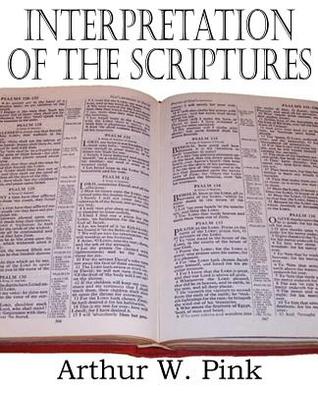
Bible reading and Bible study will be of immeasurable benefit to the reader if the Scriptures are interpreted correctly. Fortunately for us, A.W. Pink gives us some timeless principles for doing just this in his book Interpretation Of The Scriptures.

Pink acknowledges something that the Apostle Peter also acknowledged: sometimes the passages we read in the Bible can be challenging to understand. But Pink quickly adds, “God does not ask for blind credence from us, but an intelligent faith, and for that three things are indispensable: that His Word should be read (or heard), understood, and personally appropriated.”

In this book, Pink systematically gives us guidelines for the proper and effective interpretation of the the Scriptures. He does so by using many of the age-old maxims of logic and hermeneutics, but he also emphasizes the invaluable role the Holy Spirit plays in our Bible reading times. After all, the Holy Spirit was the One who inspired the writing of the Scriptures, so He is best able to illuminate the true meaning to our hearts and minds.

This is NOT a book exclusively for pastors and Bible teachers (although both will be greatly benefitted by studying this text), but it is for anyone who wants to read the Bible accurately, with an eye toward correctly applying the principles that God gives us.

I’m not sure how many times I have read through the Bible in my life, but while reading Interpretation Of The Scriptures I noticed a new attention to concepts and insights that I had previously overlooked. I highly recommend that all serious readers of the Bible read this book as well.

Thursdays With Oswald—What “Religious” Things Perplex You?

Oswald ChambersThis is a weekly series with things I’m reading and pondering from Oswald Chambers. You can read the original seed thought here, or type “Thursdays With Oswald” in the search box to read more entries.

What “Religious” Things Perplex You? 

     If we are perplexed over the question of sanctification, or about the baptism of the Holy Ghost, we ourselves are the reason why we are bothered. God has written a Book, and the phrases “sanctification” and the “baptism of the Holy Ghost” are His, not man’s; why do we not go to Him about it? 

     We are the reason why we do not go; we dare not go. If we honestly ask God to baptize us with the Holy Ghost and fire, anything that happens is His answer, and some appalling things happen. If we accept the revelation that our body is the temple of the Holy Ghost, are we prepared to ask God to fulfill the purpose of the Holy Ghost in our body? If we are, watch the consequences—that friendship must go, that book, that association, everyone of them must decay off like a lightning flash. 

     If anyone has a difficulty in getting through to God, it is never God who is to blame. We can get through to Him as soon we want to, there is nothing simpler.

From The Psychology Of Redemption

I believe Chambers’ line of reasoning goes like this:

  • God has revealed His full will in the inspired words of Scripture.
  • The same Holy Spirit Who inspired the Bible can illuminate our hearts.
  • We don’t have insight because we either don’t ask for it [James 1:5], or we don’t really want to hear the truth [James 4:3].
  • Asking for help while posturing ourselves to obey will quickly bring clarity—“Jesus Christ’s life must work through our flesh, and that is where we have to obey. So many go into raptures over God’s supernatural salvation, over the wonderful fact that God saves us by His sovereign grace (and we cannot do that too much), but they forget that now He expects us to get ourselves into trim to obey Him” (Oswald Chambers).

The Counselor Instructs Us

The life of Jesus“The Counselor” is the name Jesus gave to the Holy Spirit. Looking at the definition of the word Counselor, there are four main things the Holy Spirit will do in our lives which corresponds to another well-known passage of Scripture—

All Scripture is God-breathed and is useful for teaching, rebuking, correcting and training in righteousness, so that the man of God may be thoroughly equipped for every good work. (2 Timothy 3:16)

The Counselor teaches/instructs, rebukes, corrects, and trains. And He does this through The Word that He inspired.

The Bible is one huge “the Holy Spirit said” Book. Men wrote the words of Scripture as the Counselor Spirit inspired them (2 Peter 1:19-21). That same Counselor then helps us apply those inspired words to our lives.

Jesus is our Ultimate Example of One Who was baptized in the Holy Spirit, and fully controlled by the Holy Spirit (Luke 4:1). The Counselor helped Jesus the Man be able to apply the inspired Scripture:

Jesus told His followers to received the baptism in the Holy Spirit (Acts 1:4-5, 8), so we could be His witnesses in the world (see Acts 8:26-35 and 10:38-43).

“God does not give us power to imitate Him: He gives us His very Self. … We are not put into the place where we can imitate Jesus; the baptism of the Holy Spirit puts us into the very life of Jesus.” —Oswald Chambers

This should be our normal life! But if we discount the Holy Spirit—or even discount our worthiness to commune with The Counselor—we begin to accept sub-normal as normal, and the normal become miraculous and only obtainable by a few “spiritual giants.”

The Father’s desire is for all of us to bear a strong, unmistakable family likeness to Jesus. Christ relied on The Counselor, so we must as well.

Next Sunday I will be continuing our series on the Holy Spirit called The Counselor. If you are in the Cedar Springs area, please join us.

3 Steps To Better Bible Studies

Inspired WordThe Bible is God’s inspired Word—literally, that means it is “God-breathed” (2 Timothy 3:16-17). If the Holy Spirit inspired the Word to the biblical writers, He can best illuminate the same Word to you as you read and study it.

This is how Jesus said the Holy Spirit would help us handle God’s Word:

Teach (John 14:26a). This word means to teach by holding a discourse with someone (or in this case, with Someone). Reading the Bible is meant to be a dialogue, not a monologue.

Remind (John 14:26b). The Holy Spirit is actively involved in us recalling and applying the Word to the situations in which we find ourselves. The Bible tells us to study to be prepared (1 Peter 3:15) and to handle God’s Word like a good worker (2 Timothy 2:15). We are also told not to pre-plan what to say if we are put on the spot, but that words would be given us (Matthew 10:19) as the Holy Spirit recalls to our memory which we have studied.

Convict (John 16:8). This word means both to refute and to confute. Confute simply means proving something is wrong. Refute means to show us we’ve reached a false or illogical conclusion, perhaps a conclusion we reached without giving it very much thought.

Guide (John 16:13). We get a good idea of the meaning of this word from the negative use of the same word—Can a blind man lead [the same word for “guide” in John 16:13] a blind man? Will they not both fall in a pit? (Luke 6:39). We can trust the Holy Spirit to lead us to the truth in the Scriptures that we can apply to our lives.

Quite simply better Bible studies come from:

  1. Praying for the Holy Spirit to illuminate Scripture to you as your read it.
  2. Reading the Bible.
  3. Obeying what the Holy Spirit illuminates to your heart and mind.

Try it and see what happens. I think you’ll like the results!