


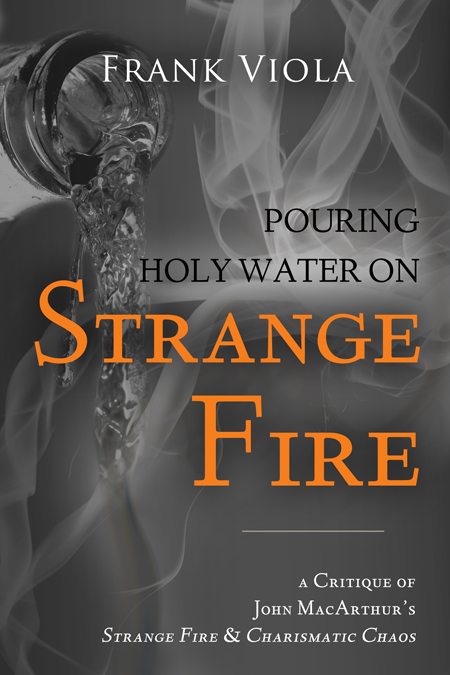
 In Pouring Holy Water On Strange Fire, Frank Viola uses an extensive array of sources, both ancient and contemporary, in his critique of John MacArthur’s book Strange Fire. You can read my full book review by clicking here. I hope you will enjoy these quotes as much as I did.
“For some do certainly drive out devils, so that those who have thus been cleansed from evil spirits frequently both believe, and join themselves to the church. Others have foreknowledge of things to come: they see visions, and utter prophetic utterances. Others still, heal the sick by laying their hands upon them, and they are made whole. Yea, moreover, as I have said, the dead even have been raised up, and remained among us for many years. And what shall I more say? It is not possible to name the number of the gifts which the church throughout the whole world has received from God, in the name of the Jesus Christ (2.32.4) … For this reason does the apostle declare, who speak wisdom among them that are perfect, terming those persons perfect who have received the Spirit of God, and who through the Spirit of God do speak in all tongues, as he used himself also to speak. In like manner we do also hear many brethren in the church, who possess prophetic gifts, and who through the Spirit speak all kinds of tongues, and bring to light for the general benefit the hidden things of God, whom also the apostle terms spiritual, they being spiritual because they partake of the Spirit (5.6.1).” —Irenaeus, Against Heresies
“Now was absolutely fulfilled that promise of the Spirit which was given by the word of Joel: ‘In the last days will I pour out My Spirit upon all flesh, and their sons and their daughters shall prophesy; and upon My servants and upon My handmaids will I pour out of my Spirit.’ Since then the Creator promised the gifts of His Spirit in the latter days; and since Christ has in these last days appeared as the dispenser of spiritual gifts … it evidently follows in connection with this prediction of the last days, that this gift of the Spirit belongs to Him who is the Christ of the predictors … Let Marcion then exhibit, as gifts of his god, some prophets, such as have not spoken by human sense, but with the Spirit of God, such as have both predicted things to come, and have made manifest the secrets of the heart; let him produce a psalm, a vision, a prayer—only let it be by the Spirit, in an ecstasy, that is, in a rapture, whenever an interpretation of tongues has occurred to him; let him show to me also, that any woman of boastful tongue in his community has ever prophesied from amongst those specially holy sisters of his. Now all these signs of spiritual gifts are forthcoming from my side without any difficulty, and they agree, too, with the rules, and the dispensations, and the instructions of the Creator; therefore without doubt the Christ, and the Spirit, and the apostle, belong severally to my God. Here, then, is my frank avowal for any one who cares to require it (Bk. 5, Ch. 8).” —Tertullian, Against Marcion
“Anyone who cuts out portions of Scripture is guilty of very grievous sin … I say once more, there, that to hold such a view [cessationism] is simply to quench the Spirit.” —D. Martin Lloyd-Jones
“Therefore to say that because we now have all the writings of Scripture complete we no longer need the miraculous inspiration of the Spirit among men as in former days is a degree of blindness as great as any that can be charged upon the scribes and the Pharisees. … There is no degree of delusion higher than that which is evidenced by those who profess to teach from the divinely inspired Scriptures that the immediate, continual illumination and working of the Spirit in men’s hearts ceased when the canon of Scripture was complete. To deny the present prophetic gift in the church is to deny also that very manifestation of Christ today to His own which the Scriptures teach is the only means to the reality of Gospel Christianity.” —William Law
“But He has left to us the same power He possess. This [the indwelling Holy Spirit to continue Jesus’s life and ministry and to perpetuate miracles] is the mighty gift of our ascended Lord. This is the supreme need of the church today … the constitution of the church is identical with the twelfth chapter of First Corinthians. … We cannot leave out any part of the gospel without weakening the rest; and if there ever was an age when the world needed the witness of God’s supernatural working, it is the day of unbelief and satanic power.” —A.B. Simpson
“The devil only bothers to counterfeit that which is real and a threat to his kingdom.” —Frank Viola
“A Bible-based sermon can be equal in truth if rooted in Scripture, but not equal in authority to the Bible.” —Frank Viola
“Spirit can embrace intellect, but human intellect won’t comprehend Spirit.” —A.W. Tozer
“We need to learn that truth consists not in correct doctrine, but correct doctrine plus the inward enlightenment of the Holy Spirit.” —A.W. Tozer
“We cannot make too much of this matter of revelation, illumination, seeing. It is basic in salvation (Acts 26:18). It is essential to effective ministry (2 Corinthians 4:6) and it is indispensable to full knowledge and full growth (Ephesians 1:17)…. The kind of seeing to which we refer is an epoch, an encounter, a revelation, a crisis. There is no power on this earth which could have changed that rabid, fanatical, bigoted Saul of Tarsus, a ‘Pharisee of the Pharisees,’ into ‘the apostle of the Gentiles’ (Romans 11:13)…. Argument would not have done it. Neither persuasion nor persecution nor martyrdom would have effected it. But it was done! That ‘conversion’ stood the test of all persecutions, sufferings, and adversities possible to man for the rest of his life…. Indeed, a fundamental and preeminent work of the Holy Spirit has to do with spiritual enlightenment and supremely as to the significance of God’s Son, Jesus Christ. It is all in the Scriptures, but still our eyes may be holden…. We can be governed by objective truth. It can be ‘the truth’—orthodox, sound, Bible truth. We can be governed by that simply because it is taught; we do it objectively. But there is something more than that. There is such a thing as the Holy Spirit taking hold of the truth of God and making it something that lives in us…. Many Christians are just Christians: that is, after they are saved, their Christian life consists in doing as they are told by the minister because it is presented to them as the thing they should do. But there is a much higher level of life than that. The thing is right, but it is altogether transformed when the Holy Spirit brings it home to us in an inward way, and adjusts us to it. We no longer do it because it has got to be done: we do it because the Lord has done something in us, and shown us that that is the thing that He wants done… it is no more mechanical, it is vital!” —T. Austin Sparks
“To downplay and criticize a genuine desire to know our Lord in greater capacity and to receive clear direction from God’s Spirit in greater measure is contrary to the exhortation and examples found in Scripture. Certainly, spiritual contentment and complacency would have drawn from Paul the strongest reproof. And it did so from Jesus in the book of Revelation.” —Frank Viola
“One thing the charismatic movement has been sent to do, I believe, is to alert us all to the fact that God, when trusted, will show His hand in many thrilling ways, and we should be expecting Him to do that, though without dictating to Him what He must do in particular situations.” —J.I. Packer


 Craig T. Owens