Takin’ Him To Easy Street And Skid Row

Listen to the podcast of this post by clicking on the player below, and you can also subscribe on AppleSpotify, or Audible. 

Jesus sent us and the Holy Spirit empowers us to take the Good News to all nations—all the streets (Luke 24:47-49; Acts 1:8). As we move away from Jerusalem and into Judea, we should expect to see more differences with our audience. And then as we move into Samaria, there will probably be more differences than similarities. Regardless of how little we may have in common with those on other streets, the Holy Spirit still empowers us to witness there. 

(You can find all of the Scriptures I reference in this post by clicking here.) 

When we don’t live on someone else’s street, we tend to make some pretty big assumptions about them. For example, until I married a school teacher, I thought, “How nice it must be to be done with work by 3:00 every afternoon and have three months off in the summer!” 

Mistakenly, we think we can so easily fix the problems people on other streets have—we think we can show them how simple it is to correct anything out of balance on their street. These are natural thought patterns when so little of our circles overlap.

If you live on Main Street, two streets which are quite different from you are Easy Street and Skid Row. When it comes to finances, there tends to be extremes in our thoughts about the Samaritans that live on those streets—

  • Those on Easy Street only cares about themselves
  • Those on Skid Row should work harder 
  • Those on Easy Street have too much—it’s not fair! 
  • Those on Skip Row don’t have enough—it’s not fair! 

But here’s the thing: It’s really not about the money but it’s about our attitude about the money. 

In Luke 21:1-6, Jesus saw both rich people from Easy Street placing their tithe in the temple treasury, and a poor widow from Skid Row doing the same. Jesus said this widow put in more than anyone else. He was talking in terms of quality, not quantity. 

While they were still in the temple, the disciples pointed out how beautifully embellished the temple was. These decorations came from the money those on Easy Street had contributed. Jesus told them not to focus on the temporal temple but on the eternal Kingdom of God.  

As I said, Jesus doesn’t have a problem with money, but He does warn us about our ungodly attitude toward money (Luke 8:1-3; Matthew 27:57; Acts 4:32-5:4; Exodus 20:17; Luke 12:13-22).  

Even though Easy Street and Skid Row seem to be at opposite ends of the spectrum, I think we are effective witnesses for Jesus on these streets in exactly the same way. 

(1) Guard your attitude about money. Remember that Gad often provides for us by giving us a skill, and then making a job available that can use our skill. So let’s be thankful for our God-given jobs. Then we guard our attitude about money by tithing regularly, and making sure that when we bless others financially, we do it without expecting any fanfare (Colossians 3:23; Malachi 3:10; Matthew 6:2-3). 

(2) Let God be unique as unique with these folks on Easy Street and Skid Row as He is with you on Main Street. Don’t try to be someone else, and don’t expect others to be you—simply obey what God has spoken to your heart, just as you allow others to obey what God has spoken to their hearts. 

(3) Don’t tell, but show how you use the resources God has given to you. It’s not our place to “preach” to others about how they should or shouldn’t be handling their finances, but simply live out the biblical principles outlined above, and let your life show your godly attitude. 

(4) Always turn the focus to the eternal. Just as Jesus did with His disciples in the temple, He always reminded people that this world with its perks or tragedies is only temporary. What ultimately matters is where we will spend eternity (Luke 13:1-5). 

Money is always a touchy subject with people, so let’s make sure we have our own attitude aligned with Scripture before we try to bring the subject up with others. 

If you’ve missed any of the other messages in our Takin’ Him To The Street series, you can find them all here. 

►► Would you please prayerfully consider supporting this ministry? My Patreon supporters get behind-the-scenes access to exclusive materials. ◀︎◀︎
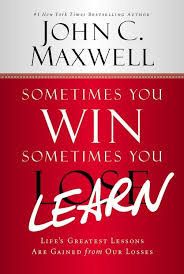
21 Quotes From “Sometimes You Win, Sometimes You Learn”

Sometimes You WinAs I mentioned in my book review (which you can read by clicking here), John Maxwell always expands my horizons with his writings. I appreciate his ability to use his own life experiences as well as historical and contemporary examples and writings. So some of my favorite quotes from Sometimes You Win, Sometimes You Learn are from Dr. Maxwell, and some are from others that he quotes. Enjoy!

“I sometimes react to making a mistake as if I have betrayed myself. My fear of making a mistake seems to be based on the hidden assumption that I am potentially perfect and that if I can just be very careful, I will not fall from heaven. But a mistake is a declaration of the way I am, a jolt to the way I intend, a reminder that I am not dealing with facts. When I have listened to my mistakes, I have grown.” —Hugh Prather

“Those who profit from adversity possess a spirit of humility and are therefore inclined to make the necessary changes needed to learn from their mistakes, failures, and losses. … When we are focused too much on ourselves, we lose perspective. Humility allows us to regain perspective and see the big picture. … Humility allows us to let go of perfection and keep trying.” —John Maxwell

“Most people spend their entire lives in a fantasy Island called ‘Someday I’ll.’” —Denis Waitley 

“An idealist believes the short-run doesn’t count. A cynic believes the long run doesn’t matter. A realist believes that what is done or left undone in the short-run determines the long run.” —Sydney J. Harris

“Those things that hurt, instruct.” —Benjamin Franklin

“You can’t grow and learn if your focus is on finding someone else to blame instead of looking at your own shortcomings.” —John Maxwell

“The highest reward for our toil is not what we get for it but what we become by it. … Mistakes are not failures. They are proof that we are making an effort. When we understand that, we can more easily move out of our comfort zone, try something new, and improve. … Improvement demands a commitment to grow long after the mood in which it was made has passed.” —John Maxwell 

“Success in most things comes not from some gigantic stroke of fate, but from simple, incremental progress.” —Andrew Wood

“The main trouble with despair is that it is self-fulfilling. People who fear the worst tend to invite it. Heads that are down can’t scan the horizon for new openings. Bursts of energy do not spring from a spirit of defeat. Ultimately, helplessness leads to hopelessness.” —Norman Cousins

“Positive thinking must be followed by positive doing.” —John Maxwell

“When you are influential and highly respected, people tend to tell you what you want to hear, not what you need to hear. They are seeking your approval, or they flatter you. Unfortunately, this creates a gap between what you hear and reality. If you find yourself in that situation, you will need to work extra hard to get the people close to you to speak honestly into your life. And you will have to become highly intentional in observing and listening.” —John Maxwell 

“Wisdom is the reward you get for a lifetime of listening when you would have preferred to talk.” —Doug Larson

“Circumstances are the rulers of the weak; but they are the instruments of the wise.” —Samuel Lover 

“Mistakes are painful when they happen, but years later a collection of mistakes is what is called experience.” —Denis Waitley

“Ninety percent of those who fail are not actually defeated; they simply quit. … As you face bad experiences, it’s important for you to remember that you can rarely see the benefits while you’re in the midst of them. You usually gain perspective on the other side of it.” —John Maxwell 

“Most people would rather change their circumstances to improve their lives when instead they need to change themselves to improve their circumstances. They put in just enough effort to distance themselves from their problems without ever trying to go after the root, which can often be found in themselves. Because they don’t try to change the source of their problems, their problems keep coming back at them.” —John Maxwell

“To grow, you must be willing to let your present and future be totally unlike your past. Your history is not your destiny.” —Alan Cohen

“If I had my life to live over again, I’d make the same mistakes, only sooner.” —Tallulah Bankhead

“Maturity is doing what you are supposed to be doing, when you’re supposed to be doing it, no matter how you feel.” —Dom Capers 

“Have you not succeeded? Continue! Have you succeeded? Continue!” —Fridtjof Nansen, Nobel Peace Prize winner

“How we think when we lose determines how long it will be until we win.” —G.K. Chesterton

The Right Questions

“The uncreative mind can spot wrong answers, but it takes a creative mind to spot wrong questions.” —Sir Anthony Jay

This has always been a challenge for me—maybe for you, too. I can easily spot when someone gives me a wrong answer, but it’s harder to spot when I’ve asked a wrong question. It could very well be that the answer I’m hearing is correct in light of the question I asked.

But spotting wrong questions requires a humility on my part to admit I may be wrong. Spotting wrong questions requires creativity, a new way of looking at things.

There is a short story about the life of King Abijah recorded in 2 Chronicles 13 in the Bible. Abijah is the second king to reign in Judah after the 10 northern tribes had seceded. He is vastly outmanned and out-spent by King Jeroboam of the northern tribes (called Israel). When it comes to a battle between north and south, Abijah can only field half as many men as Jeroboam.

Yet it is Abijah who takes charge of the battlefield before the fighting begins. He climbs to the top of Mount Zemaraim to make sure all of the northern tribes can hear him. The wrong question would have been, “Which side is God on: Israel’s or Judah’s?” The correct question which Abijah must have asked and answered for himself—is, “Are we on God’s side?

Abijah begins to recount how God chose for a descendant of David to sit on the throne (Abijah), but northern Israel was following a rebel (Jeroboam). God intended for the descendants of Aaron to oversee the sacrifices and religious practices; Judah was doing this, but Israel had their own priests. God was to be worshipped exclusively; Judah was doing this, but Jeroboam made golden calves for Israel to worship.

So Abijah correctly concludes, “God is with us; He is our leader.”

Abijah didn’t assume God was with Judah. Abijah didn’t ask, “Does God lead us or them?” Abijah asked, “Are we doing the things that God has asked of us?” Since Judah was following God, Abijah could then state with confidence, “God is with us.”

The question is not, “Is God on your side?” It’s better to ask, “Am I on God’s side?

The question is not, “What would Jesus do if He was here?” It’s better to ask, “What did Jesus already do that I can follow?

What questions are you asking? Change your questions and you just may change your life.

Get Your Mind Out Of That Rut!

“Don’t become so well-adjusted to your culture that you fit into it without even thinking.” —Apostle Paul (Romans 12:2, The Message)

It’s important to think about your thinking—to analyze why certain thoughts are swirling through your mind. But after you identify unhealthy thoughts, you need some creative thinking to be able to move your life in a new direction. This requires a whole new set of thinking skills that are called critical thinking.

Stephen Brooking described it this way, “Critical thinkers are continually exploring new ways of thinking about their lives…. Critical thinking is complex and frequently perplexing, since it requires the suspension of belief and the jettisoning of assumptions previously accepted without question.”

  • What have you accepted without question?
  • What have you become so well-adjusted to that you simply accept it?
  • Are there things you do just because it’s always been done that way?
  • Are there some things that you won’t try because it’s never been done that way?

Two warning signs in your thinking are always and never. With the exception of God, everything changes. So when you start thinking in terms of always and never you are essentially saying, “Nothing changes. And I’ve got everything figured out.” This is mind-in-the-rut thinking!

You’ve probably heard this before but it is valuable enough to be repeated—If you always do what you’ve always done you’ll always get what you always got.

If you need a change in your life, start with a change in your thinking. Ask God to help you think in new ways. In talking to His people about what He had done for them in the past God said it was time to think in creative ways—

But forget all that—it is nothing compared to what I am going to do. For I am about to do something new. See, I have already begun! Do you not see it? I will make a pathway through the wilderness. I will create rivers in the dry wasteland. (Isaiah 43:18-19 NLT)

Don’t let your thinking stay stuck in a rut. Allow God to help you jettison the old ways of thinking and expand your horizons. God will give you greater creativity if you ask Him.