It’s Not Anger Management

Listen to the podcast of this post by clicking on the player below, and you can also subscribe on AppleSpotify, or Audible.

Aristotle had an insightful quote that was almost accurate—

“Anybody can become angry—that is easy; but to be angry with the right person, and to the right degree, and at the right time, and for the right purpose, and in the right way—that is not within everybody’s power and is not easy.”

I agree with most of this, but I would argue that it’s not within anybody’s power to express their anger in the right way.

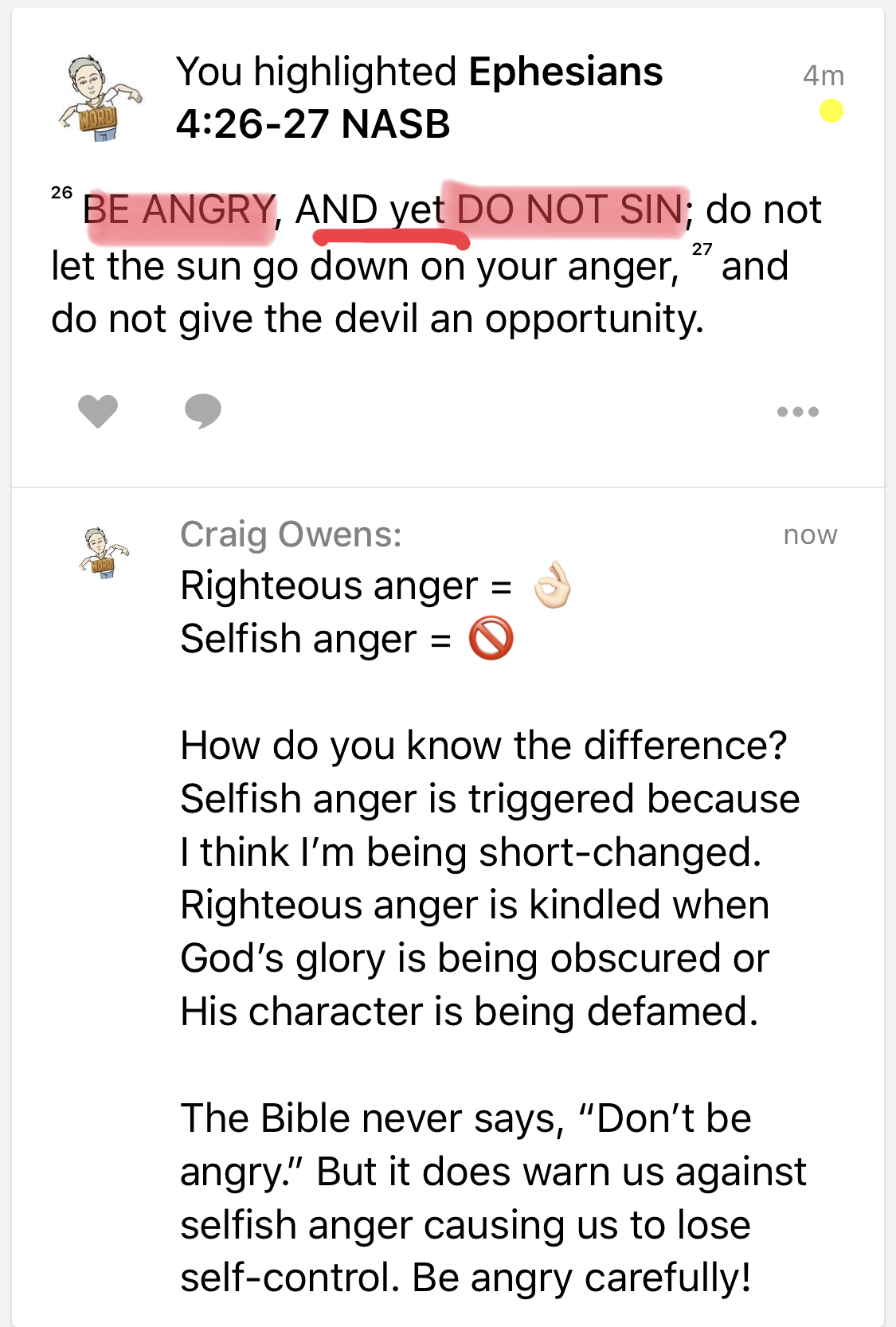
The Bible says that our challenge is to not sin when we are angry (Ephesians 4:26). But most anger is selfishly provoked. That means, I’m angry because I have been offended, or my “rights” have been violated, or someone injured me.

If my anger has been selfishly provoked, how can I be expected to express my anger in any other fashion but selfishly?!

Instead of me trying to manage my anger, I need to listen to the Holy Spirit’s voice. There is one important question the Spirit asks us (which comes from Jonah 4:9)—

Do you do well to be angry?

  • Is it good for me to be angry with this? or should I let this go?
  • Is my anger righteously provoked? or is it selfishly provoked?
  • Does this grieve the Holy Spirit (Isaiah 63:10)?

God’s Spirit within you is never silent. He will either confirm that your anger is righteously provoked (as it was with Jesus in John 2:13-17), or it’s selfishly provoked (as it was with Jonah). That’s why you must ask yourself that question and allow the Holy Spirit to help you answer it: Do I do well to be angry?

If you answer “yes,” and the Holy Spirit confirms this in your heart, then He will help you to be angry with the right person, and to the right degree, and at the right time, and for the right purpose, and in the right way (as Aristotle said).

And if you answer “no,” the Holy Spirit is the only one who can help put out the flames of your anger in a healthy way.

So don’t try to manage your temper. Listen to the Holy Spirit asking you, “Do you do well to be angry?” And let Him guide you from there.

If you want to check out the other messages in our series called Ticked Off! you may click here.

►► Would you please prayerfully consider supporting this ministry? My Patreon supporters get behind-the-scenes access to exclusive materials. ◀︎◀︎

6 Quotes On Marriage & Family From “The Book Of Man”

I really enjoyed reading The Book Of Man by William J. Bennett (you can read my book review here). The topics were very broad, so I’ll be sharing some of my favorite quotes on the different sections in this book over the next few days.

Here are six quotes about marriage and family…

“The family is the association established by nature for the supply of men’s every day wants.” —Aristotle 

“All great change starts at the dinner table.” —Ronald Reagan

General Robert E. Lee was on his way to Richmond, and was seated in the extreme end of a railroad car, every seat of which was occupied. At one of the stations, an aged woman of humble appearance entered the car, carrying a large basket. She walked the length of the aisle and not a man offered her a seat. When she was opposite General Lee’s seat, he arose promptly and said, “Madam, take this seat.” Instantly a score of men were on their feet, and a chorus of voices said, “General, have my seat.” “No, gentlemen,” he replied, “if there was no seat for this old lady, there is no seat for me.” 

“You must not encourage, but rather give yourself to what is kind and pure, chaste, true, loving, elevating, ennobling, and by all means learn to distinguish between love and lust. This is the switch at which so many are side-tracked to ruin. …Lust will degrade you; love will elevate you. Lust will make you vile, selfish, sordid, low; love will make you pure, chaste; lovable, manly. Lust will make you earthly, sensual, devilish; love will make you godlike, continent, noble.” —Rev. Lewis Johnson

“Fatherhood can sometimes be walking the floor at midnight with a baby that can’t sleep. More likely, fatherhood is repairing a bicycle wheel for the umpteenth time, knowing that it won’t last the afternoon. Fatherhood is guiding a youth through the wilderness of adolescence toward adulthood. Fatherhood is holding tight when all seems to be falling apart; and it’s letting go when it is time to part. Fatherhood is long hours at the blast furnace or in the fields, behind the wheel or in front of a computer screen, working a 12-hour shift or doing a 6-month tour of duty. It’s giving one’s all, from the break of day to its end, on the job, in the house, but most of all in the heart.” —Ronald Reagan

“And yet there is no relation on this side of the grave, more sacred, more dignified, or more elevated, than that of husband and wife. The parties might be, and should be, to each other, perpetual sources of consolation and pleasure. There should be no distrust, no suspicion, no equivocation between beings so circumstanced. They should live as much as possible as if animated by one soul and aiming at one destiny. Neither should look for perfection in the other, and yet each should endeavor to excel the other in generous efforts of gentleness, kindness, and affection.” —Robert Morris

5 Quotes On Work From “The Book Of Man”

I really enjoyed reading The Book Of Man by William J. Bennett (you can read my book review here). The topics were very broad, so I’ll be sharing some of my favorite quotes on the different sections in this book over the next few days.

Here are 5 quotes about work…

“Pleasure in the job puts perfection in the work.” —Aristotle

“Every calling is great when greatly pursued.” —Oliver Wendell Holmes

“No man is happy if he does not work. Of all miserable creatures the idler, in whatever rank of society, is in the long run the most miserable. If a man does not work, if he has not in him not merely the capacity for work but the desire for work, then nothing can be done with him. He is out of place in our community. We have in our scheme of government no room for the man who does not wish to pay his way through life by what he does for himself and for the community.” —Theodore Roosevelt

“In America no one is degraded because he works, for every one about him works also; nor is any one humiliated by the notion of receiving pay, for the President of the United States also works for pay. He is paid for commanding, other men for obeying orders. In the United States professions are more or less laborious, more or less profitable; but they are never either high or low: every honest calling is honorable.” —Alexis de Tocqueville

“Our nature consists in motion; complete rest is death. …Nothing is so insufferable to man as to be completely at rest, without passions, without business, without diversion, without study. He then feels his nothingness, his forlornness, his insufficiency, his dependence, his weakness, his emptiness. There will immediately arise from the depth of his heart weariness, gloom, sadness, fretfulness, vexation, despair.” —Blaise Pascal

Fizzle

Jehu, the king of Israel, said, “Come with me and see my zeal for the Lord!” Wow, this guy was so fired up about doing great things for God! He got rid of all of King Ahab’s idol-worshipping family, he removed all of the court officials who supported Ahab, and he even cleared all of the priests of Baal out of Israel.

God was so pleased with Jehu and his zeal for holiness that God said, “Well done! Because of what you have done, your descendants will sit on the throne of Israel for the next four generations.”

What a God-fearing man Jehu was! How on fire for God!

Unfortunately, Jehu’s passion fizzled.

Aristotle famously said, “Well begun is only half done.” Jehu started well, but his zeal for God fizzled in the end.

In fact, the very next verse after God says, “Well done!” begins with a very telling word: Yet.

Jehu didn’t continue his walk with God. He began to fall away, and so the Bible adds this sad note: In those days the Lord began to reduce the size of Israel. Yes, Jehu and his descendants still sat on the throne, but Israel became smaller and smaller.

I want to start well and finish strong.

I don’t want to hear God say, “Well begun.” I want to hear Him say, “Well done, good and faithful servant.”

I don’t want to be “king” of a smaller and smaller sphere of influence.

I don’t want to fizzle—I want to keep on burning bright for God!

Anger That Crosses The Line

Last night in our Bible study we looked at some words that David penned when he was angry. He was on the run from his son Absalom, and it seemed like everywhere he turned people were after him, or slandering him, or just doing their best to make him miserable. Yet in two back-to-back Psalms David says, “I lay down every evening and get a great night of rest.”

His sweet sleep comes from a moment of reflection before dozing off. He says:

In your anger do not sin; when you are on your beds, search your hearts and be silent. Selah.

  • Did my anger today cross the line into sin?
  • Am I allowing the time for the Holy Spirit to search my heart?
  • When the Holy Spirit points out where my anger crossed the line, do I justify my anger, or am I silent?

How do we know if our anger has not crossed that line and become sin?

Aristotle wrote, “Anybody can become angry—that is easy; but to be angry with the right person, and to the right degree, and at the right time, and for the right purpose, and in the right way—that is not within everybody’s power and is not easy.”

Being angry is not the issue. David said it (and Paul quoted it in Ephesians 4:26): “Be angry; just don’t sin.” God gets angry, but He does not sin. Jesus, in His public ministry, got angry, but He did not sin. We need to search our hearts to make sure our anger has not crossed the line to sin. We have to be angry in a godly way.

I see at least four ways to become angry without crossing the line into sin:

1.  Selfless Anger = anger at sin, but not angry at the sinner.

Love is not rude, it is not self-seeking, it is not easily angered, it keeps no record of wrongs. Love does not delight in evil but rejoices with the truth. (1 Corinthians 13:5, 6)

2.  Slow Anger = lengthen your fuse a bit.

Do not be quickly provoked in your spirit, for anger resides in the lap of fools. (Ecclesiastes 7:9)

My dear brothers, take note of this: Everyone should be quick to listen, slow to speak and slow to become angry, for man’s anger does not bring about the righteous life that God desires. (James 1:19, 20)

Good advice from Thomas Jefferson: “When angry, count to ten before you speak; if very angry, a hundred.”

3.  Protective Anger = when sinners entice others to join them in their sin. God is sad when people leave Him; He is angry at them when they take others with them.

But they put God to the test and rebelled against the Most High; they did not keep His statutes. Like their fathers they were disloyal and faithless, as unreliable as a faulty bow. They angered Him with their high places; they aroused His jealousy with their idols. When God heard them, He was very angry; He rejected Israel completely. (Psalm 78:56-59)

4.  Righteous Anger = against those who are keeping others from coming closer to God.

For I endure scorn for Your sake, and shame covers my face. I am a stranger to my brothers, an alien to my own mother’s sons; for zeal for Your house consumes me, and the insults of those who insult You fall on me. (Psalm 69:7-9)

This verse was recalled by Jesus’ disciples when they saw Him get angry and clear out the Temple in Jerusalem. Jesus was angry because of the religious clutter that was keeping God’s house from being a house of prayer for all nations.

I think everyone is familiar with the acrostic WWJD = What Would Jesus Do?

I’d like to propose something similar: WGGA = Would God Get Angry?

This is a great question to ask to make sure our anger does not cross that line into sin. Get angry—in a godly way—and do not sin.

Good And Angry

When was the last time you got good and angry? Be careful how you answer because I want you to notice that important conjunction AND. So maybe I should ask the question this way: when was the last time you got angry and were still good?

Aristotle correctly pointed out, “Anybody can become angry—that is easy; but to be angry with the right person, and to the right degree, and at the right time, and for the right purpose, and in the right way—that is not within everybody’s power and is not easy.”

Over the past week, I’ve been studying the life and leadership of Nehemiah, an incredible leader who rebuilt the walls of Jerusalem. But when I got to the final chapter of his account, I noticed quite a bit of anger coming from Nehemiah. As a kid, I used to have to really battle against my temper, so this aspect of Nehemiah’s life intrigued me. Can someone be good AND angry?

I think that the deeper I love someone or something, the greater my anger will be towards anyone or anything that violates what I love.

Nehemiah loved God and he was passionate to see God’s holiness magnified. All of his anger is directed at those people or things that violated or detracted from God’s holiness. Look how he got good AND angry

  • Towards Tobiah, who moved his personal belongings into God’s temple, a place reserved exclusively for the worship of God. “I was angry, really angry, and threw everything in the room out into the street, all of Tobiah’s stuff” (v. 8).
  • Towards the people who stopped financially supporting the priests, forcing the priests to leave the temple and work as farmers. “I immediately confronted the leaders and demanded, ‘Why has the Temple of God been neglected?’” (v. 11).
  • Towards those who violated the regulations of the Sabbath Day. “I got angry and said to the leaders of Judah, ‘This evil you are doing is an insult to the Sabbath!’” (v. 17).
  • Towards those tried to get around Nehemiah’s new Sabbath Day regulations. “I spoke sharply to them and said, ‘What are you doing out here, camping around the wall? If you do this again, I will arrest you!’” (v. 21).
  • Towards those who had intermarried with false-god-worshipping people. “I rebuked them and called curses down on them. I beat some of the men and pulled out their hair” (v. 25).
  • Towards Joiada, a priest who married a non-God-fearing woman. “I banished him from my presence” (v. 28).

After each of these incidents, you might expect Nehemiah to regret what he had done and think to himself, “Perhaps I overdid it. Maybe I was too zealous, or maybe I went a little overboard.” But instead, each time Nehemiah was righteously angry he prayed this to God, “Remember me for this, O my God. Remember me with favor because of what I have done” (vv. 14, 22, 29, 31). He was unashamed that he got good AND angry.

The Bible says, “Go ahead and be angry. You do well to be angrybut don’t use your anger as fuel for revenge. And don’t stay angry.”

Can you be good AND angry? Yes! In fact, I think being good helps us be angry with the right person or thing, in the right way, for the right purpose, and for the right length of time.