Don’t Fake It

Listen to the podcast of this post by clicking on the player below, and you can also subscribe on AppleSpotify, or Audible.

Have you ever had someone tell you, “Fake it until you make it”? In other words, you may not feel happy, but just start smiling and soon you will feel happy. Sadly, I’ve heard this type of so-called wisdom given by Christians to other Christians. Phrases like…

  • Don’t let anyone know that you feel scared, doubtful, or angry.
  • Never let ‘em see you sweat.
  • Even if you’re down, put on a happy face.

Turns out that this is not only bad advice, but harmful advice too. A study done by Michigan State University found:

     “Pretending to smile when you’re feeling bad makes you feel worse and be less productive. … [You] can’t just fake a smile and expect to feel good about it or negative feelings intensify.”

If you’re a follower of Jesus Christ, you should never fake it. Take a quick glance through the Psalms and you’ll see raw, real emotions: anger … depression … anxiety … vengeance … sadness … envy … spite … and many others. 

Here’s the deal: You may wear a {fake} smile on the outside, but God knows the {real} emotions in your heart. You’re not fooling Him. And, as it’s been revealed in this study, you’re not fooling anyone else either.

So go ahead and vent those negative emotions when you’re alone with God. Tell Him how you really feel (He already knows, but it’s good for you to hear you say it). And then let the Holy Spirit show you how to deal with those emotions in a healthy way.

Don’t bottle it up—don’t fake-it-until-you-make-it—be real and let God heal you.

UPDATE: I talk a lot about dealing with our strong, negative emotions in my book When Sheep Bite.

►► Would you please prayerfully consider supporting this ministry? My Patreon supporters get behind-the-scenes access to exclusive materials. ◀︎◀︎
Anger That Crosses The Line

Last night in our Bible study we looked at some words that David penned when he was angry. He was on the run from his son Absalom, and it seemed like everywhere he turned people were after him, or slandering him, or just doing their best to make him miserable. Yet in two back-to-back Psalms David says, “I lay down every evening and get a great night of rest.”

His sweet sleep comes from a moment of reflection before dozing off. He says:

In your anger do not sin; when you are on your beds, search your hearts and be silent. Selah.

  • Did my anger today cross the line into sin?
  • Am I allowing the time for the Holy Spirit to search my heart?
  • When the Holy Spirit points out where my anger crossed the line, do I justify my anger, or am I silent?

How do we know if our anger has not crossed that line and become sin?

Aristotle wrote, “Anybody can become angry—that is easy; but to be angry with the right person, and to the right degree, and at the right time, and for the right purpose, and in the right way—that is not within everybody’s power and is not easy.”

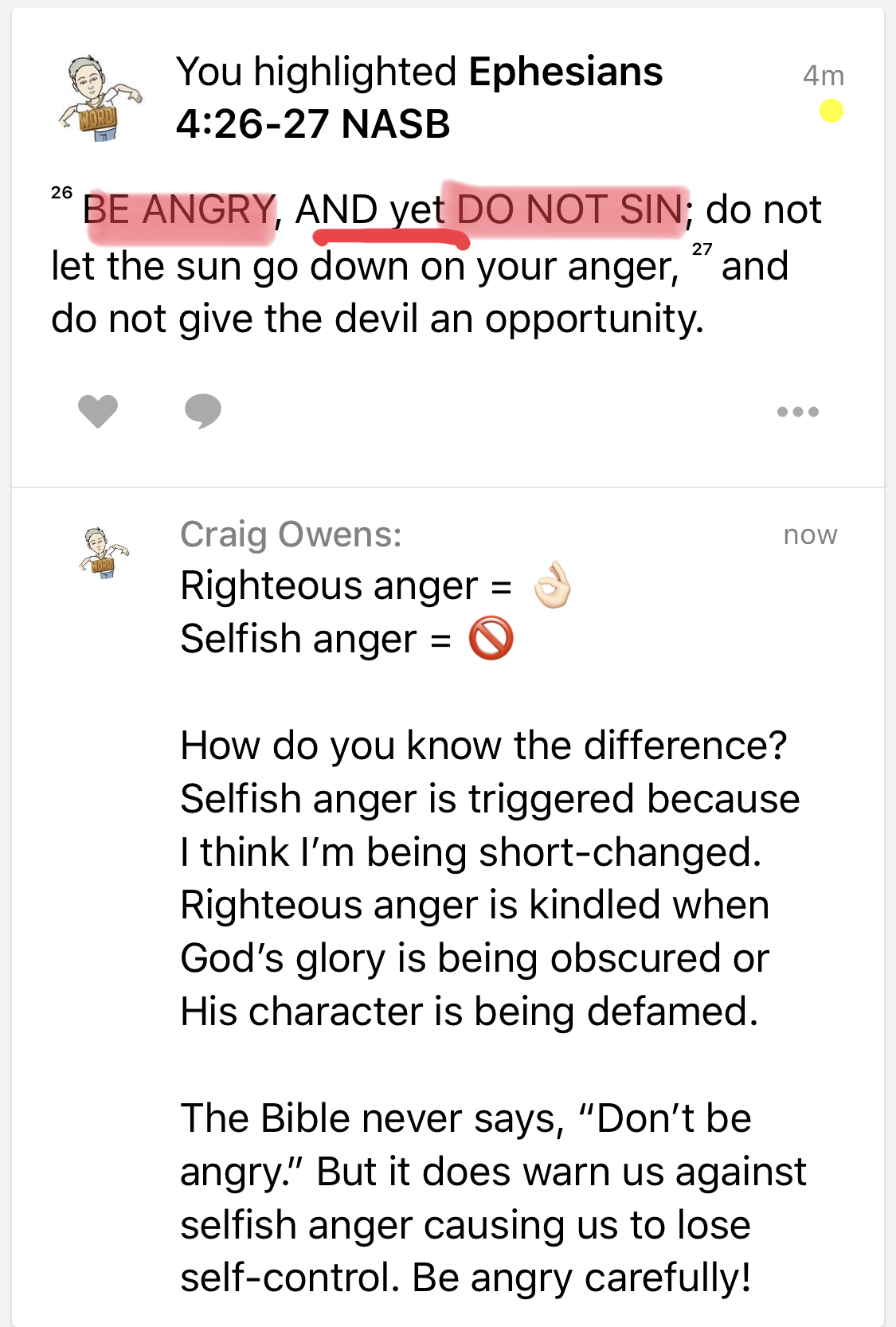
Being angry is not the issue. David said it (and Paul quoted it in Ephesians 4:26): “Be angry; just don’t sin.” God gets angry, but He does not sin. Jesus, in His public ministry, got angry, but He did not sin. We need to search our hearts to make sure our anger has not crossed the line to sin. We have to be angry in a godly way.

I see at least four ways to become angry without crossing the line into sin:

1.  Selfless Anger = anger at sin, but not angry at the sinner.

Love is not rude, it is not self-seeking, it is not easily angered, it keeps no record of wrongs. Love does not delight in evil but rejoices with the truth. (1 Corinthians 13:5, 6)

2.  Slow Anger = lengthen your fuse a bit.

Do not be quickly provoked in your spirit, for anger resides in the lap of fools. (Ecclesiastes 7:9)

My dear brothers, take note of this: Everyone should be quick to listen, slow to speak and slow to become angry, for man’s anger does not bring about the righteous life that God desires. (James 1:19, 20)

Good advice from Thomas Jefferson: “When angry, count to ten before you speak; if very angry, a hundred.”

3.  Protective Anger = when sinners entice others to join them in their sin. God is sad when people leave Him; He is angry at them when they take others with them.

But they put God to the test and rebelled against the Most High; they did not keep His statutes. Like their fathers they were disloyal and faithless, as unreliable as a faulty bow. They angered Him with their high places; they aroused His jealousy with their idols. When God heard them, He was very angry; He rejected Israel completely. (Psalm 78:56-59)

4.  Righteous Anger = against those who are keeping others from coming closer to God.

For I endure scorn for Your sake, and shame covers my face. I am a stranger to my brothers, an alien to my own mother’s sons; for zeal for Your house consumes me, and the insults of those who insult You fall on me. (Psalm 69:7-9)

This verse was recalled by Jesus’ disciples when they saw Him get angry and clear out the Temple in Jerusalem. Jesus was angry because of the religious clutter that was keeping God’s house from being a house of prayer for all nations.

I think everyone is familiar with the acrostic WWJD = What Would Jesus Do?

I’d like to propose something similar: WGGA = Would God Get Angry?

This is a great question to ask to make sure our anger does not cross that line into sin. Get angry—in a godly way—and do not sin.

Good And Angry

When was the last time you got good and angry? Be careful how you answer because I want you to notice that important conjunction AND. So maybe I should ask the question this way: when was the last time you got angry and were still good?

Aristotle correctly pointed out, “Anybody can become angry—that is easy; but to be angry with the right person, and to the right degree, and at the right time, and for the right purpose, and in the right way—that is not within everybody’s power and is not easy.”

Over the past week, I’ve been studying the life and leadership of Nehemiah, an incredible leader who rebuilt the walls of Jerusalem. But when I got to the final chapter of his account, I noticed quite a bit of anger coming from Nehemiah. As a kid, I used to have to really battle against my temper, so this aspect of Nehemiah’s life intrigued me. Can someone be good AND angry?

I think that the deeper I love someone or something, the greater my anger will be towards anyone or anything that violates what I love.

Nehemiah loved God and he was passionate to see God’s holiness magnified. All of his anger is directed at those people or things that violated or detracted from God’s holiness. Look how he got good AND angry

  • Towards Tobiah, who moved his personal belongings into God’s temple, a place reserved exclusively for the worship of God. “I was angry, really angry, and threw everything in the room out into the street, all of Tobiah’s stuff” (v. 8).
  • Towards the people who stopped financially supporting the priests, forcing the priests to leave the temple and work as farmers. “I immediately confronted the leaders and demanded, ‘Why has the Temple of God been neglected?’” (v. 11).
  • Towards those who violated the regulations of the Sabbath Day. “I got angry and said to the leaders of Judah, ‘This evil you are doing is an insult to the Sabbath!’” (v. 17).
  • Towards those tried to get around Nehemiah’s new Sabbath Day regulations. “I spoke sharply to them and said, ‘What are you doing out here, camping around the wall? If you do this again, I will arrest you!’” (v. 21).
  • Towards those who had intermarried with false-god-worshipping people. “I rebuked them and called curses down on them. I beat some of the men and pulled out their hair” (v. 25).
  • Towards Joiada, a priest who married a non-God-fearing woman. “I banished him from my presence” (v. 28).

After each of these incidents, you might expect Nehemiah to regret what he had done and think to himself, “Perhaps I overdid it. Maybe I was too zealous, or maybe I went a little overboard.” But instead, each time Nehemiah was righteously angry he prayed this to God, “Remember me for this, O my God. Remember me with favor because of what I have done” (vv. 14, 22, 29, 31). He was unashamed that he got good AND angry.

The Bible says, “Go ahead and be angry. You do well to be angrybut don’t use your anger as fuel for revenge. And don’t stay angry.”

Can you be good AND angry? Yes! In fact, I think being good helps us be angry with the right person or thing, in the right way, for the right purpose, and for the right length of time. 

Real Raw Emotions

This week I’ve been writing about my favorite book—the Bible—and why I find it so fascinating. Yesterday I talked about how the Bible helps me mentally. But we are not just mental creatures, we are emotional, too, and I have found my Bible to be an excellent way to express some of my deepest, rawest emotions.

(If you would like to read the other parts of this series, they are here, here, here, and here.)

Humans are created in God’s image, and God expresses emotion. In fact, God expresses emotion more deeply and purely than we humans can His sorrow is more bitter, His love is more intense, His jealousy is more pure.

Emotion is expressed throughout the Bible, but I’m particularly attracted to the emotional responses in the Psalms. These are prayers and songs which express the deepest emotions of angry, loving, hurting people. A few examples—

You know what I long for, Lord; You hear my every sigh. (Psalm 38:9 NLT)

Be merciful to me, O God, for men hotly pursue me; all day long they press their attack. My slanderers pursue me all day long; many are attacking me in their pride. (Psalm 56:1-2 NIV)

God, smash my enemies’ teeth to bits, leave them toothless tigers. Let their lives be buckets of water spilled, all that’s left, a damp stain in the sand. Let them be trampled grass worn smooth by the traffic. Let them dissolve into snail slime, be a miscarried fetus that never sees sunlight. Before what they cook up is half-done, God, throw it out with the garbage! (Psalm 58:6-9 The Message)

O my God, my life is cast down upon me and I find the burden more than I can bear…. (Psalm 42:6 AMP)

My God, my God, why have You forsaken me? Why are You so far from saving me, so far from the words of my groaning? O my God, I cry out by day, but You do not answer, by night, and am not silent…. I am poured out like water, and all my bones are out of joint. My heart has turned to wax; it has melted away within me. My strength is dried up like a potsherd, and my tongue sticks to the roof of my mouth…. Dogs have surrounded me; a band of evil men has encircled me, they have pierced my hands and my feet. …But you, O Lord, be not far off; O my Strength, come quickly to help me. (Psalm 22:1-2, 14-16, 19 NIV)

Jesus came to earth as fully God and fully man, able to experience the deepest, rawest emotions of anyone. “He was despised and rejected—a man of sorrows, acquainted with deepest grief” (Isaiah 53:3). Jesus knows what you feel because He felt it, too: “For we do not have a High Priest Who is unable to understand and sympathize and have a shared feeling with our weaknesses and infirmities and liability to the assaults of temptation” (Hebrews 4:15). As a result, “He lives forever to intercede with God on [our] behalf (Hebrews 7:25).

Don’t ever be afraid to express your rawest emotions in God’s presence—He knows profoundly what you are feeling. When you are struggling with deep emotion, the Bible knows how to speak your heart’s cry to God.